

Quick Answer
Silicon maker dictates compute performance, not board partner. ASUS, MSI, Gigabyte use identical NVIDIA or AMD chips. Brand variation alters cooler design, thermal dissipation, acoustic noise, physical dimensions, and warranty coverage, not raw frame rates. Select specific model via case clearance, acoustic targets, price delta, and local RMA support policy.

Pros
- 16GB GDDR7 memory on a 256-bit interface
- Listed Extreme Clock of 2640 MHz (manufacturer-stated)
- Three DisplayPort 2.1a and one HDMI 2.1b output
- Listed maximum digital resolution of 7680 x 4320
- NVIDIA Blackwell architecture with RTX 5080 chipset
Cons
- Listed length of about 15.6 inches may not fit smaller cases
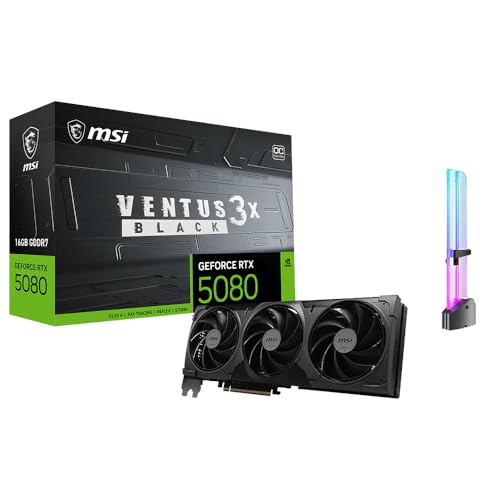
Pros
- 16GB GDDR7 memory, per the listing
- DLSS 4 support is highlighted in the features
- Three DisplayPort 2.1b outputs and one HDMI 2.1b output listed
- GPU holder included, according to the listing
Cons
- Performance claims are manufacturer-stated, not independently verified
- Power requirements and case-fit specifications are not listed

Pros
- Built on NVIDIA Blackwell architecture for the latest RTX 50 Series feature set.
- Includes 16GB GDDR7 memory for a strong high-end VRAM configuration.
- Offers modern display connectivity with HDMI 2.1 and DisplayPort 2.1.
- Supports DLSS 4, Reflex 2, and RTX AI features for gaming and creator use.
Cons
- The 2.99-slot triple-fan design may be difficult to fit in smaller PC cases.
- This is a premium-tier graphics card, so it may be more than many casual gamers need.
- The manufacturer listing does not list full dimensions or power requirements, so system compatibility must be checked separately.
Overview: The PNY NVIDIA GeForce RTX 5080 Epic-X ARGB OC is a high-end triple-fan graphics card based on NVIDIA Blackwell architecture. Its 2.99-slot cooler and ARGB styling give it an enthusiast-focused design that should appeal to builders who want both performance and a premium look.
Performance: With 16GB of GDDR7 memory, a 2775 MHz boost clock, PCIe 5.0 support, and HDMI 2.1 plus DisplayPort 2.1 outputs, this card is aimed at demanding gaming and creator workloads. NVIDIA DLSS 4, Reflex 2, and RTX AI features add meaningful value for smoother gameplay, lower latency, and AI-accelerated tasks.
Drawbacks: The large triple-fan, 2.99-slot format may not be ideal for compact cases, and the card sits firmly in the premium segment rather than the value segment. The manufacturer listing also does not provide full dimensions or power details, so buyers should verify case and system compatibility before purchase.
Verdict: This model is best suited to enthusiasts who want a powerful RTX 50 Series GPU for modern gaming, content creation, and AI-enhanced workflows. If you have the space and want current-generation NVIDIA features, it is a strong high-end option.
Does GPU Brand Matter: ASUS vs MSI vs Gigabyte
Brand matters less than the specific model tier. ASUS, MSI and Gigabyte all build cards around the same NVIDIA or AMD silicon. A top-tier model from any of them will usually outperform an entry-level model from another by a wider margin than any brand-to-brand gap at the same tier. The differences that do exist are in power delivery, thermal design, acoustics, physical envelope, firmware tuning and the quality of the RMA process. Each is covered below as a measurable engineering variable.
Chip Maker vs Board Partner
The GPU die, the memory configuration and the core architecture are defined by the chip maker (NVIDIA, AMD or Intel). The board partner designs or adapts everything else: the printed circuit board (PCB), the voltage regulator module (VRM), the cooler, the shroud, the fans, the backplate, the BIOS defaults and the bundled software. A GeForce RTX 4080 SUPER, for example, carries the same AD103 die and 16 GB of GDDR6X from every vendor. The die’s cores, cache and memory bus width are fixed, and the partner cannot change them.
Chip makers set a reference specification, including a total graphics power (TGP) target, a base and boost clock, and a validated voltage and frequency curve. Partners may exceed the reference boost clock by a few percent and offer a higher board power limit. NVIDIA’s firmware and driver stack still constrains core voltage tightly. On recent GeForce generations, maximum core voltage generally sits near 1.05 to 1.10 V under boost, so partner boards cannot use extra voltage headroom to gain much performance. The result is a narrow performance band between partner models of the same chip, typically within 1 to 3 percent in sustained gaming and compute workloads.
Each partner segments its lineup into tiers, and the tier is a better predictor of hardware quality than the brand name:
- ASUS: ROG Astral and ROG Strix (flagship), TUF Gaming (durability-focused midrange
For related maintenance and equipment benchmarks, review our technical guides on best gaming pcs, examine vr gaming pc specifications, and compare desktop gaming systems. You can also reference our analyses on 4k gaming desktops and multitasking gaming pcs. For industry engineering standards, consult PCI-SIG specification standards.


