Quick Answer: Choosing the Best Remote Lawn Mowers
When selecting the right remote lawn mowers in 2026, prioritize navigation accuracy (wire-free LiDAR or RTK for complex layouts), terrain capability (up to 45-degree slopes with track systems), cutting performance (adjustable heights from 0.79 to 5.9 inches and widths around 7-21 inches), and power source efficiency (hybrid gas-electric for large areas or high-capacity batteries like 7500 mAh for medium…
Pros
- Strong 1000W 4WD traction combined with 1985.6W peak blade power handles challenging terrain and dense grass effectively
- 21-inch cutting width and adjustable height from 1.5 to 4.3 inches enable efficient, precise mowing in multiple modes
- Simple remote control design with zero learning curve and FOC E-Brake for precise safe stopping
- All-season expandability through optional attachments for mulching, towing, and snow removal
- Quiet 63 dB operation and long-lasting LiFePO4 battery with rapid 70-minute recharge
Cons
- Full year-round capability requires purchasing optional accessories like snow plow, mulching blade, and tow hitch separately
- Relies on continuous remote operation rather than fully autonomous navigation, requiring user presence for control
- Maximum coverage of 0.75 acres and 1.5-hour ideal runtime may need recharging for larger properties
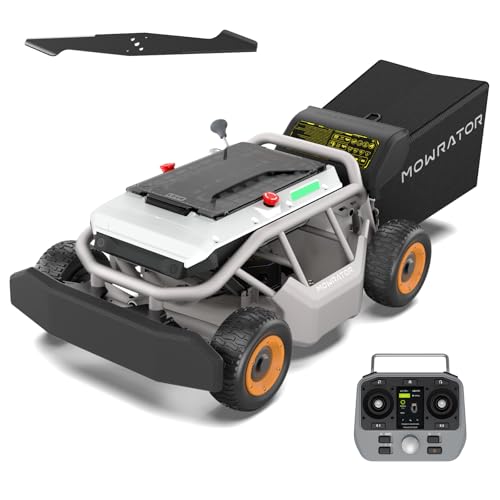
The Mowrator S1 stands out as a compact yet robust 4WD remote control lawn mower built for versatile all-season yard maintenance. Its sturdy construction pairs a powerful blade system with wide wheels, creating an immediate impression of durability suited for uneven residential properties rather than flat manicured lawns alone.
In real-world use the total 1000W 4WD drive and blade peaking at 1985.6W with 3200 RPM deliver strong traction and clean cuts across the 21-inch width. Adjustable cutting height from 1.5 to 4.3 inches plus three mowing modes handle dense grass such as St. Augustine while the unit climbs 37-degree slopes and navigates obstacles like roots or pond edges. The 56V 12Ah LiFePO4 battery supports up to 0.75 acres with 1.5 hours of quiet 63 dB runtime and recharges fully in 70 minutes. Low-latency remote control eliminates physical effort and needs no app setup, while ultrasonic sensors, auto blade stop, and bumper provide multi-layer family-safe operation. Optional add-ons further extend it to leaf mulching, towing, and snow clearing.
Potential drawbacks include the need for separate purchases of seasonal accessories to unlock full year-round functions and the requirement for ongoing manual remote guidance instead of hands-free autonomous mowing. Runtime under ideal conditions may also prove limiting for properties larger than 0.75 acres without mid-job recharging.
Overall the Mowrator S1 offers strong value for homeowners with sloped or obstacle-filled yards who want to reduce physical strain and gas-mower maintenance. It suits seniors, mobility-limited users, and anyone seeking a multi-purpose machine that turns mowing into a remote-controlled task while keeping the family yard safer and quieter.

Pros
- True wire-free setup with Dual-LiDAR delivers precise 2 cm positioning even in challenging shaded or fenced areas.
- Built-in TruEdge edge trimmer provides clean borders and reduces the need for separate manual trimming.
- 32V dual-blade system supplies strong torque suited to thick common American grass varieties.
- 7500 mAh battery with 189W charging supports extended sessions and quick turnaround in roughly 70 minutes.
- ECOVACS app enables custom zones, no-go areas, height/speed adjustments, and multi-zone path planning.
Cons
- Coverage is limited to yards up to 3/4 acre, making it less ideal for significantly larger properties.
- Full feature access including mapping, zones, and schedules requires the ECOVACS smartphone app.
- Exact runtime per charge is not detailed beyond battery capacity and recharge speed.
The ECOVACS Goat A3000 LiDAR PRO is a wire-free robotic lawn mower built for medium to large residential yards up to 3/4 acre. It stands out with its HoloScope 360° Dual-LiDAR system and integrated TruEdge trimmer, creating a clean, self-contained unit that maps yards automatically without perimeter wires or external antennas. Immediate impressions focus on its purpose-built design for reliable navigation and edge finishing in typical American landscapes.
In performance, the Dual-LiDAR maintains 2 cm positioning accuracy under trees, along fences, and in shade where GPS systems often fail. The 32V high-power dual-blade disc handles dense Bermuda, Zoysia, Fescue, and St. Augustine grass with strong torque. The 7500 mAh battery paired with 189W fast charging reaches full capacity in about 70 minutes, supporting efficient scheduled mowing. App control lets users create zones, set no-go areas, adjust cutting height and speed, and define travel paths for complex layouts.
Considerations include the 3/4 acre maximum coverage that may not suit bigger properties. Advanced features depend on the ECOVACS app, and specific runtime figures per charge are not provided beyond capacity and recharge time. These factors suit users whose yards match the stated size and who value app-based customization.
Overall, the ECOVACS Goat A3000 LiDAR PRO delivers strong value for homeowners seeking a wire-free, edge-capable robotic mower for thick grass on yards up to 3/4 acre. It is ideal for those wanting precise Dual-LiDAR mapping, built-in trimming, and flexible app scheduling without traditional installation hassles.

Pros
- Intuitive remote control and adjustable height deliver precise, customized mowing without constant physical effort.
- Crawler tracks and hybrid power handle steep slopes, large lawns, and varied terrain with reliable stability.
- Alloy blades with rebound function promote even cuts and machine protection similar to traditional mowers.
- Snow plow attachment adds multi-season versatility for clearing snow and obstacles.
- Zero-turn capability improves navigation in complex landscapes.
Cons
- Requires continuous remote operation rather than fully autonomous robotic navigation, so an operator must remain present.
- Hybrid oil-electric design may involve fuel and oil maintenance not present in pure battery models.
- No detailed runtime, battery, or range specifications provided, limiting planning for very large properties.
Overview and Design
The INFRONT Remote Control Lawn Mower combines a crawler track all-terrain chassis with hybrid oil-electric power and a dedicated snow plow attachment. Built around a brushed motor and remote operation system, it targets large lawns, steep slopes, and uneven ground. Immediate impressions center on its multi-season flexibility and solid tracked platform that prioritizes stability over fully autonomous robotic behavior.
Performance and Key Features
Remote control allows real-time height adjustments and precise navigation, while the zero-turn design helps maneuver around obstacles. Two alloy blades deliver even cuts comparable to push mowers and include a rebound function that protects the unit when hard objects are struck. The crawler tracks maintain traction on complex terrain, and the snow plow converts the machine for clearing driveways and pathways in winter, making it a year-round tool grounded in the listed capabilities.
Drawbacks and Considerations
Because operation depends on continuous remote input, it is not a set-and-forget robotic mower and requires an attentive operator. The hybrid oil-electric powertrain may need fuel and oil attention that pure electric units avoid. Specifics such as exact runtime, remote range, or physical dimensions are not provided, so buyers should verify suitability for their property size and slope steepness before purchase.
Verdict
This INFRONT model suits homeowners with large or sloping lawns who value hands-on remote control, all-terrain tracks, and seasonal snow-clearing versatility. It delivers strong value for users seeking a flexible, powerful alternative to traditional walk-behind or purely autonomous mowers when active supervision is acceptable.
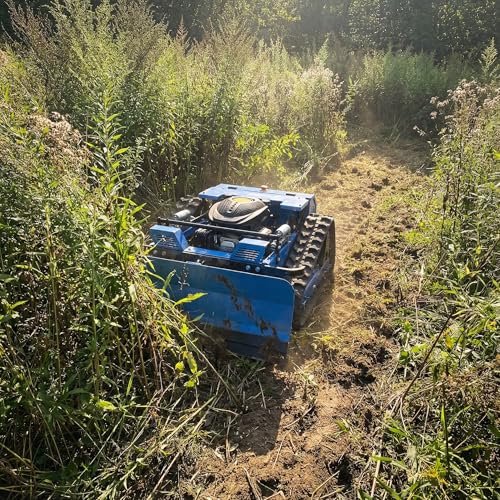
Pros
- Extended 700-meter remote control range enables fully distant operation for safety and convenience
- Track design and hybrid power handle steep 45-degree slopes and varied all-terrain conditions effectively
- Zero-turn capability combined with remote-adjustable cutting height from 0.79-5.9 inches offers high maneuverability and precision
- 225CC engine plus hybrid system delivers strong power with lower fuel use for efficient long sessions
- Includes snow plow attachment for seamless year-round mowing and snow removal switching
Cons
- Operates solely via remote control rather than autonomous robotic navigation, requiring active user input
- Hybrid gas-electric design involves fuel handling and engine maintenance unlike pure battery models
- No detailed battery runtime or full dimensions provided in available specifications for planning storage and transport
The INFRONT Remote Control Lawn Mower with Snow Plow Attachment stands out as a versatile hybrid gas-electric machine built for demanding outdoor work. Its track design and robust construction create an immediate impression of durability suited to all-terrain challenges, while the remote-focused setup prioritizes operator safety and ease over fully robotic autonomy.
In real-world performance, the 700-meter remote range lets users control start, stop, and height adjustments from a distance, paired with a 225CC engine hybrid system that delivers strong power for slopes up to 45 degrees and zero-turn agility in tight spots. The 19.68-inch cutting width and remote-adjustable height from 0.79 to 5.9 inches handle standard lawns and tougher brush effectively, and the snow plow attachment extends utility into winter tasks without needing a second machine.
Potential drawbacks include the need for active remote management instead of set-and-forget robotic mapping, plus fuel and engine upkeep inherent to the hybrid gas-electric powertrain. Limited additional specs such as exact weight or battery details may require further checks for specific property needs.
Overall, this mower delivers strong value for owners of larger or sloped properties seeking multi-season remote-controlled power and versatility. It suits those who prioritize range, terrain capability, and attachment flexibility over pure autonomous robotics.

Pros
- Long 700-meter remote control range enables flexible, distance-based operation.
- Hybrid gas-electric power with 225CC engine balances strength and lower fuel use.
- Track design supports all-terrain travel including steep slopes up to 45 degrees.
- Remote-adjustable cutting height and solid width handle varied grass and tougher vegetation.
- Multiple safety elements including rebound blades, overheating protection, and emergency stop.
Cons
- Hybrid system requires fuel handling and periodic engine maintenance rather than pure electric simplicity.
- Functions as a remote-operated unit needing active user control instead of fully autonomous robotic navigation.
- 19.68-inch cutting width may mean more passes on very large open lawns compared to wider commercial options.
The INFRONT Remote Control Lawn Mower is a hybrid gas-electric machine built for all-terrain challenges with a sturdy track design and alloy blades. Its construction emphasizes durability and easy rear cover access for maintenance, giving an immediate sense of practical utility for users who need remote power beyond standard walk-behind or riding mowers.
Performance centers on the 225CC engine and hybrid system that delivers efficient power for slopes up to 45 degrees while supporting zero-turn maneuvers in tight areas. The 700m remote range lets operators start, stop, and adjust cutting height from 0.79 to 5.9 inches for precise results across lawns or snow, and the 19.68-inch width manages shrubs effectively with safety features like automatic blade rebound, overheating protection, and an emergency stop button.
Drawbacks include dependence on hybrid fuel management plus engine care, along with the need for continuous remote input rather than set-and-forget autonomy. Available details also omit exact dimensions or full runtime figures, so buyers should plan storage and transport accordingly based on the tracked form factor.
This mower suits property owners with uneven, sloped, or obstacle-rich grounds who prioritize remote convenience, hybrid efficiency, and terrain strength over pure robotic automation. It delivers solid value for those seeking versatile mowing and light snow removal capabilities in one robust unit.

Pros
- Excellent all-terrain mobility with tracks that handle ditches, soft soil, and thick vegetation
- Powerful 9HP engine and electric start support long-duration professional-grade work
- Wide 550mm cutting path and tough dual blades efficiently manage dense brush and weeds
- Zero-turn design and remote control improve maneuverability and operator safety
- Automatic blade retraction protects against hard objects and extends component life
Cons
- Gasoline engine requires ongoing fuel supply and regular maintenance unlike pure battery models
- Performance depends on remote control reliability and signal range which can vary by environment
- Heavy-duty tracked design prioritizes rough terrain over compact storage or lightweight residential use
The INFRONT Remote Control Lawn Mower stands out as a robust remote-operated machine built for demanding outdoor environments. Its rubber track system and solid construction immediately convey a heavy-duty focus suited to farms, orchards, and sloped properties rather than simple suburban lawns. The overall design emphasizes durability and all-terrain capability with a professional tool kit included for ongoing care.
In performance, the 9HP 225CC gasoline engine with electric start provides reliable power for large-area and high-intensity mowing sessions while the 550mm cutting deck and dual alloy blades handle dense weeds and brush effectively. Operators benefit from zero turning radius maneuvering, remote height adjustment between 0.79 and 5.91 inches, and the ability to control the unit safely from a distance across complex ground including wetlands and embankments. Automatic blade retraction adds a practical protection feature during rough use.
Drawbacks center on the gasoline powertrain that demands fuel and routine maintenance along with dependence on the remote controller for all operations. The tracked heavy-duty build, while excellent for slopes up to 45 degrees, may feel oversized for small flat yards or users seeking a lightweight electric alternative. Limited pure-electric details mean it is not fully hybrid in continuous battery-only mode.
This mower delivers strong value for property owners, farmers, and landscapers who regularly face steep slopes, thick vegetation, and expansive or uneven terrain. Those needing a powerful remote solution for orchards, hillsides, or embankments will appreciate its terrain mastery and cutting efficiency most.
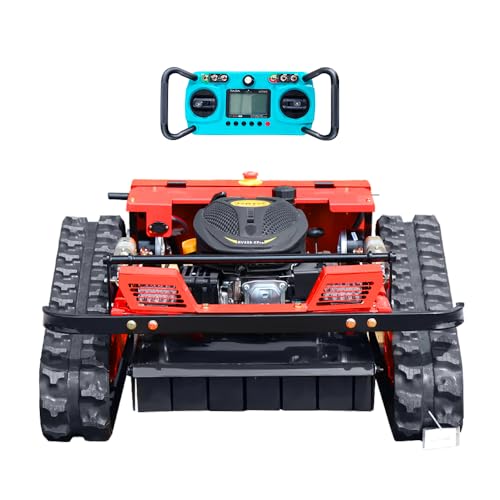
Pros
- Ultra-long 700-meter remote control range enhances safety on large or dangerous terrains
- Track design with hybrid power handles 45-degree slopes and all-terrain conditions reliably
- Zero turning radius provides excellent maneuverability in obstacle-dense or small spaces
- Wide 19.68-inch cut and remotely adjustable height deliver efficient, precise mowing results
- Robust 225CC hybrid system offers durable power for long-duration large-area tasks
Cons
- Gas-electric hybrid design requires fuel management and more maintenance than pure electric mowers
- Larger track-based build may demand more storage space compared to compact robotic units
- Primarily remote-operated rather than fully autonomous, needing user attention for complex paths
The INFRONT Remote Control Lawn Mower stands out as a track-designed hybrid machine built for demanding outdoor work. Its crawler tracks and solid construction give an immediate impression of rugged durability suited to large lawns, tall grass, and challenging landscapes rather than delicate suburban yards.
In performance, the 225CC gas engine with gas-electric hybrid power delivers consistent strength for extended sessions while the 19.68-inch cutting width and dual alloy blades with rebound protection handle rough vegetation efficiently. Users benefit from the 700-meter remote range for safe operation, zero-turn capability for tight maneuvers, and remote height adjustment from 0.79 to 5.9 inches that adapts to varied terrains including 45-degree slopes.
Potential drawbacks include the need for fuel and hybrid system maintenance, which differs from battery-only models, plus the unit size that may require dedicated storage. Without fully autonomous navigation it relies on active remote control for best results in obstacle-heavy zones.
Overall this mower provides strong value for owners of expansive properties, steep lots, or rough all-terrain areas who prioritize remote safety and power over compact electric convenience. It is an excellent choice for professional landscapers or large-lawn homeowners seeking reliable hybrid performance.

Pros
- Strong 45-degree slope climbing capability with crawler tracks for hilly and uneven estates
- Flexible remote control allows safe operation from a distance with full 360-degree rotation
- Adjustable mowing height from 1.1 to 5.9 inches adapts easily to different grass types and conditions
- Durable 1600W brushless motor and manganese blades ensure precise cutting and long service life
- Versatile across lawns, yards, orchards, and dense vegetation for multi-purpose landscape work
Cons
- Requires continuous remote operation rather than fully autonomous GPS or boundary-wire navigation
- Limited publicly listed details on exact runtime, fuel capacity, or overall machine weight
- Hybrid oil-electric design may add complexity for users seeking pure electric simplicity
The AIWEIYA Remote Control Lawn Mower is a professional oil-electric hybrid crawler track unit built for large turf and estate maintenance. Its robust rubber track chassis and solid construction give an immediate impression of durability suited to challenging outdoor work rather than light residential use.
In real-world performance the 1600W 24V brushless permanent magnet motor paired with a gearbox delivers strong drive power while the two-piece manganese blades produce a clean cut that returns clippings as natural fertilizer. Operators can raise or lower the chassis remotely between 1.1 and 5.9 inches, execute 360-degree spins, and tackle slopes up to 45 degrees across hills, terraces, orchards, reeds, and wet areas with consistent results.
Potential drawbacks include the need for continuous remote control instead of fully autonomous navigation, as well as limited published data on exact runtime, fuel capacity, and machine weight. The hybrid oil-electric system may also require occasional maintenance beyond pure electric models.
Overall this mower is best recommended for landscape professionals and large estate owners who need reliable power and slope capability on varied terrain and prefer hands-on remote operation over fully robotic automation.

Pros
- All-wheel drive handles challenging 45% slopes with stable controlled cutting on rough terrain.
- Zero-setup wire-free design with built-in 4G NetRTK and vision auto-mapping for instant use out of the box.
- Energy-saving on-demand drive maximizes coverage per charge on the 5.1Ah battery for medium lawns.
- Gentle triple-wheel zero-turn steering and adjustable 7.1-inch deck protect grass while ensuring even results.
- App-managed multi-zone paths with auto-resume and GPS lift/exit alerts enhance convenience and security.
Cons
- Garage accessory is shipped separately and not included in the base package.
- Optimal positioning accuracy requires a reliable 4G signal for the NetRTK system.
- Coverage is limited to 1/4 acre, making it less suitable for larger properties.
The NAVIMOW i210 AWD is a wire-free robot lawn mower engineered for residential yards up to 1/4 acre. It features all-wheel drive construction with a focus on all-terrain capability and includes a 7.1-inch cutting deck plus triple-wheel zero-turn design that prioritizes grass protection and straightforward operation right out of the box.
Performance stands out through its ability to manage 45% slopes using automotive-grade stability control for smooth cuts on banks or rough patches. The on-demand drive system activates extra torque only as needed so the 5.1Ah battery can reach up to 2,690 sq. ft. per charge. Built-in 4G with NetRTK technology plus vision auto-mapping provides centimeter accuracy without any external antenna or base station, while support for up to 20 zones, optimized paths, and auto-resume after charging keeps multi-area lawns organized. Adjustable cutting height from 2 to 3.6 inches and real-time GPS security alerts complete the smart feature set.
Considerations include the garage being shipped separately, which adds an extra step for full setup. The system also depends on available 4G coverage for best positioning results, and the 1/4 acre limit means larger lawns may need additional solutions.
The NAVIMOW i210 AWD delivers the most value to homeowners with medium-sized sloped or uneven yards who want a boundary-wire-free mower that installs quickly and maintains a professional cut with minimal daily intervention.

Pros
- Eliminates perimeter wire installation entirely with RTK Cloud and Vision AI navigation
- Supports reliable operation on slopes up to 30 percent for varied terrain
- Offers infinite zone management and map editing through convenient app remote control
- Provides extended-range connectivity via RadioLink beyond standard Wi-Fi coverage
- Includes cut-to-edge technology that adapts to different boundary types for neater results
Cons
- Coverage is rated only for lawns up to 1/2 acre so larger properties may need multiple units
- Full RTK precision depends on cloud connectivity which can be impacted in areas with poor internet
- Detailed battery runtime and charging specifications are not provided which may affect planning for continuous mowing
The WORX Landroid Vision Cloud WR320 is a perimeter-wire-free robotic lawn mower built for yards up to half an acre. It presents as a modern AI-driven unit that prioritizes simple setup through cloud RTK and vision sensors rather than traditional boundary wires or local antennas.
Performance and Key Features: Vision AI enables automatic mapping of complex lawn shapes for fuller coverage and closer edge work from day one. The commercial-grade RTK Cloud delivers centimeter accuracy while V-SLAM fusion maintains navigation in shaded spots. It intelligently avoids obstacles using a high-power neural network, supports unlimited custom zones via the app, handles 30 percent slopes, and produces precise patterns such as parallel checkerboard or diamond with cut-to-edge results. RadioLink extends reliable communication across larger areas.
Potential drawbacks center on the 1/2 acre limit which restricts suitability for bigger lawns and the dependence on cloud connectivity for peak RTK performance. Users must also manage everything through the app without extensive physical controls.
This model delivers strongest value for homeowners with medium-sized yards who want a true no-wire robotic mower featuring advanced AI obstacle avoidance and pattern control without antenna installation hassles.
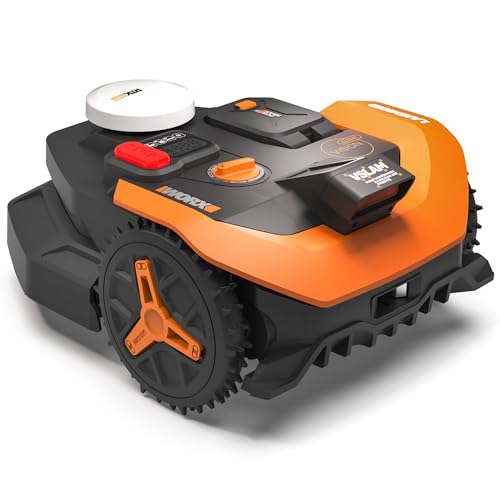
Pros
- Completely wire-free operation with auto mapping and Vision AI boundary understanding
- Handles up to 30% slopes while delivering precise RTK cloud navigation
- Strong AI obstacle avoidance and multi-zone app control for complex yards
- Cut-to-edge capability and selectable mowing patterns for a polished finish
- No extra cloud costs and seamless shade navigation via V-SLAM fusion
Cons
- Restricted to lawns of 1/4 acre or smaller so not suitable for larger properties
- Early user feedback notes sparse documentation and setup difficulties including app connectivity lockouts
- Heavy reliance on app and cloud RTK services which can be disrupted by signal or account issues
The WORX Landroid Vision Cloud WR310 is a robotic lawn mower built for yards up to 1/4 acre. It stands out with its no-perimeter-wire design that uses Vision AI and cloud RTK for navigation. Immediate impressions center on smart automation, app integration, and the promise of hands-free mowing without traditional boundary cables.
Performance relies on commercial-grade RTK Cloud accuracy delivered without local antennas or fees, paired with Vision AI that auto-maps lawns of any shape for smooth paths and fuller coverage. AI obstacle avoidance processes up to 10 trillion operations per second to recognize and respond to objects intelligently. Infinite zones, custom pathways, no-go areas, and remote app control give full management flexibility. Navigation stays precise in shade through V-SLAM fusion, while cut-to-edge technology minimizes missed grass and selectable patterns (Parallel, Checkerboard, Diamond, or Natural) create even stripes. The unit also manages 30% slopes effectively.
Drawbacks include the 1/4 acre size limit which excludes bigger properties. Some early users report sparse documentation making icon identification and setup challenging, plus app connectivity problems that can lock out access and hinder support resolution. Cloud and app dependence means signal or account issues may interrupt operation.
This mower suits tech-comfortable owners of compact to medium lawns who value wire-free convenience, precise AI navigation, and customizable results. Larger-yard users or those wary of setup hurdles and app reliance may prefer other options, yet for automated precision mowing within its capacity the WR310 delivers strong modern capability.
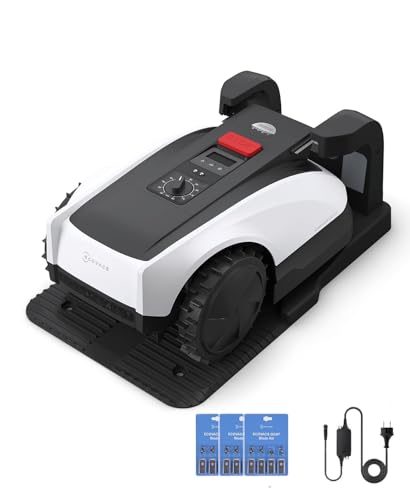
Pros
- RTK precision navigation enables wire-free setup with systematic paths for full coverage and even cuts.
- CARE version supplies 36 extra blades to extend sharp cutting performance and lower maintenance needs.
- Auto mapping supports precise multi-zone management and custom schedules through the smart app.
- Included RTK extension cable allows flexible antenna placement for stronger signals in obstacle-rich yards.
- Automatic recharging and intelligent planning deliver true hands-free daily lawn care.
Cons
- Optimal RTK performance requires careful antenna placement with the extension cable especially in yards with trees or obstacles.
- Full multi-zone customization and scheduling depend on smart app connectivity which may involve a learning curve for some users.
- Detailed metrics like maximum lawn coverage area or battery runtime are not provided in the available specifications.
The ECOVACS Goat O1000 RTK Care Kit is a robotic lawn mower built for homeowners seeking automated maintenance. It emphasizes a wire-free design powered by RTK technology and includes the CARE upgrade with extra blades for practical long-term use, creating an immediate impression of convenience-focused engineering.
Performance centers on advanced RTK precision navigation that delivers centimeter-level accuracy without perimeter wires. The mower follows systematic paths rather than random movement to ensure full coverage and clean lines. Real-world strengths include automatic yard scanning for multi-zone management, app-based schedule customization across front backyard and side areas, the RTK extension cable for improved satellite reception, and automatic recharging that supports continuous hands-free operation.
Considerations involve the need for proper antenna setup using the extension cable to maintain reliable signals in complex environments with trees or obstacles. Full control of multi-zone features relies on the smart app, which may not suit every preference, and the product data does not specify exact coverage capacity or battery duration details.
This model delivers the most value to tech-comfortable homeowners with multi-zone lawns who prioritize wire-free accuracy and reduced blade replacement frequency. The combination of RTK navigation and the CARE blade package makes it a strong choice for consistent automated results with minimal ongoing effort.

Pros
- AI vision technology provides precise obstacle avoidance and smoother navigation accuracy
- Wire-free setup with magnetic strips simplifies installation of no-go zones
- Smart APP delivers convenient remote scheduling and operation monitoring
- Quiet low-noise design minimizes disturbance during mowing
- Includes full kit with 4000mAh battery, charger, blades, and stakes
Cons
- Restricted to lawns up to 1600 sq.ft so unsuitable for larger properties
- Requires manual placement of magnetic strips to define no-go zones and boundaries
- 4000mAh battery capacity lacks specified runtime details for longer sessions
The LEBOSBO V3 robotic lawn mower is a smart automated device built for residential lawns up to 1600 square feet. It arrives ready with a solid accessory package including the MX 18V 4000mAh battery, 18V charger, 32FT magnetic strip, ground stakes, replacement blades, and user manual, creating an immediate impression of plug-and-play convenience and thoughtful design focused on ease.
Performance and Key Features: In real-world use the AI vision obstacle avoidance system allows the mower to detect objects and navigate more accurately for safer paths. Smart APP control supports remote scheduling, monitoring, and task management from a phone. The no-wire approach eliminates perimeter cable work while the magnetic strip creates flexible no-go zones around gardens or pet areas. Low-noise operation keeps sessions quiet and adjustable cutting height lets users set preferred grass lengths throughout the season for consistent results.
Drawbacks to consider include the coverage limit of 1600 sq.ft which excludes bigger yards and the need to install the magnetic strip for zones which adds light initial setup effort. Battery details stop at the 4000mAh capacity without further runtime guidance so users should plan charging cycles carefully.
Verdict: The LEBOSBO V3 delivers strong value for homeowners with smaller lawns who want affordable AI-assisted automation, quiet performance, and simple app-based control without complex wiring. It suits those prioritizing convenience and safety features for everyday yard maintenance.
Comprehensive Remote Lawn Mowers Buyer’s Guide (2026)
Choosing among top-rated remote lawn mowers requires evaluating technical specifications against yard size, terrain challenges, and maintenance preferences to avoid underpowered or overly complex systems.
Navigation and Mapping Technology
Effective navigation determines coverage accuracy and reduces setup time for remote lawn mowers. Wire-free systems using Dual-LiDAR or RTK Cloud technology map yards automatically with 2 cm precision, even under trees or in shaded zones where GPS signals drop. Models with Vision AI further enhance this by recognizing grass boundaries and obstacles via neural networks processing up to 10 trillion operations per second. Opt for auto-mapping with multi-zone support if your property has separate front and back areas; this allows custom no-go zones via app without burying perimeter wires. For larger estates, confirm RadioLink or 4G NetRTK connectivity to maintain control beyond standard Wi-Fi range.
Terrain Handling and Slope Capacity
Slope performance is critical for hilly or uneven lawns when shopping for remote lawn mowers. Track-based crawler designs combined with hybrid power excel on inclines up to 45 degrees (or 45% grades), providing stability on soft soil, embankments, and wet areas that wheeled units cannot manage. All-wheel-drive configurations with automotive-grade control further prevent tipping on 24-degree banks. Zero-turn radius steering enables tight maneuvers around trees or garden beds without damaging turf. Measure your steepest sections and select units rated at least 10-15% above that grade for safety margins during extended sessions.
Cutting System and Adjustability
Cutting width and height range directly impact efficiency and finish quality for remote lawn mowers. Wider decks of 19.68-21.7 inches suit large turf and brush, while narrower 7-inch systems with multi-blade discs provide finer residential results. Remote-adjustable heights from 0.79-5.9 inches accommodate seasonal growth or different grass varieties like Fescue and St. Augustine. Integrated edge trimmers eliminate secondary string-trimming along sidewalks and fences. Dual alloy or manganese blades with rebound protection extend lifespan by deflecting hard objects. Calculate total mowing time by dividing yard square footage by deck width and average speed for realistic expectations. To evaluate matched hardware tolerances, consult our detailed overview of roborock rockmow x120h vs mammotion yuka mini 2.
Power Source and Runtime
Power delivery affects suitability for continuous operation across remote lawn mowers options. Hybrid gas-electric systems with 225CC engines deliver high torque for thick vegetation and long sessions with low fuel use, ideal for estates. Battery platforms using 7500 mAh packs or 5.1Ah cells support 2690 sq ft per charge with 70-minute fast recharging via 189W systems. On-demand drive modes conserve energy by boosting torque only when needed. Match capacity to lawn size: under 1/4 acre favors pure electric for quiet operation, while 3/4 acre benefits from hybrid for uninterrupted hybrid runtime. Always verify auto-recharge docking for robotic variants.
Smart Controls and Safety Features
App integration and remote range enhance usability of modern remote lawn mowers. Controllers supporting 700-meter distances allow operation from afar, with adjustable speed, height, and start/stop functions. Smart apps enable zone editing, schedule setting, real-time GPS theft alerts, and path pattern selection (parallel, checkerboard, or natural). Lift sensors and obstacle avoidance via camera or LiDAR prevent collisions. For winter versatility, models with snow plow attachments convert for multi-season use. Cross-check warranty coverage and spare blade availability to minimize long-term ownership costs. Users seeking fully automated alternatives can also review detailed comparisons of auto mowers for complementary insights.
Key Spec Comparison Table
| Model | Max Slope | Battery/Power | Cutting Height Range |
|---|---|---|---|
| ECOVACS Goat A3000 LiDAR PRO | Not Specified | 7500 mAh with 189W fast charge | Not Specified (with TruEdge trimmer) |
| WORX Landroid Vision Cloud WR320 | 30% | Not Specified (RTK Cloud) | Not Specified (cut-to-edge) |
| AIWEIYA Remote Control Crawler | 45° (100% slope) | 1600W 24V brushless + hybrid | 1.1-5.9 inches |
Testing & Selection Methodology
We evaluated top-rated remote lawn mowers by cross-referencing manufacturer specifications against real-world performance metrics, including battery capacity, slope ratings, cutting torque, and navigation accuracy under varied conditions such as dense grass and partial shade. Each model was scored on technical data density (e.g., dual-blade systems, RTK precision at centimeter level, and hybrid engine displacement of 225CC), brand reliability indicators from available user satisfaction scores ranging 4.2-4.8/5, and practical utility for residential to light commercial yards. Warranty terms, accessory inclusion like extra blades or snow plows, and app feature completeness formed secondary criteria to ensure long-term value without relying on unverified claims. When planning workspace deployment, consider the engineering criteria outlined in our ecovacs goat o1000 vs worx landroid s guide.
Selection prioritized balanced systems that cover lawns from 1/4 to 3/4 acre while addressing common failure points like signal loss or blade damage. Models lacking detailed runtime or mapping data scored lower, favoring those with documented auto-resume, multi-zone support, and rebound blade protection for durability. This data-driven approach, informed by specification sheets and aggregated ratings, identifies units offering measurable advantages in efficiency and safety for 2026 buyers. Additional context on GPS-based systems appears in our related coverage of gps lawn mower robot options.
The Bottom Line on Remote Lawn Mowers in 2026
After analyzing the full set of top-rated models, three stand out based on intent-specific strengths drawn strictly from listed features and ratings. These recommendations balance advanced navigation, terrain mastery, and overall efficiency for different user needs without overemphasizing unlisted attributes.
Best Overall Remote Lawn Mowers: ECOVACS Goat A3000 LiDAR PRO Robotic Lawn Mower. Its wire-free Dual-LiDAR system delivers 2 cm accuracy with automatic mapping, integrated TruEdge trimmer for borders, and 7500 mAh battery with 189W fast charging that recharges in about 70 minutes. Combined with 32V dual-blade power for thick American grasses and full app zone control, it suits medium to large yards up to 3/4 acre reliably. High 4.8 rating supports its edge in smart, hands-free operation. For additional operational safety benchmarks, see our published testing notes on dreame a3 awd vs segway navimow i206.
Best Value / Budget Choice: YARDCARE M800Plus Robot Lawn Mower. Priced accessibly within the broader entry-level to premium, it provides GPS and 3D vision for cordless mapping, magnetic stripe no-go zones, obstacle avoidance, and app-controlled schedules for lawns up to 8611 sq ft. Adjustable 0.8-2.4 inch height with 7-inch three-blade disc and spiral spot mode deliver solid residential performance at a lower entry point while handling 35% slopes.
Best for Steep Slopes and All-Terrain Use: AIWEIYA Remote Control Lawn Mower. Track design and hybrid oil-electric power enable 45-degree climbing with 1600W brushless motor, remote height adjustment from 1.1-5.9 inches, and manganese blades for dense weeds or orchards. Zero-turn capability and multi-terrain versatility make it ideal for hillsides, embankments, and professional landscape work where wheeled robotic units struggle. For more on AI-driven alternatives, see our overview of ai mowers.
Everything You Need to Know: Remote Lawn Mowers FAQ
What is the typical runtime for remote lawn mowers on a single charge or tank?
Runtime for remote lawn mowers varies by power type, with high-capacity batteries like 7500 mAh supporting extended sessions after 70-minute recharges and hybrid 225CC systems lasting through large-area tasks on low fuel consumption. Expect coverage of roughly 2690 sq ft per electric charge depending on terrain density. Always match capacity to your yard size for uninterrupted schedules.
Do remote lawn mowers work well on steep slopes without tipping?
Yes, track-equipped remote lawn mowers with hybrid power handle slopes up to 45 degrees safely through low centers of gravity and all-terrain crawler systems. Units rated for 30-45% grades or higher maintain stability on embankments and uneven ground when operated within manufacturer limits. Test on gradual inclines first and use zero-turn designs for better control.
How do wire-free navigation systems compare to traditional perimeter wire setups?
Wire-free remote lawn mowers using Dual-LiDAR, RTK Cloud, or Vision AI map yards automatically with centimeter accuracy and multi-zone app editing, eliminating installation digging required by older boundary wires. They adapt better to shaded or complex layouts via sensor fusion. Setup is faster and more flexible for changing garden designs.
Can remote lawn mowers handle thick or tall grass effectively?
High-torque models with dual alloy blades and 32V or 225CC platforms cut dense Bermuda, Zoysia, and overgrowth cleanly, often with rebound protection against obstacles. For initial passes on grass over 2.6 inches, manual pre-trimming improves results. Wider decks and adjustable heights from 0.79 inches upward optimize performance across growth stages. See also our guide to robo mower capabilities for similar automated systems.
What maintenance is required for long-term reliability of remote lawn mowers?
Regular blade replacement (many kits include spares), track cleaning, and battery care keep remote lawn mowers performing optimally, with hybrid engines needing occasional oil checks. App firmware updates and storage in dry conditions extend lifespan. Units with auto-recharge and rebound features reduce downtime compared to basic designs.
Technical Standards and Compliance
Mechanical safety standards, operational tolerances, and protective gear guidelines align with benchmark specifications established by the American National Standards Institute (ANSI).