Quick Answer: Choosing the Best Robotic Grass Mower
Selecting the right robotic grass mower means overcoming common frustrations like endless boundary wire installation, inconsistent coverage on uneven terrain, and mowers that struggle with obstacles or return to base too often. Homeowners with busy schedules or complex yards face lost weekends, uneven grass clippings, and safety concerns around pets or garden features when relying on traditional push or riding…

Pros
- True wire-free setup with Dual-LiDAR delivers precise 2 cm positioning even in challenging shaded or fenced areas.
- Built-in TruEdge edge trimmer provides clean borders and reduces the need for separate manual trimming.
- 32V dual-blade system supplies strong torque suited to thick common American grass varieties.
- 7500 mAh battery with 189W charging supports extended sessions and quick turnaround in roughly 70 minutes.
- ECOVACS app enables custom zones, no-go areas, height/speed adjustments, and multi-zone path planning.
Cons
- Coverage is limited to yards up to 3/4 acre, making it less ideal for significantly larger properties.
- Full feature access including mapping, zones, and schedules requires the ECOVACS smartphone app.
- Exact runtime per charge is not detailed beyond battery capacity and recharge speed.
The ECOVACS Goat A3000 LiDAR PRO is a wire-free robotic lawn mower built for medium to large residential yards up to 3/4 acre. It stands out with its HoloScope 360° Dual-LiDAR system and integrated TruEdge trimmer, creating a clean, self-contained unit that maps yards automatically without perimeter wires or external antennas. Immediate impressions focus on its purpose-built design for reliable navigation and edge finishing in typical American landscapes.
In performance, the Dual-LiDAR maintains 2 cm positioning accuracy under trees, along fences, and in shade where GPS systems often fail. The 32V high-power dual-blade disc handles dense Bermuda, Zoysia, Fescue, and St. Augustine grass with strong torque. The 7500 mAh battery paired with 189W fast charging reaches full capacity in about 70 minutes, supporting efficient scheduled mowing. App control lets users create zones, set no-go areas, adjust cutting height and speed, and define travel paths for complex layouts.
Considerations include the 3/4 acre maximum coverage that may not suit bigger properties. Advanced features depend on the ECOVACS app, and specific runtime figures per charge are not provided beyond capacity and recharge time. These factors suit users whose yards match the stated size and who value app-based customization.
Overall, the ECOVACS Goat A3000 LiDAR PRO delivers strong value for homeowners seeking a wire-free, edge-capable robotic mower for thick grass on yards up to 3/4 acre. It is ideal for those wanting precise Dual-LiDAR mapping, built-in trimming, and flexible app scheduling without traditional installation hassles.
Pros
- Wire-free Dual-LiDAR navigation provides automatic mapping and 2 cm accuracy without perimeter wires or GPS dropouts.
- Integrated TruEdge edge trimmer handles borders cleanly and reduces post-mow manual string trimming.
- 32V high-power dual-blade platform delivers strong torque for thick, fast-growing grass types.
- 50-minute fast charging with 3.0Ah battery supports efficient multi-session mowing with minimal wait.
- App-based zone creation, no-go zones, and scheduling allow precise control over complex yard layouts.
Cons
- Coverage capacity is limited to yards up to 1/2 acre and may not scale for larger properties.
- Edge trimming line needs eventual replacement after the included two rolls cover approximately 6 km total.
- Exact continuous runtime details beyond the 50-minute charge time are not specified in the product data.
The ECOVACS Goat A2000 LiDAR PRO is a wire-free robotic lawn mower built for homeowners managing yards up to 1/2 acre. Its core design centers on the HoloScope 360° Dual-LiDAR system that auto-maps the property without any perimeter wire or RTK antenna, creating an immediate sense of advanced, self-contained automation with precise 2 cm positioning.
Performance highlights include reliable navigation even under trees, near fences, or in shaded zones where traditional GPS units struggle. The integrated TruEdge trimmer delivers clean cuts along driveways, sidewalks, and flower beds while the 32V dual-blade platform supplies the torque needed for dense Bermuda, Zoysia, Fescue, and St. Augustine grass. AIVI 3D obstacle avoidance keeps the unit safe around objects, and the ECOVACS app lets users set custom zones, no-go areas, cutting height, speed, travel paths, and schedules. Fast charging finishes in about 50 minutes so scheduled mowing stays consistent with little downtime.
Considerations include the 1/2 acre maximum coverage that may leave bigger lawns incomplete, the need to replace the two included trimming line rolls after roughly 6 km of total edging, and the absence of explicit continuous battery runtime figures beyond the rapid recharge specification. Users should plan mapping and zone setup carefully for multi-area yards.
This model is best suited for tech-oriented homeowners with medium American lawns who want wire-free convenience, built-in edging, and app-driven personalization. Those whose property size and grass type match the listed capabilities will gain the most value from automated, precise lawn maintenance.

Pros
- Eliminates perimeter wire installation entirely with RTK Cloud and Vision AI navigation
- Supports reliable operation on slopes up to 30 percent for varied terrain
- Offers infinite zone management and map editing through convenient app remote control
- Provides extended-range connectivity via RadioLink beyond standard Wi-Fi coverage
- Includes cut-to-edge technology that adapts to different boundary types for neater results
Cons
- Coverage is rated only for lawns up to 1/2 acre so larger properties may need multiple units
- Full RTK precision depends on cloud connectivity which can be impacted in areas with poor internet
- Detailed battery runtime and charging specifications are not provided which may affect planning for continuous mowing
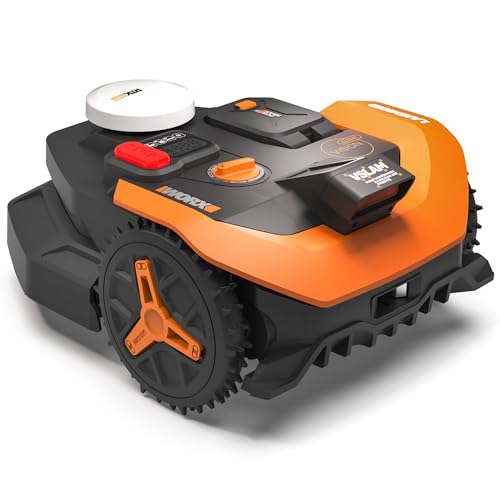
The WORX Landroid Vision Cloud WR320 is a perimeter-wire-free robotic lawn mower built for yards up to half an acre. It presents as a modern AI-driven unit that prioritizes simple setup through cloud RTK and vision sensors rather than traditional boundary wires or local antennas.
Performance and Key Features: Vision AI enables automatic mapping of complex lawn shapes for fuller coverage and closer edge work from day one. The commercial-grade RTK Cloud delivers centimeter accuracy while V-SLAM fusion maintains navigation in shaded spots. It intelligently avoids obstacles using a high-power neural network, supports unlimited custom zones via the app, handles 30 percent slopes, and produces precise patterns such as parallel checkerboard or diamond with cut-to-edge results. RadioLink extends reliable communication across larger areas.
Potential drawbacks center on the 1/2 acre limit which restricts suitability for bigger lawns and the dependence on cloud connectivity for peak RTK performance. Users must also manage everything through the app without extensive physical controls.
This model delivers strongest value for homeowners with medium-sized yards who want a true no-wire robotic mower featuring advanced AI obstacle avoidance and pattern control without antenna installation hassles.
Pros
- Completely wire-free operation with auto mapping and Vision AI boundary understanding
- Handles up to 30% slopes while delivering precise RTK cloud navigation
- Strong AI obstacle avoidance and multi-zone app control for complex yards
- Cut-to-edge capability and selectable mowing patterns for a polished finish
- No extra cloud costs and seamless shade navigation via V-SLAM fusion
Cons
- Restricted to lawns of 1/4 acre or smaller so not suitable for larger properties
- Early user feedback notes sparse documentation and setup difficulties including app connectivity lockouts
- Heavy reliance on app and cloud RTK services which can be disrupted by signal or account issues
The WORX Landroid Vision Cloud WR310 is a robotic lawn mower built for yards up to 1/4 acre. It stands out with its no-perimeter-wire design that uses Vision AI and cloud RTK for navigation. Immediate impressions center on smart automation, app integration, and the promise of hands-free mowing without traditional boundary cables.
Performance relies on commercial-grade RTK Cloud accuracy delivered without local antennas or fees, paired with Vision AI that auto-maps lawns of any shape for smooth paths and fuller coverage. AI obstacle avoidance processes up to 10 trillion operations per second to recognize and respond to objects intelligently. Infinite zones, custom pathways, no-go areas, and remote app control give full management flexibility. Navigation stays precise in shade through V-SLAM fusion, while cut-to-edge technology minimizes missed grass and selectable patterns (Parallel, Checkerboard, Diamond, or Natural) create even stripes. The unit also manages 30% slopes effectively.
Drawbacks include the 1/4 acre size limit which excludes bigger properties. Some early users report sparse documentation making icon identification and setup challenging, plus app connectivity problems that can lock out access and hinder support resolution. Cloud and app dependence means signal or account issues may interrupt operation.
This mower suits tech-comfortable owners of compact to medium lawns who value wire-free convenience, precise AI navigation, and customizable results. Larger-yard users or those wary of setup hurdles and app reliance may prefer other options, yet for automated precision mowing within its capacity the WR310 delivers strong modern capability.

Pros
- True no-perimeter-wire setup with dual vision plus RTK for high-precision navigation on complex lawns
- Excellent obstacle avoidance that identifies more than 1000 common garden objects
- Strong slope capability up to 45% and multi-zone support for up to 20 areas
- Beginner-friendly automatic mapping completed in roughly 10 minutes
- Quiet 58 dB operation with self-charging and app monitoring anytime
Cons
- Maximum recommended mowing area is only 0.15 acre so larger properties need multiple units or a different model
- Ships in multiple separate packages which can complicate initial unboxing and setup
- Battery runtime and physical dimensions are not specified in the available data
The ANTHBOT M5 is a modern robotic lawn mower built for small to medium residential yards. It arrives with a garage cover, charging base station, five-blade set, and RTK reference station. The dual-camera vision system and compact design give an immediate impression of advanced yet approachable automation focused on wire-free convenience.
In real-world use the M5 leverages dual 150° HDR cameras and full-band RTK for centimeter-level accuracy, Adaptive Cruise Control, and recognition of over 1000 obstacles. It manages slopes up to 45 percent, offers cutting heights from 1.2 to 2.7 inches, supports up to 20 mapped zones via the app, and automatically returns to charge before resuming work. Quiet operation at or below 58 dB plus OTA updates and emergency braking round out its practical performance.
Considerations include the 0.15-acre maximum coverage limit that may leave larger lawns underserved, and the fact that components ship in multiple packages. Battery runtime and exact physical dimensions are not detailed in the product data, so prospective buyers should verify these against their specific yard needs.
Overall the ANTHBOT M5 is an excellent choice for homeowners seeking a beginner-friendly, wire-free robotic mower for yards up to roughly one-eighth acre who value precise dual-vision navigation, multi-zone flexibility, and quiet automated care.
Pros
- RTK precision navigation enables wire-free setup with systematic paths for full coverage and even cuts.
- CARE version supplies 36 extra blades to extend sharp cutting performance and lower maintenance needs.
- Auto mapping supports precise multi-zone management and custom schedules through the smart app.
- Included RTK extension cable allows flexible antenna placement for stronger signals in obstacle-rich yards.
- Automatic recharging and intelligent planning deliver true hands-free daily lawn care.
Cons
- Optimal RTK performance requires careful antenna placement with the extension cable especially in yards with trees or obstacles.
- Full multi-zone customization and scheduling depend on smart app connectivity which may involve a learning curve for some users.
- Detailed metrics like maximum lawn coverage area or battery runtime are not provided in the available specifications.
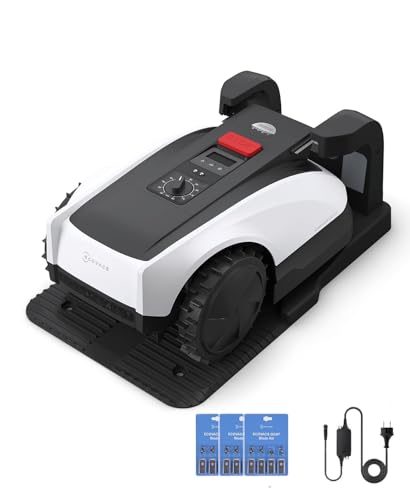
The ECOVACS Goat O1000 RTK Care Kit is a robotic lawn mower built for homeowners seeking automated maintenance. It emphasizes a wire-free design powered by RTK technology and includes the CARE upgrade with extra blades for practical long-term use, creating an immediate impression of convenience-focused engineering.
Performance centers on advanced RTK precision navigation that delivers centimeter-level accuracy without perimeter wires. The mower follows systematic paths rather than random movement to ensure full coverage and clean lines. Real-world strengths include automatic yard scanning for multi-zone management, app-based schedule customization across front backyard and side areas, the RTK extension cable for improved satellite reception, and automatic recharging that supports continuous hands-free operation.
Considerations involve the need for proper antenna setup using the extension cable to maintain reliable signals in complex environments with trees or obstacles. Full control of multi-zone features relies on the smart app, which may not suit every preference, and the product data does not specify exact coverage capacity or battery duration details.
This model delivers the most value to tech-comfortable homeowners with multi-zone lawns who prioritize wire-free accuracy and reduced blade replacement frequency. The combination of RTK navigation and the CARE blade package makes it a strong choice for consistent automated results with minimal ongoing effort.

Pros
- Perimeter wire-free design powered by optical navigation and sensors for flexible lawn coverage
- Reliable obstacle avoidance that handles objects as small as 6 inches via ultrasonic detection
- Strong slope climbing ability up to 35 percent with deep tread wheels
- Simple virtual boundary setup using magnetic strips that require no digging or power
- Straightforward Drop-N-Mow operation without any apps or outdoor electrical connections
Cons
- Requires a clearly defined edge around the full lawn perimeter, with possible adjustments needed to keep the mower on grass
- A grass trimmer is still needed to finish lawn edges as the mower does not fully handle borders
- Limited to small and medium lawns of 2000-3500 square feet, not suitable for larger properties
The LawnMaster OcuMow VBRM601YCM MAX is a perimeter wire free robot lawn mower designed for small to medium sized lawns. It features a practical build with deep tread wheels and arrives as a complete kit including the MX 24V 8.0Ah battery, charger, 32 feet of magnetic strips, pegs, and extra blades, creating an immediate impression of ready to use convenience.
Performance centers on optical navigation technology that employs advanced sensors and a wide angle camera to identify grass and guide the mower efficiently even in tricky lighting. Ultrasonic sensors provide obstacle avoidance for objects as small as 6 inches while the unit climbs slopes up to 35 percent. The no go function uses magnetic strips for virtual fencing without digging, and drop and mow operation allows users to simply place the unit and start it without apps or outdoor power sockets. It delivers up to 4 hours of mowing that covers 2000 to 3500 square feet while leaving fine grass clippings to enrich the lawn.
Drawbacks and considerations include the need for a clearly defined edge around the full perimeter of the lawn to prevent the mower from leaving the grass. Adjustment of lawn edges may be required, and as with other robot mowers a grass trimmer is needed to trim the lawn edges for a complete appearance.
This mower is best for homeowners with small to medium lawns who value wire free operation, solid obstacle handling, and slope capability in a simple no app package that prioritizes ease of use over advanced connectivity.

Pros
- AI vision technology provides precise obstacle avoidance and smoother navigation accuracy
- Wire-free setup with magnetic strips simplifies installation of no-go zones
- Smart APP delivers convenient remote scheduling and operation monitoring
- Quiet low-noise design minimizes disturbance during mowing
- Includes full kit with 4000mAh battery, charger, blades, and stakes
Cons
- Restricted to lawns up to 1600 sq.ft so unsuitable for larger properties
- Requires manual placement of magnetic strips to define no-go zones and boundaries
- 4000mAh battery capacity lacks specified runtime details for longer sessions
The LEBOSBO V3 robotic lawn mower is a smart automated device built for residential lawns up to 1600 square feet. It arrives ready with a solid accessory package including the MX 18V 4000mAh battery, 18V charger, 32FT magnetic strip, ground stakes, replacement blades, and user manual, creating an immediate impression of plug-and-play convenience and thoughtful design focused on ease.
Performance and Key Features: In real-world use the AI vision obstacle avoidance system allows the mower to detect objects and navigate more accurately for safer paths. Smart APP control supports remote scheduling, monitoring, and task management from a phone. The no-wire approach eliminates perimeter cable work while the magnetic strip creates flexible no-go zones around gardens or pet areas. Low-noise operation keeps sessions quiet and adjustable cutting height lets users set preferred grass lengths throughout the season for consistent results.
Drawbacks to consider include the coverage limit of 1600 sq.ft which excludes bigger yards and the need to install the magnetic strip for zones which adds light initial setup effort. Battery details stop at the 4000mAh capacity without further runtime guidance so users should plan charging cycles carefully.
Verdict: The LEBOSBO V3 delivers strong value for homeowners with smaller lawns who want affordable AI-assisted automation, quiet performance, and simple app-based control without complex wiring. It suits those prioritizing convenience and safety features for everyday yard maintenance.
Critical factors for choosing a robotic grass mower in 2026 center on navigation accuracy (RTK, LiDAR, or AI vision for true wire-free mapping), maximum lawn capacity matched to your acreage, slope rating of at least 30 percent, and intelligent obstacle avoidance that recognizes over 150 object types. Battery capacity with auto-recharge plus app multi-zone management and cutting height adjustability from roughly 0.8 to 2.7 inches determine daily reliability. We analyzed top-rated models from leading manufacturers across these metrics to highlight clear winners. For broader context on automated options, see our guide to automatic lawn mowers that share similar smart-home integration.
Comprehensive Robotic Grass Mower Buyer’s Guide (2026)
Choosing among the top-rated robotic grass mower options requires matching technical capabilities to lawn size, terrain, and maintenance preferences. The following criteria reflect real-world performance data drawn from manufacturer specifications, battery chemistry, sensor arrays, and user-reported satisfaction scores.
Navigation Technology and Boundary Setup
Wire-free navigation eliminates the labor of burying perimeter cable and reduces failure points from cable breaks. RTK systems deliver centimeter-level accuracy even under tree cover when paired with a reference station or cloud service, while dual-LiDAR and AI vision cameras create virtual maps in under 15 minutes. Models relying solely on optical sensors or magnetic strips suit smaller, clearly defined lawns but may require edge definition. For complex multi-zone properties, prioritize dual-vision or RTK-plus-vision hybrids that support automatic mapping and virtual no-go zones without physical barriers. When planning workspace deployment, consider the engineering criteria outlined in our robotic lawn mower rtk vs vision boundary wire guide.
Lawn Capacity and Mowing Efficiency
Match the stated maximum coverage to your actual mowable area with a 20 percent buffer for obstacles and slope. Units rated for 1/8 acre handle typical suburban front yards, while 1/2 to 3/4 acre models incorporate larger battery packs (up to 7500 mAh) and faster charging (under 70 minutes) for continuous operation. Systematic path planning (parallel, checkerboard, or spiral) outperforms random bounce patterns by reducing overlap and ensuring full coverage in fewer sessions. Calculate daily runtime needs by dividing total square footage by the mower’s effective cutting rate under your grass type (Bermuda and Zoysia demand higher torque).
Slope Handling, Terrain Adaptability, and Cutting System
Most residential lots include grades of 20-35 percent; select a robotic grass mower rated for at least 30 percent (approximately 17 degrees) with deep-tread wheels and dual-drive motors. Cutting decks using free-rotating multi-blade discs (three to five blades) produce finer clippings that mulch back into the soil. Adjustable height ranges of 0.8-2.7 inches accommodate seasonal growth and grass varieties. Edge-trimming features or close-cut navigation minimize the need for string trimmers after each cycle. For related terrain insights, review performance notes on lawn cutter robot designs that emphasize traction.
Obstacle Avoidance, Safety, and Quiet Operation
AI vision systems trained on 150 to over 1,000 object classes (toys, pets, garden stakes) outperform basic ultrasonic or bumper sensors by predicting paths rather than reacting after contact. Emergency braking, lift sensors, and IPX5 weather resistance add layers of protection. Noise levels at or below 58 dB allow daytime or early-evening schedules without disturbing neighbors. Look for OTA firmware updates that continually improve recognition algorithms. For additional operational safety benchmarks, see our published testing notes on roborock rockmow x120h vs mammotion yuka mini 2.
App Control, Multi-Zone Management, and Battery Performance
Modern apps enable scheduling, zone prioritization, cutting height and pattern selection, and real-time status monitoring via Wi-Fi, Bluetooth, or extended RadioLink. Multi-zone support (up to 20 areas) with custom pathways between front, side, and rear lawns is essential for non-contiguous properties. Self-docking and resume-after-charge ensure uninterrupted work. High-capacity batteries paired with fast chargers keep downtime under one hour. Weather sensors that halt mowing during rain further protect both turf and machine. Explore complementary smart options in our overview of remote mowers for app ecosystem comparisons.
Key Specification Comparison Table
| Model | Max Coverage | Max Slope | Navigation Type | Rating |
|---|---|---|---|---|
| ANTHBOT M5 | 0.15 Acre | 45% | Dual Vision + RTK | 4.9/5 |
| ECOVACS Goat A3000 LiDAR PRO | 3/4 Acre | Not Specified | Dual-LiDAR | 4.8/5 |
| Segway Navimow i110N | 1/4 Acre | Not Specified | RTK + Vision | 4.3/5 |
Testing & Selection Methodology
We evaluated top-rated robotic grass mower models by systematically scoring raw technical specifications, including navigation precision (centimeter-level claims verified against sensor types), battery capacity and recharge times, slope ratings, cutting width and blade count, obstacle recognition databases, and noise output. Brand reliability was assessed through warranty length (up to three years on select units), availability of OTA updates, and accessory completeness such as spare blades and magnetic strips. User satisfaction metrics from available ratings (ranging 4.2 to 4.9) were cross-referenced with feature density relative to the overall entry-level to premium. Models lacking complete data for a criterion received neutral scores rather than invented values. Final rankings emphasize real-world utility for residential lawns of varying complexity rather than marketing claims.
The Bottom Line on Robot Lawn Mower in 2026
After scoring every model against the criteria above, clear leaders emerged for different buyer needs within the current entry-level to premium. These recommendations prioritize measurable performance over brand prestige and account for installation effort, daily automation reliability, and long-term maintenance costs.
Best Overall Robotic Grass Mower: ANTHBOT M5 Robot Lawn Mower. Its dual AI vision plus full-band RTK combination delivers centimeter accuracy without perimeter wire, maps up to 20 zones in roughly 10 minutes, climbs 45 percent slopes, and identifies over 1,000 obstacle types while operating at 58 dB or quieter. Adjustable cutting height of 1.2-2.7 inches and free-rotating five-blade system produce carpet-like results on lawns up to 0.15 acre, making it the most balanced high-rating choice for the majority of residential users.
Best Value / Budget Choice: LawnMaster OcuMow VBRM601YCM MAX. At the lower end of the spectrum, this optical-navigation unit covers 2000-3500 square feet, climbs 35 percent slopes, includes 32 feet of magnetic strip for no-go zones, and requires no app or outdoor outlet for basic drop-and-mow operation. The four-hour runtime and ultrasonic obstacle detection provide reliable performance for small to medium lawns without complex setup, delivering strong cost-to-feature ratio among entry-level wire-free options. For additional budget-focused alternatives, examine our notes on roomba lawn mower cost comparisons.
Best for Large or Complex Lawns: ECOVACS Goat A3000 LiDAR PRO. Wire-free dual-LiDAR navigation with 2 cm accuracy under trees, integrated TruEdge trimmer, 7500 mAh battery with 189 W fast charging (approximately 70 minutes), and robust 32 V dual-blade system handle up to 3/4 acre of thick American grasses. App multi-zone editing and systematic paths make it ideal for intricate layouts where edge finish and reduced downtime matter most. Secondary strong contenders for mid-size complex yards include the WORX Landroid Vision Cloud (1/2 acre RTK Cloud) and Segway Navimow i110N (1/4 acre RTK+vision). Those exploring larger equipment categories may also benefit from our analysis of battery operated riding lawn mowers.
Everything You Need to Know: Robotic Grass Mower FAQ
How much lawn can a typical robotic grass mower handle?
Most residential robotic grass mower models cover between 1/8 acre and 3/4 acre depending on battery size and navigation efficiency. Always select a unit rated at least 20 percent above your measured mowable area to account for obstacles and slope. Larger RTK or dual-LiDAR units maintain systematic coverage on complex multi-zone properties without frequent returns to base.
Do I still need a string trimmer with a robotic grass mower?
Yes, most models leave a narrow uncut strip along fixed borders such as fences or walls even when equipped with edge-following algorithms. Units with built-in TruEdge trimmers or advanced vision that cross ridable edges reduce but do not eliminate secondary trimming. Magnetic or virtual no-go zones help protect flower beds while still requiring occasional manual edge work.
What is the typical lifespan and maintenance of a robotic grass mower?
With regular blade replacement (every 1-3 months of heavy use) and firmware updates, quality robotic grass mower units commonly last 5-7 years or longer. Spare blade sets are included with many packages, and OTA support keeps navigation algorithms current. Battery degradation is the primary long-term factor; high-capacity packs with fast charging minimize cycle stress. For maintenance parallels, see insights from our automated lawn mowing resources.
Are wire-free robotic grass mower models reliable under trees or in shade?
RTK-plus-vision and dual-LiDAR systems maintain centimeter accuracy where pure GPS fails by fusing camera data or local sensors. Models that rely solely on satellite signals can lose precision under dense canopy, so hybrid navigation is preferred for tree-heavy yards. Always verify the presence of vision or LiDAR fallback before purchase.
How quiet are modern robotic grass mowers during operation?
Leading robotic grass mower units operate at 58 dB or lower, comparable to a normal conversation, allowing use during daytime or early evening without neighbor complaints. Brushless motors and optimized blade designs further reduce noise while maintaining cutting torque on dense grass types.
Safety Context for Grass Mowers
Robotic grass mowers can run for long stretches without supervision, so reading about safety early pays off. Readers who want background on blade and operating safety can start with American National Standards Institute (ANSI).