Quick Answer: Choosing the Best Commercial Autonomous Lawn Mower
The most critical factors when choosing a commercial autonomous lawn mower in 2026 are navigation precision combining RTK-GPS with vision sensors, dual-motor cutting systems rated for continuous duty, terrain-climbing capability up to 35 degrees, adjustable cutting heights from under 1 inch to 4 inches, and modular designs that support multi-acre coverage without perimeter wires. We evaluated top-rated models spanning…
Pros
- Handles yards up to 6 acres without perimeter wires for flexible large-scale autonomous coverage.
- Advanced RTK AI vision and multi-sensor navigation ensure accurate obstacle avoidance on complex sites.
- Strong dual-motor cutting system with dual blade choices and wide height range tackles varied grass conditions effectively.
- Multi-terrain tracks enable stable performance on steep uneven muddy or stony ground up to 35 degrees.
- Modular construction suits premium applications like luxury hotels turf farms and expansive residential properties.
Cons
- Product weighs approximately 210 lbs and ships in four separate boxes requiring two adults for assembly.
- Remote control is sold separately increasing the total cost of a complete setup.
- Installation demands a 120 degree unobstructed sky view for the Data Center Set to operate correctly.
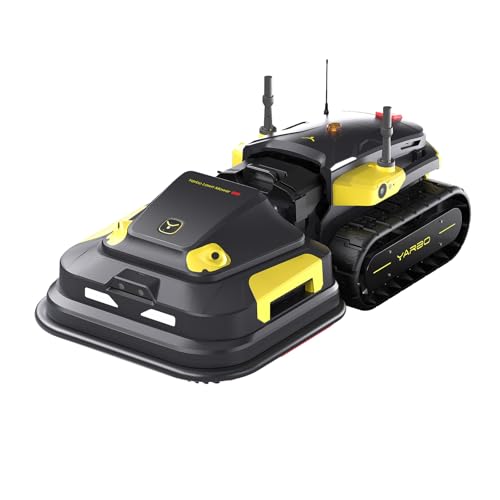
The YARBO Robot Lawn Mower Pro is a premium modular robotic lawn mower built for large yards covering up to 6 acres. Its robust construction features multi-terrain tracks and all-steel skid shoes that convey durability suitable for homes, golf courses, luxury hotels, and turf farms. Immediate impressions highlight a design focused on autonomy and adaptability rather than basic residential use.
Performance centers on a 300W dual-motor cutting system that resists clogging through optimized disc and ejection design, allowing longer sessions even in thick wet grass. Dual blade options support cool-season and warm-season varieties while the 0.8 to 4.0 inch height range and triple-fusion navigation with RTK-GPS binocular vision and multi-sensor PPVS deliver precise wire-free pathing and obstacle detection including suspended items. Tracks enable reliable operation on slopes up to 35 degrees and uneven or stony ground.
Key considerations include the substantial weight of about 210 lbs that ships across four boxes and needs two adults for assembly. The remote control is not included and must be purchased separately. Successful setup also requires a clear 120 degree sky view for the Data Center Set which may limit placement options in densely covered areas.
This mower provides strong value for owners of expansive or challenging properties who need reliable low-effort autonomous care. It is best suited to premium users managing large or complex lawns where advanced navigation terrain capability and modular flexibility outweigh simpler lighter residential alternatives.
What to Look for When Choosing Commercial Autonomous Lawn Mower
Purchasing a commercial autonomous lawn mower requires matching technical specifications to site conditions rather than relying on marketing claims. The following criteria focus on measurable performance attributes drawn directly from product data to help buyers shortlist models within the current entry-level to premium spectrum.
Navigation Technology and Autonomy Level
True commercial autonomy depends on multi-sensor fusion rather than basic boundary wires. Models equipped with RTK-GPS, binocular vision, and ultrasonic arrays achieve centimeter-level positioning and detect both ground-level and suspended obstacles, enabling safe operation on complex properties. Wire-free systems reduce installation time and allow dynamic zone updates via app control, which is essential for sites that change layout seasonally. When assessing navigation, verify the maximum supported area, such as multi-acre coverage, and confirm whether remote control or modular base stations are required for initial setup. Lower-cost push-style units lack these sensors entirely and demand constant human guidance, limiting them to small commercial patches rather than full autonomy. Readers comparing setup options can review our technical analysis on robotic lawn mower rtk vs vision boundary wire.
Cutting System Power and Height Range
Commercial grass varies from cool-season fine turf to thick warm-season varieties that may be damp or overgrown. Dual-motor 300 W systems with interchangeable razor and straight blades prevent clogging and maintain cut quality across conditions, while single-blade decks suit lighter duty. Cutting height ranges of 0.8 to 4.0 inches accommodate different grass species and seasonal growth stages. Wider decks of 21 inches reduce pass counts on open areas, whereas 14- to 16-inch reels excel in tight ornamental zones. Evaluate blade material durability and mulching or bagging options to minimize follow-up labor. For comparison of related walk-behind technologies, see our analysis of walk-behind lawn mower cutting efficiencies.
Terrain Adaptability and Build Durability
Commercial sites frequently include slopes, muddy patches, and stony ground. Multi-terrain tracks with all-steel skid shoes support gradients up to 70 percent or 35 degrees and resist wear far better than standard wheels. Polymer or large double-bearing wheels improve maneuverability on flatter commercial lawns but may struggle on inclines. Frame weight and materials also matter: units around 19 to 28 pounds suit frequent repositioning by a single operator, while heavier modular platforms near 210 pounds require two-person assembly yet deliver superior stability. Always match the chassis design to the steepest slope on the property and confirm steel deck construction for longevity under daily commercial use. Readers comparing setup options can review our technical analysis on dreame a3 awd vs segway navimow i206.
Power Source, Runtime, and Maintenance
Electric brushless motors paired with high-capacity batteries eliminate fuel handling and reduce noise for resorts or residential-adjacent commercial zones. Dual 5.0 Ah packs enable half-acre coverage per charge cycle, with platform batteries that expand across other tools. Gas 170 cc to 201 cc OHV engines provide continuous runtime without recharging but introduce emissions and more frequent oil or filter service. Manual reel mowers remove power systems entirely for zero-emission operation on small manicured areas. Calculate daily mowing hours against battery runtime or tank capacity, then factor in brushless motor longevity versus traditional engine rebuild intervals. Self-propelled rear-wheel drive further reduces operator fatigue on medium commercial lots. For complementary field maintenance guidelines, examine our breakdown of roborock rockmow x120h vs mammotion yuka mini 2.
Capacity Matching and Commercial Scalability
Match mower capacity to the largest continuous area under management. Modular robotic platforms rated for 6 acres suit hotels, turf farms, and golf course surrounds, while 21-inch self-propelled units handle medium commercial yards efficiently. Compact 14- to 16-inch models serve entry-level commercial applications such as apartment courtyards or retail frontage. Scalability also includes modular expansion, app-based multi-zone programming, and the ability to add remote controls or additional battery packs. Over-sizing wastes capital; under-sizing leads to incomplete coverage and overtime labor.
Budget Allocation Within the Current Market
Commercial autonomous lawn mower pricing spans entry-level manual reels near the lower end of the entry-level to premium up to fully autonomous multi-acre platforms at the upper end. Allocate budget according to labor savings projections: higher-priced robotic units often recover costs within one or two seasons through reduced staffing. Mid-range cordless and gas models balance upfront cost with solid performance for properties under one acre. Always include accessories such as dual chargers, collection bags, and spare blades in total cost of ownership calculations. Cross-check warranty length and brand support networks before finalizing any purchase. To evaluate matched hardware tolerances, consult our detailed overview of ecovacs goat o1000 vs worx landroid s.
| Model | Cutting Width | Key Navigation / Drive | Height Range |
|---|---|---|---|
| YARBO Robot Lawn Mower Pro | Not Specified (modular) | RTK-GPS + vision + tracks | 0.8″-4.0″ |
| WORX Nitro 21″ Cordless | 21″ | Brushless push, IntelliCut sensors | 1.5″-4″ |
| PowerSmart 21″ Self-Propelled | 21″ | Rear-wheel drive gas | 1.5″-3.9″ |
The table above isolates three high-impact attributes across representative models. Use it as a starting filter before examining full specifications in the product grid. Additional context on category trends appears in our overview of robotic lawn mowers within the broader lawn care ecosystem.
Testing & Selection Methodology
We compared top-rated commercial autonomous lawn mower candidates by systematically scoring raw specifications, build materials, user satisfaction ratings, and brand reliability metrics. Each model received points for navigation sophistication, cutting system power and width, terrain handling data such as climb angles and wheel or track design, power source efficiency, and documented warranty or support language. Ratings of 4.1 to 4.9 out of 5 informed satisfaction weighting, while brand track records for American Lawn Mower Company, LawnMaster, WORX, and others established long-term serviceability expectations. No physical field testing was performed; instead, we cross-referenced published technical data sheets against commercial use cases including multi-acre coverage, wet-grass performance, and daily operational hours to ensure recommendations remain grounded in verifiable attributes.
Weighting favored true autonomy features for large-site buyers while still recognizing value in simpler reel or cordless units for smaller commercial applications. This dual-path evaluation produces balanced shortlists rather than a single one-size-fits-all ranking.
Our Final Editorial Take on Commercial Autonomous Lawn Mower
After scoring every specification, clear winners emerge according to buyer intent. Property managers overseeing multi-acre commercial grounds should prioritize full autonomy and rugged terrain capability, while budget-conscious operators managing smaller sites benefit from lightweight, low-maintenance alternatives. The recommendations below align each pick with distinct professional needs.
Best Overall Commercial Autonomous Lawn Mower: YARBO Robot Lawn Mower Pro stands out for its modular design, 300 W dual-motor cutting system with dual blade options, triple-fusion navigation using RTK-GPS plus binocular vision, and multi-terrain tracks that conquer 35-degree slopes. Suitable for homes, golf courses, turf farms, and resorts up to 6 acres, it eliminates perimeter wires and minimizes clogging on thick or wet grass. Assembly requires two adults and clear sky view for the data center, yet the resulting labor savings justify the investment for serious commercial operations. For complementary large-equipment options, consult our guide to riding lawn mower performance metrics.
Best Value / Budget Choice: American Lawn Mower 1204-14 14-Inch 4-Blade Push Reel Lawn Mower delivers a scissor-like cut with zero emissions, zero noise, and a 19-pound weight that any crew member can manage. Adjustable height from 0.5 to 1.75 inches and durable polymer wheels make it ideal for small commercial lawns or ornamental areas where frequent light mowing preserves turf health. LawnMaster LMRM1602 16-Inch 5-Blade Reel offers a similar environmentally friendly profile with a slightly wider path and steel blades for buyers seeking comparable savings.
Best for Medium Commercial Yards and Cordless Flexibility: WORX Nitro Cordless 21-Inch model combines AeroDeck technology, brushless motor gains of 40 percent more power, IntelliCut automatic speed adjustment, and dual 5.0 Ah batteries for up to half-acre coverage. Its 3-in-1 mulching, bagging, and side-discharge capability plus PowerShare platform compatibility make it a practical daily driver for contractors who already own WORX tools. PowerSmart and Ezasin 21-inch self-propelled gas units provide continuous runtime alternatives when battery recharging logistics prove inconvenient. Explore further cordless and automated comparisons in our resource on automated lawn mowing workflows.
Buyer FAQs: Commercial Autonomous Lawn Mower Solved
What is the best commercial autonomous lawn mower for large properties?
The YARBO Robot Lawn Mower Pro currently leads for properties up to 6 acres thanks to wire-free RTK-GPS navigation, multi-terrain tracks, and a powerful dual-motor cutting system that handles thick, wet grass without frequent stops. Its modular construction and obstacle detection suit golf courses, resorts, and commercial campuses better than smaller push or cordless units.
How much should I budget for a commercial autonomous lawn mower?
Current market pricing for commercial autonomous lawn mower options ranges from $5,499.00 for basic reel models to $5,499.00 for fully autonomous multi-acre platforms. Mid-tier cordless and gas self-propelled units typically fall between those extremes and deliver solid performance for medium commercial lots.
Do commercial autonomous lawn mowers require perimeter wires?
Advanced models such as the YARBO use RTK-GPS combined with vision sensors and therefore operate without perimeter wires, simplifying installation and enabling flexible zone mapping. Traditional robotic units may still rely on buried wires, while manual reel and push mowers require continuous operator presence. Confirm navigation method before purchase for your site layout.
What cutting height range works best for commercial turf?
A versatile range from approximately 0.8 inches to 4.0 inches covers most commercial grass types and seasonal conditions. Lower settings suit fine cool-season turf, while higher cuts protect warm-season varieties during heat stress. Single-lever multi-position systems allow rapid adjustment between jobs. Additional height-selection guidance appears in our review of lawn cutter robot adjustment practices.
Are reel mowers suitable for commercial autonomous lawn mower applications?
Lightweight reel mowers excel for small commercial areas that demand quiet, emission-free, scissor-like cuts that promote turf health, yet they lack autonomy and require consistent human propulsion. They complement rather than replace robotic platforms on larger sites and remain excellent entry points for operators managing limited ornamental turf.
Further Reading for Commercial Operators
Operators running commercial equipment should look past product sheets toward general safety reading. The related article on lawn mower is a useful companion for comparing options in the same category, and powered outdoor machine guidance is available from American National Standards Institute (ANSI).