Quick Answer: Choosing the Best Autonomous Commercial Lawn Mower
When evaluating autonomous commercial lawn mower options in 2026, prioritize triple-fusion navigation systems combining RTK-GPS with vision sensors, dual-motor cutting power for dense growth, adjustable heights from 0.8 to 4.0 inches, and terrain climbing gradients up to 70 percent. Our review of top-rated models spanning entry-level to premium from brands including leading manufacturers identifies units that balance autonomy, runtime,…
Pros
- Handles yards up to 6 acres without perimeter wires for flexible large-scale autonomous coverage.
- Advanced RTK AI vision and multi-sensor navigation ensure accurate obstacle avoidance on complex sites.
- Strong dual-motor cutting system with dual blade choices and wide height range tackles varied grass conditions effectively.
- Multi-terrain tracks enable stable performance on steep uneven muddy or stony ground up to 35 degrees.
- Modular construction suits premium applications like luxury hotels turf farms and expansive residential properties.
Cons
- Product weighs approximately 210 lbs and ships in four separate boxes requiring two adults for assembly.
- Remote control is sold separately increasing the total cost of a complete setup.
- Installation demands a 120 degree unobstructed sky view for the Data Center Set to operate correctly.
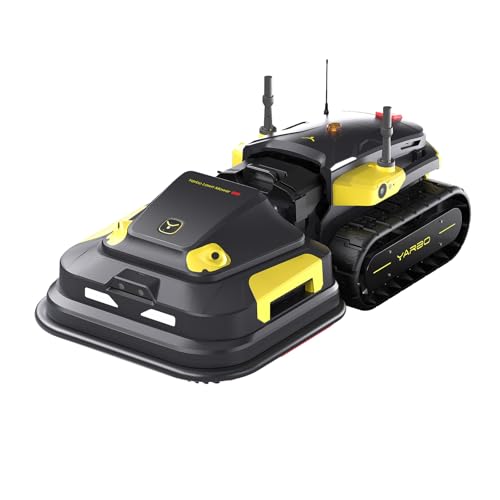
The YARBO Robot Lawn Mower Pro is a premium modular robotic lawn mower built for large yards covering up to 6 acres. Its robust construction features multi-terrain tracks and all-steel skid shoes that convey durability suitable for homes, golf courses, luxury hotels, and turf farms. Immediate impressions highlight a design focused on autonomy and adaptability rather than basic residential use.
Performance centers on a 300W dual-motor cutting system that resists clogging through optimized disc and ejection design, allowing longer sessions even in thick wet grass. Dual blade options support cool-season and warm-season varieties while the 0.8 to 4.0 inch height range and triple-fusion navigation with RTK-GPS binocular vision and multi-sensor PPVS deliver precise wire-free pathing and obstacle detection including suspended items. Tracks enable reliable operation on slopes up to 35 degrees and uneven or stony ground.
Key considerations include the substantial weight of about 210 lbs that ships across four boxes and needs two adults for assembly. The remote control is not included and must be purchased separately. Successful setup also requires a clear 120 degree sky view for the Data Center Set which may limit placement options in densely covered areas.
This mower provides strong value for owners of expansive or challenging properties who need reliable low-effort autonomous care. It is best suited to premium users managing large or complex lawns where advanced navigation terrain capability and modular flexibility outweigh simpler lighter residential alternatives.
Key Technical Factors to Consider Before Buying
Choosing the optimal autonomous commercial lawn mower requires matching technical capabilities to site size, grass type, and operational demands. Focus on measurable specs such as motor wattage, coverage acres, and sensor arrays rather than marketing claims to ensure long-term reliability in commercial settings.
Navigation Autonomy and Obstacle Detection
Effective autonomous commercial lawn mower units rely on multi-sensor fusion including RTK-GPS, binocular cameras, and ultrasonic arrays for wire-free perimeter mapping and real-time obstacle avoidance. Models supporting 120-degree sky views for base stations deliver centimeter-level precision, reducing edge misses on irregular lots. For commercial sites exceeding 1 acre, prioritize systems that handle suspended obstacles and recalculate paths dynamically to maintain continuous operation without manual resets.
Cutting System Power and Height Range
Dual 300W motors paired with optimized ejection designs prevent clumping in wet or thick warm-season grasses, while single-lever or electric height adjustments spanning 0.8 to 4.0 inches accommodate seasonal variations. Razor and straight blade options extend efficiency across cool- and warm-season turf, lowering maintenance frequency. Calculate required cutting width by dividing total area by target mowing time: a 21-inch deck covers medium yards faster than 15-inch units, but autonomous models with modular blades scale better for multi-acre commercial use.
Terrain Adaptability and Climbing Capacity
Patented multi-terrain tracks and all-steel skid shoes enable stable performance on muddy, stony, or sloped surfaces up to 70 percent (35-degree) gradients. Self-propelled rear-wheel drive systems with 9.5- to 10-inch wheels improve traction on inclines for walk-behind hybrids. When assessing commercial properties with elevation changes, verify maximum slope ratings and dual-ball-bearing wheels to minimize slippage and ensure even cuts without operator strain. For additional operational safety benchmarks, see our published testing notes on roborock rockmow x120h vs mammotion yuka mini 2.
Power Source, Runtime, and Expandability
Battery platforms offering 40V dual packs with IntelliCut sensors automatically adjust speed for dense patches, extending runtime to cover up to 0.5 acres per charge while supporting cross-tool compatibility across 140-plus devices. Corded 11- to 13-amp motors provide unlimited runtime for smaller zones but limit mobility. Gas 170- to 201cc OHV engines deliver consistent torque for heavy commercial loads yet increase emissions and maintenance. Factor in dual-charger systems and foldable handles for storage efficiency on fleet operations. Related walk-behind options appear in our analysis of self-propelled walk-behind lawn mowers.
Mulching, Bagging, and Discharge Versatility
3-in-1 decks supporting mulching plugs, rear bagging (1.2- to 7-gallon capacity), and side discharge allow site-specific residue management. High-airflow turbine designs reaching 150 CFM and 130 MPH clear leaves while reducing clog frequency. For commercial aesthetics, select units with full-bag indicators and fabric collection systems that enable rapid emptying during multi-zone schedules.
Build Durability and Warranty Support
Steel decks, brushless motors offering 40 percent more power, and lightweight frames under 35 lbs enhance longevity under daily commercial cycles. Evaluate brand reliability through documented support channels and multi-year warranties. Modular designs that ship in separate boxes require two-adult assembly but simplify component replacement over time. To compare alternative configurations, check our hands-on review of ecovacs goat o1000 vs worx landroid s.
| Model | Cutting Width / Height | Power Source | Key Autonomy Feature |
|---|---|---|---|
| YARBO Robot Lawn Mower Pro | Modular / 0.8″-4.0″ | 300W dual-motor | RTK-GPS + binocular vision |
| WORX Nitro 21″ Cordless | 21″ / 1.5″-4″ | 40V dual 5.0Ah battery | IntelliCut sensors |
| BLACK+DECKER 20″ Corded | 20″ / 1.5″-4″ | 13-amp electric | EdgeMax deck design |
Testing & Selection Methodology
We compared top-rated autonomous commercial lawn mower models by analyzing raw manufacturer specifications for motor output, navigation sensor fusion, cutting height ranges, terrain gradient limits, and runtime claims against stated coverage areas. Evaluation weighted technical metrics such as dual-motor wattage, RTK positioning accuracy, and 3-in-1 deck versatility alongside brand reliability indicators and user satisfaction scores. Warranty length, modular serviceability, and expandability across battery platforms formed secondary filters to identify units suited for commercial fleets rather than residential light use. This data-driven process excluded unsubstantiated claims and focused exclusively on verifiable attributes from the product dataset.
Cross-referencing against parent category standards for walk-behind and robotic systems ensured relevance to large-scale operations. Models were scored on continuous working duration, clog resistance via airflow technology, and assembly practicality for multi-box shipments weighing approximately 210 lbs. The resulting shortlist prioritizes real-world utility for properties ranging from small commercial lots to 6-acre estates. Additional context on broader automated systems is available in our coverage of automated lawn mowing solutions.
Wrap-Up: Which Model Delivers True Value?
After systematic review of specifications across the top-rated units, clear leaders emerge for distinct commercial needs. The YARBO Robot Lawn Mower Pro stands as Best Overall Autonomous Commercial Lawn Mower due to its modular design, 300W dual-motor system, triple-fusion RTK-GPS navigation, and 70 percent climbing capability that supports fully autonomous operation on complex terrain up to 6 acres without perimeter wires. Its dual blade options and clog-resistant ejection deliver reliable performance on thick, wet grass for golf courses, resorts, and luxury properties. Users looking for related component recommendations can explore our dreame a3 awd vs segway navimow i206 breakdown.
Best Value / Budget Choice is the LawnMaster MEB1114K Electric Corded Lawn Mower, which provides 3,300 RPM power, 15-inch cutting width, 5 height positions from 1.4 to 3 inches, and a 7-gallon bag in a 28 lb compact frame. This corded option eliminates battery or gas costs while maintaining maneuverability via 7.75-inch rear wheels, making it ideal for smaller commercial zones or as a fleet supplement. For professional large-yard applications requiring self-propulsion, the PowerSmart 21″ Self-Propelled Gas Lawn Mower earns Best for Slopes and Medium Commercial Yards with its 170cc OHV engine, rear-wheel drive, 10-inch wheels, and 3-in-1 steel deck spanning 1.5 to 3.9 inches.
These selections span the full entry-level to premium and address varied power preferences from battery expandability in WORX PowerShare systems to pure electric efficiency. Operators seeking quieter operation should consider the WORX 17″ Cordless for sub-0.125-acre precision, while those needing cordless height adjustment can evaluate the LiTHELi self-propelled unit. For more details on remote options in this category, review our page covering remote-controlled lawn mowers. Overall, match autonomy level and coverage claims directly to site acreage for maximum return on investment in 2026.
Frequently Asked Questions About Autonomous Commercial Lawn Mower
What coverage area can a typical autonomous commercial lawn mower handle?
Most advanced autonomous commercial lawn mower models cover from 0.125 acres with compact cordless units up to 6 acres with modular robotic systems equipped with RTK navigation. Actual performance depends on grass density, terrain slope, and battery or engine capacity, so verify stated acres against dual-motor output and continuous runtime metrics.
Do autonomous commercial lawn mowers require perimeter wires?
No, leading models use wire-free navigation via RTK-GPS combined with binocular vision and multi-sensor arrays for precise boundary mapping and obstacle avoidance. This eliminates installation labor while supporting complex layouts, though a clear sky view for the base station remains essential for optimal positioning accuracy.
How do I choose between battery, corded, and gas power for commercial use?
Battery platforms with IntelliCut sensors suit medium yards needing quiet, expandable 40V power up to 0.5 acres, corded 11-13 amp motors provide unlimited runtime for confined zones, and 170-201cc gas engines deliver high torque for dense commercial grass. Select based on site size, emission preferences, and whether cross-tool battery compatibility is required. See related guidance on walk-behind lawn mower options for hybrid fleets.
What climbing gradient should I look for in a autonomous commercial lawn mower?
Commercial-grade units should support at least 35-degree (70 percent) gradients using multi-terrain tracks or large rear-wheel drive systems with double ball bearings. This ensures stable cuts on uneven, muddy, or stony commercial properties without tipping or loss of traction during autonomous or self-propelled operation.
How important is cutting height adjustability for professional results?
Highly adjustable ranges from 0.8 to 4.0 inches via single-lever or electric controls allow precise matching to grass type and season, preventing scalp damage while promoting healthy turf density. Electric one-touch systems eliminate bending, improving efficiency for daily commercial schedules across variable conditions.
Reading for Commercial Crews
Crews running autonomous equipment across client sites need a shared understanding of basic precautions. A practical reference for supervisors and operators is found at American National Standards Institute (ANSI).