Quick Answer: Choosing the Best Auto Lawn Mowers
When evaluating auto lawn mowers in 2026, the most critical factors are cutting width and coverage capacity (measured in square feet or acres per charge), navigation technology (boundary wire vs. optical vs. RTK GPS), slope handling (expressed as a percentage grade), and total cost of ownership including blade replacements and potential subscription fees. Our team analyzed top-rated models across…

Pros
- Completely wire-free and RTK-base-station-free setup with rapid dual-LiDAR AI mapping
- AWD drive and active steering handle 80% slopes and large obstacles without turf damage
- 3D LiDAR plus dual AI cameras deliver reliable obstacle avoidance and edge precision
- 9.49-inch cutting width with flexible height range optimized for common US grass types
- Three years of free 4G connectivity, full app control, rain sensing, and PIN/GPS theft protection included
Cons
- Maximum coverage limited to 0.49 acres, making it unsuitable for larger properties
- Advanced app-based operation may require an initial learning period for less tech-savvy users
- No option for traditional perimeter-wire boundaries for those who prefer physical systems
The roborock RockMow X120H is a premium robotic lawn mower built for homeowners who want fully automated yard care without the hassle of perimeter wires or RTK base stations. Its solid construction pairs dual 3D LiDAR sensors, dual AI cameras, all-wheel drive motors, and a floating cutting deck to create an immediate impression of rugged, high-tech reliability ready for real-world lawns.
Performance stands out through rapid wire-free mapping that generates a centimeter-accurate 3D yard model in minutes, covering up to 0.49 acres. The AWD system with patented active steering conquers 80 percent slopes and 3.15-inch obstacles while protecting turf, and the fusion of dense LiDAR point clouds with dual-camera vision lets the mower detect and dodge toys, furniture, pets, and debris in real time. A wide 9.49-inch cutting path adjustable between 1.57 and 3.54 inches delivers efficient mowing and precise edge results, all controlled via the Roborock App with three years of free 4G, rain sensing, IPX6 waterproofing, and GPS anti-theft protection.
Honest considerations include the hard 0.49-acre coverage limit that rules out bigger properties, plus reliance on the smart app that may involve a short learning curve. Users who simply prefer the familiarity of buried boundary wires will not find that traditional option available.
In verdict, the RockMow X120H delivers outstanding value for owners of medium-sized, possibly hilly yards who prioritize effortless setup, steep-slope capability, and truly unsupervised operation. Tech-oriented gardeners seeking a modern, safe, and connected mowing solution will appreciate its feature set the most.

Pros
- Completely wire-free installation with fast one-tap auto mapping
- Stable dual LiDAR-vision navigation that functions day or night without satellites
- Strong 45 percent slope capability supported by off-road wheels and electronic stability control
- Accurate AI obstacle detection covering more than 200 types plus multi-zone GeoSketch mapping
- Full smart-home integration with voice assistants and advanced security features
Cons
- Garage accessory is shipped separately and must be obtained for complete docking functionality
- Maximum coverage limited to 0.37 acres making it unsuitable for larger properties
- Cutting height adjustment range restricted to only 2-4 inches
The NAVIMOW i215 LiDAR Robot Lawn Mower is a wire-free robotic mower built for homeowners who want efficient lawn care without installing boundary wires. Its robust chassis with off-road wheels and solid construction gives an immediate premium feel suitable for medium yards covering up to 0.37 acres.
Performance centers on solid-state LiDAR paired with vision sensors for satellite-free navigation that remains stable day or night with full 3D awareness. A 100W motor driving a 6-blade disc provides a 7.1 inch cutting width and adjustable heights from 2 to 4 inches while AI VisionFence detects over 200 obstacles at 0.4 inch accuracy. Auto mapping, up to 20 editable zones, EdgeSense edge cutting, Alexa and Google Home voice control, and app tools for custom patterns plus weather auto-docking make daily use highly convenient. The unit also manages slopes up to 45 percent with electronic stability control.
Considerations include the garage being shipped separately so full docking requires an extra purchase. Coverage is capped at 0.37 acres which excludes larger lawns, and the cutting height range of 2-4 inches may feel limited for certain grass types or seasonal needs.
The NAVIMOW i215 delivers strong value for owners of smaller to medium residential lawns who prioritize wire-free convenience, advanced dual-sensor navigation, and smart security features. Users with bigger properties or wider cutting height requirements should verify the specifications match their specific yard conditions before purchase.

Pros
- Wire-free setup with flexible dual mapping options simplifies installation on open or intricate lawns
- Full-Band RTK and Quad-Vision dual navigation maintain accurate positioning in shaded or obstructed areas
- 4WD system with active steering and suspension confidently handles 80 percent slopes and 3.15-inch obstacles without turf damage
- Wide 9.49-inch cutting width plus multi-sensor obstacle avoidance delivers efficient, safe, and uniform results
- App control with included 4G, multi-zone scheduling, and robust anti-theft features including GPS tracking
Cons
- Maximum coverage limited to 0.37 acres makes it unsuitable for larger properties
- Advanced mapping and customization fully depend on the companion app, which may require initial learning for complex layouts
- Battery runtime, exact dimensions, and other detailed specs are not provided in the available product data
The roborock RockMow X115H is a premium wire-free robot lawn mower engineered for modern homeowners seeking to eliminate traditional mowing chores. Its robust 4WD construction, advanced sensor array, and sleek design immediately convey high build quality and readiness for real-world yards with slopes, obstacles, and varied layouts.
In real-world performance the Full-Band RTK plus Quad-Vision dual navigation system provides continuous precise positioning under tree canopies, near fences, and through narrow passages. Dual mapping lets users choose AI auto-mapping for open lawns or app-controlled manual steering for hyper-precise boundaries. The pro-grade 4WD with active steering and dynamic suspension conquers 80 percent slopes and 3.15-inch obstacles while protecting the turf. A 9.49-inch cutting width adjustable from 1.57 to 3.54 inches pairs with multi-sensor AI fusion to deliver fast, uniform cuts and safe avoidance of garden objects, people, and pets. The included smart app with 4G connectivity enables multi-zone schedules, real-time progress views, wildlife-friendly mode, PIN lockout, high-decibel alarm, and GPS tracking for complete remote control and security.
Honest considerations include the hard 0.37-acre maximum coverage limit that will not suit larger properties. Setup of custom maps and advanced features relies entirely on the companion app, which can involve a short learning curve for intricate gardens. Battery life, full dimensions, and certain other operational details are not specified in the available product information, so buyers should confirm fit for their specific conditions.
The RockMow X115H is an excellent choice for tech-oriented homeowners with mid-sized lawns up to 0.37 acres who value wire-free convenience, superior navigation reliability, strong slope capability, and comprehensive safety and anti-theft features. Those seeking a hands-off, high-precision robotic solution for complex yet moderately sized yards will gain the most value from this model.

Pros
- Full-frequency RTK plus visual navigation provides stable centimetre-level positioning without buried wires
- Advanced static and dynamic obstacle avoidance with ToF radar and contact sensors enhances safety
- App-based multi-zone management and auto mapping simplify control of complex yards
- Strong 6000mAh battery capacity and four brushless motors support efficient professional-grade cutting
- IPX6 waterproof construction permits easy hose cleaning and durable outdoor performance
Cons
- Maximum coverage is limited to 1/4 acre so it is unsuitable for larger properties
- Battery runtime and exact mowing duration are not specified so users must monitor charge levels during initial use
- New brand with limited real-world feedback means long-term reliability data is still emerging
The PROUDEER ROBOT Lawn Mower is a modern wire-free robotic mower built for homeowners with lawns up to 1/4 acre. It combines a solid professional build featuring four brushless motors, SK5 blades and IPX6 waterproofing that allows direct water cleaning. The immediate impression is a compact capable unit focused on precision navigation and ease of use rather than bulk.
Performance and key features stand out through the dual RTK high-precision positioning and AI vision system that enables centimetre-level accuracy and continuous operation even under trees. Users can map boundaries, walkways and obstacles automatically or manually then let the mower calculate efficient U-shaped paths. AI cameras and ToF radar handle both vertical and flat obstacles while front safety sensors trigger instant stops. The companion app adds real value with multi-zone support for up to 20 areas, scheduling, height adjustment, live progress tracking and OTA updates.
Potential drawbacks include the fixed 1/4 acre coverage limit which restricts suitability for bigger yards. Battery capacity is listed as 6000mAh yet actual runtime is not detailed so initial sessions may require observation. As a newer brand offering the long-term durability feedback is still limited compared with established competitors.
Overall the PROUDEER ROBOT Lawn Mower delivers strong value for owners of small to mid-size lawns who want true wire-free automation with advanced RTK plus vision navigation. It is best suited for tech-comfortable users seeking precise mapping, solid obstacle avoidance and app-driven customization without the hassle of perimeter wires.
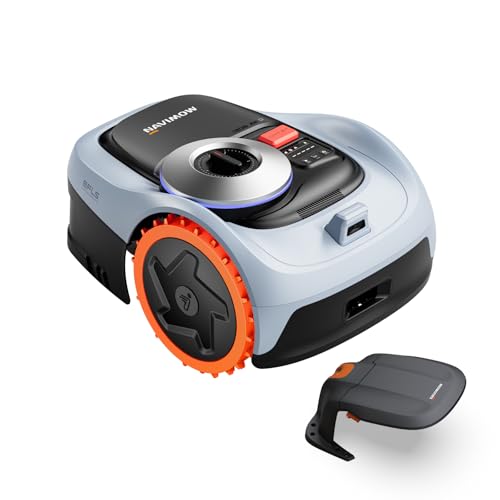
Pros
- Strong all-wheel drive and ESC stability excel on slopes up to 45 percent and uneven ground
- Advanced RTK + Vision system provides wire-free auto mapping with high positional accuracy
- Energy-saving adaptive drive and zero-turn design promote longer runtime and gentler grass care
- Multi-zone management up to 20 areas plus GPS security alerts enhance convenience and protection
Cons
- Garage ships separately and is not included with the mower unit
- Coverage is limited to 0.15 acre so full jobs require multiple battery charges of 1,350 square feet each
- Relatively narrow 7.1-inch cutting width can extend mowing duration on wider sections
The NAVIMOW i206 AWD is a wire-free robotic lawn mower built for homeowners with small yards up to 0.15 acre who need reliable performance on slopes. Its compact design pairs all-wheel drive with automotive-grade electronic stability control, creating an immediate impression of rugged capability suited to uneven or inclined terrain without the usual boundary wire installation.
In real-world use the AWD system and zero-turn third-wheel configuration maintain stable traction on 45 percent grades while the 7.1-inch cutting deck and 2 to 3.6 inch height range produce an even finish. The EFLS Network RTK combined with Vision delivers one-tap auto mapping at centimeter accuracy, and the adaptive drive system draws extra power only when needed so the 2.5Ah battery covers up to 1,350 square feet per charge. Multi-zone scheduling for as many as 20 areas plus auto-resume and GPS security alerts further streamline operation through the companion app.
Buyers should note that the garage ships separately, so complete weather protection requires an additional step. The 0.15-acre rating means multiple recharges are necessary for full coverage, and the modest cutting width may lengthen overall mowing time compared with wider decks.
Overall the NAVIMOW i206 AWD offers strong value for owners of compact sloped lawns who prioritize wire-free convenience, advanced navigation, and all-terrain grip. It is best suited to users seeking low-maintenance precision rather than large-property coverage.

Pros
- Completely eliminates boundary wires and RTK requirements through advanced triple-camera AI vision navigation.
- Delivers reliable 99% real-time obstacle avoidance including small wildlife and furniture for complex gardens.
- Supports extensive customization with app-based multi-zone mapping, schedules, and adjustable cutting height.
- Provides strong traction on slopes up to 18 degrees and coverage for areas up to 0.3 acres.
- Includes built-in garage, quiet operation under 54 dB, and GPS+4G security features.
Cons
- Maximum coverage limited to 0.3 acres making it unsuitable for larger properties.
- Cutting height adjustment range is restricted to 0.98-2.95 inches which may not fit all grass preferences.
- Performance depends on vision systems that auto-recall in low light or rain yet may require ideal visibility conditions.
The TerraMow V1000 robotic lawn mower stands out as a fully wire-free solution built around TerraVision 2.0 Triple-Camera AI Vision technology. It includes a garage and is engineered for complex gardens, offering an immediate impression of advanced autonomy without traditional installation hassles or signal dependencies.
Performance and Key Features: In real-world use the V1000 auto-maps the lawn with one click and mows up to 0.3 acres while detecting and avoiding over 99% of obstacles such as trees, pools, pets, and furniture. Rear-wheel drive and off-road wheels provide traction on slopes up to 32.5% and through paths as narrow as 23.6 inches. The companion app enables creation of up to 20 mowing zones and 3 maps, cutting height adjustment from 0.98 to 2.95 inches, path customization, and scheduling, with auto-resume after charging and automatic recall in rain or low light.
Drawbacks and Considerations: Coverage is capped at 0.3 acres so larger lawns fall outside its capacity. The cutting height range remains relatively narrow and the system relies on camera-based vision that, while robust, benefits from decent lighting conditions even with its safety recall features. Detailed battery runtime data is not provided in the core specifications.
Verdict: The TerraMow V1000 delivers excellent value for homeowners with complex yards up to 0.3 acres who want true hands-free operation, superior obstacle handling, and flexible app control without the drawbacks of wires or RTK. It is ideal for users seeking quiet, pet-friendly, and secure robotic mowing in challenging garden layouts.

Pros
- Wire-free design enables effortless out-of-the-box operation without cable setups.
- Dual RTK and vision system provides stable positioning in challenging environments like under trees.
- Automatic and remote mapping options reduce setup time and allow customizable lawn areas.
- Advanced AI obstacle avoidance ensures safer navigation around common household objects and living beings.
- Supports multi-zone management with real-time monitoring for tailored lawn care needs.
Cons
- Maximum coverage limited to 0.51 acres, unsuitable for significantly larger lawns.
- Full features depend on app connectivity via Bluetooth or WiFi for mapping and control.
- Initial setup requires proper placement of the charging base for operation.
The ANTHBOT Genie1000 is a robotic lawn mower built for wire-free convenience, combining full-band RTK with 4-eye vision technology for precise lawn care. Its design emphasizes ease of installation with just a charging base needed, creating an immediate impression of user-friendly advanced robotics suitable for residential use.
In terms of performance, the mower excels with ACC automatic mapping using AI and a four-camera system to identify boundaries and plan intelligent paths. It supports multi-zone management for over 20 areas, remote control mapping for custom designs, and 300-degree AI obstacle avoidance detecting 1000+ objects, ensuring reliable mowing even in weak GPS spots up to 0.51 acres.
Potential drawbacks include its maximum area capacity of 0.51 acres which may restrict use on bigger properties, along with reliance on Bluetooth or WiFi for complete app-based features like no-go zone setting and monitoring. These aspects require consideration for optimal performance based on the lawn size and connectivity available.
Overall, the ANTHBOT Genie1000 provides strong value for homeowners with medium-sized yards seeking an intelligent, no-wire solution with auto mapping and multi-zone capabilities. It is particularly recommended for those prioritizing safety, customization, and reduced maintenance effort in daily lawn care.

Pros
- Completely wire-free setup using Vision AI for boundary recognition ideal for simple small yards
- Convenient one-click start combined with full app control for scheduling and preferences
- Quiet 55dB operation plus adjustable cutting height keeps lawns neat with minimal disruption
- Auto-recharge and return-to-base function reduces daily intervention
- Handles up to 42 percent slopes and provides Vision AI obstacle avoidance for safer navigation
Cons
- Limited to small simple yards up to 0.15 acre so not suitable for larger or complex properties
- Best performance requires daylight and a lawn free of small toys loose branches or heavy debris
- Magnetic strips may still be needed for open edges or flower beds lacking clear visual boundaries
The SUNSEEKER V3 is a compact wireless robot lawn mower built specifically for small yards measuring up to 0.15 acre or 6400 square feet. It focuses on simple properties with clear edges such as fences sidewalks patios driveways or garden borders and delivers a clean modern design that emphasizes easy setup without any buried perimeter wire. Immediate impression is of a lightweight practical tool aimed at busy homeowners who want consistent results with minimal fuss.
In real-world use the V3 relies on dual-camera Vision AI for obstacle detection and boundary recognition while an 8-inch cutting deck with heights adjustable between 1.6 and 3.2 inches keeps grass neat. One-click start plus full app control allow schedule setting and preference tweaks and the unit automatically returns to its charging station when finished or low on power. It operates at a quiet 55dB and manages slopes up to 42 percent making daily maintenance straightforward for suitable lawns.
Drawbacks include the strict size limit that excludes larger or highly irregular properties. Optimal Vision AI performance needs good daylight and a lawn cleared of toys branches or debris. Some open edges may still require magnetic strips for reliable definition.
Overall the SUNSEEKER V3 delivers strong value for owners of small simple yards who prioritize wire-free convenience app scheduling and quiet auto-recharging operation. It is an excellent fit for those ready to keep their lawn clear and mow mainly during daylight hours.

Pros
- Wire-free RTK and vision system eliminates perimeter wire installation
- AIVI 3D obstacle avoidance detects common yard objects and pets
- Rated to navigate slopes up to 45% (24 degrees)
- ECOVACS app supports multi-zone management and custom no-go boundaries
- TruEdge technology designed for precise edge cutting
Cons
- Maximum lawn coverage is limited to 1/4 acre (10,890 sq. ft.)
- Requires clearance of at least 2.3 feet to pass through narrow corridors
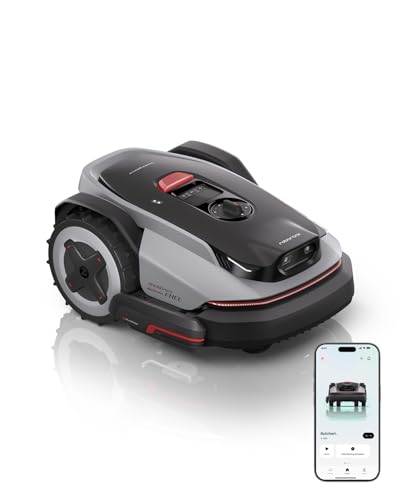
Pros
- Completely wire-free setup with flexible dual mapping modes for open or intricate lawns
- Reliable Full-Band RTK + VSLAM navigation that works in shaded and narrow 2.3 ft passages
- Intelligent AI vision obstacle avoidance that understands static and dynamic objects
- Strong slope handling up to 45% with adaptive floating cutting deck
- Full app control for multi-zone scheduling and live dashboard monitoring
Cons
- Edge-cutting module and 4G anti-theft tracking sold separately as optional accessories
- Maximum coverage limited to 1/4 acre which may not suit larger properties
- Advanced security and precision edge features require additional purchases for full capability
The Roborock RockNeo Q110H is a wire-free robotic lawn mower built for modern yards. It delivers a sturdy and intelligent first impression with dual-camera AI vision, large wheels, and a floating cutting deck that signals serious outdoor capability for residential use.
Performance centers on Full-Band RTK + VSLAM navigation that maintains accurate positioning under dense canopies, near fences, and through 2.3 ft passages. Stereo vision AI smartly avoids patio furniture, toys, humans and pets while rolling over low crossable obstacles. The floating deck adapts to ground contours, handling up to 45% slopes and 1.57-inch obstacles. Dual mapping modes (AI auto or app manual remote-style control) plus multi-zone scheduling and real-time progress tracking via the Roborock App support continuous unsupervised mowing across complex layouts up to 1/4 acre.
Drawbacks and considerations include the need to buy the optional cutting module for industry-leading 1.2-inch edge precision and the optional 4G module for advanced anti-theft tracking. Coverage is capped at 1/4 acre and advanced security features are not included out of the box, so buyers of larger or high-theft-risk properties should factor in extra cost.
The Roborock RockNeo Q110H delivers the most value to homeowners with medium-sized complex yards who want true wire-free convenience, reliable navigation in challenging conditions, and smart safety features. It is an excellent choice for those ready to invest in optional accessories for complete edge and security performance.
Comprehensive Auto Lawn Mowers Buyer’s Guide (2026)
Selecting the right auto lawn mowers requires a structured evaluation of several technical and practical criteria. The sections below break down the most important factors, with specific data points drawn from the top-rated models we analyzed. Before finalizing equipment decisions, refer to our comprehensive robotic lawn mower rtk vs vision boundary wire comparison.
1. Power Source and Drive Type
Auto Lawn Mowers fall into three main power categories: corded electric, cordless battery-powered, and fully autonomous robotic. Corded models like the LawnMaster MEB1114K deliver consistent 3,300 RPM output with zero battery degradation, making them reliable for small, bounded yards near a power outlet. Cordless models such as the Greenworks 40V 16-inch offer mobility with a 4.0Ah battery rated for up to one-third acre per charge, eliminating emissions and oil changes entirely. Robotic auto lawn mowers operate on rechargeable lithium-ion packs with automatic docking, meaning coverage per charge is the key metric rather than raw motor power.
Gas-powered options like the PowerSmart EasyCut with its 144cc OHV engine remain relevant for users who need reliable starts in variable weather and are comfortable with routine maintenance such as oil changes and air filter cleaning. The trade-off is higher noise output and ongoing fuel costs compared to electric alternatives. For broader ecosystem context, read through our operational guide on roborock rockmow x120h vs mammotion yuka mini 2.
2. Coverage Capacity and Lawn Size Matching
Matching mower coverage to your lawn size is the single most important specification check. Robotic auto lawn mowers in this review range from 1,000-2,000 sq ft (LawnMaster OcuMow) up to half an acre (WORX Landroid Vision Cloud). The YARDCARE robotic models cover up to one-eighth acre per charge, making them suitable for compact suburban lawns. Mid-range options like the eufy E15 handle up to 0.2 acres (approximately 8,700 sq ft), while the Segway Navimow i210 AWD covers up to one-quarter acre with a 5.1Ah battery yielding up to 2,690 sq ft per charge cycle. Always size up by at least 20 percent to account for obstacles, slopes, and multi-zone routing inefficiencies.
3. Navigation Technology: Boundary Wire vs. Wire-Free
Navigation technology is the defining differentiator among robotic auto lawn mowers. Boundary wire systems (used by YARDCARE models and the LawnMaster OcuMow’s magnetic strip variant) require physical installation of a perimeter guide around the lawn. This is a one-time setup task but demands accurate placement and can be disrupted by garden edging or lawn aeration. Wire-free systems use optical cameras, RTK GPS, or a combination of both. The ECOVACS Goat O1000 uses RTK for centimeter-level positioning with no wire burial. The WORX Landroid Vision Cloud pairs RTK Cloud navigation with AI-based V-SLAM sensor fusion for reliable operation even in shaded areas. The eufy E15 relies on pure stereo camera vision (V-FSD 1.0) with 0.2-meter precision zone mapping. Wire-free setups cost more upfront but eliminate installation labor and long-term wire maintenance. For troubleshooting and reliability insights, consult our in-depth ecovacs goat o1000 vs worx landroid s report.
For homeowners researching wire-free options specifically, our dedicated guide on self-mowing lawn mowers covers navigation technology in greater depth across a wider product set.
4. Slope Handling Capability
Slope rating is expressed as a percentage grade and is a hard technical limit, not a soft guideline. Exceeding a mower’s rated slope causes wheel slip, incomplete coverage, and potential tipping. Among the robotic models reviewed, the Segway Navimow i210 AWD leads with a 45 percent (24-degree) slope rating, enabled by its all-wheel-drive system with automotive-grade stability control. The WORX Landroid Vision Cloud handles up to 30 percent slopes. The eufy E15 is rated for slopes up to 18 degrees. Budget robotic options like the LawnMaster OcuMow handle 35 percent grades. If your yard has significant elevation changes, prioritize slope rating above most other specifications.
5. Cutting Width, Height Adjustment, and Blade System
Cutting width directly affects mowing efficiency. Wider decks cover more ground per pass but may struggle in narrow passages. The Greenworks 40V uses a 16-inch deck, the PowerSmart EasyCut an 18-inch steel deck, and the LawnMaster corded model a 14-inch deck. Robotic auto lawn mowers typically use smaller multi-blade disc systems. The YARDCARE models feature a triple-blade system with height adjustable from 0.8 to 2.4 inches. The Segway Navimow i210 offers a 7.1-inch cutting deck with height range of 2 to 3.6 inches. The LawnMaster MEB1114K provides five cutting positions between 1.4 and 3 inches. For mulching performance, finer clipping size from robotic multi-blade systems returns nutrients to the soil more effectively than single-blade push mowers. Readers comparing setup options can review our technical analysis on dreame a3 awd vs segway navimow i206.
6. Smart Features, App Control, and Security
App integration adds scheduling, zone management, and remote monitoring. The WORX Landroid Vision Cloud supports unlimited mowing zones with custom pathways and RadioLink connectivity for extended range beyond standard Wi-Fi. The Segway Navimow i210 manages up to 20 zones with real-time GPS anti-theft alerts. The eufy E15 includes built-in GPS tracking with automatic recall during rain or low-light conditions. Budget robotic models like the YARDCARE units offer basic app scheduling and IPX5 weather resistance but lack GPS anti-theft. The LawnMaster OcuMow operates without any app, using a simple push-button start, which suits users who prefer minimal digital overhead.
Comparison: Key Specifications Across Core Models
| Model | Coverage / Deck Width | Navigation Type | Max Slope | App Control |
|---|---|---|---|---|
| WORX Landroid Vision Cloud | 1/2 Acre | RTK Cloud + AI Vision | 30% | Yes (unlimited zones) |
| Segway Navimow i210 AWD | 1/4 Acre | 4G NetRTK, No Antenna | 45% | Yes (20 zones) |
| eufy Robot Lawn Mower E15 | 0.2 Acres | Pure Vision (V-FSD 1.0) | 18 degrees | Yes (GPS anti-theft) |
| ECOVACS Goat O1000 RTK | Multi-zone | RTK, No Wire | Not Specified | Yes (multi-zone) |
| LawnMaster OcuMow | 1,000-2,000 sq ft | Optical + Magnetic Strip | 35% | No (button start) |
| Greenworks 40V 16″ | 1/3 Acre (push) | Manual (push mower) | N/A | No |
Deck Width and App Control
Deck width and coverage, navigation type, maximum slope and app control make up the criteria here. The base data is drawn from manufacturer listings and Amazon product details, and customer ratings are noted when they show. Set side by side in the table, these columns let readers match features to the lawn they have in mind.
The Bottom Line on Robotic Lawn Mowers in 2026
Best Overall Auto Lawn Mowers: WORX Landroid Vision Cloud (WR320). For homeowners with up to half an acre and complex lawn shapes, the WORX Landroid Vision Cloud delivers the most complete feature set in this review group. Its RTK Cloud navigation requires no local antenna installation, AI obstacle avoidance processes up to 10 trillion operations per second for intelligent path correction, and the V-SLAM sensor fusion maintains centimeter-level accuracy in shaded areas where pure GPS falters. Support for parallel, checkerboard, and diamond mowing patterns adds a professional finish. The RadioLink connectivity extends reliable operation beyond standard Wi-Fi range, which is a practical advantage on larger properties.
Best Value / Budget Choice: LawnMaster MEB1114K Electric Corded Mower. At $679.99, the LawnMaster MEB1114K is the most accessible model in this set. Its 11-amp motor delivers 3,300 RPM, the 14-inch deck suits yards up to roughly 2,000 sq ft, and the 7-gallon collection bag reduces clipping disposal trips. Weighing only 28 lbs with fold-flat handles, it stores in minimal space. There are no batteries to replace, no fuel costs, and no oil changes. It is the correct choice for budget-conscious buyers with small, flat yards and access to an outdoor power outlet. For those considering other affordable mowing options, our walk-behind lawn mower category lists additional corded and cordless push models worth comparing.
Best for Steep Terrain and Full Automation: Segway Navimow i210 AWD. The Navimow i210 is the only all-wheel-drive robotic mower in this review set, rated for 45 percent slopes with automotive-grade stability control. Its built-in 4G with NetRTK technology eliminates the need for a separate GNSS antenna or base station, and one-tap auto mapping delivers centimeter-accurate positioning wherever a 4G signal is available. The zero-turn triple-wheel steering system avoids grass tearing on direction changes. At the top of the price range, it is built for buyers who need maximum slope capability and fully autonomous operation with minimal manual intervention. For those exploring the broader robotic mower market, our robotic mower comparison hub covers additional models across price tiers.
What is the difference between boundary wire and wire-free auto lawn mowers?
Boundary wire models require you to install a physical perimeter cable around your lawn to define the mowing area, while wire-free models use GPS, RTK, optical cameras, or magnetic strips to navigate without buried cables. Wire-free systems cost more upfront but eliminate installation labor and the risk of wire damage from aeration or edging. Models like the WORX Landroid Vision Cloud and eufy E15 use wire-free RTK or vision-based navigation, while the YARDCARE robotic mowers and LawnMaster OcuMow use boundary wire or magnetic strip setups.
How do I choose the right auto lawn mowers for my lawn size?
Match the mower’s rated coverage capacity to your lawn size and add a 20 percent buffer for obstacles, slopes, and multi-zone routing. For lawns under 2,000 sq ft, the LawnMaster OcuMow or YARDCARE robotic models are sufficient. For one-quarter to one-half acre, consider the Segway Navimow i210 or WORX Landroid Vision Cloud. Push mowers like the Greenworks 40V cover up to one-third acre per charge and are suitable for users who prefer manual operation. You can compare coverage specs side by side in our Roomba for grass guide, which benchmarks robotic mower efficiency across yard sizes.
Are auto lawn mowers safe around children and pets?
Most robotic auto lawn mowers include bump sensors, ultrasonic obstacle detection, or AI-based 3D perception to detect and avoid objects, including pets. The eufy E15 uses a stereo camera and Vision SLAM system to identify low obstacles like toys and re-route accordingly. The WORX Landroid Vision Cloud’s neural network processes obstacle data in real time. That said, no autonomous mower should be treated as a substitute for supervised outdoor environments when young children or pets are present. Always review the specific safety sensor specifications of any model before purchase.
Do robotic auto lawn mowers work in the rain?
Most robotic auto lawn mowers in this review set include weather sensors that trigger an automatic return to the charging station when rain is detected. The YARDCARE models carry an IPX5 weather-resistance rating, meaning they can handle water jets from any direction but are not submersible. The eufy E15 also auto-recalls during rain or low-light conditions. Mowing wet grass is generally discouraged as it can clog blades, compact soil, and produce uneven cuts regardless of mower type.
What ongoing maintenance do auto lawn mowers require?
Robotic auto lawn mowers require periodic blade replacement (typically every 1-3 months depending on lawn size and grass density), cleaning of sensors and camera lenses, and occasional software updates via the companion app. The ECOVACS Goat O1000 RTK Care Kit bundles 36 replacement blades to reduce maintenance frequency and cost. Cordless push mowers like the Greenworks 40V are described as virtually maintenance-free with no gas, oil, or emissions. Gas-powered models like the PowerSmart EasyCut require oil changes, air filter checks, and spark plug inspections on a seasonal schedule.
Safety Basics for Auto Mowers
Auto lawn mowers can run while nobody is watching, so setting safe boundaries and checking sensors should come first. A useful starting point for general safety information is the American National Standards Institute (ANSI).