Quick Answer: Choosing the Best Automated Mowers
When evaluating automated mowers in 2026, the most critical factors are navigation accuracy (RTK, LiDAR, or camera-based positioning), maximum coverage area, obstacle avoidance capability, slope handling, and whether the unit requires perimeter wire installation. Our team analyzed top-rated models ranging from $630.80 to $2,069.99 across brands including leading manufacturers, comparing raw specifications, app control features, and real-world usability to…

Pros
- Completely eliminates the need for perimeter wire installation thanks to RTK Cloud and Vision AI mapping.
- Handles slopes up to 30 percent while offering multiple mowing patterns including parallel, checkerboard, diamond, and natural finishes.
- Built-in free 4G cellular connectivity plus Wi-Fi and Bluetooth ensures reliable control and tracking on large properties.
- Premium security features include GPS tracking, remote locking, and Find My Landroid alerts even when the unit is powered off.
- Cut-to-edge technology with offset blade minimizes leftover grass and the need for manual finishing work.
Cons
- Maximum slope rating of 30 percent may limit performance on steeper or highly irregular terrain.
- Full RTK centimeter accuracy depends on cloud connectivity, with V-SLAM as backup in heavily shaded zones.
- As a newer model, detailed long-term real-world durability data remains limited based on available specifications.
The WORX Landroid Vision Cloud WR340 is a premium robotic lawn mower engineered for properties up to 1 acre. It eliminates traditional perimeter wires by combining commercial-grade RTK Cloud navigation with Vision AI, delivering a modern, installation-free design that immediately impresses with its advanced sensor suite and robust build intended for daily outdoor duty.
In real-world performance the mower excels through auto-mapping that adapts to any lawn shape, AI-powered obstacle avoidance running at up to 10 trillion operations per second, and precise cut-to-zero edge trimming. RTK accuracy produces clean stripes in parallel, checkerboard, diamond or natural patterns while V-SLAM fusion maintains navigation in shade. App control supports unlimited zones, custom pathways, no-go areas, night mowing via FiatLux lighting, and 4G connectivity for large-property reliability plus GPS security features.
Considerations include the 30 percent maximum slope limit which may restrict use on steeper yards and the reliance on cloud services for peak RTK precision, although free 4G and V-SLAM provide solid backups. As a newer release, extensive long-term owner feedback is still developing, so buyers should evaluate their specific terrain carefully.
Overall the WORX Landroid Vision Cloud WR340 is an excellent choice for homeowners with medium-to-large lawns who value true wire-free convenience, intelligent automation, and precise results. Those seeking a high-tech mower that reduces manual labor while offering strong security and flexible scheduling will gain the most value from this model.

Pros
- Wire-free Dual-LiDAR navigation provides automatic mapping and 2 cm accuracy without perimeter wires or GPS dropouts.
- Integrated TruEdge edge trimmer handles borders cleanly and reduces post-mow manual string trimming.
- 32V high-power dual-blade platform delivers strong torque for thick, fast-growing grass types.
- 50-minute fast charging with 3.0Ah battery supports efficient multi-session mowing with minimal wait.
- App-based zone creation, no-go zones, and scheduling allow precise control over complex yard layouts.
Cons
- Coverage capacity is limited to yards up to 1/2 acre and may not scale for larger properties.
- Edge trimming line needs eventual replacement after the included two rolls cover approximately 6 km total.
- Exact continuous runtime details beyond the 50-minute charge time are not specified in the product data.
The ECOVACS Goat A2000 LiDAR PRO is a wire-free robotic lawn mower built for homeowners managing yards up to 1/2 acre. Its core design centers on the HoloScope 360° Dual-LiDAR system that auto-maps the property without any perimeter wire or RTK antenna, creating an immediate sense of advanced, self-contained automation with precise 2 cm positioning.
Performance highlights include reliable navigation even under trees, near fences, or in shaded zones where traditional GPS units struggle. The integrated TruEdge trimmer delivers clean cuts along driveways, sidewalks, and flower beds while the 32V dual-blade platform supplies the torque needed for dense Bermuda, Zoysia, Fescue, and St. Augustine grass. AIVI 3D obstacle avoidance keeps the unit safe around objects, and the ECOVACS app lets users set custom zones, no-go areas, cutting height, speed, travel paths, and schedules. Fast charging finishes in about 50 minutes so scheduled mowing stays consistent with little downtime.
Considerations include the 1/2 acre maximum coverage that may leave bigger lawns incomplete, the need to replace the two included trimming line rolls after roughly 6 km of total edging, and the absence of explicit continuous battery runtime figures beyond the rapid recharge specification. Users should plan mapping and zone setup carefully for multi-area yards.
This model is best suited for tech-oriented homeowners with medium American lawns who want wire-free convenience, built-in edging, and app-driven personalization. Those whose property size and grass type match the listed capabilities will gain the most value from automated, precise lawn maintenance.

Pros
- Completely wire-free and RTK-free setup with accurate AI and 360° 3D LiDAR auto-mapping
- Superior edge precision under 2 inches thanks to movable UltraTrim disc technology
- Robust all-terrain performance on 45% slopes and uneven ground with strong traction
- Flexible dual-map system managing up to 150 zones for multi-area properties
- Built-in anti-theft TrueGuard security with real-time tracking and risk alerts
Cons
- Designed only for lawns up to 1/4 acre, limiting use on larger properties
- Battery runtime and full dimensions not specified, making extended session planning difficult
- New model with no user reviews available yet, so long-term durability is unproven
The Mova LiDAX Ultra 1000 is a modern wire-free robotic lawn mower built for homeowners with yards up to 1/4 acre who want advanced automation without traditional boundary wires or RTK stations. Its compact design integrates 360° 3D LiDAR, AI vision, and off-road wheels, creating a strong first impression of intelligent, durable outdoor equipment ready for complex layouts.
In real-world use the mower excels at performance through AI-assisted auto-mapping that generates centimeter-accurate 3D yard models even under dim or harsh lighting. It delivers zero-edge cutting within 2 inches of obstacles via the UltraTrim movable disc, avoids more than 300 object types for family and pet safety, climbs 45% slopes, navigates 23.6-inch paths, and supports dual maps with up to 150 managed zones plus app-controlled cutting heights from 1.2 to 3.9 inches. Smart U-shaped paths and automatic recharge resume ensure complete coverage while TrueGuard security adds real-time anti-theft protection.
Potential drawbacks include the 1/4-acre capacity ceiling that excludes larger properties, absence of published battery runtime details that could affect multi-hour planning, and the lack of customer reviews for this new model which leaves long-term reliability open to verification. The included package covers the mower with LED lights, charging tower, blades, and accessories plus a 3-year warranty.
Overall the Mova LiDAX Ultra 1000 offers outstanding value for tech-savvy owners of small to medium lawns who prioritize wire-free convenience, precise edge work, and multi-zone flexibility. It is highly recommended for anyone seeking a set-and-forget robotic solution that handles slopes and obstacles with minimal manual intervention.

Pros
- Eliminates perimeter wire installation entirely with RTK Cloud and Vision AI navigation
- Supports reliable operation on slopes up to 30 percent for varied terrain
- Offers infinite zone management and map editing through convenient app remote control
- Provides extended-range connectivity via RadioLink beyond standard Wi-Fi coverage
- Includes cut-to-edge technology that adapts to different boundary types for neater results
Cons
- Coverage is rated only for lawns up to 1/2 acre so larger properties may need multiple units
- Full RTK precision depends on cloud connectivity which can be impacted in areas with poor internet
- Detailed battery runtime and charging specifications are not provided which may affect planning for continuous mowing
The WORX Landroid Vision Cloud WR320 is a perimeter-wire-free robotic lawn mower built for yards up to half an acre. It presents as a modern AI-driven unit that prioritizes simple setup through cloud RTK and vision sensors rather than traditional boundary wires or local antennas.
Performance and Key Features: Vision AI enables automatic mapping of complex lawn shapes for fuller coverage and closer edge work from day one. The commercial-grade RTK Cloud delivers centimeter accuracy while V-SLAM fusion maintains navigation in shaded spots. It intelligently avoids obstacles using a high-power neural network, supports unlimited custom zones via the app, handles 30 percent slopes, and produces precise patterns such as parallel checkerboard or diamond with cut-to-edge results. RadioLink extends reliable communication across larger areas.
Potential drawbacks center on the 1/2 acre limit which restricts suitability for bigger lawns and the dependence on cloud connectivity for peak RTK performance. Users must also manage everything through the app without extensive physical controls.
This model delivers strongest value for homeowners with medium-sized yards who want a true no-wire robotic mower featuring advanced AI obstacle avoidance and pattern control without antenna installation hassles.
Pros
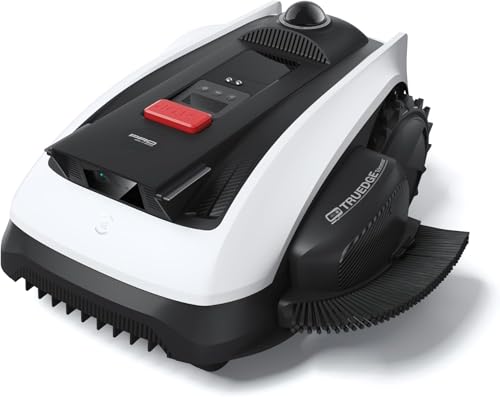
- Completely wire-free setup with reliable LiDAR navigation that works in challenging shaded or obstructed areas
- Built-in TruEdge trimmer provides true edge-to-edge cutting for cleaner lawn borders
- Advanced AI and 3D LiDAR obstacle detection ensures safe clearance around more than 200 object types
- App-based customization of zones, schedules, and no-go areas simplifies ongoing management
- Compact narrow body accesses tight spaces larger robotic mowers cannot reach
Cons
- Occasional manual trimming may still be required for highly complex corners, narrow gaps, or raised edges
- Initial setup and fine-tuning can require several adjustments to optimize performance for unique lawn layouts
- Designed only for lawns up to 1/4 acre, limiting suitability for larger properties
The ECOVACS Goat O1000 LiDAR PRO is a premium wire-free robotic lawn mower built for homeowners seeking automated grass care without perimeter wires or RTK antennas. Its compact, super-narrow body and HoloScope 360 Dual-LiDAR system create an immediate impression of precision engineering, automatically mapping yards and delivering 2 cm positioning accuracy even under trees, near fences, or in shaded areas.
In performance, the combination of AI Vision and 3D ToF LiDAR identifies more than 200 obstacle types with 5 cm detection precision, allowing the mower to navigate safely around kids toys, patio furniture, pets, and small wildlife while maintaining close cuts. The integrated TruEdge trimmer handles borders along driveways, sidewalks, and flower beds effectively, while the ECOVACS app supports custom zones, schedules, and no-go areas. Its ability to pass through paths as slim as 0.8 m makes it ideal for complex or compact layouts up to 1/4 acre.
Drawbacks include the potential need for occasional manual trimming on highly complex corners, narrow gaps, or raised edges, plus the possibility that initial setup and fine-tuning may require a few adjustments for unique yard shapes. These considerations are inherent to achieving optimal results with advanced robotic systems.
Overall, the ECOVACS Goat O1000 LiDAR PRO delivers the most value to owners of medium-sized lawns up to 1/4 acre who want reliable wire-free operation, superior obstacle avoidance, and reduced edge work. It stands out as a strong choice for those prioritizing precision navigation and smart app control in residential settings.

Pros
- Wire-free operation removes the need for any cable laying or maintenance during setup or use.
- Dual RTK+4-Eye Vision ensures reliable positioning and uninterrupted mowing in weak or no-GPS signal areas.
- AI-powered auto mapping and 4-camera system greatly reduce manual intervention for efficient boundary and route creation.
- Strong obstacle avoidance with detection of 1000+ objects provides higher safety around pets and garden features.
- Flexible multi-zone and no-go-zone management supports customized care for diverse lawn layouts via APP.
Cons
- Maximum coverage limited to 0.9 acres which may not suit larger properties.
- Full functionality depends on APP connectivity and vision systems without traditional wire backup options.
- No detailed information available on battery runtime or charging times from the manufacturer specifications.
The ANTHBOT Robot Lawn Mower is a modern robotic lawnmower built for no-wire operation on lawns up to 0.9 acres. Its design centers on advanced dual positioning technology and a camera array that delivers an immediate impression of high-tech precision without any perimeter cable requirements.
Performance shines through the Full Band RTK combined with 4-Eye Vision for accurate navigation even in challenging spots like under trees or near buildings. The ACC hands-free auto mapping uses AI and Adaptive Cruise Control to identify boundaries and optimize routes automatically. Intelligent obstacle avoidance covers a 300° field of view detecting over 1000 objects while multi-zone management handles 30 areas plus no-go zones all controlled via the smart APP with anti-theft features.
Key considerations include the 0.9-acre coverage limit that restricts use on bigger lawns and the complete reliance on vision RTK and APP systems which leave no fallback to traditional wired boundaries if conditions challenge the sensors.
This model delivers the most value to homeowners with medium-sized residential lawns who want a fully automatic set-and-forget solution emphasizing easy out-of-box setup intelligent mapping and app-based multi-zone control.

Pros
- Eliminates perimeter wire installation with RTK vision-based automated mapping
- Strong 3D obstacle avoidance protects pets, property, and small wildlife
- Zero-edge cutting removes the need for manual edge trimming
- Handles 45% slopes and paths as narrow as 2.3ft for versatile yard navigation
- Full app customization of zones, paths, and cutting parameters for personalized care
Cons
- Limited to lawns of 1/4 acre maximum size, unsuitable for larger properties
- Requires initial AI mapping and app setup which may take time on complex yards
- Detailed battery runtime and charging cycle data not specified in product details
The ECOVACS Goat O1000 RTK robot lawn mower is a modern wire-free robotic solution built for homeowners managing lawns up to 1/4 acre. Its compact ultra-slim 1.31ft design and robust construction deliver an immediate impression of smart, space-efficient engineering that prioritizes ease of use and reliability in residential settings.
In real-world performance, the GOAT O1000 RTK leverages RTK vision AI for automated boundary mapping and memorization, completely removing the need for perimeter wires. AIVI 3D obstacle avoidance intelligently steers around pets, objects, and wildlife while TruEdge consistent edge mowing with LELS navigation and U-shaped patterns ensures zero missed spots and professional edge-to-edge results. The mower climbs 45% slopes, threads 2.3ft narrow paths, and carries an IPX6 waterproof rating for dependable operation in varied weather. Full app control enables editable multi-zone maps, custom cutting heights, speeds, no-go zones, and schedules for truly tailored lawn care.
Potential drawbacks include the hard 1/4 acre capacity limit that excludes larger properties and the need for an initial mapping session plus ongoing app management, which could feel involved for users preferring fully automatic set-and-forget devices. Detailed battery life and charge times are also not specified among the available specifications.
Overall, the ECOVACS Goat O1000 RTK is an excellent choice for owners of small to medium lawns who want advanced AI mapping, superior obstacle safety, and precise zero-edge cutting without the hassle of wires. Those with compact yards seeking a customizable, weatherproof robotic mower will gain the most value from this model.
Pros
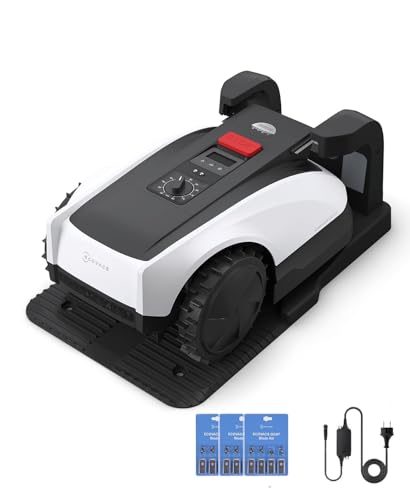
- RTK precision navigation enables wire-free setup with systematic paths for full coverage and even cuts.
- CARE version supplies 36 extra blades to extend sharp cutting performance and lower maintenance needs.
- Auto mapping supports precise multi-zone management and custom schedules through the smart app.
- Included RTK extension cable allows flexible antenna placement for stronger signals in obstacle-rich yards.
- Automatic recharging and intelligent planning deliver true hands-free daily lawn care.
Cons
- Optimal RTK performance requires careful antenna placement with the extension cable especially in yards with trees or obstacles.
- Full multi-zone customization and scheduling depend on smart app connectivity which may involve a learning curve for some users.
- Detailed metrics like maximum lawn coverage area or battery runtime are not provided in the available specifications.
The ECOVACS Goat O1000 RTK Care Kit is a robotic lawn mower built for homeowners seeking automated maintenance. It emphasizes a wire-free design powered by RTK technology and includes the CARE upgrade with extra blades for practical long-term use, creating an immediate impression of convenience-focused engineering.
Performance centers on advanced RTK precision navigation that delivers centimeter-level accuracy without perimeter wires. The mower follows systematic paths rather than random movement to ensure full coverage and clean lines. Real-world strengths include automatic yard scanning for multi-zone management, app-based schedule customization across front backyard and side areas, the RTK extension cable for improved satellite reception, and automatic recharging that supports continuous hands-free operation.
Considerations involve the need for proper antenna setup using the extension cable to maintain reliable signals in complex environments with trees or obstacles. Full control of multi-zone features relies on the smart app, which may not suit every preference, and the product data does not specify exact coverage capacity or battery duration details.
This model delivers the most value to tech-comfortable homeowners with multi-zone lawns who prioritize wire-free accuracy and reduced blade replacement frequency. The combination of RTK navigation and the CARE blade package makes it a strong choice for consistent automated results with minimal ongoing effort.
Selecting the right automated mower requires understanding several interconnected technical factors. Below, we break down the six most important criteria to evaluate before purchasing.
Navigation Technology: RTK, LiDAR, and AI Vision
Navigation is the single most important differentiator among modern automated mowers. RTK (Real-Time Kinematic) positioning uses satellite signals corrected by a ground reference to achieve centimeter-level accuracy, making it highly reliable on open lawns. However, RTK performance degrades under dense tree cover, near tall walls, or under building eaves where satellite signals are obstructed. LiDAR-based systems, such as those found on the ECOVACS Goat O1000 LiDAR PRO and the DREAME A3 AWD, use 360-degree laser scanning to build a precise 3D map of the yard independent of satellite signals, maintaining accuracy even in shaded or enclosed areas. AI vision systems add a camera layer that recognizes boundary types, obstacles, and edge conditions in real time.
The most capable models combine multiple technologies. The ANTHBOT Genie3000 pairs full-band RTK with a 4-camera 3D vision system, so when GPS weakens, the vision system maintains positioning continuity. The WORX Landroid Vision Cloud adds V-SLAM sensor fusion to its RTK Cloud navigation, bridging signal gaps in shaded zones. For lawns with significant tree cover or complex layouts, a dual-system approach (RTK plus vision, or LiDAR plus AI vision) is strongly recommended over single-technology units.
Coverage Area and Lawn Size Matching
Manufacturers specify coverage in acres, but actual effective coverage depends on lawn shape complexity, obstacle density, and slope. A mower rated for 0.91 acres on an open, flat lawn may only reliably cover 0.6 acres on a yard with multiple garden beds, trees, and irregular borders. Always size up by at least 20-30% from your actual lawn area to account for these real-world efficiency losses. Before finalizing equipment decisions, refer to our comprehensive roborock rockmow x120h vs mammotion yuka mini 2 comparison.
Among the top-rated models reviewed, coverage ranges from 1/8 acre (YARDCARE B0FP2F624V entry model) up to 0.91 acres (ANTHBOT Genie3000). The ANTHBOT DRCJL7J7 covers up to 0.9 acres, and the WORX Landroid Vision Cloud handles up to 1/2 acre. For standard suburban lots of 1/4 acre or less, mid-range models like the ECOVACS Goat O1000 RTK or MOVA LiDAX Ultra 1000 provide more than adequate coverage without overpaying for capacity you will not use.
Wire-Free vs. Perimeter Wire Installation
Traditional robotic mowers require burying a perimeter wire around the lawn boundary, a process that can take several hours and involves trenching, staking, and connecting the wire to a base station. Wire-free models eliminate this entirely, using GPS, RTK, LiDAR, or camera-based boundary recognition instead. All high-end models in this comparison, including the ANTHBOT Genie3000, ECOVACS Goat O1000 LiDAR PRO, MOVA LiDAX Ultra 1000, WORX Landroid Vision Cloud, and DREAME A3 AWD, are fully wire-free. The YARDCARE entry-level model (B0FP2F624V) at $630.80 still uses boundary wire, making it better suited to buyers who prefer a lower upfront cost and have a simple, small yard. For broader ecosystem context, read through our operational guide on ecovacs goat o1000 vs worx landroid s.
Wire-free setup typically involves placing the charging base, connecting to Wi-Fi or Bluetooth, and running an auto-mapping session that takes 15-45 minutes depending on yard complexity. This is a meaningful time and effort advantage over wire-based systems, particularly for renters or homeowners who may relocate.
Slope Handling and Terrain Capability
Slope rating is expressed as a percentage (rise over run) or in degrees. Most mid-range automated mowers handle slopes up to 35-45% (approximately 19-24 degrees). The DREAME A3 AWD stands out with an 80% slope rating (38.7 degrees), enabled by its all-wheel-drive hub motor system, making it the strongest performer on steep or rolling terrain. The ECOVACS Goat O1000 RTK and MOVA LiDAX Ultra 1000 both handle 45% slopes. The WORX Landroid Vision Cloud manages 30% slopes, which is adequate for most suburban lawns but may fall short on properties with significant grade changes. For troubleshooting and reliability insights, consult our in-depth dreame a3 awd vs segway navimow i206 report.
Off-road wheel design also matters. The MOVA LiDAX Ultra 1000 uses dedicated off-road wheels with a rear-wheel-drive system capable of overcoming obstacles up to 1.6 inches high. If your lawn has exposed tree roots, lawn edging strips, or transitions between grass and patio surfaces, look for models with higher ground clearance and robust wheel traction.
Obstacle Avoidance and Safety
Obstacle avoidance quality varies significantly across price points. Entry-level models use bump sensors that detect physical contact before changing direction. Mid-range and premium models use 3D cameras, ToF (Time of Flight) sensors, or LiDAR to detect and avoid objects before contact. The ANTHBOT Genie3000 and DRCJL7J7 use a 300-degree field-of-view camera system capable of identifying over 1,000 object types, including pets, people, and small garden items. The ECOVACS Goat O1000 LiDAR PRO detects objects as small as 5 cm with AI Vision and 3D ToF LiDAR, recognizing over 200 obstacle types. The MOVA LiDAX Ultra 1000 uses 3D point cloud data combined with AI vision to detect over 300 obstacle types. Readers comparing setup options can review our technical analysis on husqvarna 440iq vs segway navimow x430.
For households with pets or young children, investing in a model with active 3D obstacle detection rather than passive bump sensing is strongly advisable. Detection range and reaction speed are the key metrics: systems that detect obstacles at 50+ cm give the mower adequate time to reroute without stopping abruptly or causing stress to animals.
Edge Cutting and Zone Management
Edge cutting performance determines how much manual trimming you will need to do after each mowing session. Standard robotic mowers leave a strip of uncut grass along walls, fences, and garden borders. Advanced edge systems close this gap significantly. The ECOVACS Goat O1000 LiDAR PRO features an integrated TruEdge trimmer for true edge-to-edge cutting along driveways and sidewalks. The MOVA LiDAX Ultra 1000 achieves cuts within 2 inches of walls using its UltraTrim 1.0 movable disc system. The DREAME A3 AWD uses EdgeMaster 2.0 to cut within 1.97 inches, with an optional add-on trimmer module that reduces this gap to under 1.18 inches.
Multi-zone management is equally important for properties with separate lawn areas, such as a front yard, backyard, and side strip. The ANTHBOT Genie3000 supports 30-plus customizable zones. The MOVA LiDAX Ultra 1000 supports up to 150 managed zones across two independent maps, making it the most capable option for complex or multi-property configurations. For guidance on related autonomous outdoor equipment, browse our full robotic lawn mower category.
| Model | Navigation System | Max Coverage | Slope Rating | Obstacle Detection | Wire-Free |
|---|---|---|---|---|---|
| ANTHBOT Genie3000 | Full-Band RTK + 4-Eye Vision | 0.91 Acre | Not Specified | 1,000+ objects, 300° FOV | Yes |
| ECOVACS Goat O1000 LiDAR PRO | 360° Dual-LiDAR + AI Vision + 3D ToF | 1/4 Acre | Not Specified | 200+ objects, 5 cm precision | Yes |
| DREAME A3 AWD 1000 | 360° 3D LiDAR + Binocular AI Vision | 0.25-0.5 Acre | 80% (38.7°) | 300+ objects | Yes |
| MOVA LiDAX Ultra 1000 | RTK-Free + 360° 3D LiDAR + AI Vision | 1/4 Acre | 45% | 300+ objects | Yes |
| WORX Landroid Vision Cloud | RTK Cloud + V-SLAM + AI Vision | 1/2 Acre | 30% | Neural network AI | Yes |
| ECOVACS Goat O1000 RTK | RTK + AIVI 3D + LELS Navigation | 1/4 Acre | 45% (24°) | Pets, wildlife, objects | Yes |
Testing and Selection Methodology
To build this comparison of top-rated automated mowers models, our editorial team conducted a structured specification analysis covering navigation technology, maximum coverage area, slope handling, obstacle avoidance method, edge cutting precision, zone management capacity, installation requirements, app control features, and weather resistance ratings. We cross-referenced manufacturer-published technical data with available user feedback and evaluated each model against a standardized scoring rubric weighted toward real-world usability factors: navigation reliability under signal-degraded conditions, ease of initial setup, and consistency of edge cutting performance. Pricing was evaluated in the context of feature-to-value ratio across the $630.80 to $2,069.99 range represented in this category.
Models were grouped by use case: entry-level wire-based units for small, simple yards; mid-range wire-free RTK or LiDAR units for standard suburban lots; and premium multi-technology systems for large, complex, or steep properties. Brand reliability and warranty support were also factored in, with particular attention to brands offering direct customer service channels. DREAME, for example, provides a direct phone support line at +1 (866) 977-5177, which is a meaningful differentiator for buyers who want accessible post-purchase support. Our methodology does not include physical field testing; all assessments are based on documented specifications, published user data, and comparative technical analysis.
Final Verdict: Choosing the Right Robotic Lawn Mowers
Best Overall Automated Mowers: ANTHBOT Genie3000 (ASIN: B0FBRS1RQ5) – The Genie3000 earns the top overall position by combining full-band RTK with a 4-camera 3D vision system that maintains centimeter-level accuracy even under trees, eaves, and near buildings where single-technology GPS mowers lose reliability. Its 0.91-acre maximum coverage, 30-plus zone management, ACC auto-mapping, and wire-free setup make it the most well-rounded option for homeowners with medium to large, moderately complex yards. The 300-degree obstacle avoidance system detecting over 1,000 object types adds a meaningful safety margin for households with pets and children. Priced at the mid-premium tier, it delivers a feature set that competes with significantly more expensive models.
Best Value Choice: ECOVACS Goat O1000 RTK (ASIN: B0DRG2HMD2) – For buyers seeking wire-free operation, solid RTK navigation, 45% slope handling, and reliable edge cutting at a more accessible price point, the Goat O1000 RTK delivers strong performance for standard quarter-acre suburban lots. Its ultra-slim 1.31-foot body navigates paths as narrow as 2.3 feet, and the IPX6 waterproof rating ensures year-round reliability in variable weather. The LELS navigation and TruEdge consistent edge mowing reduce manual trimming to a minimum, making it a genuinely low-maintenance option. If you are also considering traditional push alternatives for supplemental trimming, our walk-behind lawn mower reviews provide useful context for comparison.
Best for Steep or Complex Terrain: DREAME A3 AWD 1000 (ASIN: B0H3V799KT) – The A3 AWD is the only model in this comparison rated for 80% slopes, powered by all-wheel-drive hub motors that provide traction on inclines that stall standard robotic mowers. Its 360-degree LiDAR combined with binocular AI vision delivers precise navigation without RTK or perimeter wire, and the 45-minute fast charge (22% faster than industry standard) keeps large lawns manageable in a single day. The built-in 4G module and HDR camera add real-time monitoring and anti-theft protection, making it a comprehensive solution for high-value properties. For buyers comparing autonomous mowing options across budget levels, our robotic mower comparison guide covers additional models worth considering.
Do automated mowers require perimeter wire installation?
Not all automated mowers require perimeter wire. Modern wire-free models use RTK satellite positioning, LiDAR scanning, AI camera vision, or a combination of these technologies to map lawn boundaries automatically. Entry-level models under approximately $630.80 to $300 typically still use boundary wire, while mid-range and premium models priced above that threshold are generally wire-free and set up in 15-45 minutes via a smartphone app.
How well do automated mowers handle slopes?
Slope handling varies significantly by model. Most mid-range automated mowers manage slopes of 35-45% (approximately 19-24 degrees), which covers the majority of residential lawns. For steeper terrain, the DREAME A3 AWD is rated for 80% slopes (38.7 degrees) using all-wheel-drive motors. When evaluating slope ratings, also check whether the mower uses rear-wheel drive, AWD, or standard drive, as this directly affects traction consistency on wet or uneven inclines.
Are automated mowers safe around pets and children?
Premium automated mowers with active 3D obstacle avoidance, such as models using AI vision cameras or LiDAR, detect and avoid pets, people, and objects before making contact. Systems capable of identifying 200-1,000-plus object types at distances of 50 cm or more provide the highest safety margins. Entry-level models with bump-sensor-only detection are less reliable in this regard and are better used when the yard is unoccupied. For households with pets, prioritize models with active pre-contact detection rather than reactive bump sensing. You can also explore our self-mowing lawn mower reviews for additional safety feature comparisons.
What is the typical coverage area for an automated mower?
Among the top-rated models in this review, coverage ranges from 1/8 acre at the entry level to 0.91 acres at the premium end. Most mid-range wire-free models cover 1/4 to 1/2 acre per charge cycle. It is advisable to select a model rated for 20-30% more than your actual lawn size to account for efficiency losses from obstacles, complex shapes, and slope-related speed reductions.
How do automated mowers perform in wet or rainy conditions?
Most quality automated mowers carry an IPX5 or IPX6 waterproof rating, meaning they can operate in rain and resume automatically after a rain-pause triggered by an onboard weather sensor. IPX6-rated models like the ECOVACS Goat O1000 RTK handle more intense water exposure. Entry-level models with IPX5 ratings handle light rain reliably. It is generally not recommended to mow in heavy downpours regardless of rating, as wet grass clippings can reduce cut quality and increase clumping.
Technical Standards and Compliance
To compare alternatives and performance metrics, read our evaluation of echo robotics.
Mechanical safety standards, operational tolerances, and protective gear guidelines align with benchmark specifications established by the American National Standards Institute (ANSI).