Quick Answer: Choosing the Best Autonomous Lawn Mowers
When choosing autonomous lawn mowers in 2026, prioritize navigation technology (vision AI, RTK-GPS, or 360° LiDAR for wire-free mapping), maximum coverage area, slope handling percentage, adjustable cutting height range, and safety sensors for obstacle avoidance. Evaluating these criteria across top-rated models ensures you select a unit that matches your property size and terrain while delivering consistent performance. For additional…
Pros
- Handles yards up to 6 acres without perimeter wires for flexible large-scale autonomous coverage.
- Advanced RTK AI vision and multi-sensor navigation ensure accurate obstacle avoidance on complex sites.
- Strong dual-motor cutting system with dual blade choices and wide height range tackles varied grass conditions effectively.
- Multi-terrain tracks enable stable performance on steep uneven muddy or stony ground up to 35 degrees.
- Modular construction suits premium applications like luxury hotels turf farms and expansive residential properties.
Cons
- Product weighs approximately 210 lbs and ships in four separate boxes requiring two adults for assembly.
- Remote control is sold separately increasing the total cost of a complete setup.
- Installation demands a 120 degree unobstructed sky view for the Data Center Set to operate correctly.
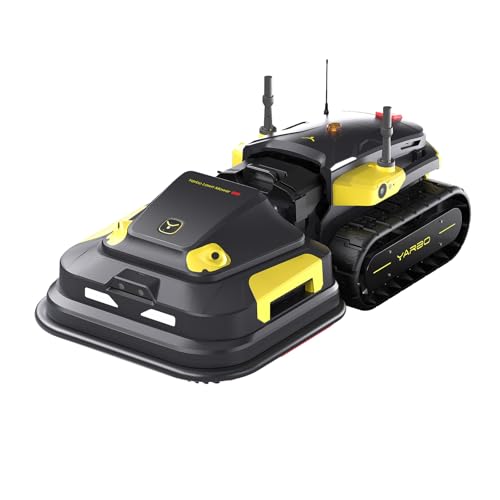
The YARBO Robot Lawn Mower Pro is a premium modular robotic lawn mower built for large yards covering up to 6 acres. Its robust construction features multi-terrain tracks and all-steel skid shoes that convey durability suitable for homes, golf courses, luxury hotels, and turf farms. Immediate impressions highlight a design focused on autonomy and adaptability rather than basic residential use.
Performance centers on a 300W dual-motor cutting system that resists clogging through optimized disc and ejection design, allowing longer sessions even in thick wet grass. Dual blade options support cool-season and warm-season varieties while the 0.8 to 4.0 inch height range and triple-fusion navigation with RTK-GPS binocular vision and multi-sensor PPVS deliver precise wire-free pathing and obstacle detection including suspended items. Tracks enable reliable operation on slopes up to 35 degrees and uneven or stony ground.
Key considerations include the substantial weight of about 210 lbs that ships across four boxes and needs two adults for assembly. The remote control is not included and must be purchased separately. Successful setup also requires a clear 120 degree sky view for the Data Center Set which may limit placement options in densely covered areas.
This mower provides strong value for owners of expansive or challenging properties who need reliable low-effort autonomous care. It is best suited to premium users managing large or complex lawns where advanced navigation terrain capability and modular flexibility outweigh simpler lighter residential alternatives.

Pros
- Covers expansive areas up to 6 acres without any perimeter wire installation
- Handles steep inclines up to 70% slopes thanks to patented all-terrain tracks
- Modular platform enables multi-season use beyond just mowing
- Wide 20-inch cutting deck with adjustable height for tailored professional results
- Advanced AI Vision and RTK navigation for precise autonomous pathing
Cons
- Leaf blower and snow blower modules must be purchased separately
- Heavy unit at approximately 200 lbs ships in 4 boxes and requires two adults for assembly
- Installation of the Data Center Set needs a 120 degree unobstructed sky view for optimal RTK performance
The YARBO Robot Lawn Mower stands out as a premium robotic solution built specifically for large properties. Its modular chassis and all-terrain tracks create an immediate impression of robust, purpose-built engineering ready for serious yard work without the usual wire boundaries.
Performance and key features shine through real-world capability. The mower manages up to 6.2 acres using AI Vision and RTK navigation, a 20-inch cutting deck, and adjustable heights from 1.2 to 4.0 inches. With 120 minutes of runtime and auto recharging, it follows scheduled routes efficiently. The patented tracks confidently tackle 70% slopes, uneven ground, and ditches that defeat most competitors, while the modular system allows future expansion into leaf and snow modules.
Drawbacks and considerations include the need to buy leaf blower and snow blower modules separately. The unit weighs about 200 lbs, arrives in four boxes, and requires two adults for assembly. Successful RTK setup also demands a clear 120 degree sky view for the Data Center Set.
Overall, the YARBO Robot Lawn Mower delivers exceptional value for owners of large or hilly properties who want truly hands-free, wire-free operation and multi-season potential. It is best suited for users prepared for initial setup investment who prioritize coverage, terrain capability, and long-term modularity over lighter consumer-grade models.

Pros
- Independent 4WD hub motors enable stable climbing on slopes as steep as 38.7° across uneven ground.
- 3D LiDAR plus dual AI vision system detects more than 300 obstacles with high precision and no boundary wires required.
- Dual floating discs deliver a wide 15.8 inch cut and EdgeMaster 2.0 minimizes leftover margins for neater results.
- Full app control supports virtual mapping, multi-zone management, scheduling and GPS tracking from a smartphone.
- Built-in human detection, GPS and 4G provide continuous security and anti-theft protection.
Cons
- Detailed battery runtime and recharging specifications are not provided in the available product data.
- Maximum slope rating of 38.7° means steeper or highly irregular terrain may still require manual intervention.
- Full setup and advanced features rely on the companion app which may involve an initial learning curve for virtual boundary creation.
The DREAME A3 AWD Pro 3500 is a premium robotic lawn mower that combines LiDAR mapping, all-wheel drive and dual-disc cutting in a wire-free package complete with a garage set. Its robust construction focuses on stability and traction so it can tackle complex backyard layouts that traditional mowers often struggle with. Immediate impressions center on the modern sensor suite and the convenience of automatic virtual boundaries instead of physical wires.
In real-world performance the true 4WD system with independent hub motors maintains grip on slopes up to 38.7 degrees while OmniSense 3.0 uses 360 degree 3D LiDAR and dual AI vision to detect over 300 obstacles at centimeter-level accuracy. The dual floating discs cover a 15.8 inch width and EdgeMaster 2.0 technology keeps uncut edges minimal. Users manage everything through the Dreame app including multi-zone schedules, GPS tracking and security alerts for reliable hands-off mowing.
Potential drawbacks include the absence of published battery life figures so owners must monitor charge cycles themselves. The 38.7 degree slope limit may restrict use on extremely steep properties and initial virtual mapping plus app configuration can take extra time before optimal results are achieved. Physical bumper backup helps safety yet dense obstacles may still slow progress until the map is refined.
Overall the DREAME A3 AWD Pro 3500 is best suited for homeowners with medium to large uneven or sloped lawns who want advanced wire-free automation, strong obstacle avoidance and built-in security. Those seeking a simple set-and-forget solution for challenging terrain will gain the most value from its combination of 4WD power and intelligent LiDAR navigation.

Pros
- Strong all-terrain performance including steep slopes and dirt paths with omnidirectional wheels
- Advanced AI path planning and 360-degree vision for reliable obstacle avoidance
- Effective FlowCut mulching that reduces lawn debris while promoting healthier grass growth
- Convenient multi-connectivity options with app control, GPS, and auto-return charging
- Durable outdoor readiness via IPX6 waterproof rating and efficient brushless motor
Cons
- Detailed battery runtime and charging duration not provided in available specifications
- Exact cutting width, dimensions, and weight remain unspecified for planning storage or coverage
- Full GPS tracking and remote features depend on stable Cellular or WIFI connectivity setup
The AirSeekers Tron 15AH stands out as a robust robotic lawn mower engineered for demanding outdoor environments. Its ATV-inspired structure combined with large omnidirectional wheels delivers an immediate impression of durability and capability, while the IPX6 waterproof rating reinforces confidence for regular outdoor deployment on grass fields or dirt paths.
In real-world performance the unit leverages AI-powered technology and a 360-degree panoramic vision system to plan efficient mowing paths and avoid obstacles such as trees and walls. The FlowCut mulching chamber finely chops clippings into natural mulch that supports soil moisture and grass health, with adjustable cutting heights ranging from 1.18 inches to 3.54 inches. An upgraded blade and brushless motor handle thick or wet grass effectively, and Bluetooth WIFI or Cellular links allow app-based status tracking along with automatic return-to-home charging.
Potential drawbacks include the absence of specified battery runtime, charging times, cutting width, dimensions, and weight in the manufacturer listing. Full use of GPS tracking and remote monitoring also requires reliable connectivity setup, which may add an initial configuration step for some users.
Overall the AirSeekers Tron 15AH delivers strong value for homeowners managing uneven slopes or larger challenging lawns who prioritize autonomous navigation, mulching benefits, and remote control. It suits tech-comfortable owners seeking reduced manual mowing effort while accepting that long-term user feedback and complete technical metrics are still limited.

Pros
- Optional straight blades enhance overall cutting performance
- Suitable for both residential and commercial lawn care applications
- Effectively manages cool season and warm season grasses
- Modular design works with existing Yarbo Core for flexible use
- Compact Pro Module focuses specifically on mowing efficiency
Cons
- Requires separate purchase of the Yarbo Core for full functionality
- Straight blades listed as optional so may involve additional acquisition
- Limited standalone specifications provided beyond core compatibility and grass handling
The YARBO Robot Lawn Mower Pro Module stands as a specialized modular attachment in the robotic lawn mowers category. Built by the YARBO brand, it focuses on delivering targeted mowing capability and pairs directly with the Yarbo Core unit sold separately. Immediate impressions center on its clean modular approach that prioritizes cutting tasks over a complete all-in-one mower system.
In performance, the module emphasizes versatile real-world use across residential and commercial settings. It expertly handles both cool and warm season grasses while offering optional straight blades that improve cutting results. This combination supports consistent lawn maintenance without needing multiple specialized tools for different grass types or property scales.
Key considerations include the requirement for a separately purchased Yarbo Core to enable mowing operations, which adds to the overall setup needs. Straight blades being optional may also mean extra steps for users seeking maximum cutting performance. Detailed independent specifications beyond these points remain limited in available data.
Overall, the YARBO Robot Lawn Mower Pro Module delivers strong value for owners already using or planning to adopt the Yarbo Core system who need reliable modular mowing for mixed grass lawns in home or commercial environments. Those seeking a fully self-contained mower may want to evaluate complete units instead.

Pros
- Completely wire-free and RTK-free setup with accurate AI and 360° 3D LiDAR auto-mapping
- Superior edge precision under 2 inches thanks to movable UltraTrim disc technology
- Robust all-terrain performance on 45% slopes and uneven ground with strong traction
- Flexible dual-map system managing up to 150 zones for multi-area properties
- Built-in anti-theft TrueGuard security with real-time tracking and risk alerts
Cons
- Designed only for lawns up to 1/4 acre, limiting use on larger properties
- Battery runtime and full dimensions not specified, making extended session planning difficult
- New model with no user reviews available yet, so long-term durability is unproven
The Mova LiDAX Ultra 1000 is a modern wire-free robotic lawn mower built for homeowners with yards up to 1/4 acre who want advanced automation without traditional boundary wires or RTK stations. Its compact design integrates 360° 3D LiDAR, AI vision, and off-road wheels, creating a strong first impression of intelligent, durable outdoor equipment ready for complex layouts.
In real-world use the mower excels at performance through AI-assisted auto-mapping that generates centimeter-accurate 3D yard models even under dim or harsh lighting. It delivers zero-edge cutting within 2 inches of obstacles via the UltraTrim movable disc, avoids more than 300 object types for family and pet safety, climbs 45% slopes, navigates 23.6-inch paths, and supports dual maps with up to 150 managed zones plus app-controlled cutting heights from 1.2 to 3.9 inches. Smart U-shaped paths and automatic recharge resume ensure complete coverage while TrueGuard security adds real-time anti-theft protection.
Potential drawbacks include the 1/4-acre capacity ceiling that excludes larger properties, absence of published battery runtime details that could affect multi-hour planning, and the lack of customer reviews for this new model which leaves long-term reliability open to verification. The included package covers the mower with LED lights, charging tower, blades, and accessories plus a 3-year warranty.
Overall the Mova LiDAX Ultra 1000 offers outstanding value for tech-savvy owners of small to medium lawns who prioritize wire-free convenience, precise edge work, and multi-zone flexibility. It is highly recommended for anyone seeking a set-and-forget robotic solution that handles slopes and obstacles with minimal manual intervention.

Pros
- True wire-free design with no RTK needed enables quick out-of-box setup for clear-boundary small lawns.
- AI vision combined with sensors provides reliable detection and avoidance of over 300 obstacle types.
- Dual systematic or random mowing modes improve efficiency and prevent track patterns on the lawn.
- Smart auto-recharge, rain protection, and comprehensive safety sensors ensure hands-off reliability.
- Supports multi-zone scheduling and remote guidance for adaptable control on varied layouts.
Cons
- Limited to a maximum of 0.15 acre coverage, restricting use to small lawns only.
- Boundary stakes for setting virtual fences in open areas are sold separately and not included.
- Complex or multi-area layouts may require app mapping or remote control rather than fully automatic operation.
The RoboUP Raccoon 2 SE is a compact wire-free robotic lawn mower built for small lawns with clear boundaries. It delivers an immediate impression of simplicity and intelligence through its AI-focused design that prioritizes easy button-start operation without cables or complex antennas, making it a practical upgrade from manual mowers.
Performance centers on efficient coverage of up to 0.15 acre with multi-zone support and customizable modes. Advanced AI vision plus bumper sensors enable automatic lawn detection and avoidance of people, pets, and over 300 obstacle types. The electric cutting height adjusts from 1.18 to 3.15 inches, while the 5Ah battery provides 150 minutes of runtime and recharges in 70 minutes. It handles 20-degree slopes, narrow passages, and uneven ground, switching between systematic parallel mowing for efficiency and random patterns, with auto-return for rain or low battery.
Key considerations include the restriction to small 0.15 acre areas and the separate purchase needed for boundary stakes in open properties. Complex layouts benefit from remote guidance or app mapping rather than pure autonomy, and basic use works best on straightforward lawns.
The Raccoon 2 SE offers strong value for homeowners with compact, simple yards who want quiet, safe, and low-maintenance robotic mowing. It suits those prioritizing wire-free convenience and AI features over large-area capacity.
What to Look for When Choosing Autonomous Lawn Mowers
Selecting effective autonomous lawn mowers requires matching technical specifications to your lawn conditions, budget range of entry-level to premium, and desired automation level. The following criteria draw from detailed specification analysis of current models to guide practical decisions.
Navigation and Mapping Technology
Navigation systems form the core of reliable autonomous lawn mowers performance. Units employing RTK-GPS fused with binocular vision and multi-sensor PPVS achieve centimeter-level positioning without perimeter wires, while 360° 3D LiDAR combined with AI vision enables auto-mapping even in low light or complex layouts. Vision-only systems with HD cameras and impact sensors identify over 150 obstacle types and recalculate paths after bumps. Prefer models with dual-map support for separate front and back yards, as this eliminates the need for multiple machines. Wire-free setups reduce installation time compared to traditional boundary wire systems, though magnetic strip options still provide flexible no-go zones for flower beds or pools.
Yard Size Coverage and Runtime Efficiency
Match the mower’s rated coverage to your property: large-yard models handle up to 6 acres with modular designs and 120-minute runtimes before auto-recharging, while compact units suit 1/8 to 1/4 acre lots. Calculate daily mowing needs by dividing total square footage by cutting width and path efficiency. U-shaped path planning ensures complete coverage without overlaps, and automatic resume after charging maintains progress. For multi-zone properties, dual independent maps supporting up to 150 managed zones allow customized schedules. Battery systems with auto-return and weather sensors pause operations during rain to protect both the unit and turf.
Slope Handling and Terrain Adaptability
Slope capability separates basic autonomous lawn mowers from all-terrain models. Track-based designs with multi-terrain tracks and all-steel skid shoes conquer 70% (35°) gradients on uneven, muddy, or stony ground. Rear-wheel drive with off-road wheels manages 45% slopes and 1.6-inch obstacles. Standard wheeled units typically handle 20° to 50% inclines. Assess your steepest sections and choose accordingly. Hybrid gas-electric remote options extend capability for extreme terrain, while pure electric models prioritize quiet operation around 65 dBA. Patented tracks improve traction over traditional wheels on complex landscapes. For complementary field maintenance guidelines, examine our breakdown of roborock rockmow x120h vs mammotion yuka mini 2.
Cutting Performance, Height Adjustment, and Blade Systems
Cutting systems determine finish quality and grass type suitability. Dual-motor 300W setups with razor and straight blade options efficiently process thick, wet, or overgrown grass while preventing clogging via optimized ejection. Adjustable heights from 0.8″ to 4.0″ or 1.2″ to 3.9″ accommodate cool- and warm-season grasses. Zero-edge or movable disc designs achieve cuts within 2 inches of walls and hedges. Triple-blade or dual alloy systems with rebound protection handle mixed vegetation. Manual or app-based height changes let users adapt to seasonal growth. Wider decks (16″ to 21″) reduce total passes for medium lots, while modular platforms allow swapping to leaf or snow modules for year-round utility.
Safety Features, App Control, and Anti-Theft Protection
Essential safety elements include lift sensors that stop blades immediately, rain detection, emergency stop switches, and AI vision for 300+ obstacle types. App control enables scheduling, real-time monitoring, zone management, and height adjustment from mobile devices. Anti-theft systems with geofencing and real-time tracking alert owners if the unit leaves mapped areas. IPX5 weather resistance supports outdoor reliability. For remote-control hybrids, 700-meter range keeps operators at a safe distance on hazardous terrain. Compare these against simpler push or corded alternatives when full autonomy is not required. Users interested in hybrid approaches can review remote-controlled lawn mowers for large or steep properties.
Power Source, Installation, and Maintenance Requirements
Electric battery models dominate for quiet, zero-emission operation with auto-charging docks. Corded options eliminate battery concerns for smaller yards but limit range. Gas-electric hybrids deliver high power for tall grass yet require fuel and more maintenance. Installation ranges from fully wire-free auto-mapping to DIY magnetic strips or perimeter wires with included kits. Modular large-yard units ship in multiple boxes and need two adults for assembly plus clear sky view for RTK data centers. Maintenance involves blade replacement, sensor cleaning, and occasional track inspection. Low-noise designs (65 dBA) suit residential neighborhoods. For walk-behind comparisons that share similar power platforms, examine walk-behind lawn mowers within the broader category.
| Model | Max Coverage | Max Slope | Cutting Height Range |
|---|---|---|---|
| YARBO Robot Lawn Mower Pro | Up to 6 acres | 70% (35°) | 0.8″-4.0″ |
| MOVA LiDAX Ultra 1000 | 1/4 acre | 45% | 1.2″-3.9″ |
| MowRo Robot Lawn Mower | 1/4 acre | 50% | Adjustable |
Testing & Selection Methodology
We evaluated top-rated autonomous lawn mowers models by systematically comparing manufacturer specifications for navigation accuracy, coverage capacity, slope ratings, cutting systems, battery or power metrics, sensor arrays, and app functionality. User satisfaction indicators such as star ratings (where available) and reported reliability informed rankings, alongside brand track records for modular design longevity and software update support. Warranty considerations and ease of DIY installation kits were weighted for practical homeowner adoption. Real-world utility analysis focused on how each unit addresses common pain points like wet-grass clogging, multi-zone management, and zero-edge precision without requiring physical lab testing of every unit. This data-driven process prioritizes models that deliver measurable reductions in manual labor while maintaining lawn health across diverse terrains. To evaluate matched hardware tolerances, consult our detailed overview of ecovacs goat o1000 vs worx landroid s.
Cross-referencing technical datasheets against typical residential and light-commercial scenarios ensured balanced recommendations. Emphasis remained on transparent specification matching rather than promotional claims, allowing readers to verify claims directly against their own yard measurements and slope angles.
Our Final Editorial Take on Robot Lawn Mower
After reviewing the full set of specifications, three standout autonomous lawn mowers emerge for distinct buyer needs in 2026. These selections balance advanced navigation, terrain capability, and practical features while spanning the available spectrum of automation levels. When planning workspace deployment, consider the engineering criteria outlined in our dreame a3 awd vs segway navimow i206 guide.
Best Overall Autonomous Lawn Mowers: YARBO Robot Lawn Mower Pro with Modular Design for Large Yard up to 6 Acres stands out for its triple-fusion navigation (RTK-GPS + binocular vision + multi-sensor PPVS), 300W dual-motor cutting system with dual blade options, 0.8″-4.0″ height range, and patented multi-terrain tracks supporting 70% slopes. The modular architecture and clog-resistant ejection make it suitable for premium properties, golf courses, and complex estates requiring minimal intervention. Its auto-recharging and AI obstacle detection deliver consistent professional results across large areas.
Best Value / Budget Choice: MowRo Robot Lawn Mower provides efficient automation for up to 1/4 acre with updated programming, 50% slope capability, low 65 dBA noise, rain sensor, and complete self-installation kit including boundary wire. High-torque motor and rugged wheels handle uneven terrain at a cost-effective entry point, automating schedules to eliminate hours of weekly labor while remaining quiet enough for suburban use. It represents strong cost-to-performance for first-time robotic owners.
Best for Large or Complex Properties: YARBO Robot Lawn Mower for Large Yard up to 6 Acres offers hands-free operation with perimeter-wire-free AI vision and RTK navigation, 1.2″-4.0″ cutting height, 70% slope tracks, and modular expandability for leaf or snow functions. Runtime of 120 minutes per charge with intelligent route planning suits extensive properties where traditional mowing becomes impractical. For those exploring hybrid remote alternatives on extreme terrain, compare with remote mowers that share track designs. Overall, prioritize wire-free RTK or LiDAR models if installation simplicity is key, and verify sky visibility for RTK base stations during setup. These picks align with the latest available data for reliable long-term ownership.
Buyer FAQs: Autonomous Lawn Mowers Solved
Do autonomous lawn mowers need perimeter wires?
Many modern autonomous lawn mowers operate completely wire-free using RTK-GPS, 360° LiDAR, or AI vision for auto-mapping and precise navigation. Some budget or entry models still rely on boundary wires or magnetic strips for no-go zones, but wire-free designs dominate higher-end units and simplify installation significantly.
What slope can autonomous lawn mowers handle safely?
Slope ratings range from 20° on compact visual models to 45-50% on mid-tier units and up to 70% (35°) on track-equipped large-yard designs. Always match the published maximum to your steepest sections and confirm traction features such as off-road wheels or multi-terrain tracks for reliable performance on wet or uneven ground.
How much maintenance do robotic lawn mowers require?
Routine maintenance is minimal and typically involves cleaning sensors and blades, replacing blades periodically, and ensuring the charging station remains clear. Rain sensors and auto-return functions reduce exposure damage. Modular designs allow component swaps rather than full unit replacement, keeping long-term costs manageable compared to gas equipment.
Can one unit manage both front and back yards?
Yes, models supporting dual independent maps and up to 150 managed zones can treat separate areas with customized schedules and height settings. This capability removes the need for a second mower on multi-section properties. For broader category context including non-robotic options, visit the robotic lawn mowers section.
What cutting height range works best for most lawns?
Adjustable ranges from 0.8″-2.4″ suit fine residential turf, while 1.2″-3.9″ or 0.8″-4.0″ cover diverse cool- and warm-season grasses plus taller growth. App-based or remote height control allows seasonal fine-tuning without tools, promoting healthier root systems and reducing thatch buildup over time.
Further Reading on Autonomous Mowers
Reading across several sources helps, since autonomous mowers vary widely. Pair this page with robot lawnmowers, which shares the same equipment focus, and check American National Standards Institute (ANSI) for safety background on outdoor power equipment.