
Quick Answer
Power off and unplug system. Remove RAM module. Gently rub contacts with clean soft eraser to remove surface contamination. Avoid heavy abrasion because gold plating layer is extremely thin. Brush away all eraser residue using clean brush before reseating module. True gold oxidation is rare; dirty pins or seating failure are more likely.

Pros
- High-density 96GB capacity (2x48GB modules)
- Up to 6000MT/s speed with CL30 timings
- Runs at 1.35V on its AMD EXPO profile
- Sleek silver Royal Neo design aesthetics
Cons
- Requires BIOS adjustments for rated performance
- Not compatible for mixing with other memory kits
Pros
- Substantial 64GB capacity across two modules
- Very low CL26-36-36-96 rated latency
- AMD EXPO profile for compatible AMD boards
- Up to 6000MT/s rated memory speed
Cons
- Reaches advertised speed only via BIOS profile
- Operates at a higher 1.45V profile voltage
- Mixing separate memory kits is not supported
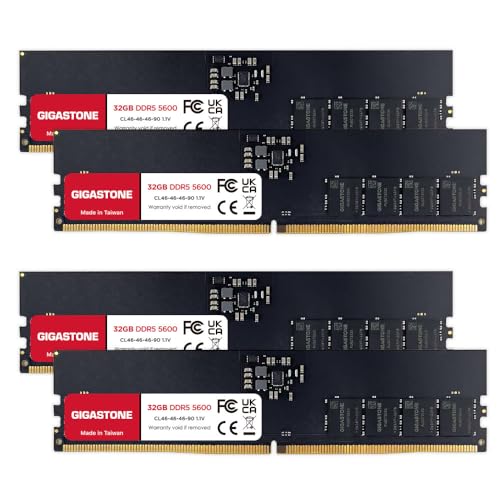
Pros
- Four 32GB modules totaling 128GB capacity
- DDR5-5600 PC5-44800 unbuffered non-ECC UDIMM design
- Rated CL46-46-46-90 timings and 1.1V per listing
- Onboard PMIC listed for power management efficiency
Cons
- Compatibility is limited to select DDR5 desktop PCs per listing
Oxidized or contaminated edge-connector contacts on DRAM modules are a common cause of failed POST sequences, intermittent memory training faults, and unexplained instability. Mechanical cleaning with a non-abrasive eraser is a long-standing field technique. It removes surface films, but it also removes plating if applied incorrectly. This guide covers the failure mechanisms, the tooling, the safety controls, and a repeatable cleaning and reseating procedure, with the measurable acceptance criteria that go with it.
Why Contacts Get Dirty
Gold does not oxidize under normal atmospheric conditions. The discoloration seen on “oxidized” gold fingers comes from other mechanisms in the contact stack. A typical DIMM edge connector uses 0.76 µm (30 µin) hard gold over a 3-5 µm nickel barrier layer on a copper trace. Budget modules may use flash gold of only 0.05-0.1 µm, which is porous.
- Pore corrosion: In thin gold, atmospheric sulfur and chlorine compounds reach the nickel or copper underlayer through microscopic pores. The corrosion products creep across the gold surface as dark brown, green, or gray films.
- Fretting corrosion: Many DIMM sockets use tin-plated or tin-alloy contacts mated against gold. Micromotion of a few micrometers, caused by thermal cycling or vibration, wears through the tin and produces insulating oxide debris. Tin oxide is a poor conductor and builds up in the contact zone.
- Environmental contamination: Sulfur-bearing gases, humidity above 60% RH, skin oils, flux residues, and dust fibers all form films at the interface.
- Thermal cycling: DRAM modules typically operate between 30 °C and 85 °C under load. Repeated expansion and contraction accelerates micromotion and the resulting wear.
Low-level contact resistance (L
For related maintenance and equipment benchmarks, review our technical guides on gaming desktop memory, examine multitasking ram benchmarks, and compare pc desktop motherboards. You can also reference our analyses on 4k gaming memory configs and high speed memory setups. For industry engineering standards, consult JEDEC memory standards.