For operators needing true heavy-duty debris clearing without gas fumes, high-output handheld and backpack units offer high airflow but demand trade-offs in continuous full-throttle runtime and weight distribution.
Pros
- Brushless motor provides strong 200-MPH and 800-CFM performance for efficient debris removal
- 15 percent lighter weight design reduces user fatigue during extended operation
- Quiet zero-emission operation suitable for eco-conscious residential use
- Includes full 40V 7.5 Ah battery and charger kit for out-of-box readiness
- Compatible 40V battery system works across Husqvarna handheld tools
Cons
- Battery-powered design requires recharging and offers finite runtime unlike gas alternatives
- Handheld form may still cause fatigue on very large properties despite the lighter build
- Battery appearance may vary from images as noted in the product details
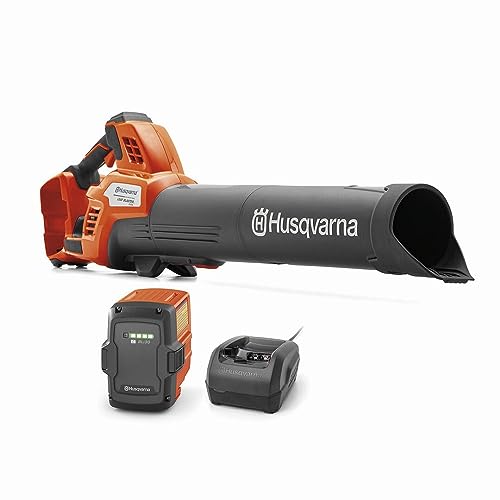
The Husqvarna Leaf Blaster 350iB is a battery-powered cordless leaf blower that arrives as a complete kit with a 40V lithium-ion 7.5 Ah battery and charger. Its brushless motor construction and focus on reduced weight create an immediate impression of a modern, user-friendly tool built for regular lawn maintenance and outdoor cleanup tasks.
In performance, this model generates wind speeds up to 200 MPH with 800 CFM airflow to move leaves and debris effectively while remaining quiet and producing zero emissions. Simple keypad controls allow instant starts, cruise control supports hands-free convenience, and the power boost mode adds 20 percent more power along with a built-in debris scraper for wet or sticky material. The shared 40V battery further increases value by working with other Husqvarna handheld tools.
Considerations include the inherent limits of cordless operation, which depends on battery charge and requires recharging between uses. Even with the 15 percent lighter design, the handheld style can lead to arm fatigue over very large areas, and battery appearance may vary from promotional images.
Overall, the Husqvarna Leaf Blaster 350iB delivers excellent value for homeowners, fathers, or outdoor workers seeking a powerful yet quieter alternative to traditional blowers, particularly those who appreciate the convenience of a full battery kit and ecosystem compatibility.

Pros
- High-volume airflow rated up to 680 CFM
- Includes two 21V batteries and a charger
- 5-speed variable control for delicate or heavy debris
- Lightweight build at just 3.6 pounds
- Ergonomic handle with anti-slip grip
Cons
- Battery life drops faster at maximum speed
- Requires swapping and charging batteries

Pros
- Delivers up to 615 CFM and 170 MPH in turbo mode
- Variable speed dial with lock-on button from 200–480 CFM
- High-efficiency brushless motor reduces operating vibration
- Includes 56V 2.5Ah battery and standard 50-minute charger
- Fully compatible with all EGO 56V ARC Lithium batteries
Cons
- Turbo mode rapidly reduces the available battery runtime
- Weighs 7.5 pounds, which may feel heavy with larger batteries
Pros
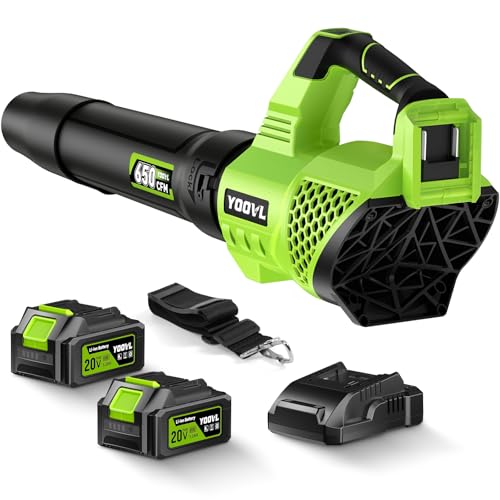
- Airflow rated up to 650 CFM using advanced turbo technology
- Comes with two high-capacity 20V 5.2Ah batteries and fast charger
- Three selectable speed modes for delicate to heavy-duty jobs
- Includes an adjustable shoulder strap to reduce arm fatigue
- Includes blower tube and extension nozzle attachments
Cons
- Maximum 150-minute runtime applies only to low-speed mode
- Heavier battery packs may add weight during prolonged handheld use

Pros
- High-performance brushless motor rated up to 700 CFM and 170 MPH
- Includes an 80V 2.5Ah battery and compatible charger
- Cruise control and variable-speed trigger for effortless pacing
- Rated at 74 dB for quieter operation than comparable gas units
Cons
- Operating continuously on turbo mode quickly depletes the 2.5Ah battery
- Weighs 5.84 pounds before factoring in user movement

Pros
- Delivers up to a rated 750 CFM for heavy debris
- Brushless motor provides efficient operation
- Backpack design distributes weight for easier carrying
- Variable speed control allows adjustable airflow
- Includes 4.0Ah battery and charger
Cons
- Total weight of 9.48 lbs plus battery may tire users over time

Pros
- Delivers up to a rated 710 CFM and 175 MPH
- Includes two 5.0Ah HP batteries and dual charger
- Thumb-activated turbo boost and cruise control
- Padded backpack harness balances 10.69 lb weight
- Backed by a 3-year manufacturer warranty
Cons
- Bulkier setup than standard handheld blowers
- Higher weight profile requiring backpack wear

Pros
- Brushless motor delivers rated airflow up to 650 CFM and 180 MPH
- Includes two 20V 4.0Ah batteries and a fast charger
- Six adjustable speed settings ranging from 80 to 180 MPH
- Comes with an ergonomic shoulder strap and two detachable nozzles
- Includes a storage bag to keep components organized
Cons
- Stated 30-minute runtime is restricted to low-speed operation
- High-speed settings will deplete battery charge more rapidly

Pros
- Delivers up to a stated 930 CFM airflow and 197 MPH
- Includes two 4.0Ah batteries and a fast charger
- Six variable-speed settings with a constant-speed lock
- Tool-free assembly with included blower tubes
Cons
- Stated dual-battery runtime is limited to 30–60 minutes

Pros
- Brushless motor delivers rated airflow up to 505 CFM
- Variable speed dial with on-demand turbo boost button
- Includes a 40V 5.0Ah lithium-ion battery and charger
- Works with over 75 tools in the Greenworks 40V platform
Cons
- Heavy overall build weighing 13.42 pounds
- Mulch collection bag details are unspecified in data
Handheld vs. Backpack Form Factors for Prolonged Work
Backpack blowers shift the physical strain from your wrist and forearm to your shoulders and core, making them significantly better suited for extended commercial landscaping jobs. Handheld blowers offer quick deployment and nimble maneuverability for tight spaces, but holding a high-capacity battery at your side quickly leads to operator fatigue during hour-long cleanups.
For example, the Greenworks 80V Backpack Leaf Blower, 750 CFM and the Greenworks 40V Backpack Leaf Blower, 710 CFM, (2) utilize padded shoulder harnesses to balance multi-pound battery packs across the torso. In contrast, handheld powerhouses like the Husqvarna Leaf Blaster 350iB Battery Powered pack 800 CFM and an advertised 200 MPH wind speed into a one-handed design. While Husqvarna notes this tool is engineered to be 15% lighter than comparable blowers when paired with its 7.5 Ah battery, prolonged single-handed sweeping still exerts continuous torque on the wrist. If your cleanups span wide parking lots or multi-acre lawns, a backpack frame provides mechanical leverage that handheld designs cannot match.
CFM and Airspeed: What the Performance Ratings Actually Mean
CFM measures total air volume to push wide mounds of leaves, whereas MPH measures air velocity to break loose stuck, wet debris. Matching the tool to the debris profile is essential because high velocity with low volume narrows your clearing path, while high volume with low velocity struggles against compacted dirt.
The Greenworks 80V Electric Leaf Blower, 700 CFM pairs an advertised 700 CFM with 170 MPH in turbo boost, designed to dislodge damp clippings and wet foliage. The EGO POWER+ Cordless Electric Leaf Blower, 615 CFM tops out at 615 CFM and 170 MPH, which easily sweeps typical lawn debris and driveway buildup, though it moves slightly less aggregate volume per sweep than the 700+ CFM models. Meanwhile, budget-oriented tools such as the 930CFM Electric Leaf Blower Cordless with 2 X 4.0 advertise a massive 930 CFM and 197 MPH rating on paper, yet lack the heavy-duty ecosystem backing of major outdoor power brands. When selecting a blower, consider whether you are sweeping dry pavement—where wide volume clears paths quickly—or peeling matted leaves off turf, which requires focused velocity.
Voltage and Platform Ecosystems Across Brands
A blower’s battery voltage dictates power delivery under load, but locking into a battery ecosystem is the primary long-term financial decision for commercial use. Investing in a specific battery format means your spare packs can interchange across string trimmers, edgers, and chainsaws from the same manufacturer.
The Husqvarna Leaf Blaster 350iB runs on a 40V platform with a substantial 7.5 Ah battery included, seamlessly fitting into Husqvarna’s broader 40V commercial and prosumer handheld lineup. Greenworks segments its equipment into both 40V and higher-output 80V platforms. The Greenworks 40V Leaf Blower / Vacuum, 505 CFM integrates with over 75 tools in the Greenworks 40V system, while their 80V commercial-grade line targets maximum performance comparable to small gas engines. Similarly, the EGO POWER+ 615 CFM model connects to EGO’s 56V ARC Lithium ecosystem. Choosing higher voltage platforms like 56V or 80V generally facilitates faster energy discharge for demanding tasks, but lower voltage tools can be more economical if you already maintain matching battery packs.
Runtime Management and Multi-Battery Configurations
Continuous maximum-power operation drains lithium-ion packs rapidly, making dual-battery kits or rapid chargers mandatory for uninterrupted workflow. Relying on turbo modes without a rotation strategy causes frequent downtime on commercial properties.
Several models solve this issue by shipping with dual batteries right out of the box. The Greenworks 40V Backpack Leaf Blower includes two 5.0 Ah HP batteries alongside a 4A rapid dual-port charger designed to replenish packs concurrently. On the budget handheld side, the Cordless Leaf Blower, 680 CFM High Power Battery and the Leaf Blower Cordless, 650CFM Electric Leaf Blowers each bundle two 20V or 21V batteries, allowing you to run one pack while the other charges. For models with a single battery included, such as the EGO POWER+ (2.5 Ah pack) or the Husqvarna 350iB (7.5 Ah pack), operators must rely on cruise control settings rather than turbo modes to conserve amp-hours across larger properties.
Frequently Asked Questions About Commercial Battery Blowers
How long will a commercial battery leaf blower run on a single charge?
Runtime varies widely depending on the battery's amp-hour (Ah) capacity and the power setting used. Engaging continuous turbo boost can deplete a battery in a fraction of the time compared to using low or medium cruise-control settings. To ensure uninterrupted operation, verify the included battery capacity and keep a secondary pack on a fast charger.
Can commercial battery leaf blowers match gas blowers for wet leaves?
Yes, high-output battery units producing between 700 and 800 CFM with airspeeds around 170 to 200 MPH can effectively dislodge wet leaves and compacted debris. However, maintaining that level of power requires significant energy draw, meaning you will need higher-capacity batteries compared to dry debris maintenance.
Are battery leaf blower batteries interchangeable between different brands?
No, battery platforms are proprietary to each manufacturer and generally only work across tools of the same voltage line within that brand. For example, Greenworks 80V batteries do not fit Greenworks 40V tools, and neither will fit Husqvarna or EGO equipment.
Choosing the Right Commercial Battery Blower for Your Property
Selecting the right commercial-grade blower comes down to balancing structural fatigue against overall clearing volume and battery compatibility. If you manage expansive properties with long blowing sessions, backpack platforms distribute pack weight comfortably, whereas handheld units excel at rapid spot-clearing, vehicle detailing, and hardscape sweep-downs.
For demanding residential grounds or light commercial landscaping, the Greenworks 80V Backpack Leaf Blower, 750 CFM is the standout recommendation. Its backpack harness alleviates physical fatigue, and its 80V motor delivers up to 750 CFM of robust clearing force. However, its primary trade-off is the bulk of a harness system, which makes it less convenient for quick 5-minute porch sweeps. For property owners seeking a nimble, high-velocity handheld alternative that still delivers pro-grade clearing power, the Husqvarna Leaf Blaster 350iB Battery Powered provides an impressive 800 CFM and 200 MPH within an ergonomic handheld chassis.