

If you need maximum clearing output for extensive, debris-heavy lawns, a high-displacement backpack model delivers the airflow you need, though it adds significant bulk and requires carrying up to 21 pounds. For smaller driveways or quick touch-ups, a handheld gas power blower avoids the extra weight but trades away the high cubic-feet-per-minute (CFM) output of larger platforms.

Pros
- Lightweight 9.4-pound design offers easy handheld maneuvering
- Reduced-resistance recoil system eases engine pull starts
- Translucent fuel tank allows quick monitoring of gas levels
- Cushioned anti-vibration handle helps dampen arm strain
- Capable of up to 380 CFM and 180 MPH airflow
Cons
- Requires mixing 2-cycle gas and oil at a 50:1 ratio
- Modest 380 CFM output is best suited for lighter debris

Pros
- Delivers up to 550 CFM and 230 MPH for moving wet yard debris
- Lightweight 17-pound backpack design with cushioned straps
- Thumb throttle includes cruise control for steady blowing
- 33.8 fl oz fuel tank yields up to 45 minutes of run time
- Operating temperature range spans 14°F to 104°F
Cons
- Requires 2-cycle fuel mixing and engine maintenance
- 550 CFM is modest for a backpack-class gas blower
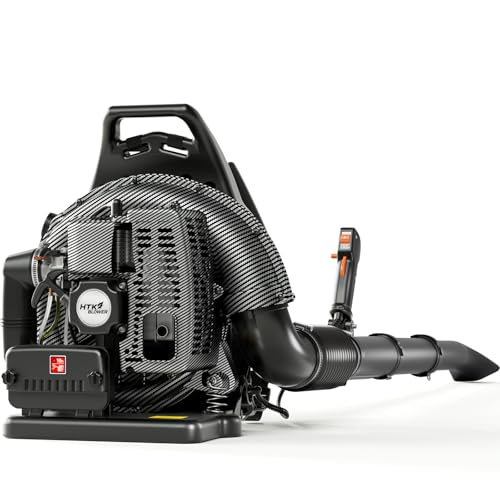
Pros
- 63CC 2-stroke engine provides up to 665 CFM and 205 MPH
- Fully padded ergonomic backpack harness
- Variable-speed throttle with built-in cruise control
- Generous 1.7 L fuel tank for extended yard sessions
Cons
- Requires 2-stroke fuel mixing and gas engine maintenance

Pros
- 4-cycle engine eliminates fuel and oil mixing
- Delivers up to 410 CFM and 125 MPH clearing power
- Automatic compression release for easier pull starts
- Lubricates in all directions without stalling or leaks
Cons
- Not available for purchase or delivery in California
- Requires routine gas engine maintenance and oil checks

Pros
- 63cc 2-cycle engine produces 665 CFM and 205 MPH
- 1.7-liter fuel tank enables extended sessions between refills
- Cruise control locks in throttle to reduce hand strain
- Padded harness and vibration reduction improve carry comfort
- Tool-free access simplifies two-stage air filter maintenance
Cons
- Substantial 21-pound dry weight requires physical stamina
- Requires ongoing 2-stroke oil and gasoline mixing

Pros
- 2.7kW 63cc two-stroke engine delivers up to 6,800 RPM
- Multi-directional air outlet adjusts vertically and horizontally
- 0.47-gallon fuel tank enables long runs between top-offs
- Constant speed switch holds chosen throttle effortlessly
- Backpack harness features heat-insulating back padding
Cons
- Substantial 22-pound dry weight adds strain on long sessions
- Requires manual two-stroke oil and gasoline mixing

Pros
- 28cc 1.1-HP 2-stroke gas engine
- Rated up to 280 MPH and 490 CFM
- Quick-start ignition mechanism
- 0.65-liter translucent fuel tank
- Lightweight 9.5-pound bare tool weight
Cons
- Requires 2-cycle gas and oil mixing
- Produces engine noise and emissions

Pros
- 65cc engine delivers a high-volume 850 CFM at 205 MPH
- Includes both fan and concentrator nozzle attachments
- 1.7-liter fuel tank reduces frequent stopping for refills
- Backpack harness features ventilated backrest for comfort
- Variable throttle with cruise control simplifies steady operation
Cons
- Requires 2-stroke fuel mixing and routine engine upkeep
- At 70.8 inches long assembled, storage requires ample space
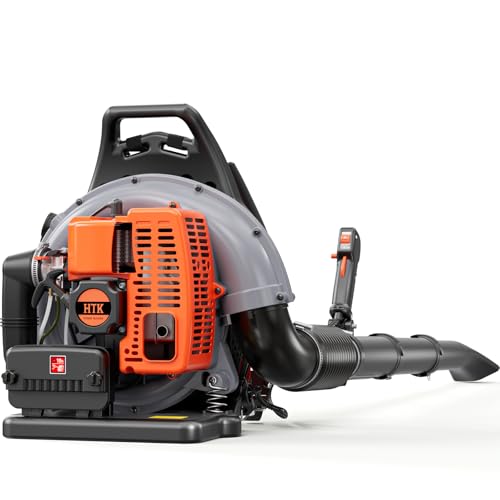
Pros
- 63cc 2-stroke engine delivers 665 CFM and 205 MPH airspeed
- Padded ergonomic backpack harness balances weight across shoulders
- Cruise control locks throttle to relieve trigger finger strain
- Generous 1.7L fuel tank supports extended property maintenance
- Manufacturer-rated sound level of 71 dB for quieter operation
Cons
- Requires ongoing two-cycle oil-to-gasoline fuel mixing
- Bulkier footprint demands sufficient garage or shed storage

Pros
- Claims up to 1,110 CFM airflow and 220 MPH air speed
- Generous 1.89-liter fuel tank allows 50 to 60 minutes of runtime
- Padded harness and shock-absorption system reduce vibration
- Cruise control locks throttle for continuous operation
- Includes earmuffs, maintenance tools, and fuel mixing bottle
Cons
- Heavy 26.46-pound total weight can fatigue operators
- Requires mixing 2-cycle gas and oil fuel
Should You Choose a Handheld or Backpack Gas Power Blower?
Your choice between a handheld or backpack frame depends directly on yard size and how long you can comfortably support the machine’s weight. Handheld blowers prioritize low physical weight and tight maneuverability around garden beds, while backpack models distribute larger, heavier engines across your shoulders to support extended yard work.
For instance, the 28 CC Gas Leaf Blower, 490 CFM 280 MPH weighs an advertised 9.5 pounds, making it suitable for quick sweeps of patios and sidewalks with one hand. In contrast, the Thalorus 52cc Gas Backpack Leaf Blower, 550 CFM weighs 17 pounds, relying on a padded harness to spread the load across your back. If you are comparing tool styles for flat surfaces, our guide on leaf blowers for driveways highlights when smaller platforms are adequate versus when higher displacement pays off.
Two-Stroke vs. Four-Stroke Maintenance and Fuel Mixing
A four-stroke gas blower eliminates the chore of mixing two-cycle oil into gasoline, but two-stroke engines generally offer higher power-to-weight ratios across outdoor power equipment. If you dislike measuring fuel additives, a 4-cycle design provides convenience at the expense of lower top-end airspeed.
The SENIX 4QL 26.5cc 4-Cycle Handheld Gas Leaf Blower features a 4QL engine requiring no fuel mixing, while delivering a manufacturer-stated 410 CFM and 125 MPH. However, it cannot be shipped to California due to state environmental restrictions. Meanwhile, two-cycle handhelds like the Getell 26cc Gas Leaf Blower require a 50:1 fuel mixture, but compensate by delivering a higher claimed airspeed of 180 MPH to dislodge stuck debris.
Comparing High-Displacement Backpacks: 63cc vs. 65cc Models
When clearing acreage or thick ground cover, 63cc and 65cc engines provide the air volume needed to move piles without frequent passes. Between these large platforms, subtle variations in tank size, weight, and advertised airflow determine which fits your routine.
Consider the trade-offs between these capable commercial-style backpacks:
- Getell 63CC Gas Backpack Leaf Blower: Advertises 665 CFM, 205 MPH, a 1.7 L fuel capacity, and weighs 21 pounds with a 2-stage air filter.
- Getell 65CC Backpack Leaf Blower, Gas Powered: Steps up displacement to 65cc with an advertised 850 CFM and 205 MPH at a lighter claimed weight of 17.5 pounds, though it operates at a stated 75 dB noise level.
- HTK Gas Backpack Leaf Blower, 63CC 2-Stroke: Features 665 CFM, 205 MPH, an air-purge primer, and a manufacturer-stated 71 dB noise rating for a slightly quieter profile.
- VEVOR 63CC Gas Backpack Leaf Blower: Features an advertised 1110 CFM and 220 MPH output, alongside a 1.89 L fuel tank designed for 50 to 60 minutes of run time, packaged with safety earmuffs.
While the VEVOR 63CC Gas Backpack Leaf Blower advertises higher output numbers, all large backpacks present storage challenges and require regular carburetor maintenance compared to light yard tools.
Air Volume and Airspeed Trade-Offs for Wet Yard Debris
CFM measures the total volume of air leaving the tube, whereas MPH measures how fast that air travels; choosing between them depends on whether you are shifting heavy, wet mounds or scraping stubborn pine needles. High CFM clears broad paths across open turf, while high MPH provides the focused impact to break up damp mats.
For example, the Backpack Gas Powered Leaf Blower provides a manufacturer-claimed 850 CFM backed by a 2.7kW engine, making it well-suited for moving broad swathes of wet clippings or light snow. Conversely, a compact unit like the 28 CC Gas Leaf Blower, 490 CFM 280 MPH relies on an intense 280 MPH velocity to peel matted material off asphalt, despite pushing less overall air volume.
Frequently Asked Questions About Gas Power Blowers
Do all gas blowers require mixing oil with gasoline?
No. Two-cycle engines require a pre-mixed fuel and oil ratio (such as 50:1), whereas four-cycle engines, like the SENIX 4QL, use straight gasoline in the fuel tank and keep lubricating oil in a separate reservoir.
What is the primary trade-off of a backpack gas blower?
Backpack blowers offer higher displacement and advertised airflow to tackle large properties, but they weigh significantly more (typically 17 to 21 pounds) and take up more storage space than compact handheld alternatives.
Final Decision: Choosing the Best Gas Blower for Your Yard
To choose the right gas blower, balance the physical demands of the machine against the scale of your property. Buyers tackling expansive suburban lots with dense tree cover will benefit most from a backpack configuration with cruise control, while owners of small residential lots will appreciate the rapid deployment of a handheld unit.
The recommended option for demanding acreage is the Getell 65CC Backpack Leaf Blower, Gas Powered, which suits large-property owners seeking an advertised 850 CFM airflow paired with a manageable 17.5-pound frame. Its primary limitation is the ongoing maintenance of a 2-stroke engine and a bulky footprint in the garage. If you only maintain a standard driveway and small patio, the SENIX 4QL 26.5cc 4-Cycle Handheld Gas Leaf Blower is the better alternative, offering easy no-mix fueling in a lightweight handheld format.


