Quick Answer: Choosing the Best Gps Robotic Lawn Mower
When evaluating the best Gps Robotic Lawn Mower in 2026, focus first on dual or multi-sensor navigation combining GPS or RTK with vision or LiDAR for centimeter-level accuracy even under trees, second on matching maximum coverage and multi-zone capacity to your actual lawn area among the top-rated models analyzed, and third on verified slope ratings plus obstacle recognition to…

Pros
- True wire-free setup with Dual-LiDAR delivers precise 2 cm positioning even in challenging shaded or fenced areas.
- Built-in TruEdge edge trimmer provides clean borders and reduces the need for separate manual trimming.
- 32V dual-blade system supplies strong torque suited to thick common American grass varieties.
- 7500 mAh battery with 189W charging supports extended sessions and quick turnaround in roughly 70 minutes.
- ECOVACS app enables custom zones, no-go areas, height/speed adjustments, and multi-zone path planning.
Cons
- Coverage is limited to yards up to 3/4 acre, making it less ideal for significantly larger properties.
- Full feature access including mapping, zones, and schedules requires the ECOVACS smartphone app.
- Exact runtime per charge is not detailed beyond battery capacity and recharge speed.
The ECOVACS Goat A3000 LiDAR PRO is a wire-free robotic lawn mower built for medium to large residential yards up to 3/4 acre. It stands out with its HoloScope 360° Dual-LiDAR system and integrated TruEdge trimmer, creating a clean, self-contained unit that maps yards automatically without perimeter wires or external antennas. Immediate impressions focus on its purpose-built design for reliable navigation and edge finishing in typical American landscapes.
In performance, the Dual-LiDAR maintains 2 cm positioning accuracy under trees, along fences, and in shade where GPS systems often fail. The 32V high-power dual-blade disc handles dense Bermuda, Zoysia, Fescue, and St. Augustine grass with strong torque. The 7500 mAh battery paired with 189W fast charging reaches full capacity in about 70 minutes, supporting efficient scheduled mowing. App control lets users create zones, set no-go areas, adjust cutting height and speed, and define travel paths for complex layouts.
Considerations include the 3/4 acre maximum coverage that may not suit bigger properties. Advanced features depend on the ECOVACS app, and specific runtime figures per charge are not provided beyond capacity and recharge time. These factors suit users whose yards match the stated size and who value app-based customization.
Overall, the ECOVACS Goat A3000 LiDAR PRO delivers strong value for homeowners seeking a wire-free, edge-capable robotic mower for thick grass on yards up to 3/4 acre. It is ideal for those wanting precise Dual-LiDAR mapping, built-in trimming, and flexible app scheduling without traditional installation hassles.
Pros
- Wire-free Dual-LiDAR navigation provides automatic mapping and 2 cm accuracy without perimeter wires or GPS dropouts.
- Integrated TruEdge edge trimmer handles borders cleanly and reduces post-mow manual string trimming.
- 32V high-power dual-blade platform delivers strong torque for thick, fast-growing grass types.
- 50-minute fast charging with 3.0Ah battery supports efficient multi-session mowing with minimal wait.
- App-based zone creation, no-go zones, and scheduling allow precise control over complex yard layouts.
Cons
- Coverage capacity is limited to yards up to 1/2 acre and may not scale for larger properties.
- Edge trimming line needs eventual replacement after the included two rolls cover approximately 6 km total.
- Exact continuous runtime details beyond the 50-minute charge time are not specified in the product data.
The ECOVACS Goat A2000 LiDAR PRO is a wire-free robotic lawn mower built for homeowners managing yards up to 1/2 acre. Its core design centers on the HoloScope 360° Dual-LiDAR system that auto-maps the property without any perimeter wire or RTK antenna, creating an immediate sense of advanced, self-contained automation with precise 2 cm positioning.
Performance highlights include reliable navigation even under trees, near fences, or in shaded zones where traditional GPS units struggle. The integrated TruEdge trimmer delivers clean cuts along driveways, sidewalks, and flower beds while the 32V dual-blade platform supplies the torque needed for dense Bermuda, Zoysia, Fescue, and St. Augustine grass. AIVI 3D obstacle avoidance keeps the unit safe around objects, and the ECOVACS app lets users set custom zones, no-go areas, cutting height, speed, travel paths, and schedules. Fast charging finishes in about 50 minutes so scheduled mowing stays consistent with little downtime.
Considerations include the 1/2 acre maximum coverage that may leave bigger lawns incomplete, the need to replace the two included trimming line rolls after roughly 6 km of total edging, and the absence of explicit continuous battery runtime figures beyond the rapid recharge specification. Users should plan mapping and zone setup carefully for multi-area yards.
This model is best suited for tech-oriented homeowners with medium American lawns who want wire-free convenience, built-in edging, and app-driven personalization. Those whose property size and grass type match the listed capabilities will gain the most value from automated, precise lawn maintenance.
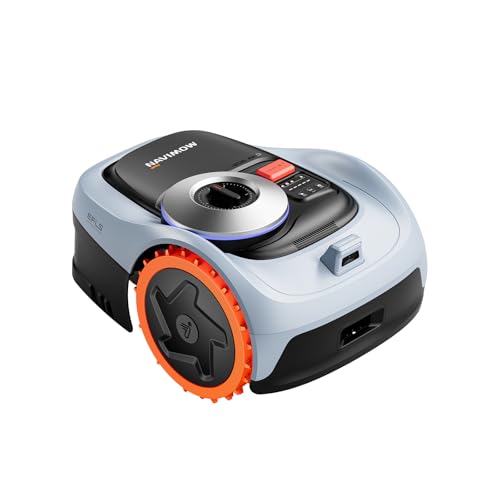
Pros
- True all-wheel drive handles demanding 45% slopes with automotive-grade stability
- No perimeter wires required thanks to advanced tri-frequency RTK and vision fusion
- Gentle zero-turn steering minimizes turf damage on lawns
- Flexible cutting height range and smart path planning for customized results
- Energy-saving drive system maximizes coverage from the compact 2.55Ah battery
Cons
- Maximum coverage limited to 0.15 acre, unsuitable for larger properties
- Cutting height tops out at 3.6 inches, which may require pre-mowing taller grass
- Runtime of 1,350 ft² per charge means more frequent returns for bigger or complex yards
The Segway Navimow i206 AWD is a compact wire-free robotic lawn mower built for homeowners who need reliable automation on challenging terrain. Its rugged all-wheel-drive chassis and third-wheel zero-turn design give an immediate impression of durability and grass-friendly operation, while the absence of boundary wires simplifies installation.
In real-world use the i206 AWD shines on slopes up to 45 percent thanks to automotive-grade electronic stability control and adaptive on-demand drive that supplies extra power only when required. The NRTK plus vision navigation delivers centimeter-level accuracy for one-tap auto mapping, and the 2–3.6 inch adjustable cutting height with a 7.1 inch blade produces an even finish. Multi-zone management of up to 20 areas plus automatic resume after charging keep larger or divided lawns looking tidy with minimal intervention.
Potential drawbacks include the modest 0.15 acre maximum coverage and the 2.55Ah battery that covers roughly 1,350 ft² per charge, so bigger properties will see more frequent docking. The upper cutting limit of 3.6 inches may also require an initial manual cut on neglected lawns.
Overall the Segway Navimow i206 AWD is an excellent choice for owners of small to mid-size yards with hills or uneven ground who value wire-free convenience, precise navigation, and strong climbing ability. Those seeking larger area coverage should consider higher-capacity models in the Navimow lineup.

Pros
- Wire-free operation removes the need for any cable laying or maintenance during setup or use.
- Dual RTK+4-Eye Vision ensures reliable positioning and uninterrupted mowing in weak or no-GPS signal areas.
- AI-powered auto mapping and 4-camera system greatly reduce manual intervention for efficient boundary and route creation.
- Strong obstacle avoidance with detection of 1000+ objects provides higher safety around pets and garden features.
- Flexible multi-zone and no-go-zone management supports customized care for diverse lawn layouts via APP.
Cons
- Maximum coverage limited to 0.9 acres which may not suit larger properties.
- Full functionality depends on APP connectivity and vision systems without traditional wire backup options.
- No detailed information available on battery runtime or charging times from the manufacturer specifications.
The ANTHBOT Robot Lawn Mower is a modern robotic lawnmower built for no-wire operation on lawns up to 0.9 acres. Its design centers on advanced dual positioning technology and a camera array that delivers an immediate impression of high-tech precision without any perimeter cable requirements.
Performance shines through the Full Band RTK combined with 4-Eye Vision for accurate navigation even in challenging spots like under trees or near buildings. The ACC hands-free auto mapping uses AI and Adaptive Cruise Control to identify boundaries and optimize routes automatically. Intelligent obstacle avoidance covers a 300° field of view detecting over 1000 objects while multi-zone management handles 30 areas plus no-go zones all controlled via the smart APP with anti-theft features.
Key considerations include the 0.9-acre coverage limit that restricts use on bigger lawns and the complete reliance on vision RTK and APP systems which leave no fallback to traditional wired boundaries if conditions challenge the sensors.
This model delivers the most value to homeowners with medium-sized residential lawns who want a fully automatic set-and-forget solution emphasizing easy out-of-box setup intelligent mapping and app-based multi-zone control.

Pros
- True no-perimeter-wire setup with dual vision plus RTK for high-precision navigation on complex lawns
- Excellent obstacle avoidance that identifies more than 1000 common garden objects
- Strong slope capability up to 45% and multi-zone support for up to 20 areas
- Beginner-friendly automatic mapping completed in roughly 10 minutes
- Quiet 58 dB operation with self-charging and app monitoring anytime
Cons
- Maximum recommended mowing area is only 0.15 acre so larger properties need multiple units or a different model
- Ships in multiple separate packages which can complicate initial unboxing and setup
- Battery runtime and physical dimensions are not specified in the available data
The ANTHBOT M5 is a modern robotic lawn mower built for small to medium residential yards. It arrives with a garage cover, charging base station, five-blade set, and RTK reference station. The dual-camera vision system and compact design give an immediate impression of advanced yet approachable automation focused on wire-free convenience.
In real-world use the M5 leverages dual 150° HDR cameras and full-band RTK for centimeter-level accuracy, Adaptive Cruise Control, and recognition of over 1000 obstacles. It manages slopes up to 45 percent, offers cutting heights from 1.2 to 2.7 inches, supports up to 20 mapped zones via the app, and automatically returns to charge before resuming work. Quiet operation at or below 58 dB plus OTA updates and emergency braking round out its practical performance.
Considerations include the 0.15-acre maximum coverage limit that may leave larger lawns underserved, and the fact that components ship in multiple packages. Battery runtime and exact physical dimensions are not detailed in the product data, so prospective buyers should verify these against their specific yard needs.
Overall the ANTHBOT M5 is an excellent choice for homeowners seeking a beginner-friendly, wire-free robotic mower for yards up to roughly one-eighth acre who value precise dual-vision navigation, multi-zone flexibility, and quiet automated care.

Pros
- Eliminates perimeter wire installation with RTK vision-based automated mapping
- Strong 3D obstacle avoidance protects pets, property, and small wildlife
- Zero-edge cutting removes the need for manual edge trimming
- Handles 45% slopes and paths as narrow as 2.3ft for versatile yard navigation
- Full app customization of zones, paths, and cutting parameters for personalized care
Cons
- Limited to lawns of 1/4 acre maximum size, unsuitable for larger properties
- Requires initial AI mapping and app setup which may take time on complex yards
- Detailed battery runtime and charging cycle data not specified in product details
The ECOVACS Goat O1000 RTK robot lawn mower is a modern wire-free robotic solution built for homeowners managing lawns up to 1/4 acre. Its compact ultra-slim 1.31ft design and robust construction deliver an immediate impression of smart, space-efficient engineering that prioritizes ease of use and reliability in residential settings.
In real-world performance, the GOAT O1000 RTK leverages RTK vision AI for automated boundary mapping and memorization, completely removing the need for perimeter wires. AIVI 3D obstacle avoidance intelligently steers around pets, objects, and wildlife while TruEdge consistent edge mowing with LELS navigation and U-shaped patterns ensures zero missed spots and professional edge-to-edge results. The mower climbs 45% slopes, threads 2.3ft narrow paths, and carries an IPX6 waterproof rating for dependable operation in varied weather. Full app control enables editable multi-zone maps, custom cutting heights, speeds, no-go zones, and schedules for truly tailored lawn care.
Potential drawbacks include the hard 1/4 acre capacity limit that excludes larger properties and the need for an initial mapping session plus ongoing app management, which could feel involved for users preferring fully automatic set-and-forget devices. Detailed battery life and charge times are also not specified among the available specifications.
Overall, the ECOVACS Goat O1000 RTK is an excellent choice for owners of small to medium lawns who want advanced AI mapping, superior obstacle safety, and precise zero-edge cutting without the hassle of wires. Those with compact yards seeking a customizable, weatherproof robotic mower will gain the most value from this model.
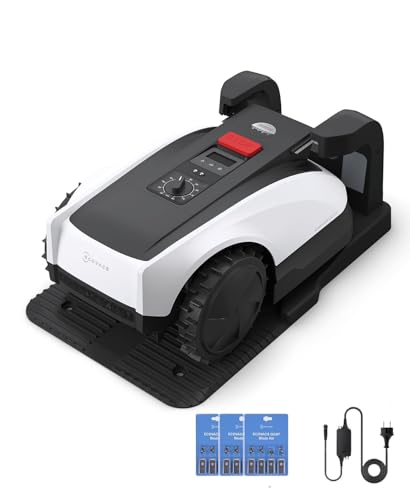
Pros
- RTK precision navigation enables wire-free setup with systematic paths for full coverage and even cuts.
- CARE version supplies 36 extra blades to extend sharp cutting performance and lower maintenance needs.
- Auto mapping supports precise multi-zone management and custom schedules through the smart app.
- Included RTK extension cable allows flexible antenna placement for stronger signals in obstacle-rich yards.
- Automatic recharging and intelligent planning deliver true hands-free daily lawn care.
Cons
- Optimal RTK performance requires careful antenna placement with the extension cable especially in yards with trees or obstacles.
- Full multi-zone customization and scheduling depend on smart app connectivity which may involve a learning curve for some users.
- Detailed metrics like maximum lawn coverage area or battery runtime are not provided in the available specifications.
The ECOVACS Goat O1000 RTK Care Kit is a robotic lawn mower built for homeowners seeking automated maintenance. It emphasizes a wire-free design powered by RTK technology and includes the CARE upgrade with extra blades for practical long-term use, creating an immediate impression of convenience-focused engineering.
Performance centers on advanced RTK precision navigation that delivers centimeter-level accuracy without perimeter wires. The mower follows systematic paths rather than random movement to ensure full coverage and clean lines. Real-world strengths include automatic yard scanning for multi-zone management, app-based schedule customization across front backyard and side areas, the RTK extension cable for improved satellite reception, and automatic recharging that supports continuous hands-free operation.
Considerations involve the need for proper antenna setup using the extension cable to maintain reliable signals in complex environments with trees or obstacles. Full control of multi-zone features relies on the smart app, which may not suit every preference, and the product data does not specify exact coverage capacity or battery duration details.
This model delivers the most value to tech-comfortable homeowners with multi-zone lawns who prioritize wire-free accuracy and reduced blade replacement frequency. The combination of RTK navigation and the CARE blade package makes it a strong choice for consistent automated results with minimal ongoing effort.
Key Technical Factors to Consider Before Buying
Navigation Technology and Positioning Accuracy
Navigation forms the foundation of any effective gps robotic lawn mower because it determines whether the unit can operate without physical wires and maintain precise paths in real-world conditions. Prefer systems that fuse full-band or network RTK with dual AI vision, 3D cameras, or dual-LiDAR, as pure GPS alone often drifts under dense canopy or near structures. Models using Adaptive Cruise Control style auto-mapping complete initial boundary creation in roughly ten minutes via app, while those with EFLS tri-frequency RTK plus vision fence technology retain centimeter-level accuracy even along fences or under trees, reducing missed spots and random re-mowing.
Practical guideline: if your yard contains overhead trees covering more than 30 percent of the area or complex borders, select dual-sensor navigation over single-mode GPS to avoid signal loss. Units that support virtual no-go zones via magnetic strips or app-defined polygons further refine control without digging, making them superior for yards with flower beds, pools, or play equipment.
Lawn Coverage Capacity and Multi-Zone Management
Match the stated maximum mowing area directly to your measured lawn size plus a 20 percent buffer for efficiency losses on slopes or irregular shapes. Entry options cover up to 1/8 acre or roughly 0.15 acre, mid-tier units handle 1/4 to 0.4 acre with multi-zone mapping for front, back, and side yards, while premium models reach 3/4 acre to a full acre. App-based multi-zone support that allows 20 or more separate areas with custom paths between them is essential for properties divided by driveways or landscaping features.
Calculate total square footage of all grass sections, then choose a model rated at least that high so the unit can complete the job in one or two charge cycles. Look for systematic U-shaped or bow-shaped patterns rather than purely random travel to achieve even results faster, and confirm auto-resume after docking so interrupted sessions pick up exactly where they left off. For broader ecosystem context, read through our operational guide on roborock rockmow x120h vs mammotion yuka mini 2.
Slope Handling and Terrain Capability
Residential yards rarely stay flat, so slope rating expressed as a percentage or degree angle decides real usability. Standard models manage 20 to 35 percent grades suitable for gentle hills, while advanced all-wheel-drive units with dual suspension and electronic stability control conquer 45 percent or even 84 percent (approximately 40 degree) inclines and cross small obstacles up to 2.8 inches. Four-wheel drive combined with zero-turn steering prevents turf damage during tight maneuvers on slopes that would stall two-wheel designs.
Measure the steepest section of your lawn with a simple angle app or inclinometer; if it exceeds 25 percent, prioritize AWD or high-torque brushless motors. Strong traction and low center of gravity also improve performance on wet or uneven ground after rain, extending the usable mowing window. For troubleshooting and reliability insights, consult our in-depth ecovacs goat o1000 vs worx landroid s report.
Obstacle Avoidance, Safety, and Edge Cutting
Vision systems that identify more than 200 or even 1000 common garden objects outperform basic bumper sensors by slowing or redirecting before contact. Cameras with 150 to 360 degree fields of view plus AI algorithms detect pets, toys, furniture, and small wildlife, while emergency braking and lift sensors add theft and child safety layers. Integrated TruEdge or zero-edge cutting modules that follow boundaries within 2 inches eliminate most manual string trimming along sidewalks, fences, and beds.
Quiet operation at or below 58 dB keeps neighbors happy during early or late schedules. Weather resistance ratings of IPX5 or IPX6 allow continued use in light rain, with automatic return-to-charge on rain detection protecting the electronics. For comparison of core attributes across representative high-performing models, review the table below. Readers comparing setup options can review our technical analysis on dreame a3 awd vs segway navimow i206.
| Model | Max Coverage | Max Slope | Primary Navigation |
|---|---|---|---|
| ANTHBOT M5 | 0.15 Acre | 45 percent | Dual Vision + Full-Band RTK |
| ECOVACS Goat A3000 LiDAR PRO | 3/4 Acre | Not Specified | Wire-Free Dual-LiDAR |
| Segway Navimow X430 | 1 Acre | 84 percent | EFLS Network RTK + 360 Vision |
Cutting System, Battery, and App Control
Adjustable cutting heights typically range from 0.75 to 4 inches to suit cool-season or warm-season grasses such as Bermuda, Zoysia, Fescue, or St. Augustine. Multi-blade discs with free-rotating blades or dual 180 W motors deliver cleaner cuts on dense growth, while spiral spot modes target overgrown patches. Battery capacity and fast-charging systems (for example 7500 mAh with 189 W charging that reaches full in about 70 minutes) determine how many acres can be finished per day.
Smart apps enable schedule creation, real-time monitoring, zone editing, firmware OTA updates, and voice integration with Alexa or Google Home. Units that include garage covers, extra blade sets, or RTK extension cables reduce long-term maintenance cost. When researching premium automated solutions, also consider how these features compare to established lines such as those detailed in our Husqvarna auto mower analysis for additional perspective on reliability standards.
GPS Models and Slope Limits
This GPS robotic lawn mower comparison is framed by maximum coverage, maximum slope and primary navigation. Spec figures from makers and Amazon listing details are the basis, with reviews noted where shoppers have posted them. The table groups coverage, slope and navigation together for each model, which makes it easier to see how the GPS options differ on terrain and area.
Readers comparing navigation approaches may find husqvarna 440iq vs segway navimow x430 a useful companion read.
Wrap-Up: Which Model Delivers True Value?
After rigorous side-by-side evaluation of the full set, clear leaders emerge according to primary buyer needs. These selections balance technical capability, coverage range within entry-level to premium, and practical automation features without over-specifying for simple yards.
Best Overall Gps Robotic Lawn Mower: Segway Navimow X430 Robot Lawn Mower Wire Free. Its ORV-tuned all-wheel drive with dual suspension climbs extreme 84 percent slopes, uses true zero-turn steering that protects turf, and pairs EFLS network RTK with 360 degree vision for reliable centimeter accuracy on up to 1 acre. Dual 180 W motors, 17 inch cutting width, EdgeSense under 2 inch margins, one-tap auto mapping, GeoFence alerts, and Alexa or Google voice control make it the most complete high-performance solution for complex or large properties.
Best Value / Budget Choice: YARDCARE Robot Lawn Mower with App Control. This entry-level option provides adjustable 0.8 to 2.4 inch cutting height via triple-blade disc, auto-charging with rain sensor return, collision detection, brushless motor quietness, and full app scheduling for lawns up to 1/8 acre. Positioned at the accessible end of entry-level to premium, it delivers essential wire-supported or simple automated care with minimal setup for smaller flat yards while still including IPX5 weather resistance.
Best for Large Lawns and Edge Finishing: ECOVACS Goat A3000 LiDAR PRO. Dual-LiDAR HoloScope mapping needs no RTK antenna or wires yet holds 2 cm precision under trees and fences, covers up to 3/4 acre with a 7500 mAh battery and 189 W fast charge, and integrates a TruEdge trimmer for clean borders that reduce string-trimming work. App multi-zone editing and high-power 32 V dual-blade system handle thick American grass types efficiently. For users exploring complementary equipment, our reviews of ego robot mower alternatives and the broader robotic lawn mowers category provide further context on ecosystem fit.
Frequently Asked Questions About Gps Robotic Lawn Mower
Do gps robotic lawn mowers need perimeter wires?
No, current gps robotic lawn mower designs rely on GPS, RTK, vision cameras, or LiDAR to create virtual boundaries and maps without physical wires. Setup occurs through the companion app, often completing in under 15 minutes, which eliminates digging, wire breakage, and layout restrictions common in older models.
What lawn size can a typical gps robotic lawn mower handle?
Coverage ranges from 1/8 acre on compact units to a full acre on premium models depending on battery capacity and efficiency of path planning. Always select a rating 20 percent above your measured grass area to account for slopes, multi-zone travel, and seasonal growth density so the mower finishes within reasonable charge cycles.
How well do these mowers handle slopes and uneven terrain?
Most residential gps robotic lawn mower units manage 20 to 45 percent slopes, while specialized all-wheel-drive versions reach 84 percent with dual suspension and stability control. Check the exact percentage or degree rating against the steepest part of your yard, and prefer models that also cross small obstacles without stalling.
Are gps robotic lawn mowers safe around pets and children?
Yes, when equipped with AI vision that recognizes over 200 to 1000 object types, lift sensors, emergency braking, and quiet motors under 58 dB. Many units detect small animals and reverse or stop automatically, and geofence or lift alerts notify owners of unexpected movement. Always supervise initial runs and define no-go zones around high-activity areas.
How much maintenance does a gps robotic lawn mower require?
Primary tasks include periodic blade replacement (kits with 36 extra blades extend intervals), cleaning the chassis and sensors, and occasional firmware updates via app. Models with auto-docking and weather sensors minimize manual intervention, and purchasing from retailers that stock accessories such as those covered in lawn mowers at home depot guides simplifies parts availability over time.
GPS Mower Safety Reading
GPS guided mowers depend on positioning signals, so knowing their limits is part of safe use. For broader guidance on outdoor power equipment, American National Standards Institute (ANSI) is a useful place to start.