

Quick Answer
Modern gaming needs six to eight CPU cores. Extra cores yield diminishing returns from single-thread engine bottlenecks. Heavy work like video editing, 3D rendering, and compilation scale across twelve to sixteen cores. Match core count against budget, single-core clock speed, IPC, and L3 cache size.

Pros
- Listed PCIe 5.0 x16 slot plus PCIe 4.0 x16 and x1 slots
- Dual M.2 slots: one PCIe Gen5 x4 and one Gen4 x4
- Four SATA3 ports for additional SSD or HDD storage
- Realtek 2.5G LAN, USB 3.2 Type-C and DisplayPort listed
- White Micro-ATX board with BIOS Flashback listed
Cons
- Overclocked DDR5 8200+ speed is manufacturer-stated only
- Not compatible with all built-in computers or systems, per listing

Pros
- Strong feature set for a midrange AM5 gaming motherboard
- Built-in WiFi 6 and 2.5 Gb Ethernet offer both wireless and wired networking options
- Modern connectivity includes PCIe 5.0 M.2 and USB4 support
- Cooling-focused design includes heatsinks and fan management tools
Cons
- The full-size ATX form factor requires a compatible case with enough space
- The manufacturer listing does not include a complete specification table, so buyers may need to verify exact slot and rear I/O details
- RGB lighting and gaming-focused extras may be unnecessary for users who want a minimal build
Overview: The ASUS TUF Gaming B650-PLUS WiFi is an ATX AM5 motherboard built for AMD Ryzen 7000, 8000, and 9000 desktop processors. It uses the TUF design language and focuses on stable power delivery, cooling, and modern connectivity for gaming and general performance builds.
Performance: Its 12+2 teamed power stages, ProCool sockets, alloy chokes, and durable capacitors are designed to support consistent power delivery. For everyday use and gaming, the board also adds PCIe 5.0 M.2 support, USB4 support, WiFi 6, and 2.5 Gb Ethernet for fast storage and responsive networking.
Drawbacks: This is a full-size ATX board, so it needs the right case. The raw product data does not include a complete slot and rear I/O breakdown, which means shoppers should double-check layout and expansion needs before buying.
Verdict: This motherboard is a strong fit for builders who want a feature-rich AM5 platform with wired and wireless networking, modern storage support, and practical cooling tools. It is especially appealing for gamers and upgrade-focused users who value stability and connectivity over a minimalist feature set.
Pros
- Onboard Wi-Fi is included, so users do not need an extra wireless adapter.
- Wide AM4 CPU support covers multiple Ryzen desktop generations.
- Cooling-focused hardware includes large heatsinks and Fan Xpert 2+ support.
- Multiple display outputs add flexibility for monitor compatibility and APU-based systems.
Cons
- The microATX form factor usually offers fewer expansion options than a full-size ATX board.
- 802.11ac Wi-Fi is older than newer Wi-Fi 6 solutions.
- The A520 platform is more entry-level than higher-end AM4 chipsets.
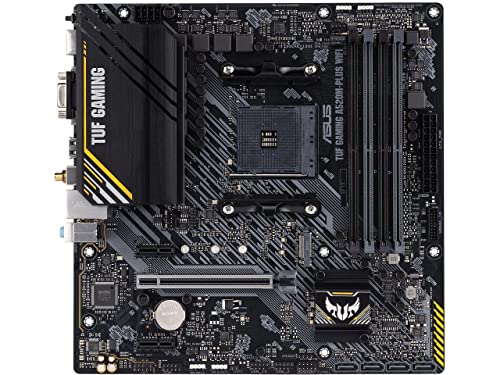
Overview: The ASUS TUF Gaming A520M-PLUS (WiFi) is a microATX AM4 motherboard built for Ryzen 5000, 4000 G-Series, and 3000 Series desktop processors. It is aimed at compact PC builders who want a practical board with TUF styling.
Performance and features: The board includes 802.11ac Wi-Fi, TUF LANGuard, TurboLAN, large VRM and PCH heatsinks, Fan Xpert 2+, BIOS FlashBack, 32Gb/s M.2 support, SATA 6Gb/s, and display outputs for DisplayPort, HDMI, and D-Sub.
Drawbacks to consider: As a microATX board with an A520 platform, it is more basic than higher-end AM4 options and will usually offer fewer expansion possibilities than larger ATX models. Its wireless support is also limited to 802.11ac rather than newer Wi-Fi 6.
Verdict: This motherboard makes the most sense for budget-conscious Ryzen builds, small gaming PCs, or users who want built-in Wi-Fi and straightforward connectivity without paying for premium extras.
What
For related maintenance and equipment benchmarks, review our technical guides on best gaming pcs, examine multitasking gaming desktops, and compare streaming pc builds. You can also reference our analyses on vr desktop performance and high-performance gaming pcs. For industry engineering standards, consult IEEE Computer Society benchmarks.


