Quick Answer: How to Change Lawn Mower Oil Type and Capacity
Quick Answer: Most lawn mowers use SAE 30 or 10W-30 oil depending on climate and engine type. Check your owner’s manual for the exact viscosity grade and capacity (typically 15 to 48 oz). Drain oil while the engine is warm, replace the filter if equipped, refill to the dipstick line, and dispose of used oil at a recycling center or auto parts store. Always tilt the mower away from the carburetor to prevent flooding during drainage.
Oil Type and Viscosity Comparison Chart
The choice between SAE 30 and 10W-30 is the most common decision lawn mower owners face. SAE 30 is a single-viscosity (straight-grade) oil that flows easily at high temperatures but becomes very thick in cool conditions. This makes it ideal for summer-only operation in warm climates. 10W-30 is a multi-grade oil that combines the cold-flow properties of a 10-weight oil with the high-temperature protection of a 30-weight oil, making it suitable for spring, summer, and fall use.
If your lawn mower manual specifies SAE 30 and you live in a region where temperatures consistently exceed 50°F during mowing season, SAE 30 is acceptable and often less expensive. However, 10W-30 is the safer universal choice because it starts more reliably on cooler mornings and provides better protection during engine cold-start, when metal-to-metal contact is greatest. Most modern Briggs & Stratton and Honda mowers default to 10W-30 as their recommended oil, recognizing that many homeowners mow in variable spring and fall conditions. Standard operational and maintenance protocols can be consulted via EPA Clean Air Act standards for non-road small engines.
Temperature Considerations
Check the average outdoor temperature during your mowing season. If you mow from May through September in a hot climate and temperatures rarely drop below 60°F, SAE 30 performs adequately. If you mow March through November or live in a region with cool mornings, use 10W-30. The “W” stands for Winter, and the number preceding it (10) indicates how the oil flows at 0°F, lower numbers mean thinner flow and easier engine starting.
Understanding Oil Capacity: Briggs & Stratton and Other Brands
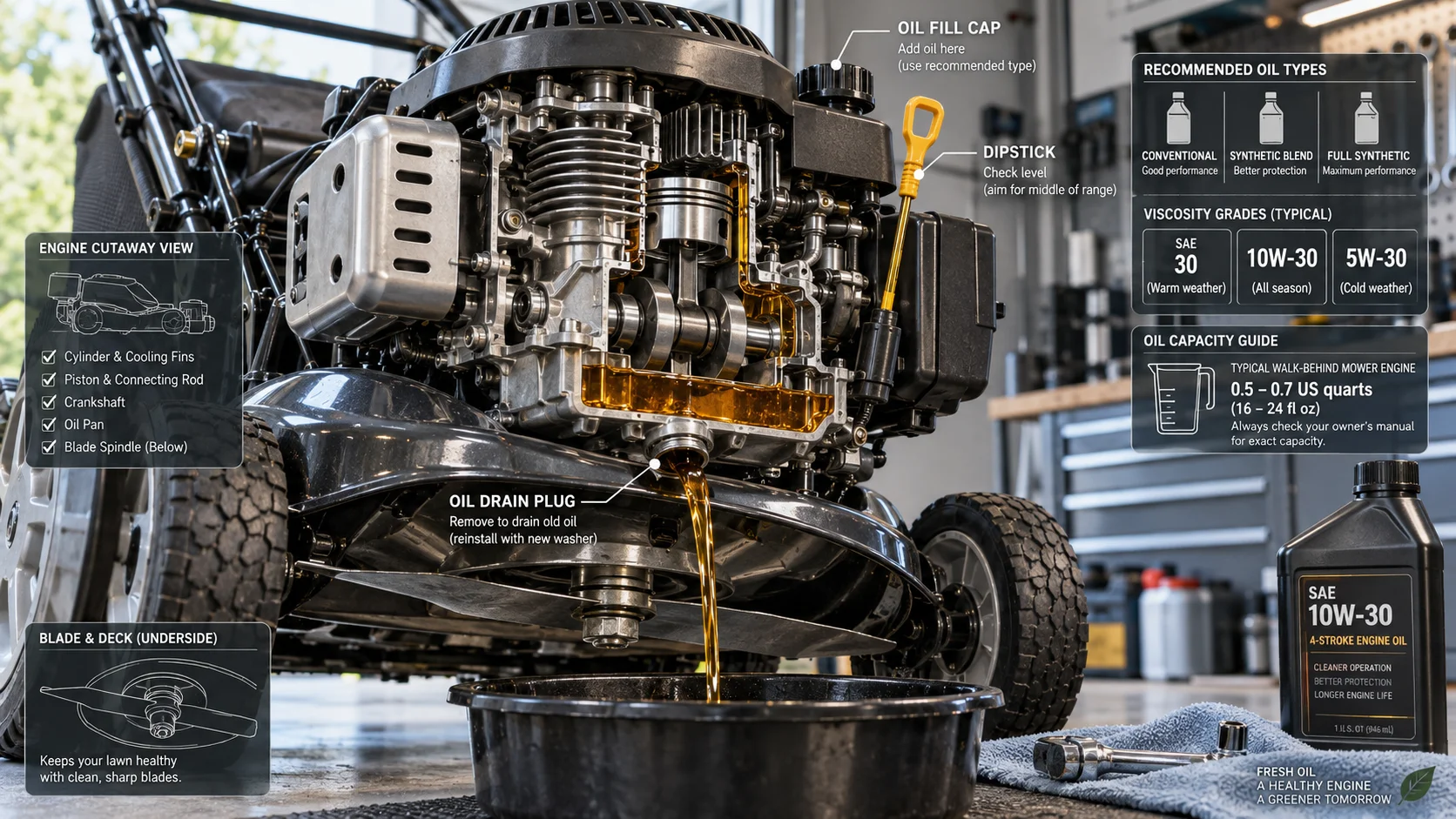
Oil capacity varies significantly depending on engine displacement and type. A small single-cylinder push mower typically holds 15, 20 fluid ounces (0.44, 0.59 liters), while larger riding mowers can hold 48, 64 ounces (1.4, 1.9 liters). Always consult your specific machine’s manual to find the exact capacity, as overfilling can cause smoke, fouled spark plugs, and engine damage, while underfilling leads to inadequate lubrication and accelerated wear. To evaluate matched hardware tolerances, consult our detailed overview of lawn mower spark plug gap chart. For complementary hardware performance, examine our breakdown on self propelled lawn mowers specifications.
Briggs & Stratton Oil Capacity by Engine Series
Briggs & Stratton engines are among the most common in consumer lawn mowers. Their oil capacity depends on the engine displacement:
- Series 625EX (140cc): 15 to 18 fl oz (single-speed walk-behind mowers)
- Series 675EX (190cc): 18 to 20 fl oz (variable-speed and self-propelled mowers)
- Intek Pro (Vertical Shaft): 18 to 22 fl oz (professional-grade push mowers)
- Series 1450 (Horizontal Shaft): 24 to 28 fl oz (generators, small equipment)
- Big Block Series (500cc+): 48 to 52 fl oz (riding mowers and zero-turn models)
Honda Push Mower Oil Change Specifications
Honda GCV series engines (found on premium push mowers like the HRX series) typically use SAE 10W-30 synthetic or conventional oil. Most Honda push mower models hold 16 to 20 fl oz of oil. Honda specifies using their Genuine Synthetic Motor Oil or equivalent API SH-rated oil. Always verify your model by checking the dipstick tube or owner’s manual, as Honda manufactures several engine sizes. The dipstick is the most reliable method for confirming proper fill level, oil should reach the full line without exceeding it.
Step-by-Step Oil Change Instructions
Preparation and Safety
Before beginning an oil change, ensure the mower is on level ground and the engine has cooled for at least 5 minutes if recently running (warm oil drains more completely but is still hot enough to cause burns). Disconnect the spark plug wire or remove the spark plug cap to prevent accidental starting. Locate the drain plug or oil drain port, most push mowers have a drain plug at the lowest point of the crankcase or an oil filler/drain tube that doubles as an access point.
Tilting the Mower Without Flooding the Carburetor
This is critical. If you tilt a mower in the wrong direction, oil and fuel can flow into the carburetor and spark plug, causing hard starts or no-starts. Identify which side of the mower has the carburetor and air filter, typically the side with visible white or yellow plastic tubing. Always tilt the mower so the carburetor side is elevated (tilts up), not down. This prevents oil from flowing toward the carburetor while you drain the crankcase from the opposite (lower) side.
For most horizontal-shaft push mowers, tilt the mower toward the handlebar end so the carburetor (usually near the top) remains above the oil level. For vertical-shaft riding mowers, consult the manual, as the orientation may differ. When in doubt, take a photo of your mower before tipping and identify the carburetor location, it will have fuel lines and an air filter attached.
Draining Used Oil
Place a drain pan (a 2-quart capacity is sufficient for most push mowers) directly under the drain plug or drain tube. Remove the drain plug by turning it counterclockwise with the appropriate wrench, typically a 10mm, 12mm, or 14mm socket. If your mower has a drain tube with a bolt or screw-cap, unscrew it and pull out the tube, directing it into the drain pan. Allow the oil to flow for 1 to 2 minutes. For the most thorough drain, gently rotate the engine by hand to shift internal oil pools; however, do not rotate the engine forcefully or overfill the crankcase.
Once drainage slows to occasional drips, replace the drain plug or reinstall the drain tube and tighten firmly but not excessively (over-tightening can strip the threads and cause future leaks). If your mower has an external oil filter (common on larger engines and riding mowers), now is the time to replace it. Use an oil filter wrench to remove the old filter by turning counterclockwise. Wipe the filter head seal with a clean cloth and apply a thin coat of new oil to the rubber gasket of the replacement filter. Screw the new filter on by hand until the gasket contacts the seal, then tighten an additional three-quarter turn.
Refilling with Fresh Oil
Return the mower to level ground and orient it properly (carburetor side up if you tilted it). Locate the oil filler cap, it is usually marked with an oil can symbol and located on the top of the engine. Remove the cap and set it aside on a clean surface. Insert a clean funnel into the filler opening. Slowly pour fresh oil of the specified grade (SAE 30, 10W-30, etc.) into the funnel, watching the level rise. Stop before the oil reaches the filler neck.
Now check the dipstick. Most lawn mower dipsticks are attached directly to the filler cap. Wipe it clean with a lint-free cloth, reinsert it fully (you may need to screw it back in), and remove it again to read the level. The oil should reach the “Full” line on the dipstick. If it falls short, add a small amount more (typically 2, 4 fl oz). If you overfill, use a turkey baster or syringe to extract excess oil into the drain pan. Reinstall the filler cap firmly and wipe any spilled oil from the outside of the engine with a clean rag. To compare alternative configurations, check our hands-on review of litheli vs worx compact mower.
Post-Change Verification
Run the engine for 20 to 30 seconds to circulate the new oil through the crankcase and verify there are no leaks at the drain plug, filter, or filler cap. Stop the engine and wait 2 to 3 minutes for oil to settle, then recheck the dipstick to confirm the level. Small leaks at the drain plug may be sealed by tightening slightly; if a leak persists, the drain plug may need replacement. Allow the engine to cool completely before handling, then dispose of the used oil properly (see Recycling Used Motor Oil section below).
Oil Change Intervals and Maintenance Schedule
Most lawn mower manufacturers recommend changing oil every 50, 100 operating hours or once per season, whichever comes first. For homeowners who mow weekly, this typically means one oil change per mowing season (spring or early summer). Heavy-use commercial or rental mowers may require oil changes every 50 hours. Synthetic oils (such as Briggs & Stratton Premium Synthetic or Honda Genuine Synthetic) often allow extended intervals (up to 100 hours or one season), but this depends on operating conditions and dust exposure. Users looking for related component recommendations can explore our ego vs greenworks battery mower showdown breakdown.
Check the oil level every time you mow, a quick dipstick inspection takes 30 seconds and prevents catastrophic engine damage. If the level drops between changes, look for leaks or check if the engine is burning oil (white or blue smoke during operation indicates excessive oil consumption). Never mix old and new oil; always perform a complete drain and refill.
Recommended Hardware & Essential Equipment
Performing an oil change requires minimal tools, but having quality equipment on hand makes the job cleaner, faster, and safer. The items below are specifically chosen to handle standard push and riding mower oil changes without damage to seals, threads, or filters.

Pros
- Precise EPOS positioning system ensures accurate navigation without boundary wires
- Handles slopes up to 45 percent and works rain or shine for year-round reliability
- Full app control for schedules, patterns, cutting height, and theft tracking
- Bundle includes ready-to-use cordless trimmer with dual-direction head and power boost
- Simple blade swaps and hose-down cleaning make ongoing upkeep quick and easy
Cons
- Maximum mowing capacity limited to 0.5 acres, unsuitable for larger properties
- Virtual mapping setup requires manually driving the mower to define boundaries, adding initial time investment
- Performance details such as exact battery runtime for the mower are not specified in available data
The Husqvarna 410iQ Automower Bundle combines the brand's robotic mower with the 320iL cordless string trimmer into a complete lawn care package. Built for American yards, the 410iQ features a rugged bumper, larger wheels, and solid construction that crosses paths and driveways smoothly while the included trimmer arrives with a 4 Ah battery and charger for immediate use. The overall design prioritizes wire-free convenience and ease of maintenance from the first unboxing.
In performance, the Exact Positioning Operating System uses satellite communication for centimeter-level accuracy, allowing the mower to handle slopes up to 45 percent and cut heights from 1 to 4 inches without tearing grass. App-guided virtual mapping replaces boundary wires, and the mower operates rain or shine with customizable schedules and patterns. The companion 320iL trimmer delivers a 16-inch cutting width, dual-direction head to keep clippings off beds, and a power boost mode offering 20 percent more power for heavy weeds, all while remaining 25 percent lighter with active cooling for consistent runtime.
Considerations include the 0.5-acre capacity limit, which may restrict use on bigger properties, and the initial virtual mapping process that requires driving the unit around the lawn. Available data also lacks specific battery life figures for the mower itself, so owners should plan for typical robotic charging cycles based on lawn conditions.
This bundle delivers excellent value for homeowners seeking automated mowing plus versatile cordless trimming on medium-sized properties. Those with complex landscaping who value app control, precision navigation, and a ready-to-go trimmer kit will benefit most from the Husqvarna 410iQ and 320iL combination.

Pros
- True wire-free setup with virtual boundaries and EPOS for accurate navigation without cables
- Strong slope performance up to 45 percent plus ability to cross hard surfaces without damaging turf
- Complete bundle that includes mower, charging station, reference station, blades, and storage hook
- App-driven scheduling, height adjustment, and theft protection for convenient hands-off operation
Cons
- Maximum capacity limited to 0.5 acres so larger properties will need a higher-capacity model
- Requires mounting and powering the separate RS1 EPOS reference station for full positioning accuracy
- Storage hook is compatible only with the 410iQ, 420iQ, and 440iQ series models
The Husqvarna 410iQ Automower bundle is a complete wire-free robotic mowing system built for American lawns up to 0.5 acres. It arrives with the mower, charging station, RS1 EPOS reference station, blades, and a compact wall-mounted storage hook. The design emphasizes durability with a rugged bumper and larger wheels that handle driveways and paths while leaving no tracks or torn grass.
In real-world use the Exact Positioning Operating System communicates with satellites and the dedicated RS1 station to deliver centimeter-level accuracy. Users drive the mower once to create virtual boundaries and stay-out zones through the app. The unit climbs slopes of 45 percent (24 degrees), cuts heights from 1 to 4 inches, and runs rain or shine. Maintenance stays simple with quick blade changes and hose cleaning. The Husqvarna Connect app lets owners change schedules, patterns, cutting height, download updates, and track the mower with its built-in anti-theft alarm.
Considerations include the 0.5-acre limit and the need to install and power the RS1 reference station for optimal performance. The storage hook works only with 410iQ, 420iQ, and 440iQ models. Setup of virtual maps requires a short guided drive around the property.
Overall the 410iQ bundle suits homeowners with mid-size complex lawns who want true wire-free automation, precise navigation, and easy seasonal storage. It delivers reliable daily results for those ready to adopt satellite-guided robotic mowing.

Pros
- Powerful 9hp engine combined with tracked chassis for strong performance on complex terrains
- Long 1968ft wireless remote range significantly improves safety on slopes and marshes
- 45° climbing capacity and all-terrain design conquer hills, gravel, and wetlands effectively
- Electric start ensures fast reliable machine activation in varied conditions
- Includes snowplow function for year-round multi-purpose utility beyond mowing and weeding
Cons
- Requires constant remote operator input rather than fully autonomous navigation
- Lacks detailed published specs on cutting width, weight, or fuel capacity for precise planning
- Seller message check needed post-order which may delay delivery if overlooked
The SYKEND 9hp Remote-Controlled Lawn Mower stands out as a compact tracked all-terrain unit built for demanding outdoor maintenance. Its robust track system and solid chassis give an immediate impression of durability suited to slopes, gravel, and muddy ground rather than delicate residential lawns. Brand focus on remote operation and multi-functionality positions it as a heavy-duty tool for larger properties.
In performance the mower leverages its 9hp power with 45° climbing capacity and wireless remote reach of up to 1968ft to handle rolling hills, terraces, grassy wetlands, and overgrown areas. Electric start supports quick activation while the tracked design maintains stability and even mowing results across rugged sections of estates, farms, municipal gardens, and golf course roughs. The added snowplow and weeder capabilities expand seasonal usefulness.
Drawbacks center on the need for active remote control by an operator instead of hands-free autonomy, plus limited published technical details on dimensions or runtime. Users must also monitor seller messages after ordering to avoid delivery schedule impacts. These factors may limit appeal for those seeking fully automated or plug-and-play solutions.
Overall the SYKEND 9hp model delivers strong value for property managers, farmers, and groundskeepers facing complex terrain where traditional mowers fail. It suits large-area users who prioritize remote safety, climbing power, and multi-season versatility over basic robotic autonomy.

Pros
- High-efficiency 1600W 24V brushless motor ensures lasting power and reduced wear
- Crawler tracks provide excellent grip and stability for extreme slopes and varied landscapes
- Remote adjustable cutting height chassis offers flexible mowing customization
- Dual manganese steel blades deliver precision cutting with natural mulching benefits
- Hybrid power and snow plow support multi-season all-terrain use
Cons
- Requires continuous remote control input and lacks full autonomous navigation
- Oil-electric hybrid system may need fuel handling and extra maintenance attention
- Product data omits specifics on cutting width, overall dimensions, and runtime
The AIWEIYA Remote Control Lawn Mower with Snow Plow is a crawler track all-terrain machine built for challenging outdoor spaces. Its oil-electric hybrid design and adjustable chassis create a sturdy first impression suited to large turf and extreme slopes.
In performance, the 1600W 24V permanent magnet brushless motor paired with a precision gearbox supplies reliable power and durability. Dual manganese steel blades cut cleanly while mulching clippings for soil benefits. Crawler tracks enable stable travel across lawns, hills, reed beds, terraces, orchards, parks, and wetlands, with remote 360 degree rotation and smooth climbing.
Key considerations include the need for ongoing remote operator control instead of autonomous function. The hybrid power setup may involve fuel management. Available details do not cover cutting width or full dimensions.
This mower delivers strong value for property owners managing large or steep terrains who want remote convenience plus snow plow versatility for multi-season work.
Recycling Used Motor Oil: Legal Disposal Options
Used motor oil is a hazardous waste and must never be poured down storm drains, into soil, or into the trash. One quart of used oil can contaminate up to 250,000 gallons of groundwater. Most municipalities offer free or low-cost recycling programs.
Disposal Options
- Auto Parts Retailers: AutoZone, O’Reilly, Advance Auto Parts, and NAPA accept used oil for free. Some offer small discounts on new oil purchases if you bring in old oil.
- Municipal Hazardous Waste Facilities: Most cities host collection events monthly or maintain permanent drop-off locations. Call your local waste management department or visit Earth911.com to find nearby sites.
- Waste Oil Recycling Centers: Dedicated recycling facilities and service stations often accept oil in bulk.
- Quick-Lube Shops: Jiffy Lube, Valvoline Instant Oil Change, and independent shops may accept oil from do-it-yourselfers for a small fee (typically $2 to 5).
Store used oil in a sealed, labeled container (a clean milk jug works in a pinch, but dedicated oil containers are more spill-proof). Keep it in a cool, dry place away from children and pets until you can transport it to a recycling center. Never mix used oil with other liquids, fuels, or solvents, as this contaminates the recycling process.
Common Questions on How To Change Lawn Mower Oil Answered
Can I use car oil in my lawn mower?
Yes, but with caution. Car engine oil (10W-30 or 10W-40) meets similar viscosity standards and can function in a lawn mower if no mower-specific oil is available. However, lawn mower engines differ from car engines, they run hotter, have less complex filtration, and operate at higher RPMs (3,000 to 3,600 RPM vs. 1,500 to 2,500 RPM for cars at highway speeds). Lawn mower oils are formulated to handle these conditions with additives that reduce foam and protect under extreme heat. For best performance and warranty compliance, always use oil labeled for small engines (Briggs & Stratton, Honda, Kohler, Toro, or equivalent generic small-engine oil).
What happens if I overfill the oil?
Overfilled oil spills onto the piston and valve components, increasing internal pressure and causing the crankcase to overflow through the breather tube. This results in blue or white smoke from the exhaust, fouled spark plugs that prevent starting, sluggish engine performance, and potential hydro-lock (where excess oil prevents piston movement, causing catastrophic engine failure). If you overfill, use a syringe or turkey baster to extract oil until the dipstick reads “Full.” Even 2 to 3 fl oz of excess oil can cause these issues in small mowers.
How do I know if my mower’s carburetor flooded with oil?
A flooded carburetor (caused by tilting the mower incorrectly during oil changes) exhibits the following: engine refuses to start despite multiple pull attempts, spark plug is visibly wet or coated with black oil, strong smell of raw fuel without starting, or white/blue smoke accompanied by fuel-like odor. To recover, disconnect the spark plug wire, remove the spark plug, and set it aside to dry for 30 minutes. Wipe the plug dry with a clean cloth. Return to the spark plug hole and gently pull the recoil cord 5 to 6 times without the spark plug installed, this clears excess fuel from the combustion chamber. Reinstall the dry plug, reconnect the wire, and attempt starting. If the engine still will not start, leave the mower for 1 to 2 hours with the spark plug removed to allow residual fuel to evaporate, then retry.
Should I use synthetic or conventional oil?
Synthetic oils offer longer drain intervals (up to 100 operating hours vs. 50 for conventional), better cold-start performance, and superior heat stability. However, they cost 2 to 3 times more per quart. For casual homeowners mowing once weekly, conventional oil is cost-effective and adequate if changed yearly. Commercial operators or those mowing in extreme conditions should use synthetic to maximize intervals and reduce downtime. Check your mower manual, some manufacturers void warranties if synthetic oil is not used in premium models, while others approve it unconditionally. Briggs & Stratton and Honda both offer synthetic options and approve equivalent aftermarket synthetics meeting their specifications.
Can I skip an oil change if the mower hasn’t been used much?
No. Even if a mower sits unused for an entire season, old oil must be changed before the next mowing session. Oil degrades over time through oxidation and moisture absorption, losing its protective properties regardless of engine running hours. Additionally, old fuel remaining in the tank and carburetor breaks down into gum and varnish, potentially clogging the fuel system. At minimum, perform a complete oil change and fuel system cleaning (or fuel additive treatment) at the start of each mowing season, even if the mower only ran a few hours the previous year.
Conclusion
Changing your lawn mower’s oil is a straightforward task that extends engine life, improves performance, and prevents costly repairs. The key decisions, selecting between SAE 30 and 10W-30, confirming your engine’s oil capacity, and tilting the mower correctly to prevent carburetor flooding, are easily mastered with the knowledge in this guide. Always consult your owner’s manual for model-specific instructions, use the correct oil grade, fill to the dipstick line, and recycle used oil responsibly. With annual or seasonal oil changes and regular level checks, your mower will provide reliable service for many years.
Engine Oil Reading Notes
Oil type and capacity should match the engine manual, and used oil disposal should follow local rules. Readers who also maintain cutting tools can look at the heavy-duty chainsaw buyer guide, and American National Standards Institute (ANSI) offers useful industry background on engines and fluids.