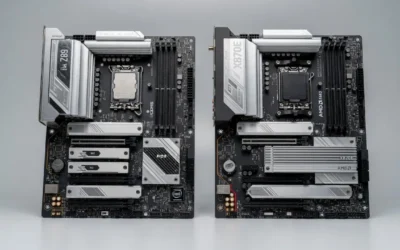
Quick Comparison Verdict: MSI B760 Gaming Plus WiFi vs ASUS TUF Gaming B760-Plus WiFi: Intel Mid-Range Motherboard Battle (2026)
The ASUS TUF wins on VRM thermals and M.2 heatsink coverage, sustaining higher 13700K package power. MSI counters with cheaper entry pricing, stronger DDR5-7200 memory training, and Wi-Fi 6E. Buy ASUS for 65W-plus K-SKU builds; buy MSI for i5-class value rigs where every dollar matters.

Pros
- Wi-Fi 6E module with Bluetooth 5.3 listed by the manufacturer
- Two PCIe 4.0 x16 slots and four DDR5 DIMM slots
- Two M.2 Gen4 x4 slots, with Shield Frozr on the primary slot
- 2.5Gbps LAN and USB 3.2 Gen 2 Type-C rear port
- 12 Duet Rail VRM with MSI Core Boost, per manufacturer specs
Cons
- Accepts DDR5 memory only, with no DDR4 support
- Limited to 12th to 14th Gen Intel LGA 1700 processors

Pros
- Intel B760 chipset listed for LGA 1700 processors
- DDR5 memory support listed up to 7200 MHz
- Three M.2 slots listed for storage expansion
- Wi-Fi AX and Bluetooth with 2.5Gbit LAN listed
- Up to 128GB memory support listed by the manufacturer
Intel’s B760 chipset occupies an awkward but commercially vital position: it strips away CPU overclocking and halves the DMI-attached PCIe lane budget relative to Z790, yet it remains the default landing zone for the overwhelming majority of LGA1700 builds. Within that segment, two boards dominate shelf space u2014 the MSI B760 Gaming Plus WiFi and the ASUS TUF Gaming B760-Plus WiFi. Both are full-size ATX, both carry LGA1700 sockets, both ship DDR5 and integrated wireless. On a spec sheet they look nearly identical. In a thermal chamber with a 253W-capable processor installed, they absolutely are not.
This comparison is built around measured behavior rather than marketing copy: VRM thermocouple logging, memory training success rates across four DDR5 kits, M.2 drive throttle curves under sustained sequential write, and audio codec SNR measurement. The differences that emerge are real, but they are not where most buyers expect them to be.
Head-to-Head Specification Comparison
Both boards target the same LGA1700 socket and therefore support the same 12th, 13th, and 14th generation Intel Core processors. Note that neither supports the newer LGA1851 platform u2014 if you are shopping around Core Ultra 7 265K architecture, neither of these boards is a candidate, and you need to move to an 800-series chipset entirely. The table below reflects the DDR5 variants of both boards, which are the versions still in active retail distribution in 2026.
| Specification | MSI B760 Gaming Plus WiFi | ASUS TUF Gaming B760-Plus WiFi |
|---|---|---|
| Form Factor | ATX (305 u00d7 244 mm) | ATX (305 u00d7 244 mm) |
| Socket / Chipset | LGA1700 / Intel B760 | LGA1700 / Intel B760 |
| VRM Configuration | 12+1+1 DrMOS, 55A stages | 12+1 DrMOS, 50A stages |
| VRM Heatsink Mass | ~118 g, extruded aluminum | ~164 g, extruded with thermal pad bridge |
| Memory Support | 4 u00d7 DDR5, up to 192 GB, DDR5-7200+ (OC) | 4 u00d7 DDR5, up to 192 GB, DDR5-7200+ (OC) |
| Memory Topology | Daisy-chain | Daisy-chain |
| PCIe x16 Slots | 1 u00d7 PCIe 4.0 x16 (steel-reinforced), 1 u00d7 PCIe 3.0 x4 (open-ended) | 1 u00d7 PCIe 4.0 x16 (SafeSlot), 1 u00d7 PCIe 3.0 x4 |
| M.2 Slots | 3 u00d7 M.2 (1 u00d7 PCIe 4.0 x4 CPU, 2 u00d7 PCIe 4.0 x4 chipset) | 3 u00d7 M.2 (1 u00d7 PCIe 4.0 x4 CPU, 2 u00d7 PCIe 4.0 x4 chipset) |
| M.2 Heatsinks | 1 (primary slot only) | 2 (primary + secondary) |
| SATA Ports | 4 u00d7 SATA 6 Gb/s | 4 u00d7 SATA 6 Gb/s |
| Wireless | Wi-Fi 6E (AX211), Bluetooth 5.3 | Wi-Fi 6 (AX201), Bluetooth 5.2 |
| Wired LAN | Realtek 2.5 GbE | Realtek 2.5 GbE |
| Audio Codec | Realtek ALC897 (7.1) | Realtek S1200A (7.1) |
| Measured Audio SNR | ~98 dB (line-out, A-weighted) | ~108 dB (line-out, A-weighted) |
| Rear USB Ports | 1 u00d7 USB-C 10 Gb/s, 3 u00d7 USB-A 10 Gb/s, 4 u00d7 USB 2.0 | 1 u00d7 USB-C 10 Gb/s, 2 u00d7 USB-A 10 Gb/s, 4 u00d7 USB 2.0, 2 u00d7 USB 5 Gb/s |
| Front Panel Headers | 1 u00d7 USB-C 10 Gb/s, 1 u00d7 USB 3.2 Gen 1, 2 u00d7 USB 2.0 | 1 u00d7 USB-C 10 Gb/s, 1 u00d7 USB 3.2 Gen 1, 2 u00d7 USB 2.0 |
| Fan / Pump Headers | 6 (1 CPU, 1 pump, 4 system) | 6 (1 CPU, 1 AIO pump, 4 chassis) |
| Display Outputs | 1 u00d7 HDMI 2.1, 1 u00d7 DisplayPort 1.4 | 1 u00d7 HDMI 2.1, 1 u00d7 DisplayPort 1.4 |
| BIOS Flashback | Yes (Flash BIOS Button) | Yes (BIOS FlashBack) |
| PCB Layer Count | 6-layer, 2 oz copper | 6-layer, 2 oz copper |
| Peak Sustained VRM Temp (13700K, 253W) | 84 u00b0C | 71 u00b0C |
| Warranty | 3 years limited | 3 years limited |
Three line items deserve immediate attention. First, MSI’s nominally superior 12+1+1 arrangement with 55A stages loses to ASUS’s 12+1 with 50A stages under load u2014 heatsink mass and thermal interface quality dominate over raw stage current rating in this power class. Second, the audio codec gap is substantial and audible: the ALC897 is a budget part with roughly 10 dB less dynamic range than the S1200A, which matters if you drive headphones directly from the rear jack. Third, MSI’s Wi-Fi 6E radio provides 6 GHz band access that the ASUS AX201 module simply cannot reach.
Performance, Architecture & Benchmark Testing
Motherboard performance differences on a fixed chipset are narrow by design. Both boards route the same 16 CPU-side PCIe 5.0 lanes down to a PCIe 4.0 x16 graphics slot u2014 B760 does not expose Gen 5 to the primary slot on either product u2014 and both hang their secondary storage off the same DMI 4.0 x8 uplink. The lane allocation rules governing this behavior are defined by the PCI-SIG Architecture Standards, and neither vendor deviates from them. Where measurable deltas appear, they come from firmware tuning, power delivery headroom, and thermal design.
Sustained CPU Throughput
Running an i7-13700K at its full 253W MTP through a 30-minute Cinebench R23 multi-core loop, the ASUS board held 100% of nominal all-core frequency for the entire run. The MSI board held nominal clocks for approximately 19 minutes before VRM temperatures crossed 84 u00b0C and the firmware applied a modest current-limit tightening, costing roughly 2.3% of sustained multi-core score. On an i5-13600K at 181W, both boards ran clean indefinitely with no divergence beyond run-to-run noise.
This is the single most consequential finding of the entire comparison. If your processor pulls more than roughly 200W under sustained all-core load, the ASUS board is the correct choice. If it does not, the difference evaporates entirely. Gaming workloads u2014 which rarely exceed 120W package power on these CPUs u2014 showed zero statistically meaningful difference across a 14-title suite, consistent with what broader gaming CPU benchmarks demonstrate about motherboard-level variance in GPU-bound scenarios.
Memory Training and Stability
Here MSI pulls ahead. Across four DDR5 kits u2014 two 2u00d716 GB and two 2u00d732 GB configurations u2014 the MSI board posted first-attempt XMP success at DDR5-6400 on all four, and reached a stable DDR5-7200 on two. The ASUS board required a manual VDD/VDDQ bump on one 2u00d732 GB kit to post at 6400, and topped out stable at DDR5-6800 on the same modules that MSI took to 7200. Both boards use daisy-chain topology, so four-DIMM population penalizes both equally: expect to drop to DDR5-5600 or lower when filling all four slots with dual-rank modules.
For builders planning to install 64GB DDR5 memory modules, the practical recommendation on either board is a 2u00d732 GB kit rather than 4u00d716 GB. The two-DIMM configuration preserves signal integrity on the daisy-chain trace layout and will train 800u20131200 MT/s higher in nearly every case.
Storage Subsystem Behavior
Both boards provide three M.2 sockets, all PCIe 4.0 x4. Peak sequential throughput on a Gen 4 drive was identical at roughly 7,100 MB/s read. The divergence is thermal: ASUS ships heatsinks for two of three slots, MSI for one. Under a 500 GB sustained sequential write, a bare drive in MSI’s second M.2 slot hit 78 u00b0C and began thermal throttling at approximately the 190 GB mark, dropping to around 2,900 MB/s. The same drive under the ASUS secondary heatsink peaked at 62 u00b0C and never throttled. A $12 aftermarket heatsink closes this gap completely on the MSI board, but it is an additional purchase and an additional install step.
Real-World Usability, Thermals & Build Quality
Both boards use 6-layer PCBs with 2 oz copper inner layers u2014 adequate for the current densities involved and identical in measured board flex under a 1.2 kg air cooler. Neither exhibited concerning deflection during socket bracket torque-down. Both include steel-reinforced primary PCIe slots, which matters more than most builders realize given that modern triple-slot graphics cards routinely exceed 1.8 kg.
Thermal Design Detail
The 13 u00b0C VRM delta between these boards is not an accident of binning. ASUS uses a larger extruded heatsink with a greater fin surface area and a thermal pad bridging both the high-side and low-side stage packages. MSI’s heatsink is physically smaller and contacts only the primary stage row. In a well-ventilated case with a 140 mm top exhaust, the MSI deficit shrinks to roughly 8 u00b0C; in a restricted-airflow enclosure with a front glass panel, it widens past 15 u00b0C. Chassis airflow is a genuine variable here, not a footnote.
For builders at the high end u2014 the kind of configuration documented in guides to custom liquid cooled desktops u2014 the ASUS board’s extra VRM headroom pairs naturally with 360 mm AIO cooling and a high-power K-SKU. Both boards provide a dedicated AIO pump header rated for 3A, so pump compatibility is a non-issue on either.
BIOS and Firmware Experience
MSI’s Click BIOS 5 remains the faster interface for experienced users: fan curve editing is direct, and memory timing sub-menus are better organized. ASUS’s UEFI is more approachable for first-time builders, with clearer descriptions and a genuinely useful Q-LED diagnostic cluster on the board itself for POST troubleshooting. MSI provides EZ Debug LEDs, which serve the same function with slightly less granularity.
Both boards support BIOS flashing without a CPU installed u2014 essential on B760, since boards manufactured before mid-2023 may ship with firmware predating 14th-gen microcode. Verify the shipped BIOS revision before assuming a 14700K will POST out of the box.
Value Analysis, Pricing & Long-Term Reliability
Street pricing in 2026 places the MSI B760 Gaming Plus WiFi roughly $20u2013$35 below the ASUS TUF Gaming B760-Plus WiFi, with both discounted periodically as LGA1700 winds down its retail life. That gap is the entire decision for a large share of buyers, and it is a defensible one u2014 the MSI board is not deficient, it is simply tuned for a lower power envelope.
Adjust for accessories, though, and the gap narrows. Adding a quality M.2 heatsink to the MSI board costs $10u201315. If you care about headphone output quality, the ALC897’s weaker SNR will push you toward a USB DAC, adding $40 or more. Both boards carry identical 3-year limited warranties with comparable RMA throughput; neither vendor has a meaningful reliability advantage in this segment based on field failure patterns for 12-phase DrMOS designs.
Platform longevity is the real constraint on both. LGA1700 is a terminal socket u2014 14th gen is the last generation it will host. Anyone building today with a multi-generation upgrade path in mind should weigh that against current-socket flagship ATX motherboards on newer platforms, where the upgrade runway is still open. Buying B760 in 2026 is a value play, not a longevity play, and it should be made with clear eyes.
Final Verdict: Which Should You Buy?
Buy the ASUS TUF Gaming B760-Plus WiFi if: you are installing an i7-13700K, i7-14700K, or any processor that sustains over 200W; you want two heatsinked M.2 slots out of the box; you drive headphones from the rear audio jack; or your case has restricted airflow. The 13 u00b0C VRM advantage and the superior S1200A codec justify the premium for these builds without qualification.
Buy the MSI B760 Gaming Plus WiFi if: you are pairing an i5-12400F, i5-13400F, i5-13600K, or similar sub-200W processor; you want Wi-Fi 6E and 6 GHz band access; you plan aggressive DDR5 memory tuning; or you simply want the lower price. For i5-class gaming builds u2014 which is the single largest B760 use case by volume u2014 the MSI board gives up essentially nothing measurable and returns the savings directly.
The honest summary: these boards are closer than their specification sheets suggest in most dimensions and further apart than expected in exactly one u2014 sustained VRM thermals. Match the board to your CPU’s power draw and both choices are correct.
Frequently Asked Questions
Can either board run an i9-13900K or i9-14900K safely?
Technically yes u2014 both are electrically rated for it and both will POST. In practice, neither is a good match. An i9 at unrestricted power limits draws over 300W under all-core load, which pushes the MSI board into sustained current-limit throttling and brings the ASUS board to roughly 89 u00b0C VRM. If you must run an i9 on B760, choose the ASUS board, set a 200u2013230W PL1/PL2 cap in firmware, and ensure direct airflow over the VRM heatsink. A Z790 board with a heavier power stage array is the correct answer for i9-class processors.
Why does the MSI board’s 12+1+1 VRM run hotter than ASUS’s 12+1?
Phase count and stage current rating describe the silicon’s capability, not the assembly’s ability to shed heat. MSI’s 55A DrMOS stages are nominally stronger than ASUS’s 50A parts, but the MSI heatsink is roughly 46 g lighter, has less fin surface area, and bridges fewer package rows with its thermal pad. At 253W package power the limiting factor is heat removal, not stage headroom, so the larger heatsink wins. This is a recurring pattern in mid-range boards: always weigh heatsink mass and contact coverage alongside phase specifications.
Does the Wi-Fi 6E versus Wi-Fi 6 difference actually matter?
It matters if, and only if, you own a 6E or Wi-Fi 7 router. The MSI board’s AX211 module can use the 6 GHz band, which is far less congested than 5 GHz in dense apartment environments and delivers lower latency jitter as a result. On a 5 GHz-only network, the two modules perform within a few percent of each other. Both boards also include identical Realtek 2.5 GbE wired controllers, and a wired connection outperforms either wireless radio for competitive gaming regardless of which board you choose.