Quick Answer: Choosing the Best Robot Mowing
When choosing robot mowing in 2026, prioritize navigation accuracy (RTK or dual LiDAR for centimeter-level mapping), maximum lawn capacity matching your acreage, slope handling above 20-45%, and AI obstacle detection covering 200+ object types to ensure safe, consistent performance. These factors, combined with adjustable cutting heights from 0.75-4 inches and auto-recharge resume functions, determine which of the top-rated models…

Pros
- True wire-free installation using app-driven virtual boundaries simplifies setup on complex American lawns.
- EPOS precision navigation paired with radar obstacle avoidance ensures thorough, track-free mowing.
- Wide 1-4 inch cut-height range and 45% slope capability handle varied terrain effectively.
- Robust app control covers scheduling, pattern selection, height adjustment, and over-the-air updates.
- Includes anti-theft GPS tracking, 4-year warranty, and a full year of free replacement blades.
Cons
- Maximum mowing capacity is limited to 0.5 acres, restricting use on larger properties.
- Full accuracy requires proper placement of the included RS1 EPOS reference station.
- Initial virtual mapping requires the user to manually drive the mower via the app, which takes time and care.
The Husqvarna Automower 410iQ is a premium wire-free robotic lawn mower engineered specifically for American lawns. As part of the iQ Series from the world leader in robotic mowing, it arrives with a durable chassis featuring larger wheels, a robust bumper for crossing varied surfaces, a charging station, the RS1 EPOS reference station, and all materials needed for standard installation.
Performance centers on the Exact Positioning Operating System that supplies centimeter-accurate location data and onboard radar that helps the mower avoid obstacles without tearing grass or leaving tracks. It manages up to 0.5 acres and slopes of 45 percent while offering the widest adjustable cut height range of 1 to 4 inches. The Husqvarna Connect app gives complete control over mowing schedules, cutting height, patterns such as random, striped or checkerboard, and software updates. Security is reinforced by an anti-theft alarm and real-time GPS tracking, and the unit is hose-washable for easy cleanup after use.
Considerations include the 0.5-acre capacity limit that makes it unsuitable for bigger yards, the need to correctly install the RS1 EPOS reference station for full precision, and the requirement to create a virtual map by driving the mower around the lawn with the smartphone app, which demands an initial investment of time and accuracy.
The Automower 410iQ delivers the most value to homeowners with medium-sized lawns who want true wire-free convenience, advanced navigation, and reliable app-based management. It is especially appealing for those seeking a low-maintenance automated mower backed by a strong warranty and a year of free blades, making it a practical long-term lawn care solution.

Pros
- Superior navigation precision from combined 360° LiDAR and dual-camera AI vision system.
- Strong all-wheel-drive performance handling up to 80% slopes and 50 mm curbs or roots.
- Advanced real-time detection of over 300 obstacle types powered by a high-speed AI chip.
- Powerful dual 88W cutting motors with density-based auto-adjustment and solid 135-minute battery life.
- Flexible 15-zone management with no-go areas and multiple efficient path patterns.
Cons
- Coverage capacity limited to 0.37 acres so larger properties may need multiple units or sessions.
- 135-minute runtime and 400m²/h rate can require recharging cycles for denser or full-yard coverage.
- Cutting height range of 2.2 to 4.0 inches offers less flexibility for users wanting shorter cuts.
The Mammotion LUBA 3 AWD 1500H is a high-end robotic lawn mower built for homeowners managing yards up to 0.37 acres. It combines robust all-wheel-drive construction with advanced sensing hardware including a 360° LiDAR unit and dual-camera AI vision. Immediate impressions highlight a purpose-built design focused on autonomy and terrain adaptability, complete with an included charging station and spare blades for straightforward setup.
In performance the dual positioning system delivers ±1 cm accuracy while mapping up to 230 ft and detecting over 300 obstacle types via a 10 TOPS AI chip. Four independent motors handle 80% slopes and 50 mm obstacles with omni-wheel pivots and adaptive suspension. Dual 88W motors with 6-blade discs auto-adjust for grass density, supported by a 9.4Ah battery providing 135 minutes of runtime at roughly 400m² per hour. Intelligent path options such as zigzag or checkerboard plus 15 multi-zone support with no-go areas enable efficient coverage and personalized layouts.
Considerations include the 0.37-acre limit which may not suit bigger properties and the 135-minute runtime that can necessitate mid-job recharges in denser grass. The cutting height starts at 2.2 inches so users preferring lower cuts have fewer options. These factors stem directly from the core specifications rather than external feedback.
Overall the Mammotion LUBA 3 AWD 1500H delivers strong value for owners of mid-sized complex lawns who prioritize precise navigation, steep-slope capability, and multi-zone automation. It is best suited for those seeking low-supervision results on varied terrain within its stated coverage range.
Pros
- Completely wire-free setup with reliable LiDAR navigation that works in challenging shaded or obstructed areas
- Built-in TruEdge trimmer provides true edge-to-edge cutting for cleaner lawn borders
- Advanced AI and 3D LiDAR obstacle detection ensures safe clearance around more than 200 object types
- App-based customization of zones, schedules, and no-go areas simplifies ongoing management
- Compact narrow body accesses tight spaces larger robotic mowers cannot reach
Cons
- Occasional manual trimming may still be required for highly complex corners, narrow gaps, or raised edges
- Initial setup and fine-tuning can require several adjustments to optimize performance for unique lawn layouts
- Designed only for lawns up to 1/4 acre, limiting suitability for larger properties
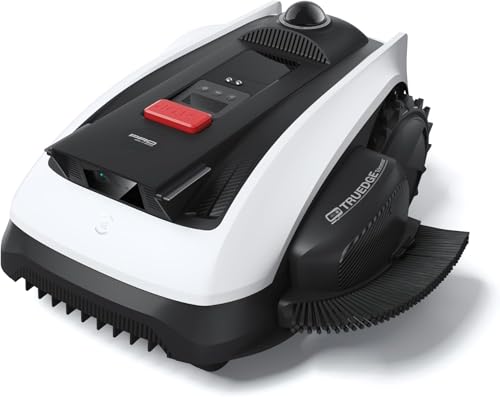
The ECOVACS Goat O1000 LiDAR PRO is a premium wire-free robotic lawn mower built for homeowners seeking automated grass care without perimeter wires or RTK antennas. Its compact, super-narrow body and HoloScope 360 Dual-LiDAR system create an immediate impression of precision engineering, automatically mapping yards and delivering 2 cm positioning accuracy even under trees, near fences, or in shaded areas.
In performance, the combination of AI Vision and 3D ToF LiDAR identifies more than 200 obstacle types with 5 cm detection precision, allowing the mower to navigate safely around kids toys, patio furniture, pets, and small wildlife while maintaining close cuts. The integrated TruEdge trimmer handles borders along driveways, sidewalks, and flower beds effectively, while the ECOVACS app supports custom zones, schedules, and no-go areas. Its ability to pass through paths as slim as 0.8 m makes it ideal for complex or compact layouts up to 1/4 acre.
Drawbacks include the potential need for occasional manual trimming on highly complex corners, narrow gaps, or raised edges, plus the possibility that initial setup and fine-tuning may require a few adjustments for unique yard shapes. These considerations are inherent to achieving optimal results with advanced robotic systems.
Overall, the ECOVACS Goat O1000 LiDAR PRO delivers the most value to owners of medium-sized lawns up to 1/4 acre who want reliable wire-free operation, superior obstacle avoidance, and reduced edge work. It stands out as a strong choice for those prioritizing precision navigation and smart app control in residential settings.
Essential Engineering Checklist for Robot Mowing
A structured approach to robot mowing selection starts with matching technical capabilities to your yard layout, grass type, and maintenance preferences. Below are the core criteria derived from specification analysis across the current range of models priced between $1,022.27 and $2,599.99.
Navigation Technology and Mapping Precision
Navigation defines operational reliability for any robot mowing. Systems combining Network RTK or EPOS with 360° vision or LiDAR deliver centimeter-level accuracy even under trees or near fences, eliminating traditional perimeter wires. Models using dual LiDAR or AI vision create virtual boundaries and multi-zone maps via app, allowing no-go areas and systematic patterns such as zigzag or checkerboard. For complex layouts, prefer units with one-tap auto-mapping and GeoSketch editing to reduce setup time to under an hour while maintaining path efficiency that minimizes overlaps and missed spots. For additional operational safety benchmarks, see our published testing notes on robotic lawn mower rtk vs vision boundary wire.
Lawn Coverage Capacity and Efficiency
Match stated coverage (from 0.2 acre up to 2 acres) to actual usable lawn area rather than total property size, accounting for obstacles and multi-zone division. Higher-capacity units typically feature wider cutting decks (up to 17 inches), dual motors around 165-180W each, and battery runtimes supporting 175 minutes or more per charge with auto-resume. Efficiency metrics like 500 m²/h coverage help estimate weekly cycles needed for consistent grass height. Smaller yards benefit from compact bodies that navigate 0.8 m corridors, while larger properties require models supporting 30 zones for segmented scheduling. For additional operational safety benchmarks, see our published testing notes on dreame a3 awd vs segway navimow i206.
Slope Handling and Terrain Adaptability
Slope ratings range from 20° (approximately 36%) on entry models to 40° (84%) on advanced all-wheel-drive systems with dual suspension and independent motors. All-wheel-drive configurations with omni wheels or eccentric steering prevent turf damage during zero-turn maneuvers and allow crossing of 2.8-inch obstacles or 50 mm curbs. Adaptive suspension and high-traction designs maintain stability on uneven ground common in residential lawns. Calculate your maximum incline using rise-over-run (for example, 20% equals 11.3°) and select a model with at least 10-15% buffer for wet conditions or dense grass. To compare alternative configurations, check our hands-on review of roborock rockmow x120h vs mammotion yuka mini 2.
Obstacle Avoidance and Safety Systems
AI vision combined with 3D ToF LiDAR or radar identifies over 200-300 object types including toys, pets, furniture, and wildlife at 5 cm precision, enabling close mowing without collisions. Lift sensors, anti-theft GPS tracking, and GeoFence alerts add security layers. Integrated edge trimming modules reduce manual string-trimmer follow-up by cutting to within 2 inches of borders. These features prove essential for households with children, animals, or irregular landscaping. For related slope and safety considerations on premium models, see our analysis of Husqvarna Automower performance characteristics.
Cutting Performance and Adjustability
Look for dual or triple blade discs with 6-12 blades, adjustable heights spanning 0.75-4 inches, and adaptive speed control that increases power in dense grass. Brushless motors and spiral or edge-sense modes improve uniformity on thicker patches. Regular blade replacement maintains cut quality, and hose-washable designs simplify upkeep. Wider decks (7-17 inches) paired with systematic path planning deliver even results with fewer passes.
App Control, Smart Integration, and Maintenance
Smartphone apps enable schedule creation, zone editing, firmware updates, cutting pattern selection, and remote monitoring. Voice control via Alexa or Google Home and auto-return-to-charge with resume function minimize hands-on time. Warranty lengths of 4 years on select premium units, combined with US-based support lines, factor into long-term ownership costs. Magnetic strips or virtual no-go zones further customize operation without digging. Users looking for related component recommendations can explore our ecovacs goat o1000 vs worx landroid s breakdown.
| Model | Max Coverage | Max Slope | Primary Navigation |
|---|---|---|---|
| Husqvarna Automower 440iQ | 2 acres | 45% | EPOS with radar |
| Segway Navimow X430 | 1 acre | 84% (40°) | Network RTK + 360° Vision |
| YARDCARE N1600 PRO | 0.4 acre | 20° | RTK + AI Vision |
This comparison highlights capacity versus terrain trade-offs among representative options within the entry-level to premium spectrum. Additional details on seasonal deals appear in our current robot lawnmower sale overview.
Testing & Selection Methodology
We evaluated top-rated robot mowing models by systematically comparing manufacturer specifications for navigation sensors (LiDAR, RTK, vision, EPOS), coverage ratings, slope percentages, motor wattage, cutting width and height range, obstacle detection counts, battery runtime estimates, and zone management limits. Brand reliability was assessed through established market presence of leading manufacturers and warranty terms such as multi-year coverage with GPS anti-theft. User satisfaction metrics were limited by available ratings, so emphasis remained on quantifiable engineering attributes, installation complexity (wire-free preference), and real-world utility factors including edge-to-edge performance and multi-zone support. This data-driven process prioritizes models that solve documented homeowner pain points around setup, safety, and consistency without relying on unsubstantiated claims.
Cross-referencing against category standards for robotic systems ensured selections cover budget through premium tiers while remaining practical for typical residential lawns ranging from compact side yards to multi-acre properties.
Final Verdict: Choosing the Right Robotic Lawn Mower
After specification analysis of the full set, clear leaders emerge for different buyer priorities within the available robot mowing options.
Best Overall Robot Mowing: Husqvarna Automower 440iQ stands out for its 2-acre capacity, 45% slope handling, EPOS centimeter accuracy, adjustable 1-4 inch cut height, and app-controlled patterns including striped and checkerboard modes. Larger wheels, durable bumper, hose-washable design, 4-year warranty, and built-in anti-theft GPS make it suitable for American-style lawns with varied surfaces and paths. It delivers reliable wire-free operation backed by extensive support resources.
Best Value / Budget Choice: YARDCARE N1600 PRO (or closely related M800Plus) offers RTK plus vision navigation, multi-zone mapping, 0.4-acre coverage, 3D obstacle avoidance, and app control at a significantly lower entry point. Auto-resume charging, adjustable cutting, and 20° slope capability provide core automation benefits without premium cost, ideal for medium residential lawns seeking systematic mowing and virtual boundaries.
Best for Steep or Complex Terrain: Segway Navimow X430 (or X450 for larger areas) excels with 4WD ORV-tuned suspension handling 84% slopes, zero-turn turf-safe steering, dual 180W motors, 17-inch dual-disc cutting, and EFLS Network RTK plus 360° vision identifying 200+ obstacles. One-tap mapping, EdgeSense under 2-inch margins, and voice control suit properties with hills, narrow passages, and dense obstacles. For further Automower comparisons and category context, consult our dedicated Husqvarna 420 iQ insights alongside broader grass-focused robotic solutions.
Common Questions on Robot Mowing Answered
What lawn size works best for robot mowing?
Most modern robot mowing models handle 0.2 to 2 acres effectively when coverage ratings match usable grass area after subtracting obstacles. Select units supporting multi-zone mapping for properties with separated sections, and verify runtime supports your desired mowing frequency without daily intervention.
Do robot mowers need boundary wires?
No, current leading robot mowing options use RTK, LiDAR, GPS, and vision systems for fully wire-free virtual boundaries created in the companion app. This approach simplifies installation, allows easy zone adjustments, and avoids digging or wire maintenance common in older generations.
How steep of a slope can robot mowing handle?
Capability ranges from 20° on standard models to 40° (84%) on all-wheel-drive units with dual suspension. Measure your steepest sections and choose a model with excess capacity for wet grass or irregular surfaces to maintain traction and prevent tracking.
What maintenance does a robotic lawn mower require?
Primary tasks include periodic blade replacement for clean cuts, occasional cleaning of sensors and underside (many are hose-washable), and firmware updates via app. Battery longevity typically supports multi-year use with proper charging cycles, and most systems include auto-return features that reduce manual handling.
Can robot mowing replace traditional mowers completely?
For many residential lawns under 2 acres with moderate complexity, yes, especially models with edge trimming and systematic patterns that leave uniform results. Highly irregular edges or extremely dense tall growth may still need occasional manual touch-ups, but overall labor drops dramatically. Explore additional category options at the main robotic lawn mowers section for complementary tools.
Technical Standards and Compliance
Mechanical safety standards, operational tolerances, and protective gear guidelines align with benchmark specifications established by the American National Standards Institute (ANSI).