Quick Answer: Segway Navimow i110N vs eufy E15, Which Should You Buy in 2026?
Pros
- Completely wire-free Pure Vision Navigation with stereo cameras requires no buried boundaries or external stations
- Precise multi-zone management and 0.2m virtual walls controlled entirely from the eufy smartphone app
- Advanced AI 3D perception system safely avoids both low and tall obstacles in complex gardens
- Delivers beautiful parallel cuts with automatic re-mowing of missed spots and full edge coverage
- Includes GPS anti-theft tracking and automatic recall features for worry-free daily operation
Cons
- Restricted to lawns of 0.2 acres or less with grass under 3.5 inches tall and height differences under 1.2 inches
- Not suitable for St. Augustine grass or dense Zoysia grass varieties
- Requires optional 4G data subscription through the app when Wi-Fi does not fully cover the yard
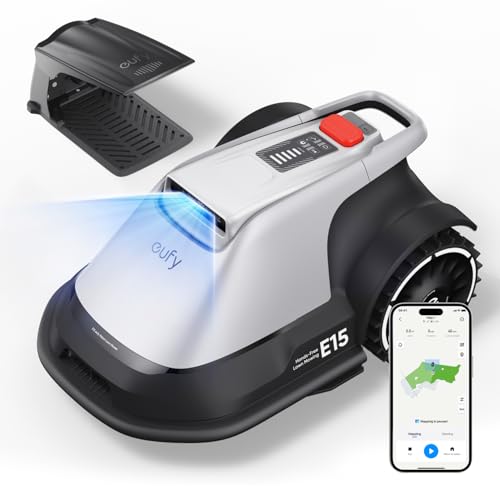
The eufy Robot Lawn Mower E15 is an advanced wire-free robotic lawn mower that relies on Pure Vision Navigation with high-precision stereo cameras and AI algorithms. It maps and navigates yards on its own after simple base placement, creating an immediate impression of modern convenience without traditional boundary wires or external stations.
Performance centers on smart auto mapping that displays the full yard layout on a smartphone for multi-zone management, custom exclusion areas, and virtual walls at 0.2m precision. The AI 3D obstacle avoidance system using stereo cameras and Vision SLAM detects rocks, toys, trees, pool borders, and garden beds then re-routes intelligently. High-precision parallel cutting with Ride-on Edge technology produces clean uniform lines, zero missed spots, and complete boundary coverage on lawns up to 0.2 acres and slopes of 18 degrees or less. GPS anti-theft tracking, automatic rain or low-light recall, and full app control for scheduling and live maps complete the reliable real-world experience.
Key considerations include the need for grass under 3.5 inches tall and height differences under 1.2 inches. The mower is not suitable for St. Augustine grass or dense Zoysia grass. Yards lacking complete Wi-Fi coverage require a 4G data subscription via the app for stable connectivity, and users must confirm all lawn requirements prior to setup since the box includes everything needed.
The eufy E15 offers strongest value to homeowners with medium lawns who want truly hands-free operation and intelligent navigation. Those managing moderately complex gardens with multiple zones will appreciate the Pure Vision technology and app-based precision most.

Pros
- Wire-free RTK and vision positioning system
- Identifies over 150 types of obstacles
- Supports up to 12 distinct mowing zones
- AI-assisted mapping generates virtual boundaries
- Quiet operation rated at 58 dB(A)
Cons
- Rated for yards up to only 1/8 acre
- Anti-theft 4G module sold separately
Specifications Side-by-Side
| Specification | Segway Navimow i110N | eufy E15 |
|---|---|---|
| Product type | Wire-free robotic lawn mower | Wire-free robotic lawn mower |
| Price in manufacturer specifications | $789.00 | $1,199.99 |
| Amazon rating | 4.6/5 | 4.5/5 |
| Advertised lawn coverage | Up to 1/4 acre | Up to 0.2 acres |
| Navigation | EFLS 2.0 RTK enhanced with vision sensors | eufy V-FSD 1.0 pure vision navigation with stereo cameras |
| Mapping | Automatic AI-assisted mapping | Smart automatic mapping |
| Boundary setup | No perimeter wire; virtual boundary | No boundary wire; no external station |
| Obstacle avoidance | Vision-assisted navigation | AI 3D obstacle avoidance |
| Multi-zone management | Yes | Yes |
| Slope rating | Not stated in manufacturer specifications | 18° |
| Noise rating | 58dB(A) | Not stated |
| App control | Yes | Yes |
| Anti-theft feature | Not stated | GPS anti-theft |
These two mowers take different approaches to wire-free autonomy. The Navimow i110N uses a hybrid system: RTK positioning supplies the primary location reference, while vision sensors help it deal with more complicated parts of the lawn. The eufy E15 avoids RTK and uses stereo cameras with computer vision instead. That difference matters more than the marketing labels because your choice depends on whether you prefer satellite-assisted precision or a camera-led setup with no external station.
Performance
Core Performance
The i110N has the stronger headline capacity. Segway lists it for lawns up to 1/4 acre, compared with the E15’s stated 0.2 acres. Those numbers do not describe cutting quality by themselves, but they give the Navimow more room for a small-to-medium residential lawn. The i110N is therefore the safer pick if your grassed area is near the upper end of either mower’s advertised range. For complementary field maintenance guidelines, examine our breakdown of robotic lawn mower rtk vs vision boundary wire.
There is no supplied cutting-width, blade-count, cutting-height, or blade-material specification for either product. That means it would be misleading to declare one a winner for the neatness of the cut, performance in tall grass, or edge finishing. The available evidence supports a capacity advantage for the Segway, not a lab-tested superiority in the actual cut.
Both models are designed to mow without a buried perimeter wire. This removes one of the most labor-intensive parts of installing a traditional robotic mower. The i110N uses virtual boundaries created through its mapping system, while the E15 maps the lawn with its cameras and operates without a boundary wire or external station. To evaluate matched hardware tolerances, consult our detailed overview of roborock rockmow x120h vs mammotion yuka mini 2.
Handling & Ergonomics
The E15 has the clearer published slope specification: it is rated for slopes up to 18°. It also lists AI 3D obstacle avoidance, which is intended to help the mower identify and navigate around objects in the yard. Those features make the E15 easier to evaluate for a property with known inclines and a lawn where obstacle recognition is a priority.
Segway describes the i110N’s EFLS 2.0 system as centimetre-level navigation accuracy. Its RTK positioning is enhanced by vision sensors, and the supplied research describes Navimow i Series RTK positioning as accurate to approximately 2 cm according to Segway. The product description specifically says the system is designed for challenging layouts, including areas beneath trees and narrow passages. When planning workspace deployment, consider the engineering criteria outlined in our ecovacs goat o1000 vs worx landroid s guide.
That does not make the i110N an all-terrain mower. The research notes that RTK-based mowers need a clear view of the sky, and the i110N product data does not state a slope rating or identify all-wheel drive. If your property is steep, highly uneven, or dominated by obstructions, do not assume either compact mower will match a dedicated AWD model simply because both are wire-free.
Runtime / Fuel & Maintenance
Both are battery-powered robotic mowers, so there is no fuel tank, engine oil, or fuel-efficiency figure to compare. However, manufacturer specifications does not state battery capacity, expected runtime, recharge time, charging behavior, or the amount of lawn each mower can cover per charge. We cannot responsibly claim that one runs longer or finishes a lawn faster. For additional operational safety benchmarks, see our published testing notes on dreame a3 awd vs segway navimow i206.
The more useful comparison is the advertised coverage: up to 1/4 acre for the i110N and 0.2 acres for the E15. In practice, the mower may need to return to its charging base during a scheduled mowing cycle, but the research supplied here does not provide a measured cycle time. Buyers should treat both coverage numbers as suitability guides, not guaranteed one-charge runtime figures.
Best Use Cases
- Navimow i110N: small-to-medium lawns up to 1/4 acre, homeowners who want RTK-assisted wire-free navigation, and buyers who want the lower upfront price.
- eufy E15: lawns up to 0.2 acres, users who prefer camera-based pure-vision navigation, and yards where the listed 18° slope rating, AI 3D obstacle avoidance, or GPS anti-theft feature is especially important.
- Either model: homeowners who want app control, automatic mapping, virtual or digital lawn boundaries, and multi-zone management without burying perimeter wire.
Maintenance & Running Costs
Neither product listing supplies a consumables schedule, replacement-blade price, battery-replacement price, service interval, or warranty detail. Accordingly, the long-term running-cost winner cannot be established from the supplied evidence. Both machines will still require ordinary robotic-mower care: keep the cutting area and sensors clear, inspect the underside periodically, and replace wear items according to the manufacturer’s instructions.
Wire-free installation can reduce setup labor because there is no perimeter wire to bury. The i110N’s mapping is described as quick and wire-free, with smartphone-guided setup, while eufy says the E15 can be placed at its base, connected through the app, and allowed to map automatically. The E15’s claim that it needs no external station is a practical distinction; the i110N product data identifies RTK hardware but does not provide enough detail here to describe the installation requirements of every yard.
Navigation hardware can affect maintenance indirectly. The i110N combines RTK and vision, so its performance depends on both the positioning environment and the cleanliness or visibility of its sensors. The E15 relies on high-precision stereo cameras and AI algorithms, making camera cleanliness and adequate visual conditions important considerations. The supplied research does not include failure rates or service-test results for either model.
Features & Usability
Segway Navimow i110N: The central feature is EFLS 2.0, Segway’s RTK positioning technology enhanced with vision sensors. The system is intended to provide centimetre-level accuracy and to remain useful across varied lawn layouts, including narrow passages and areas beneath trees. It supports AI-assisted automatic mapping, virtual boundaries, app control, and multi-zone management. The product is also rated at 58dB(A), giving buyers a concrete noise specification.
For a first-time robotic-mower owner, the i110N’s appeal is straightforward: open the app, create the map without installing perimeter wire, and manage multiple lawn zones digitally. Its lower cost also means the buyer is paying less to access RTK-plus-vision navigation than with the E15’s current supplied price. The main unknowns are the absence of a supplied slope rating, runtime figure, and detailed cutting specification.
eufy E15: The E15’s identity is its V-FSD 1.0 pure vision navigation. It uses high-precision stereo cameras and AI algorithms to see, map, and navigate the yard without RTK, a buried wire, or an external station. The product data also lists smart automatic mapping, multi-zone management, app control, AI 3D obstacle avoidance, GPS anti-theft, and support for slopes up to 18°.
The E15 will make the most sense to people who value a camera-led system and want the base-station installation to be as simple as possible. GPS anti-theft is an additional security feature that the i110N listing does not mention. The tradeoff is price: the E15 costs substantially more while covering a smaller stated area, and the listing does not provide a noise rating or battery figures.
Price & Value Analysis
Based on manufacturer specifications, the Navimow i110N costs $789.00 and the eufy E15 costs $1,199.99. The difference is $410.99. The Segway also has the higher listed Amazon rating at 4.6/5 versus 4.5/5 for eufy, although that small rating difference should not be treated as a controlled performance test.
The i110N offers better value on the information available. It costs less, covers up to 1/4 acre instead of 0.2 acres, includes wire-free RTK-plus-vision navigation, and has a stated 58dB(A) noise level. The research also identifies the Navimow i110N as a best-value wire-free mower, reinforcing the case for choosing it when budget and coverage are the main priorities.
The E15 is worth the premium only when its specific advantages matter to your yard or preferences. Its pure-vision design, no-external-station setup, 18° slope rating, AI 3D obstacle avoidance, and GPS anti-theft feature make it a more feature-focused alternative. If you do not need those distinctions, paying $410.99 more for a mower with the smaller advertised coverage area is difficult to justify.
Prices can change after publication, but the comparison here uses the supplied product-data prices rather than the approximate prices quoted in broader 2026 buying guides. Check the current listing before ordering, particularly if a sale changes the gap between these two models.
Which Should You Buy?
Choose Segway Navimow i110N if…
- You want the lower-cost option at $789.00.
- Your lawn is no larger than the advertised 1/4-acre capacity.
- You want RTK positioning enhanced by vision sensors rather than a pure-vision system.
- You prefer centimetre-level navigation accuracy, described in the research as approximately 2 cm according to Segway.
- You want wire-free installation, AI-assisted mapping, virtual boundaries, app control, and multi-zone management.
- A published 58dB(A) noise rating is important to your buying decision.
- You want the best value between these two models and do not need the E15’s listed GPS anti-theft feature.
Choose eufy E15 if…
- You specifically want pure-vision navigation using stereo cameras and AI algorithms.
- You want a setup that eufy describes as requiring no boundary wire and no external station.
- Your lawn is within the stated 0.2-acre coverage area.
- Your property has slopes up to the listed 18° rating and you want a published slope figure.
- AI 3D obstacle avoidance is more important to you than the i110N’s RTK-plus-vision approach.
- You want GPS anti-theft, a feature listed for the E15 but not in the supplied i110N data.
- You are comfortable paying $1,199.99 for those specific features.
Consider a different model if…
- Your lawn is substantially larger than 1/4 acre or 0.2 acres.
- You need a mower with a clearly documented all-wheel-drive system or a much higher slope rating.
- Your property has terrain that is steep, rough, or difficult for compact two-wheel robotic mowers.
- You need guaranteed runtime, charging-time, cutting-width, or cutting-height specifications that are not supplied for either model.
- You want dealer installation or a more established local service network.
- Your lawn has heavy tree cover or other conditions that could interfere with the positioning or visual-navigation approach; a mower using a different navigation technology may be a better fit.
Not sure between these two? Our complete guide to Best Robot Lawn Mowers covers more options at every price point.
Frequently Asked Questions About Segway Navimow I105n Vs Eufy E15
Is the Segway Navimow i110N better than the eufy E15?
For most buyers comparing these exact prices, yes. The i110N costs $410.99 less, has the larger advertised coverage area at up to 1/4 acre, and combines RTK positioning with vision sensors. The E15 is preferable when you specifically want pure-vision navigation, no external station, an 18° slope rating, AI 3D obstacle avoidance, or GPS anti-theft.
Do either mower require a perimeter wire?
No. Both are advertised as wire-free. The Navimow i110N uses AI-assisted mapping and virtual boundaries, while the eufy E15 uses pure-vision mapping and navigation. Eufy specifically states that the E15 needs no boundary wire and no external station.
Which mower is quieter?
The Segway Navimow i110N is the only one with a supplied noise rating, at 58dB(A). The E15 listing does not provide a noise figure, so a numerical comparison is not possible. That makes the i110N the better-documented choice for shoppers who want to consider operating noise.
Which one is best for slopes?
The eufy E15 is rated for slopes up to 18°. The supplied i110N product data does not state a slope rating, so we cannot make a direct numerical comparison. Neither listing establishes that these models are intended for very steep or rough terrain; buyers with demanding slopes should consider a mower with a clearly documented AWD design and higher slope capability.
Related Comparisons
- Segway Navimow vs Mammotion comparison
- Robot lawn mower comparisons
- Robotic lawn mower reviews and brand guides
Robot Lawn Mower Electrical Background
Robot lawn mowers are electrical appliances that run outdoors, so general electrotechnical guidance is worth a look. The International Electrotechnical Commission (IEC) offers a broad introduction to that field. It says little about these mowers, so read it for context.