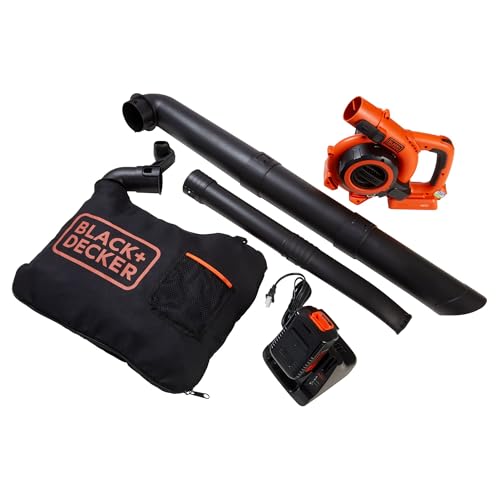
A compact handheld gas blower offers cordless mobility and quick cleanups for driveways and patio edges, but you trade off the heavy-clearing air volume of commercial backpack units and must take on routine small-engine maintenance.

Pros
- Lightweight 9.4-pound design offers easy handheld maneuvering
- Reduced-resistance recoil system eases engine pull starts
- Translucent fuel tank allows quick monitoring of gas levels
- Cushioned anti-vibration handle helps dampen arm strain
- Capable of up to 380 CFM and 180 MPH airflow
Cons
- Requires mixing 2-cycle gas and oil at a 50:1 ratio
- Modest 380 CFM output is best suited for lighter debris
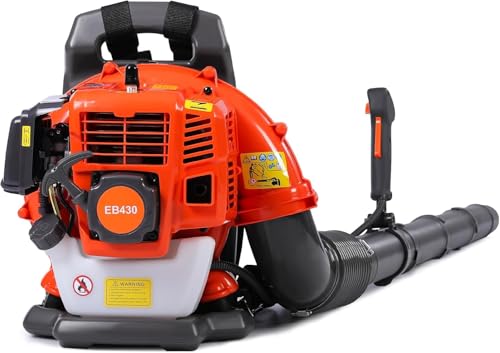
Pros
- Delivers up to 550 CFM and 230 MPH for moving wet yard debris
- Lightweight 17-pound backpack design with cushioned straps
- Thumb throttle includes cruise control for steady blowing
- 33.8 fl oz fuel tank yields up to 45 minutes of run time
- Operating temperature range spans 14°F to 104°F
Cons
- Requires 2-cycle fuel mixing and engine maintenance
- 550 CFM is modest for a backpack-class gas blower
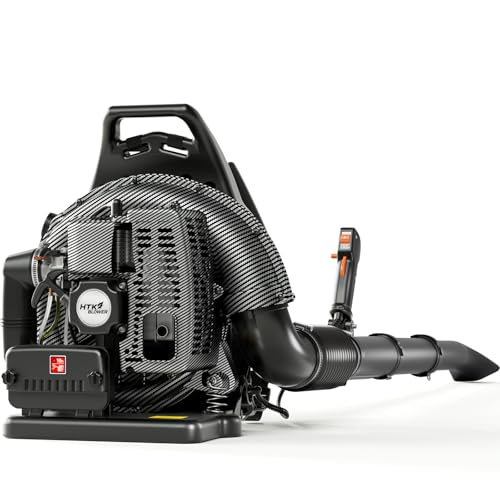
Pros
- 63CC 2-stroke engine provides up to 665 CFM and 205 MPH
- Fully padded ergonomic backpack harness
- Variable-speed throttle with built-in cruise control
- Generous 1.7 L fuel tank for extended yard sessions
Cons
- Requires 2-stroke fuel mixing and gas engine maintenance

Pros
- 4-cycle engine eliminates fuel and oil mixing
- Delivers up to 410 CFM and 125 MPH clearing power
- Automatic compression release for easier pull starts
- Lubricates in all directions without stalling or leaks
Cons
- Not available for purchase or delivery in California
- Requires routine gas engine maintenance and oil checks

Pros
- Lightweight design at only 4.4 pounds
- 7-Amp motor rated up to 180 MPH and 180 CFM
- Built-in cord retention prevents unplugging
- Zero emissions with instant push-button start
- Simple, low-maintenance corded design
Cons
- Extension cord is not included
- Operating range is limited by cord reach

Pros
- 2.7kW 63cc two-stroke engine delivers up to 6,800 RPM
- Multi-directional air outlet adjusts vertically and horizontally
- 0.47-gallon fuel tank enables long runs between top-offs
- Constant speed switch holds chosen throttle effortlessly
- Backpack harness features heat-insulating back padding
Cons
- Substantial 22-pound dry weight adds strain on long sessions
- Requires manual two-stroke oil and gasoline mixing

Pros
- 28cc 1.1-HP 2-stroke gas engine
- Rated up to 280 MPH and 490 CFM
- Quick-start ignition mechanism
- 0.65-liter translucent fuel tank
- Lightweight 9.5-pound bare tool weight
Cons
- Requires 2-cycle gas and oil mixing
- Produces engine noise and emissions

Pros
- Claims up to 1,110 CFM airflow and 220 MPH air speed
- Generous 1.89-liter fuel tank allows 50 to 60 minutes of runtime
- Padded harness and shock-absorption system reduce vibration
- Cruise control locks throttle for continuous operation
- Includes earmuffs, maintenance tools, and fuel mixing bottle
Cons
- Heavy 26.46-pound total weight can fatigue operators
- Requires mixing 2-cycle gas and oil fuel

Pros
- 51cc 2-cycle engine produces up to 765 CFM and 270 MPH
- Padded harness and hip belt provide balanced load distribution
- Air purge system removes fuel line air for easier starting
- Variable speed throttle includes cruise control functionality
- Proven X-Torq engine technology maintains high clearing force
Cons
- Heavier 22-pound build can cause fatigue on extended jobs
- Requires routine 2-cycle gas and oil fuel maintenance

Pros
- 28-cc engine delivers up to 470 CFM and 170 MPH
- Cruise control function enables comfortable sustained operation
- Air purge system removes air from carburetor for easier starting
- Auto-return stop switch automatically resets to the on position
- Adjustable soft-grip handle engineered to reduce strain
Cons
- Requires 2-cycle fuel and oil mixing
- Produces engine exhaust emissions and engine noise
Handheld vs. Compact Backpack Blowers: How Size Impacts Fatigue
Handheld gas blowers keep storage simple and maneuver easily in tight garden rows, but supporting the entire machine with one arm causes fatigue much faster during extended property cleanups than wearing a harness.
For quick sweeps across porches, walkways, and small suburban lawns, handheld units provide immediate convenience. The Elementool 28 CC Gas Leaf Blower lists a dry weight of 9.5 pounds, allowing single-handed operation around landscaped borders. In contrast, stepping up to a compact backpack like the Thalorus 52cc Gas Backpack Leaf Blower shifts 17 pounds onto wide, cushioned shoulder straps. While backpack rigs require more storage space in your shed or trunk, carrying the weight on your torso leaves your arm responsible only for directing the air tube, making them far more tolerable when a cleanup job stretches past 20 minutes. If your property demands maximum output, consider looking into a high-powered leaf blower designed for extensive acreage.
2-Cycle vs. 4-Cycle Small Engines: Mixing Fuel vs. Convenience
Choosing a 4-cycle small gas blower eliminates the chore of measuring two-stroke oil into your fuel can, but 4-cycle handhelds often deliver lower maximum airspeeds than comparable 2-cycle engines.
Most small outdoor blowers use 2-cycle engines, such as the Getell 26cc Gas Leaf Blower and the Husqvarna 125B Gas Leaf Blower. These engines run on a pre-mixed gas-and-oil blend (commonly 50:1). This setup keeps the engine compact and simple, generating high velocity—reaching an advertised 180 MPH on the Getell and 170 MPH on the Husqvarna. The downside is the ongoing inconvenience of mixing oil with fresh gasoline and the risk of engine damage if an incorrect fuel ratio is introduced.
By contrast, the SENIX 4QL 26.5cc 4-Cycle Handheld Gas Leaf Blower uses a separate lubrication system, letting you pour straight unleaded pump gas into the tank. While this simplifies refueling and lowers emissions, its advertised maximum airspeed tops out at 125 MPH, making it slightly less aggressive at peeling wet debris off hard surfaces. Prospective buyers should also note that the SENIX 4QL is explicitly not available for sale in California due to regional emissions restrictions.
Airflow Volume (CFM) vs. Airspeed (MPH) for Small Yard Clearing
Air volume (measured in CFM) determines the overall width and quantity of leaf piles you can roll forward, while air velocity (MPH) dictates how effectively the airstream scours compacted, wet matter from the ground.
Compact blowers balance these two metrics differently depending on their intended duty:
- Velocity-Focused Handhelds: The Elementool 28 CC advertises 280 MPH alongside 490 CFM, giving it substantial scouring force for breaking up rain-soaked turf debris. The Husqvarna 125B offers a factory-stated 470 CFM and 170 MPH, which provides a balanced spread for typical seasonal leaves.
- Volume-Focused Backpacks: When clearing open lawn spaces, raw volume moves broad piles faster. The HTK Gas Backpack Leaf Blower delivers 665 CFM at up to 205 MPH from its 63cc engine, while Hasanen’s 63cc backpack claims up to 850 CFM. Moving more air per minute shortens yard passes, though larger displacement engines consume fuel more rapidly and produce louder operating profiles.
Starting Mechanisms and Pull-Start Reliability
Small gas engines rely heavily on air purge bulbs and mechanical recoil assists to minimize the physical pull effort required to get the motor spinning.
Small-displacement pull-starts can frustrate operators if the fuel delivery requires dozens of hard yanks. To mitigate this, models like the Husqvarna 125B and HTK 63CC include integrated air-purge primers that evacuate trapped air from the carburetor and fuel lines prior to pulling. Mechanical assists also play a significant role: the Getell 26cc incorporates a reduced-resistance recoil starter designed to cut pulling effort by an advertised 50 percent, while the SENIX 4QL uses automatic compression release. For homeowners with shoulder sensitivity who still prefer gas over a cordless battery leaf blower, an effective starter system is critical to prevent fatigue before yard work even begins.
Frequently Asked Questions About Small Gas Blowers
Do all small gas blowers require mixing gas and oil?
No. While most compact blowers use 2-cycle engines requiring a 50:1 gas-and-oil mix (such as the Getell 26cc and Husqvarna 125B), 4-cycle blowers like the SENIX 4QL have separate oil reservoirs and run on regular unleaded gasoline.
Can a small handheld gas blower effectively move wet leaves?
Yes, provided the blower generates sufficient air velocity. Handheld models with airspeeds between 170 MPH and 280 MPH, such as the Husqvarna 125B or Elementool 28 CC, provide enough focused force to loosen wet debris, though higher-CFM backpack models clear large piles faster.
Choosing the Right Small Gas Blower for Your Yard
Selecting the right compact blower comes down to evaluating whether your yard maintenance involves short, precise passes over hard surfaces or longer sweeping sessions across open turf.
For standard suburban lots with paved driveways, patios, and small garden beds, the Husqvarna 125B Gas Leaf Blower offers the ideal blend of balanced handling, proven 28cc 2-cycle power, and dependable air-purge starting. Its main limitation is that it still requires manual fuel-oil mixing and places all 12.5 Newtons of blowing force on your arm, making it tiring for clearing multi-acre properties. If you want to skip fuel mixing entirely on smaller lots, choose the SENIX 4QL 26.5cc 4-Cycle Handheld Gas Leaf Blower (outside California), or step up to the Thalorus 52cc Gas Backpack Leaf Blower if you need a lightweight harness to distribute engine weight across your shoulders.