Quick Answer
Choose the Nakamichi Shockwafe 9.2.4 if you want more channels, two 10-inch subwoofers, DTS:X support, and a higher product rating of 4.8/5 versus 4.3/5. Choose the ULTIMEA Skywave X70 if you want the lower listed price and a 7.1.4 system with one wireless 10-inch subwoofer.

Pros
- The fully wireless design offers flexible placement without signal dropouts.
- The GaN amplifier ensures powerful, clean audio with minimal heat generation.
- Extensive customization is available through the ULTIMEA App, including a 10-band EQ and 121 presets.
- Includes a 60-day hassle-free replacement policy and 24/7 technical support.
Cons
- The system has significant weight (48.5 pounds) and dimensions, which may affect placement options.
- The advanced features and professional-grade components are designed for a premium experience, which may be more than needed for casual listeners.
Pros
- True wireless surround sound eliminates cable clutter.
- Powerful 760W peak output with clear, detailed audio.
- Advanced amplifier technology reduces heat and improves efficiency.
- Supports high-resolution 24-bit/192kHz audio with low distortion.
Cons
- Relatively heavy at 22.05 pounds, which may affect wall mounting or relocation.
- Requires stable 5GHz wireless environment for optimal performance.
- No customer evidence provided to validate real-world claims.

Pros
- Fully wireless rear speakers reduce cable clutter
- Height channels add overhead sound for immersive 5.1.2 audio
- Deep 35Hz sub-bass with clean output at high volumes
- GaN amplifier runs cooler and more efficiently than silicon
- 4K HDR pass-through keeps video quality uncompromised
Cons
- Large 43.31-inch bar and wood subwoofer require significant space
- Wireless rear speakers depend on stable 5GHz connection in your room
- No customer evidence provided to verify real-world performance

Pros
- Immersive Dolby Atmos height effects from up-firing drivers
- Lossless audio via HDMI eARC for uncompressed detail
- Extensive app-based customization with EQ and presets
- Automatic TV and soundbar control through CEC
Cons
- Not compatible with DTS sources
- Requires HDMI eARC for full lossless performance
- App control and OTA updates depend on smartphone use
Specifications Side-by-Side
The two systems take different approaches to immersive sound. The ULTIMEA is identified as a 7.1.4-channel professional wireless surround system. Nakamichi uses the product name Shockwafe 9.2.4, lists Dolby Atmos and DTS:X support, and pairs its soundbar with dual 10-inch subwoofers and four modular surround speakers.
| Specification | ULTIMEA Skywave X70 | Nakamichi Shockwafe 9.2.4 |
|---|---|---|
| Brand | ULTIMEA | Nakamichi |
| Product name | Skywave X70 7.1.4ch Professional Wireless Surround Sound System | Shockwafe 9.2.4 Dolby Atmos/DTS:X Surround Soundbar System |
| Channel configuration | 7.1.4 | 9.2.4 |
| Listed price | $799.00 | $1,099.00 |
| Product rating | 4.3/5 | 4.8/5 |
| Power rating in manufacturer specifications | Up to 980W peak power | 1,300W listed output |
| Main soundbar drivers | Ten drivers: six horizontal 2.25-inch drivers, two up-firing 2.25-inch drivers, and two 1-inch tweeters | Driver breakdown not provided |
| Subwoofer arrangement | One 10-inch wireless subwoofer | Two wireless 10-inch subwoofers |
| Surround speakers | Two wireless surround speakers with up-firing drivers | Four modular surround speakers |
| Wireless transmission | Dual 5GHz wireless transmission | Wireless subwoofers are listed; further wireless transmission details were not provided |
| Bluetooth | Bluetooth 5.4 | Not provided in manufacturer specifications |
| Immersive formats | Dolby Atmos | Dolby Atmos and DTS:X |
| Processing or platform | Advanced RF and networking protocols are listed for wireless connectivity | SSE MAX proprietary hardware and software engine |
| Manufacturer positioning | Professional immersive home theater experience | Plug-and-play performance with 360-degree surround and room-filling bass claims |
Performance
Core Performance
The most measurable advantage goes to the Nakamichi on the supplied power specifications. Its system is listed at 1,300W, whereas the Skywave X70 is described as delivering up to 980W of peak power. That is a difference of 320W in the listed ratings, although the figures are not presented using identical wording: Nakamichi lists 1,300W, while ULTIMEA specifies peak power. They should therefore be treated as product claims rather than a direct laboratory comparison. When planning workspace deployment, consider the engineering criteria outlined in our lg s40tr vs ultimea poseidon m60 guide. For complementary hardware performance, examine our breakdown on sony bravia theater system 6 vs jbl bar 700mk2 specifications.
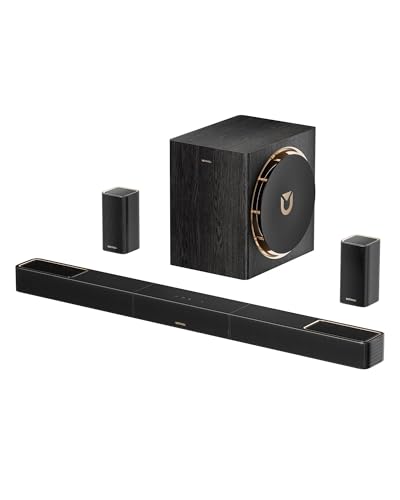
The physical speaker layouts also point to different priorities. The X70 uses a 7.1.4 arrangement built around a soundbar with ten drivers: six horizontal 2.25-inch drivers, two up-firing 2.25-inch drivers, and two 1-inch tweeters. Its two wireless surround speakers also have up-firing drivers. This gives the ULTIMEA a clearly documented route to front, rear, and overhead effects in compatible Dolby Atmos content.
Nakamichi’s 9.2.4 configuration adds two channels and a second subwoofer compared with the X70’s 7.1.4 configuration and single-subwoofer design. Its manufacturer information highlights dual wireless 10-inch subwoofers, four modular surround speakers, Dolby Atmos, and DTS:X. For buyers who want more separate surround hardware and bass sources, those are meaningful system-level advantages. For additional operational safety benchmarks, see our published testing notes on sony bravia quad ht a9m2 vs bose smart ultra. For complementary hardware performance, examine our breakdown on sony bravia quad ht a9m2 vs bose smart ultra specifications.
Handling & Ergonomics
Neither product is a handheld appliance, so handling primarily means installation, positioning, and everyday operation. ULTIMEA’s strongest convenience claim is its fully wireless setup. The X70 uses dual 5GHz wireless transmission, with the brand stating that its RF and networking protocols are intended to provide stable connectivity, minimize interference, and eliminate dropouts. The system includes a wireless subwoofer and wireless rear speakers, reducing the need to run speaker cables across the room.
The Nakamichi also uses wireless subwoofers and includes four modular surround speakers. That configuration may offer more flexibility in distributing surround sound around a room, but manufacturer specifications does not describe the exact installation process, speaker dimensions, cable requirements, or wireless protocol. It is therefore not possible to declare one system easier to physically install in every room.
For source flexibility, the X70 has Bluetooth 5.4 in the supplied research. Nakamichi’s product data emphasizes plug-and-play operation, SSE MAX processing, and Dolby Atmos/DTS:X compatibility, but does not provide a Bluetooth version. Buyers who specifically want a documented current Bluetooth specification have clearer information for the ULTIMEA.
Runtime / Fuel & Maintenance
Runtime and fuel efficiency do not apply to either system because the manufacturer information describes mains-powered home-theater equipment rather than a battery or fuel appliance. There is no battery-capacity, playback-runtime, fuel-consumption, or charging information to compare.
Maintenance should be relatively straightforward at the product level: both systems are made up of a soundbar, subwoofer hardware, and surround speakers rather than a device with filters, brushes, tanks, blades, or engine components. However, the research does not provide cleaning instructions, replacement-part schedules, firmware policy, warranty terms, or servicing costs. Those details should be checked before purchase if long-term support is a priority.
Best Use Cases
- Movies and television with Dolby Atmos: Both products are designed for immersive home theater, and both list Dolby Atmos support.
- Films or games with DTS:X: The Nakamichi has a documented advantage because its manufacturer specifications lists both Dolby Atmos and DTS:X; DTS:X support is not listed for the X70 in manufacturer specifications.
- Rooms where cable reduction matters: The X70 is specifically marketed as a fully wireless system with dual 5GHz transmission.
- Large-scale bass presentation: Nakamichi lists two wireless 10-inch subwoofers, while the X70 includes one wireless 10-inch subwoofer.
- Value-focused upgrades: The $799 X70 costs less than the Nakamichi and still provides separate wireless surround speakers and up-firing drivers.
Maintenance & Running Costs
These systems do not use the conventional consumables associated with home appliances. The manufacturer information identifies no dust bags, water filters, cleaning solutions, brushes, belts, blades, batteries, or fuel. It also gives no replacement-subwoofer, surround-speaker, or remote-control prices. As a result, the purchase price is the only confirmed cost available for this comparison.
Both systems contain multiple wireless components, so keeping the soundbar, subwoofer, and surround speakers positioned according to the installation guidance will be important for reliable operation. For the X70, ULTIMEA specifically references dual 5GHz wireless transmission and advanced RF and networking protocols. The brand says these features are intended to minimize interference and dropouts, but the supplied research does not include independent long-term reliability testing or a failure rate. Users looking for related component recommendations can explore our wireless home theater system breakdown.
There are no measured energy-use figures in the research. Do not assume that the lower-priced or lower-rated system will necessarily use less electricity. Similarly, the 980W and 1,300W figures are audio-output claims, not electricity-consumption measurements. Buyers comparing ongoing household energy costs would need manufacturer consumption data that is not supplied here.
Features & Usability
ULTIMEA’s feature set is centered on wireless freedom and a clearly specified speaker arrangement. The Skywave X70 has a 7.1.4 layout, a ten-driver soundbar, two up-firing soundbar drivers, two up-firing surround speakers, a 10-inch wireless subwoofer, Dolby Atmos support, Bluetooth 5.4, and dual 5GHz wireless transmission. The combination is aimed at buyers who want overhead effects without assembling a separate AV receiver and speaker package. Before finalizing equipment decisions, refer to our comprehensive vacuum that steam cleans comparison.
The X70’s wireless design is also its clearest usability argument. ULTIMEA says the system is engineered with RF and networking protocols that stabilize the connection, minimize interference, and eliminate dropouts. Those are manufacturer claims rather than measurements from the supplied research, but they explain why the model is positioned as a clutter-reducing home-theater solution.
Nakamichi’s Shockwafe 9.2.4 emphasizes scale. It includes four modular surround speakers rather than two, two wireless 10-inch subwoofers rather than one, and a 9.2.4 channel configuration rather than 7.1.4. The SSE MAX proprietary hardware and software engine is intended to bring Dolby Atmos and DTS:X to life. Nakamichi also presents the system as plug-and-play and describes 360-degree surround and room-filling bass.
The higher channel count does not automatically make the Nakamichi the better choice for every room. A system with four modular surround speakers and two subwoofers may require more placement decisions and more available space than a system with two surround speakers and one subwoofer. manufacturer specifications does not include dimensions, so the practical fit cannot be quantified here.
Price & Value Analysis
The ULTIMEA Skywave X70 is listed at $799.00, while the Nakamichi Shockwafe 9.2.4 is listed at $1,099.00. The Nakamichi therefore costs $300 more, or $300 above the X70’s listed price. The ULTIMEA also has a product rating of 4.3/5, compared with 4.8/5 for Nakamichi in manufacturer specifications. Ratings can help indicate buyer satisfaction, but they do not replace a controlled, like-for-like listening test.
The X70 is the stronger value proposition when the goal is a complete immersive system at the lower price. For $799, it offers a documented 7.1.4 layout, wireless rear speakers, a wireless 10-inch subwoofer, Dolby Atmos, Bluetooth 5.4, and up-firing drivers. It is worth choosing when those features meet the room’s needs and the additional $300 for Nakamichi’s expanded hardware would not provide a meaningful benefit.
The Nakamichi earns its higher price through the hardware it adds: a 9.2.4 configuration, 1,300W listed output, two wireless 10-inch subwoofers, four modular surround speakers, and listed support for both Dolby Atmos and DTS:X. It is worth the extra $300 for buyers who specifically want the larger surround layout, dual-subwoofer arrangement, or documented DTS:X support.
Neither price should be interpreted as a guarantee of superior sound in every room. Placement, room size, content format, and listener preference all affect the result, and the supplied research does not include standardized measurements for frequency response, maximum loudness, dialogue clarity, bass extension, or distortion.
Which Should You Buy?
Choose ULTIMEA Skywave X70 if…
- You want to spend $799 rather than $1,099 on the system.
- You want a documented 7.1.4 Dolby Atmos system with separate wireless surround speakers.
- You prefer a fully wireless setup with dual 5GHz wireless transmission.
- You want one wireless 10-inch subwoofer and do not specifically need two subwoofers.
- Bluetooth 5.4 is an important feature for your sources or listening habits.
- You want up-firing drivers in both the soundbar arrangement and surround speakers.
Choose Nakamichi Shockwafe 9.2.4 if…
- You are comfortable paying the additional $300 for a $1,099 system.
- You want the higher 9.2.4 channel configuration.
- You want dual wireless 10-inch subwoofers rather than one.
- You prefer four modular surround speakers to the X70’s two wireless surround speakers.
- You want a system whose manufacturer specifications list both Dolby Atmos and DTS:X.
- You prioritize the listed 1,300W output over the X70’s up-to-980W peak-power rating.
Consider a different model if…
- You need measured noise, energy consumption, or long-term reliability data before buying; those figures are not supplied for either model.
- You need exact speaker and subwoofer dimensions to confirm room fit; dimensions are not included in manufacturer specifications.
- You require documented warranty, service, replacement-part, or firmware-support details; the research does not provide them.
- You want a conventional receiver-and-passive-speaker system rather than a wireless soundbar package.
- For more options at every price point, see our full guide to Best Wireless Home Theater Systems.
Everything You Need to Know: Ultimea Skywave X70 Vs Nakamichi Shockwafe 924 FAQ
Is the Nakamichi Shockwafe 9.2.4 better than the ULTIMEA Skywave X70?
It is the more fully equipped system on paper, with a 9.2.4 channel configuration, 1,300W listed output, dual wireless 10-inch subwoofers, four modular surround speakers, and Dolby Atmos/DTS:X support. The X70 remains the better value for buyers who want an immersive wireless 7.1.4 system at $799 rather than paying $1,099.
What is the price difference between the Skywave X70 and Shockwafe 9.2.4?
The ULTIMEA Skywave X70 is listed at $799.00 and the Nakamichi Shockwafe 9.2.4 at $1,099.00. The Nakamichi costs $300 more.
Do both systems support Dolby Atmos?
Yes. Dolby Atmos is listed for both systems. The Nakamichi also lists DTS:X in manufacturer specifications, while DTS:X is not listed for the ULTIMEA in the information provided here.
Which system has more subwoofers and surround speakers?
The Nakamichi has more of both: two wireless 10-inch subwoofers and four modular surround speakers. The X70 has one wireless 10-inch subwoofer and two wireless surround speakers.
Related Maintenance and Operating Guides
To keep your equipment running at peak operating efficiency, explore our related technical walkthroughs and maintenance tutorials:
- Consult our detailed breakdown on Suction.
Related Comparisons
- Soundbar Comparisons
- Home Theater Comparisons
- Dolby Atmos Soundbar Comparisons
Sound System Background Notes
Speaker systems with subwoofers and wireless links raise placement and power questions worth reading about. A broad introduction to electronic product guidance can be found at American National Standards Institute (ANSI).