

Quick Answer
RAM timings measure delay in clock cycles between memory operations. CAS latency indicates cycles needed to return column data. Lower values mean faster access at identical frequencies, but true nanosecond latency depends on clock speed too. Most workloads benefit more from total capacity and transfer speed than tight timings.
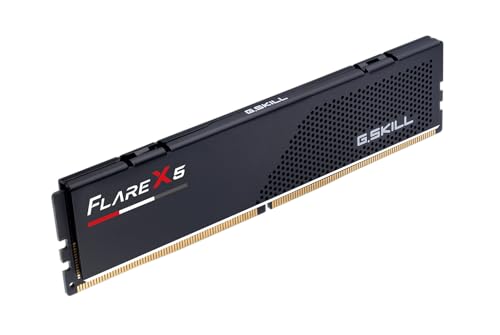
Pros
- Includes JEDEC default plus AMD EXPO and Intel XMP 3.0 profiles
- Non-ECC DDR5 U-DIMM with 288-pin desktop design
- Listed for recent Intel Z790, Z890 and AMD X670, X870 platforms
- Matte black finish with a 1.35V listed voltage
Cons
- Rated speed up to 6000MT/s requires overclocking or BIOS changes
- Listing warns that mixing with other memory kits can cause instability

Pros
- Strong feature set for high-performance AM5 gaming builds.
- Includes both wired and wireless networking options, plus Bluetooth 5.3.
- Advanced cooling hardware is designed to support sustained heavy workloads.
- DDR5 and PCIe 5.0 readiness make it a future-facing platform choice.
Cons
- Requires an AM5 CPU and DDR5 memory, so it is not compatible with older AMD platforms.
- ATX form factor may not fit smaller cases without checking clearance first.
- Its feature-rich design may be more than casual builders need for a basic PC.
Overview & Design: The MSI MPG X670E Carbon WiFi is an ATX gaming motherboard built for AMD's AM5 platform. It is positioned as a high-end board with a premium thermal layout, RGB lighting support, and a clean design aimed at performance-focused desktop builds.
Performance & Key Features: This board supports AMD Ryzen 9000, 8000, and 7000 Series processors, along with dual-channel DDR5 memory and PCIe 5.0 connectivity. Features like Lightning Gen 5 x4 M.2, USB 3.2 Gen 2, Wi-Fi 6E, Bluetooth 5.3, and 2.5Gbps LAN make it well suited for gaming, fast storage, and responsive networking.
Drawbacks & Considerations: The main tradeoff is compatibility and scope. It requires AM5 processors and DDR5 memory, so it is not an upgrade path for older systems. Its ATX size also means buyers should confirm case support before planning a build.
Verdict: The MPG X670E Carbon WiFi is best for users building a premium AMD gaming PC who want modern connectivity, strong cooling support, and long-term platform value. It is most compelling for enthusiasts who plan to use fast storage, high-speed networking, and a visually coordinated build.

Pros
- Supports Intel Core Ultra Series 2 processors on LGA 1851
- Dual-channel DDR5 memory support up to 256GB, per manufacturer
- Four onboard M.2 connectors for expandable storage
- Wi-Fi 7 with a 320MHz channel (manufacturer-stated)
- Extended PWM heatsink design for high-end processors (manufacturer-stated)
Cons
- No customer reviews are included in the listing data
- Wi-Fi 5.8Gbps figure is a manufacturer maximum, not typical speed
RAM timings are the cycle-count delays that govern how a DRAM module services read, write, and refresh operations. The best known of them, CAS latency (CL), is routinely quoted on retail packaging as if it were a standalone quality score. Technical analysis shows it is only meaningful when paired with the module’s data rate, and that real-world behavior depends on the memory controller, the DRAM die, rank configuration, and thermal conditions. This guide covers the underlying mechanics, the arithmetic that converts timings into nanoseconds, and the workloads where tuning produces measurable results.
What CAS Latency Measures
CAS (Column Address Strobe) latency is the number of memory clock cycles between the memory controller issuing a READ command to an already-opened row and the first word of data appearing on the data bus. The DRAM array is organized in banks, rows, and columns. A row must be activated
For related maintenance and equipment benchmarks, review our technical guides on gaming desktop memory, examine multitasking ram benchmarks, and compare pc desktop motherboards. You can also reference our analyses on 4k gaming memory configs and high speed memory setups. For industry engineering standards, consult JEDEC memory standards.


