Quick Answer: Choosing the Best Wireless Robotic Lawn Mowers
Critical factors for choosing wireless robotic lawn mowers in 2026 include RTK plus vision navigation accuracy for centimeter-level path planning without boundary wires, maximum coverage matching lawn size from 0.15 to 0.9 acres, slope handling up to 45 percent, AI-based obstacle recognition of over 1,000 objects, and app-driven multi-zone management with auto-resume after charging. Our review of top-rated models…

Pros
- Wire-free Dual-LiDAR navigation provides automatic mapping and 2 cm accuracy without perimeter wires or GPS dropouts.
- Integrated TruEdge edge trimmer handles borders cleanly and reduces post-mow manual string trimming.
- 32V high-power dual-blade platform delivers strong torque for thick, fast-growing grass types.
- 50-minute fast charging with 3.0Ah battery supports efficient multi-session mowing with minimal wait.
- App-based zone creation, no-go zones, and scheduling allow precise control over complex yard layouts.
Cons
- Coverage capacity is limited to yards up to 1/2 acre and may not scale for larger properties.
- Edge trimming line needs eventual replacement after the included two rolls cover approximately 6 km total.
- Exact continuous runtime details beyond the 50-minute charge time are not specified in the product data.
The ECOVACS Goat A2000 LiDAR PRO is a wire-free robotic lawn mower built for homeowners managing yards up to 1/2 acre. Its core design centers on the HoloScope 360° Dual-LiDAR system that auto-maps the property without any perimeter wire or RTK antenna, creating an immediate sense of advanced, self-contained automation with precise 2 cm positioning.
Performance highlights include reliable navigation even under trees, near fences, or in shaded zones where traditional GPS units struggle. The integrated TruEdge trimmer delivers clean cuts along driveways, sidewalks, and flower beds while the 32V dual-blade platform supplies the torque needed for dense Bermuda, Zoysia, Fescue, and St. Augustine grass. AIVI 3D obstacle avoidance keeps the unit safe around objects, and the ECOVACS app lets users set custom zones, no-go areas, cutting height, speed, travel paths, and schedules. Fast charging finishes in about 50 minutes so scheduled mowing stays consistent with little downtime.
Considerations include the 1/2 acre maximum coverage that may leave bigger lawns incomplete, the need to replace the two included trimming line rolls after roughly 6 km of total edging, and the absence of explicit continuous battery runtime figures beyond the rapid recharge specification. Users should plan mapping and zone setup carefully for multi-area yards.
This model is best suited for tech-oriented homeowners with medium American lawns who want wire-free convenience, built-in edging, and app-driven personalization. Those whose property size and grass type match the listed capabilities will gain the most value from automated, precise lawn maintenance.

Pros
- Eliminates perimeter wire installation entirely with RTK Cloud and Vision AI navigation
- Supports reliable operation on slopes up to 30 percent for varied terrain
- Offers infinite zone management and map editing through convenient app remote control
- Provides extended-range connectivity via RadioLink beyond standard Wi-Fi coverage
- Includes cut-to-edge technology that adapts to different boundary types for neater results
Cons
- Coverage is rated only for lawns up to 1/2 acre so larger properties may need multiple units
- Full RTK precision depends on cloud connectivity which can be impacted in areas with poor internet
- Detailed battery runtime and charging specifications are not provided which may affect planning for continuous mowing
The WORX Landroid Vision Cloud WR320 is a perimeter-wire-free robotic lawn mower built for yards up to half an acre. It presents as a modern AI-driven unit that prioritizes simple setup through cloud RTK and vision sensors rather than traditional boundary wires or local antennas.
Performance and Key Features: Vision AI enables automatic mapping of complex lawn shapes for fuller coverage and closer edge work from day one. The commercial-grade RTK Cloud delivers centimeter accuracy while V-SLAM fusion maintains navigation in shaded spots. It intelligently avoids obstacles using a high-power neural network, supports unlimited custom zones via the app, handles 30 percent slopes, and produces precise patterns such as parallel checkerboard or diamond with cut-to-edge results. RadioLink extends reliable communication across larger areas.
Potential drawbacks center on the 1/2 acre limit which restricts suitability for bigger lawns and the dependence on cloud connectivity for peak RTK performance. Users must also manage everything through the app without extensive physical controls.
This model delivers strongest value for homeowners with medium-sized yards who want a true no-wire robotic mower featuring advanced AI obstacle avoidance and pattern control without antenna installation hassles.
Pros
- Completely wire-free operation with auto mapping and Vision AI boundary understanding
- Handles up to 30% slopes while delivering precise RTK cloud navigation
- Strong AI obstacle avoidance and multi-zone app control for complex yards
- Cut-to-edge capability and selectable mowing patterns for a polished finish
- No extra cloud costs and seamless shade navigation via V-SLAM fusion
Cons
- Restricted to lawns of 1/4 acre or smaller so not suitable for larger properties
- Early user feedback notes sparse documentation and setup difficulties including app connectivity lockouts
- Heavy reliance on app and cloud RTK services which can be disrupted by signal or account issues
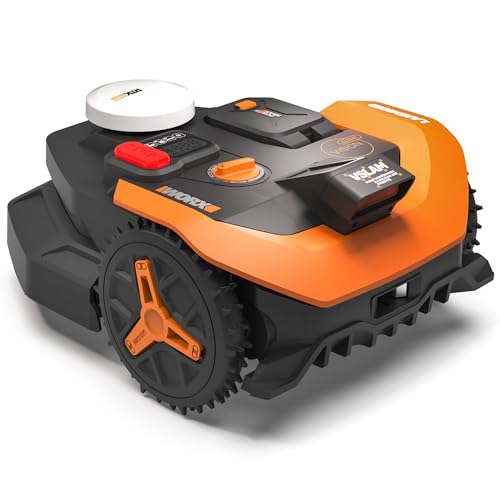
The WORX Landroid Vision Cloud WR310 is a robotic lawn mower built for yards up to 1/4 acre. It stands out with its no-perimeter-wire design that uses Vision AI and cloud RTK for navigation. Immediate impressions center on smart automation, app integration, and the promise of hands-free mowing without traditional boundary cables.
Performance relies on commercial-grade RTK Cloud accuracy delivered without local antennas or fees, paired with Vision AI that auto-maps lawns of any shape for smooth paths and fuller coverage. AI obstacle avoidance processes up to 10 trillion operations per second to recognize and respond to objects intelligently. Infinite zones, custom pathways, no-go areas, and remote app control give full management flexibility. Navigation stays precise in shade through V-SLAM fusion, while cut-to-edge technology minimizes missed grass and selectable patterns (Parallel, Checkerboard, Diamond, or Natural) create even stripes. The unit also manages 30% slopes effectively.
Drawbacks include the 1/4 acre size limit which excludes bigger properties. Some early users report sparse documentation making icon identification and setup challenging, plus app connectivity problems that can lock out access and hinder support resolution. Cloud and app dependence means signal or account issues may interrupt operation.
This mower suits tech-comfortable owners of compact to medium lawns who value wire-free convenience, precise AI navigation, and customizable results. Larger-yard users or those wary of setup hurdles and app reliance may prefer other options, yet for automated precision mowing within its capacity the WR310 delivers strong modern capability.
Pros
- True all-wheel drive handles demanding 45% slopes with automotive-grade stability
- No perimeter wires required thanks to advanced tri-frequency RTK and vision fusion
- Gentle zero-turn steering minimizes turf damage on lawns
- Flexible cutting height range and smart path planning for customized results
- Energy-saving drive system maximizes coverage from the compact 2.55Ah battery
Cons
- Maximum coverage limited to 0.15 acre, unsuitable for larger properties
- Cutting height tops out at 3.6 inches, which may require pre-mowing taller grass
- Runtime of 1,350 ft² per charge means more frequent returns for bigger or complex yards
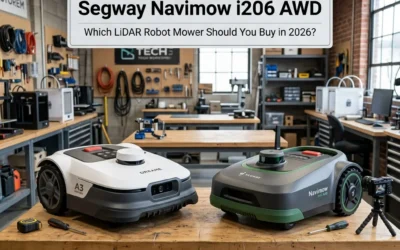
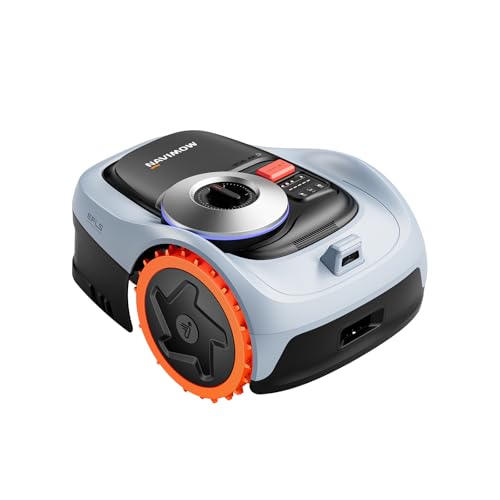
The Segway Navimow i206 AWD is a compact wire-free robotic lawn mower built for homeowners who need reliable automation on challenging terrain. Its rugged all-wheel-drive chassis and third-wheel zero-turn design give an immediate impression of durability and grass-friendly operation, while the absence of boundary wires simplifies installation.
In real-world use the i206 AWD shines on slopes up to 45 percent thanks to automotive-grade electronic stability control and adaptive on-demand drive that supplies extra power only when required. The NRTK plus vision navigation delivers centimeter-level accuracy for one-tap auto mapping, and the 2–3.6 inch adjustable cutting height with a 7.1 inch blade produces an even finish. Multi-zone management of up to 20 areas plus automatic resume after charging keep larger or divided lawns looking tidy with minimal intervention.
Potential drawbacks include the modest 0.15 acre maximum coverage and the 2.55Ah battery that covers roughly 1,350 ft² per charge, so bigger properties will see more frequent docking. The upper cutting limit of 3.6 inches may also require an initial manual cut on neglected lawns.
Overall the Segway Navimow i206 AWD is an excellent choice for owners of small to mid-size yards with hills or uneven ground who value wire-free convenience, precise navigation, and strong climbing ability. Those seeking larger area coverage should consider higher-capacity models in the Navimow lineup.

Pros
- Wire-free operation removes the need for any cable laying or maintenance during setup or use.
- Dual RTK+4-Eye Vision ensures reliable positioning and uninterrupted mowing in weak or no-GPS signal areas.
- AI-powered auto mapping and 4-camera system greatly reduce manual intervention for efficient boundary and route creation.
- Strong obstacle avoidance with detection of 1000+ objects provides higher safety around pets and garden features.
- Flexible multi-zone and no-go-zone management supports customized care for diverse lawn layouts via APP.
Cons
- Maximum coverage limited to 0.9 acres which may not suit larger properties.
- Full functionality depends on APP connectivity and vision systems without traditional wire backup options.
- No detailed information available on battery runtime or charging times from the manufacturer specifications.
The ANTHBOT Robot Lawn Mower is a modern robotic lawnmower built for no-wire operation on lawns up to 0.9 acres. Its design centers on advanced dual positioning technology and a camera array that delivers an immediate impression of high-tech precision without any perimeter cable requirements.
Performance shines through the Full Band RTK combined with 4-Eye Vision for accurate navigation even in challenging spots like under trees or near buildings. The ACC hands-free auto mapping uses AI and Adaptive Cruise Control to identify boundaries and optimize routes automatically. Intelligent obstacle avoidance covers a 300° field of view detecting over 1000 objects while multi-zone management handles 30 areas plus no-go zones all controlled via the smart APP with anti-theft features.
Key considerations include the 0.9-acre coverage limit that restricts use on bigger lawns and the complete reliance on vision RTK and APP systems which leave no fallback to traditional wired boundaries if conditions challenge the sensors.
This model delivers the most value to homeowners with medium-sized residential lawns who want a fully automatic set-and-forget solution emphasizing easy out-of-box setup intelligent mapping and app-based multi-zone control.

Pros
- True no-perimeter-wire setup with dual vision plus RTK for high-precision navigation on complex lawns
- Excellent obstacle avoidance that identifies more than 1000 common garden objects
- Strong slope capability up to 45% and multi-zone support for up to 20 areas
- Beginner-friendly automatic mapping completed in roughly 10 minutes
- Quiet 58 dB operation with self-charging and app monitoring anytime
Cons
- Maximum recommended mowing area is only 0.15 acre so larger properties need multiple units or a different model
- Ships in multiple separate packages which can complicate initial unboxing and setup
- Battery runtime and physical dimensions are not specified in the available data
The ANTHBOT M5 is a modern robotic lawn mower built for small to medium residential yards. It arrives with a garage cover, charging base station, five-blade set, and RTK reference station. The dual-camera vision system and compact design give an immediate impression of advanced yet approachable automation focused on wire-free convenience.
In real-world use the M5 leverages dual 150° HDR cameras and full-band RTK for centimeter-level accuracy, Adaptive Cruise Control, and recognition of over 1000 obstacles. It manages slopes up to 45 percent, offers cutting heights from 1.2 to 2.7 inches, supports up to 20 mapped zones via the app, and automatically returns to charge before resuming work. Quiet operation at or below 58 dB plus OTA updates and emergency braking round out its practical performance.
Considerations include the 0.15-acre maximum coverage limit that may leave larger lawns underserved, and the fact that components ship in multiple packages. Battery runtime and exact physical dimensions are not detailed in the product data, so prospective buyers should verify these against their specific yard needs.
Overall the ANTHBOT M5 is an excellent choice for homeowners seeking a beginner-friendly, wire-free robotic mower for yards up to roughly one-eighth acre who value precise dual-vision navigation, multi-zone flexibility, and quiet automated care.
Pros
- RTK precision navigation enables wire-free setup with systematic paths for full coverage and even cuts.
- CARE version supplies 36 extra blades to extend sharp cutting performance and lower maintenance needs.
- Auto mapping supports precise multi-zone management and custom schedules through the smart app.
- Included RTK extension cable allows flexible antenna placement for stronger signals in obstacle-rich yards.
- Automatic recharging and intelligent planning deliver true hands-free daily lawn care.
Cons
- Optimal RTK performance requires careful antenna placement with the extension cable especially in yards with trees or obstacles.
- Full multi-zone customization and scheduling depend on smart app connectivity which may involve a learning curve for some users.
- Detailed metrics like maximum lawn coverage area or battery runtime are not provided in the available specifications.
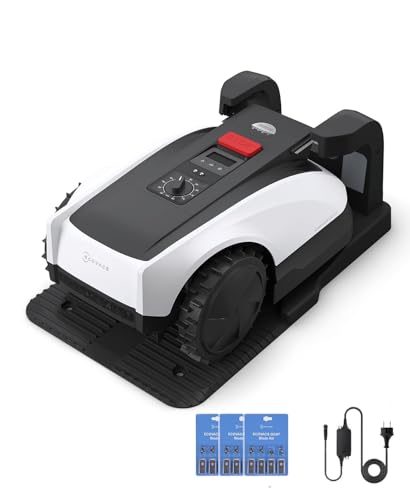
The ECOVACS Goat O1000 RTK Care Kit is a robotic lawn mower built for homeowners seeking automated maintenance. It emphasizes a wire-free design powered by RTK technology and includes the CARE upgrade with extra blades for practical long-term use, creating an immediate impression of convenience-focused engineering.
Performance centers on advanced RTK precision navigation that delivers centimeter-level accuracy without perimeter wires. The mower follows systematic paths rather than random movement to ensure full coverage and clean lines. Real-world strengths include automatic yard scanning for multi-zone management, app-based schedule customization across front backyard and side areas, the RTK extension cable for improved satellite reception, and automatic recharging that supports continuous hands-free operation.
Considerations involve the need for proper antenna setup using the extension cable to maintain reliable signals in complex environments with trees or obstacles. Full control of multi-zone features relies on the smart app, which may not suit every preference, and the product data does not specify exact coverage capacity or battery duration details.
This model delivers the most value to tech-comfortable homeowners with multi-zone lawns who prioritize wire-free accuracy and reduced blade replacement frequency. The combination of RTK navigation and the CARE blade package makes it a strong choice for consistent automated results with minimal ongoing effort.
Key Technical Factors to Consider Before Buying
Choosing among available wireless robotic lawn mowers requires evaluating technical specifications against property needs rather than relying on brand marketing claims. The following criteria draw from direct analysis of product data including navigation systems, coverage ratings, and sensor capabilities to guide practical decisions for residential use. When planning workspace deployment, consider the engineering criteria outlined in our robotic lawn mower rtk vs vision boundary wire guide.
Navigation Technology and Mapping Accuracy
RTK combined with vision systems forms the foundation of effective wire-free operation in modern wireless robotic lawn mowers. Models using full-band RTK plus dual or multi-eye cameras achieve centimeter-level positioning that remains stable under trees or near structures where pure GPS fails. Look for auto-mapping features that complete virtual boundary creation in under 10 minutes via adaptive cruise control, eliminating the need to drive the unit manually around the perimeter. Systems supporting V-SLAM sensor fusion further improve reliability in shaded zones by blending visual data with satellite signals.
App-based virtual boundary editing and no-go zone definition prove essential for properties with flower beds or pools. Prioritize units that allow real-time map adjustments and seamless path creation between zones without requiring physical markers. This technology reduces setup time from days of wire installation to a single afternoon while maintaining consistent edge-to-edge coverage through planned systematic patterns rather than random movement. For additional operational safety benchmarks, see our published testing notes on roborock rockmow x120h vs mammotion yuka mini 2.
Lawn Coverage Capacity and Runtime Efficiency
Match the stated maximum coverage of each wireless robotic lawn mowers model precisely to your total lawn area, allowing a 20 percent buffer for complex shapes or multi-zone layouts. Units rated for 0.15 acre suit compact yards and deliver extended runtime per charge with smaller batteries, while 0.4 to 0.9 acre models handle larger properties through efficient path planning and auto-resume after docking. Battery capacities such as 2.55 Ah enable coverage of approximately 1,350 square feet per cycle on advanced all-wheel-drive units before returning to charge automatically.
Calculate daily requirements by dividing total lawn square footage by cutting width and speed estimates derived from runtime figures. Models with brushless motors and on-demand drive systems conserve energy on flat sections, extending effective working time. Verify that the charging base includes weather protection and that the unit resumes exactly where it left off to avoid incomplete cuts across multi-day schedules. To compare alternative configurations, check our hands-on review of ecovacs goat o1000 vs worx landroid s.
Slope Handling and Terrain Adaptability
Slope capability determines suitability for non-flat properties when selecting wireless robotic lawn mowers. Units rated for 20 degree or 30 percent gradients work for most residential hills, while 45 percent models with all-wheel drive and electronic stability control manage steeper embankments without wheel slip or tipping. Traction systems and zero-turn designs prevent grass damage during direction changes on uneven ground.
Test claims against real terrain by confirming the presence of adaptive drive that applies power only when sensors detect incline demands. This feature extends battery life compared to continuous high-power modes. For properties combining flat sections with slopes, multi-zone mapping allows separate cutting height and pattern settings per area, optimizing results across varied topography. Cross-reference these capabilities with options in our Segway robot lawn mower overview for additional all-terrain insights.
Obstacle Avoidance, Safety Sensors, and Quiet Operation
AI vision systems that identify over 1,000 common garden objects outperform basic ultrasonic or bumper sensors by enabling early detection and smooth path adjustment rather than last-second stops. Dual or 4-eye camera arrays with 140 to 300 degree fields of view provide superior coverage for pets, toys, and landscape features. Integrated tilt sensors trigger immediate shutdown if the unit is lifted, adding a critical safety layer for households with children. Users looking for related component recommendations can explore our dreame a3 awd vs segway navimow i206 breakdown.
Noise output at or below 58 to 60 dB ensures operation does not disturb neighbors during early morning or evening schedules. Confirm emergency braking response times and OTA update support for ongoing algorithm improvements. These elements combine to create reliable unattended performance while minimizing collision risks and noise complaints.
App Control, Multi-Zone Management, and Cutting Adjustments
Smartphone apps enabling management of 20 to 30 or unlimited zones form a core requirement for flexible wireless robotic lawn mowers use. Features should include customizable schedules, cutting height selection from approximately 1.0 to 3.6 inches, pattern options such as parallel or checkerboard, and real-time monitoring with GPS anti-theft alerts. Units offering RadioLink or extended connectivity maintain control across larger properties beyond standard Wi-Fi range.
Adjustable free-rotating blades and cutting widths around 7.1 inches deliver carpet-like finishes when height ranges accommodate seasonal grass growth. Compare these controls against simpler units that limit zone counts or lack pattern variety. For properties requiring extensive customization, prioritize models with seamless pathway creation between front and back yards. Additional context on commercial-grade alternatives appears in our commercial robotic lawn mowers comparison.
Key Specification Comparison Table
| Model | Max Coverage | Max Slope | Navigation System |
|---|---|---|---|
| ANTHBOT M5 | 0.15 Acre | 45% | Dual Vision + Full-Band RTK |
| YARDCARE N1600 PRO | 0.4 Acre | 20° | RTK + Vision |
| WORX Landroid Vision Cloud | 0.5 Acre | 30% | RTK Cloud + Vision AI |
This table highlights coverage versus slope trade-offs among representative high-rated units. Select based on the dominant characteristic of your property while confirming app support for the required number of zones.
Wireless Coverage and Navigation Systems
Wireless robotic lawn mowers in this guide are set against maximum coverage, maximum slope and navigation system. The basis is manufacturer specifications and Amazon listings, and reviews from buyers appear where they exist. The table keeps coverage, slope and navigation system together for every model, so the wireless options can be compared without extra steps.
Wrap-Up: Which Model Delivers True Value?
After reviewing the full set of specifications across top-rated options, clear leaders emerge for different buyer needs in the current market. The strongest overall performers balance high slope capability, advanced dual-vision RTK navigation, extensive obstacle recognition, and beginner-friendly auto-mapping without compromising quiet operation or multi-zone flexibility.
Best Overall Wireless Robotic Lawn Mowers: ANTHBOT M5 Robot Lawn Mower stands out for its 4.9 rating, dual AI vision with full-band RTK delivering centimeter precision, 45 percent slope handling suitable for over 99 percent of residential yards, recognition of 1,000-plus obstacles, adjustable 1.2 to 2.7 inch cutting height with five free-rotating blades, and support for 20 work zones via app with 10-minute auto-mapping. Package inclusion of garage cover, charging base, blades, and RTK station plus noise at or below 58 dB and OTA updates make it the most complete choice for medium yards up to 0.15 acre seeking reliable daily automation.
Best Value / Budget Choice: STEELITE Robotic Lawn Mower S7 provides strong performance at a lower entry point with no boundary wire requirement, app control including one-click edge cutting and zone partition, obstacle avoidance plus tilt-sensor auto-stop, 180-minute runtime covering up to 1/4 acre, 7.1 inch cutting width, adjustable height from 0.98 to 2.36 inches, 20 degree slope capacity, and quiet operation at 60 dB or less. It delivers essential wire-free features and safety sensors without excess cost for smaller to medium properties focused on simple setup and consistent results.
Best for Large Lawns and Complex Terrain: ANTHBOT Robot Lawn Mower NO Wire model rated for 0.9 acre coverage combines full-band RTK with 4-eye vision for positioning even under dense trees, ACC hands-free auto-mapping, 300 degree AI obstacle avoidance detecting 1,000-plus objects, management of 30-plus zones with no-go areas, and app monitoring for anti-theft. For extreme slopes, the Segway Navimow i206 AWD alternative offers all-wheel drive with electronic stability control for 45 percent gradients, zero-turn design, 2 to 3.6 inch height adjustment, and NRTK plus vision auto-mapping. Buyers comparing these against traditional equipment may also find value in our walk-behind lawn mower alternatives or broader lawn mowers and tractors category resources.
Frequently Asked Questions About Wireless Robotic Lawn Mowers
How do wireless robotic lawn mowers work without perimeter wires?
Wireless robotic lawn mowers rely on RTK satellite positioning fused with onboard vision cameras and AI algorithms to create and follow virtual boundaries mapped through a smartphone app. The system builds a precise digital map of the lawn, often automatically in under 10 minutes, then uses planned systematic paths with obstacle recognition to stay within defined zones while returning to the charging station as needed. This eliminates physical wire installation and allows easy boundary edits for changing garden layouts.
What slope percentage can most wireless robotic lawn mowers handle effectively?
Most residential wireless robotic lawn mowers handle slopes between 20 degrees and 30 percent, while premium models with all-wheel drive reach 45 percent gradients using electronic stability control and adaptive traction. Verify the specific rating matches your steepest areas and confirm the presence of zero-turn or third-wheel designs that protect grass during directional changes on inclines.
How many mowing zones can typical app-controlled models manage?
App-controlled wireless robotic lawn mowers commonly support 20 to 30 zones or unlimited zones depending on the model, enabling separate schedules, cutting heights, and no-go areas for front yards, backyards, and side sections. Advanced units create connecting pathways automatically and allow real-time map editing so users can adapt to seasonal landscaping changes without hardware modifications. For more on multi-zone systems see our related yard mower automation guide.
Are wireless robotic lawn mowers safe around pets and children?
Yes, modern units incorporate AI vision that identifies over 150 to 1,000 common objects including animals, combined with tilt sensors that stop the blades immediately if the mower is lifted and emergency braking systems. Operating noise stays at or below 58 to 60 dB, and virtual no-go zones further restrict access to sensitive areas. Always supervise initial mapping sessions and follow manufacturer safety guidelines for optimal protection.
What maintenance do wireless robotic lawn mowers typically require?
Wireless Robotic Lawn Mowers require periodic blade replacement, usually after several months of regular use, cleaning of cameras and sensors to maintain navigation accuracy, and occasional charging base inspections. Models that include spare blade sets or support OTA firmware updates reduce long-term effort, while self-charging and weather-resistant designs minimize daily intervention beyond seasonal height adjustments via the app.
Wireless Robotic Mower Basics
Wireless models skip buried boundary wire, but they still rely on careful zone setup and reliable signal coverage. Background on general safety for outdoor power equipment can be read through American National Standards Institute (ANSI).