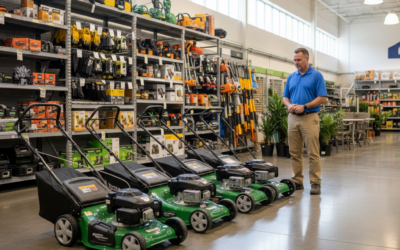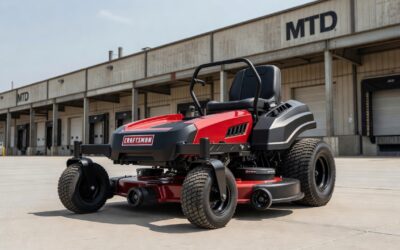
A true 30-inch cutting deck on a sit-down riding zero-turn is uncommon. On mowers, “30-inch” almost always means cutting width, and that size is far more typical of walk-behind machines than mainstream riding zero-turns. Compact zero-turns more often start a few inches wider. Shop by published deck width, overall width, and gate clearance rather than assuming a 30-inch riding ZTR is a standard catalog item.
What “30-inch zero-turn” actually means
When someone searches for a 30-inch zero-turn mower, two ideas are usually stacked together: a size and a steering style. Mixing those up is how people hunt for a machine that mainstream catalogs rarely stock in that exact combination.
On consumer and commercial lawn mowers, a figure such as 30-inch almost always refers to cutting-deck width—the width of grass the blades can cut in a single pass. It is not engine size, seat height, or the width of the whole machine as it sits in a shed. The cutting deck is the housing under the mower that holds one or more blades. Deck width is the useful mowing number, and it is the number most product names use.
Cutting-deck width is not overall width
Overall machine width is often several inches greater than the deck because of drive tires, the frame, footrests, and especially the discharge chute. A machine that cuts 30 inches can still be too wide for a 30-inch gate once the chute is down. Some specification sheets list a narrower figure with the chute raised or with a mulch plug installed. That chute-up or mulched width is the one that matters for squeezing through a fence opening. Gate clearance is a measurement you take on the property, then compare with the machine’s overall width, not with the deck sticker.
What counts as a zero-turn
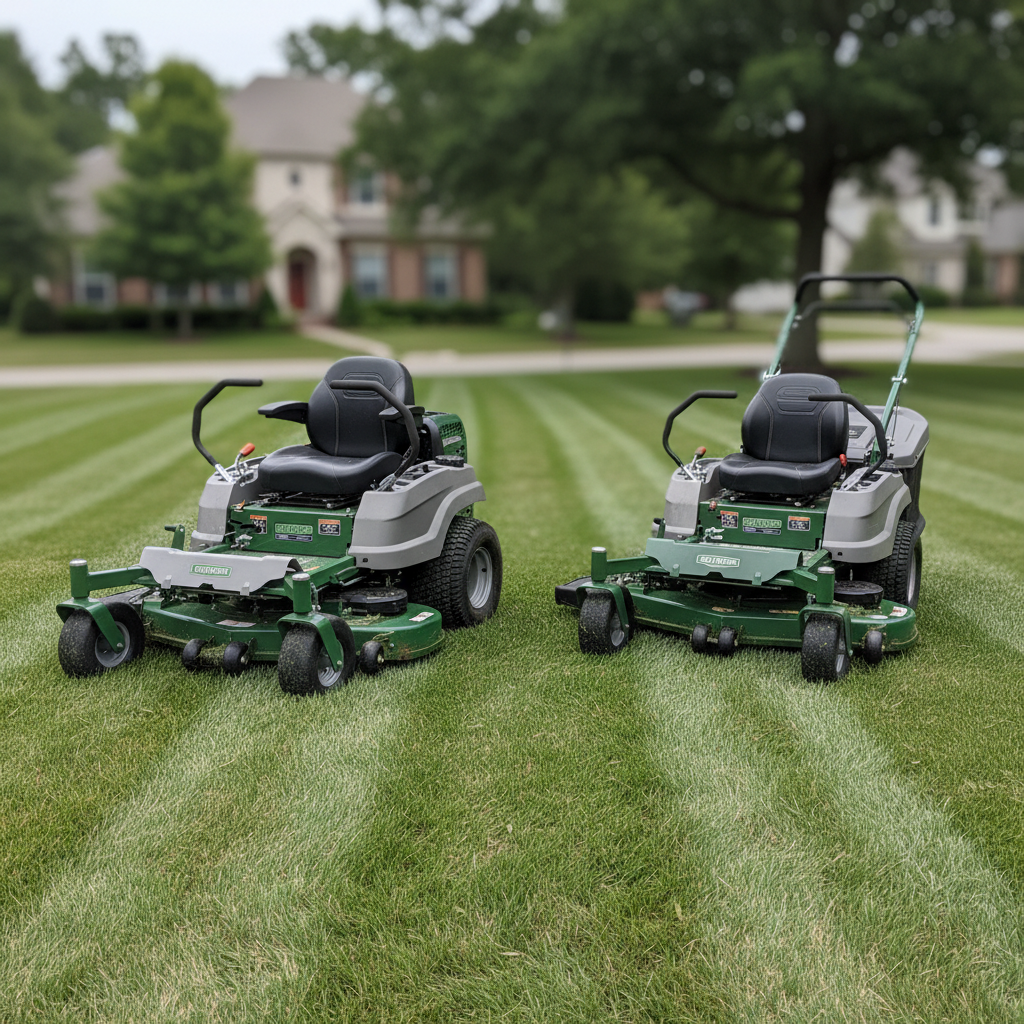
Zero-turn describes how the machine steers, not how wide it cuts. A zero-turn mower uses independently driven drive wheels, typically with a hydrostatic transmission on each side or an equivalent electric drive. By speeding one wheel and slowing or reversing the other, the machine can spin in place or nearly in place. That is different from a lawn tractor or many compact riders that use a steering wheel and a pivoting front axle. Those machines can have a tight turning radius, but they usually leave a larger uncut circle around trees, posts, and beds.
Marketing sometimes uses “zero-turn” loosely for any tight-turning rider. Check the steering and drive description rather than the label alone. Dual levers or sticks that control independent drive wheels point to a genuine zero-turn. A steering wheel and a conventional front-steer chassis point to a lawn tractor or compact rider, even if the brochure emphasizes a tight turn.
Machine types that get both labels
Several formats can be described as compact and as zero-turn, and they are not interchangeable:
- Sit-down riding zero-turns put the operator on a seat, with the deck under or ahead of the chassis, and use lap bars or similar controls.
- Stand-on mowers put the operator on a rear platform. They still carry the operator and are often chosen when a full sit-down chassis feels bulky.
- Walk-behind zero-turns keep the operator on the ground behind a deck that uses independent drive wheels or a similar zero-turn style drive. These frequently show up in the same size conversation as 30-inch decks.
A 30-inch walk-behind and a 30-inch sit-down rider share a cutting-width number and little else. The rider still has to package a seat, foot deck, power unit, and drive tires around a very small deck. That packaging problem is why a 30-inch sit-down zero-turn is an odd catalog item even though 30-inch walk-behinds are ordinary.
Does anyone actually make a 30-inch zero-turn?
For a sit-down residential or commercial riding zero-turn, a dedicated 30-inch cutting deck is uncommon and is not a standard mass-market size. If you scan current mainstream catalogs, you should not expect a 30-inch sit-down zero-turn to appear as a normal, widely stocked width the way common walk-behind sizes or mid-size riding decks do.
Walk-behind mowers, including some walk-behind units with zero-turn style drives, frequently use decks in the high-20s to about 30 inches. That is why the search phrase feels familiar. Thirty inches is a real and ordinary cutting width in the walk-behind world. Stand-on and specialty compact machines can also occupy the narrower end of the riding market, but their exact deck widths vary by maker and year. Those widths should be read on a specification sheet, not assumed from a category name.
Could a used, older, or custom machine exist even if current mainstream catalogs skip this exact width? In principle, yes. Product lineups change. Specialty builders and private sellers sometimes list unusual combinations. That is not the same as saying the used market always has a 30-inch sit-down zero-turn waiting, or that a homemade or cut-down deck is an acceptable substitute. Availability is year-specific and region-specific. A machine that existed in one market years ago may not be supported, stocked, or even accurately described today.
Do not rely on memory, a forum nickname, or an advertisement headline. Brochure language can round a nearby width, reuse an old push-mower size, or describe overall width instead of cut width. The reliable source is the manufacturer’s current specification for cutting width, plus a model number you can look up. If a dealer cannot show that number, treat the listing as unverified.
The conservative answer is therefore split by format. A true 30-inch sit-down riding zero-turn is not something you should plan on as a normal catalog item. A 30-inch walk-behind, including some zero-turn walk-behinds, is a much more ordinary product. Compact sit-down zero-turns exist as a category, but they more often use decks a few inches wider than 30. Confirm whatever you find against a published deck-width specification rather than against a search phrase.
How 30 inches compares with typical zero-turn deck sizes
Sit-down residential zero-turns are commonly sold with decks well above 30 inches, often in the low-to-mid 40s and upward. Commercial sit-down decks are frequently larger still. Some compact riders exist below the most common residential widths. Those are qualitative ranges, not a statistical survey of the market, and they shift as brands add or drop frames. There is no single smallest standard width that every maker uses, and there is no industry rule that riding zero-turns must start at a particular inch mark.
Riding zero-turns usually need more width than a walk-behind for physical reasons. A sit-down machine has to leave room for a seat, a foot deck, an engine or battery pack, and a pair of drive tires that can carry the machine’s weight and deliver independent drive. A 30-inch deck leaves little room to arrange those parts without hanging tires, footrests, or a chute outside the cut. The result is either an unusually cramped chassis or an overall width that is no longer “30-inch” in any practical access sense.
A narrower deck also changes how you mow. Each pass covers less ground, so the same lawn generally takes more passes and more time. Overlap between passes still matters, which means the productivity gap versus a typical mid-size residential deck is larger than the raw inch difference suggests. A narrow deck can still be the right tool where gates, paths, or landscaping are tight enough that a wider machine cannot enter or cannot turn without scuffing beds and fences. That is a fit question, not an automatic upgrade.
If a true 30-inch riding deck is not on the shelf, expect compact sit-down options to cluster at nearby wider widths rather than at an exact 30. How nearby depends on the year and the brand. Do not treat any single nearby number as the official compact standard, and do not assume a width you saw once is still in production. Shop the published cutting width and the published overall width of whatever is actually offered.
The uncut circle is another size-related idea that is easy to confuse with deck width. On a genuine zero-turn, the machine can usually pivot so the uncut circle around a tree or post is very small compared with a lawn tractor. A lawn tractor with a tight turning radius still typically swings the front wheels through a larger arc and can leave a doughnut of uncut grass unless the operator backs up and fills in. Deck width does not create that difference; the drive layout does. A 30-inch lawn tractor and a 30-inch zero-turn would still behave differently in the same bed.
Why someone looks for a 30-inch zero-turn
People rarely want 30 inches because it is an efficient production width. They want it because something on the property is narrow, and they hope a sitting zero-turn can still fit.
Typical constraints include:
- Fence gates and side-yard openings that will not pass a mid-size rider
- Dense landscaping, raised beds, and tight paths between a house and a fence or garage
- Small urban or suburban lots where a wide commercial deck is more machine than the lawn
- Trailer ramps, shed doors, or garage bays that limit how large a rider can be stored or hauled
- Operators who like zero-turn maneuverability—spinning in place and trimming close to obstacles—but do not want a wide deck
Those are real property problems. A 30-inch sit-down rider is not automatically the solution. Overall width and chute position vary by design, so a compact rider will not necessarily fit a 30-inch gate even if the deck is 30 inches or close to it. Measure the opening at its tightest point, then compare that number with overall width with the chute in the position you will actually use.
A narrow walk-behind or a stand-on can be a better match than a tiny sit-down rider when the limiting factor is access or storage rather than a desire to sit down. Walk-behind zero-turns keep independent-drive maneuverability and often stay closer to familiar walk-behind deck sizes. A conventional walk-behind plus a string trimmer or another small trim tool can finish a tight lot without forcing a riding chassis through a gate. Stand-on mowers can reduce the seated footprint and improve forward visibility for some operators, but they are still heavier than a walk-behind and still have an overall width larger than the deck.
Chasing the smallest possible riding deck has tradeoffs. A very small riding deck can still be heavier, wider overall, and harder to store than a walk-behind, while covering less ground per pass than a typical zero-turn. Fuel tanks or battery packs, a seat, and drive tires add bulk that a 30-inch walk-behind never carries. Compact chassis can also feel busier to operate: less room for feet, a discharge chute closer to the operator’s line of sight, and less margin when you misjudge a bed or a fence post.
None of that means a compact sit-down zero-turn is the wrong tool. It means the search should start from the property constraint—gate, path, shed, trailer—and from the steering style you actually want, not from the assumption that 30 inches on a rider is a standard stocked size.
What to shop for if a true 30-inch riding deck is unavailable
If you still want to buy after the existence answer, treat the job as a criteria problem, not a hunt for a ranked compact winner. Lineups change, and a width that sounds close in conversation can fail a gate by an inch.
Measurements that matter more than the nickname
Record these published figures when you compare machines:
- Cutting width, which is the grass you cut per pass
- Overall width with the discharge chute down
- Overall width with the chute up or with a mulch plug installed
- Height, if a garage door, trailer lid, or low branch is a limit
- Dry weight, if published, for ramps, sheds, and two-person handling
- Fuel or battery format as a category only, without assuming runtime or coverage
- The manufacturer’s description of steering and drive, so you know you are looking at a genuine zero-turn and not a tight-turning lawn tractor
Measure the narrowest gate, path, and trailer or shed opening yourself. Record the clear width at the tightest point, including hinges, latches, weather stripping, and any slope that tilts the machine as it passes. Compare those numbers with overall width, not deck width alone. If you mulch or bag, use the width that matches that setup. If you side-discharge, assume the chute is down unless you will raise it every time you pass through.
Categories to consider, not a shortlist of models
Nearby options exist as categories, not as a promised set of exact widths:
- Slightly wider compact sit-down zero-turns, if a few extra inches of cut still clear the opening
- Stand-on mowers, when you want the machine to carry you and you prefer a platform to a seat
- Walk-behind zero-turns, when you want in-place turning at a walk-behind scale
- A conventional walk-behind plus a separate trim tool, when the lot is small or the access is truly tight
- Optional categories such as compact electric riders or robotic mowers, if your goal is less about a 30-inch deck and more about keeping a large gasoline rider off a small property
Those last options are not drop-in substitutes for a 30-inch zero-turn. They change the workflow. Do not assign them a runtime, an acre rating, or a price from memory.
How to compare on a lot or a spec sheet
- Gate clearance versus overall width in the chute position you will use
- Turning behavior: independent drive and a small uncut circle versus a lawn-tractor turning radius
- Discharge side, and whether the chute, deflector, or bagger sticks out toward fences, windows, or a sidewalk
- Storage footprint: length and width as parked, including a folded or removed chute only if the maker allows that
- Operator fit: whether you can sit or stand comfortably, reach the controls, and see the front deck edge
Questions for a dealer or a specification sheet
- What is the published cutting width, and is that a manufacturer figure or a nickname?
- What are overall width chute-down and chute-up or mulched?
- Is this a dual-lever independent-drive zero-turn or a steering-wheel compact rider?
- Does the maker describe turning behavior or an uncut circle?
- Are bags, a mulch plug, or chute restrictions approved for this deck?
- What slope and use limits does the operator manual state for this chassis?
- If the unit is leftover or used, is the model number still supported with parts?
Do not modify a larger deck down to 30 inches, and do not build a homemade zero-turn. Deck structure, blade overlap, belt or electric-drive geometry, and stability are designed as a system. Cutting a shell or swapping an unapproved deck is a safety and structural problem, not a workshop shortcut. If a seller offers a cut-down or transplanted deck, treat that as a reason to pass.
Safety and practical limits of compact riding mowers
A short, narrow rider can feel less stable than a wider, heavier zero-turn. Less track width and less mass generally mean the machine is more sensitive to side slopes, soft shoulders, hidden stumps, and the moment when one drive tire drops off a curb or into a drainage swale. That is a general mechanical caution. It is not a claim about injury rates, and it is not a substitute for the slope rating in a manual.
Follow the manufacturer’s slope, speed, and use limits in the operator’s manual for that specific machine. Do not borrow a degree number from a forum, a neighbor’s different model, or a rule of thumb. If the manual says not to mow a slope, or to mow it only in a certain direction, treat that as the limit. Uneven ground, wet turf, and hidden holes matter as much as the average grade. Compact equipment can tempt people to mow strips a wider machine never reached; those leftover strips are often the steepest or the closest to a drop-off.
Stay away from drop-offs: retaining walls, creek banks, driveway edges, and pond margins. Compact riders can get closer to those edges than a wide commercial deck, which is exactly when a tire can leave the surface. If a bank or wall is in play and you are not sure the machine is appropriate, use a walk-behind on that strip or hire a qualified landscape professional.
Do not tow trailers, rollers, or other attachments, and do not add bags, wheel weights, or ballast unless the manufacturer allows that equipment on that model. Extra rear or side weight changes how a narrow chassis behaves. Aftermarket weight added “just to hold it down” is not a stability upgrade.
Thrown-object and rollover risk are real on any riding mower. Keep the discharge pointed away from people, pets, windows, sidewalks, and traffic. Clear the lawn of sticks, wire, and stones before you mow. Do not carry passengers. Use operator-presence and interlock features as designed; do not bypass them.
Operator-fit issues matter more on a compact chassis. Confirm that you can sit fully on the seat, or stand stably on a platform, keep both feet on the intended surfaces, and work the drive levers without stretching. Check that you can see the front of the deck and the discharge side. A chute that sits close to the operator can throw debris into the operator zone if a deflector is damaged or missing. Replace damaged deflectors and guards before use. If controls feel cramped, the machine is a poor fit even when the deck width looks right on paper.
If you are not comfortable judging a slope, a drop-off, or whether a compact rider is appropriate for the lot, ask a dealer to place the actual machine next to your gate and walk through the manual’s limits. Otherwise keep a walk-behind for the risky parts of the property.
How to verify a listing that claims to be a 30-inch zero-turn
Ads, classified listings, and specialty builds often use size words loosely. Verify before you travel or send money.
Spec-sheet fields that confirm the measurement
Look for a manufacturer cutting-width or mower-deck-width specification, an overall-width figure that may be split by chute position, and a full model number rather than only a series name. A factory decal or stamped deck number that matches the model you looked up is stronger evidence than a seller’s headline. Photos that show a tape across the full cutting deck, or a clear factory size decal, help more than a lifestyle shot. Even a tape on the outside of the shell may not match the manufacturer’s cutting-width definition, so prefer the published spec when it exists.
How “zero-turn” gets stretched in ads
In a classified ad, “zero-turn” may mean a genuine dual-hydrostatic or dual-electric independent-drive machine, or it may mean a lawn tractor that turns tightly. Look for lap bars or steering sticks and a description of independently driven wheels. A steering wheel plus a phrase such as “turns like a zero-turn” is a warning that you may be looking at a compact tractor, not a zero-turn mower. Ask how the machine steers, and look at a photo of the controls.
Private listings may also confuse cutting width with an old walk-behind size the seller remembers, a number stamped on a tractor deck that is not the installed width, or a story that the machine “fit through a 30-inch gate.” Gate stories are about overall width and chute position, not about deck width.
What to inspect on a used or specialty machine
Besides the stated size, look at:
- Frame rust, cracks, and bent rails
- Deck rust, holes, and bent baffles
- Spindle play, checked only with the machine safely supported and the blades treated as a hazard, following the manual’s service position
- Tire condition, including drive-tire wear that can affect straight tracking
- Steering-lever or stick play, bent controls, and whether both sides drive and reverse
- Whether a model number still has parts support from the maker or a documented aftermarket
Do not assume a custom 30-inch deck is structurally sound, approved, or safe on a given chassis. Unusual welds, a cut-down shell, or a deck transplanted from another machine are reasons to walk away unless a qualified technician can verify the work against the manufacturer’s design. In most private sales that verification will not exist. Unusual electrical or fuel-system work on a compact chassis deserves the same caution.
If the seller cannot produce a model number and a matching cutting-width specification, treat the machine as unspecified. You can still evaluate a used mower by measuring the deck and the overall width yourself, but you should not treat an unverified “30-inch zero-turn” headline as proof that manufacturers make that combination as a standard product.
Frequently asked questions
Is a 30-inch zero-turn the same thing as a 30-inch lawn tractor?
No. The number can match while the steering does not. A lawn tractor uses a steering wheel and a front axle. A zero-turn uses independently driven wheels and typically lap bars or sticks. Confirm the drive description before you treat a compact rider as a zero-turn.
Will a 30-inch deck fit a 30-inch gate?
Not necessarily. Tires, the frame, and the discharge chute usually make overall width greater than cutting width. Measure the gate and compare it with overall width in the chute position you will use, including a mulch plug if that is how you mow.
If nobody nearby stocks a 30-inch sit-down zero-turn, should I wait?
Shop the access problem you actually have. Compact sit-down zero-turns, stand-ons, walk-behind zero-turns, and ordinary walk-behinds already cover many narrow properties when you compare measured overall width and turning behavior. Waiting for an exact 30-inch sitting deck can leave you without a machine while a slightly different format would have cleared the gate.