For a standard gas push mower on a cold start, move the mower to flat, dry ground and clear debris; check the oil and fuel; set the choke to ‘cold start’; prime the bulb 3-5 times; squeeze the safety bar; and pull the starter cord firmly. Once the engine catches, gradually open the choke and adjust the throttle.
Understanding How a Lawn Mower Starts
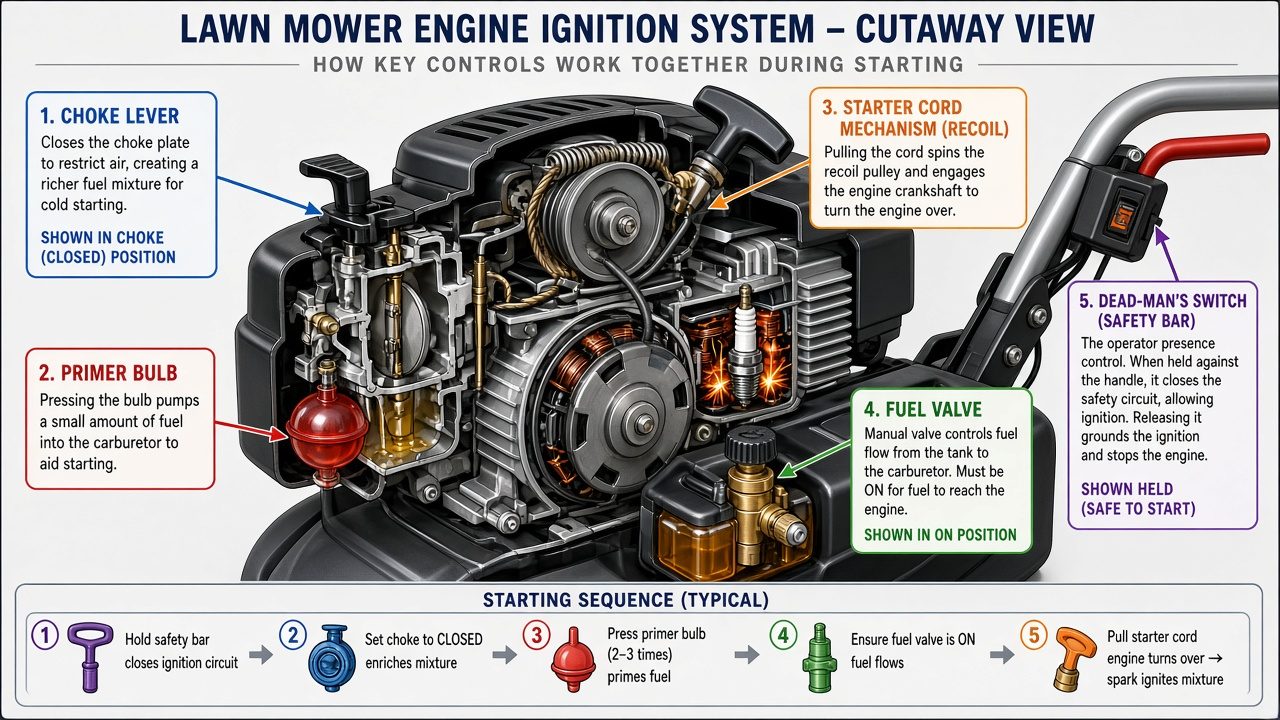
Starting a lawn mower involves engaging several key components to ignite the engine. The main parts include the choke, which restricts air flow for a richer fuel mixture during cold starts; the primer bulb, which manually pumps fuel into the carburetor; the starter cord, which turns the engine over; and the fuel valve, which controls fuel flow. Safety is paramount, with most mowers featuring a dead-man’s switch (safety bar) that must be held against the handle to keep the engine running.
The procedure differs significantly based on the engine’s state. A cold start (engine off for a while) requires choke and priming. A warm restart (engine was recently running) typically skips these steps. The mower type also dictates the method: gas push mowers use a pull cord, riding mowers use a key ignition with brake/clutch engagement, and electric mowers start with a button or key.
Key Factors to Consider Before Starting
Before you begin, adapt the steps to your specific model by considering these variables:
- Safety Checks: Always start on flat, dry ground. Clear debris from the mower deck and your work area. Keep hands and feet away from the blade. Disconnect the spark plug wire before performing any maintenance.
- Mower Type: This guide focuses on gas push mowers. Riding mowers require you to sit on the seat, engage the brake/clutch, and turn a key. Electric mowers eliminate the pull cord but still require a safety button or key.
- Engine Temperature: Determine if it’s a cold start or warm restart. This changes whether you use the choke and primer.
- Safety Features: Models with a blade brake clutch may require a different handle engagement than standard operator presence control.
Step-by-Step Guide: Starting a Gas Push Mower (Cold Start)
This is the most common scenario for a standard gas-powered push mower that hasn’t run recently.
1. Preparation and Safety
Move the mower to a flat, dry surface like a driveway or patio. Clear any sticks, rocks, or debris from the mower deck and the area around it. Ensure the fuel tank has fresh gasoline (stale fuel is a common cause of starting issues).
2. Pre-Start Checks
Check the engine oil level using the dipstick; add oil if it’s low. Locate and open the fuel valve if your mower has one (often a small lever near the carburetor).
3. Set Choke and Prime
Set the choke lever to the ‘Cold Start’ or ‘Closed’ position. If your mower has a primer bulb (a small, clear plastic bulb), press it firmly 3 to 5 times until you see fuel flow into it. Do not over-prime.
4. Engage Safety and Pull Start
Stand behind the mower and firmly squeeze the safety bar (dead-man’s switch) against the main handle. With your other hand, grasp the starter cord handle. Pull the cord slowly until you feel resistance (this positions the piston). Then, give it one sharp, smooth pull. Avoid yanking it repeatedly without resistance.
5. After the Engine Starts
Once the engine catches and runs, gradually move the choke lever to the ‘Open’ or ‘Run’ position over 10-15 seconds. Adjust the throttle lever to your desired mowing speed. Continue holding the safety bar to keep the engine running.
Variant Notes: Warm Restarts, Riding Mowers, and Electric Models
Warm Restart (Gas Push Mower): If the engine is warm from recent use, skip the choke and priming steps. Simply ensure the fuel valve is open, squeeze the safety bar, and pull the starter cord.
Starting a Riding Lawn Mower: Sit on the mower. Engage the parking brake. Move the attachment clutch lever to the ‘Off’ or ‘Disengaged’ position. Turn the ignition key to the ‘Start’ position. Once started, adjust the throttle and engage the blades as needed.
Starting an Electric or Battery-Powered Mower: Ensure the battery is charged and properly inserted. Press and hold the safety button (if equipped), then pull the bail handle or press the start button. There is no choke or primer.
Troubleshooting: What If the Mower Won’t Start?
If your mower doesn’t start after following these steps, common causes include stale fuel, a clogged carburetor, a fouled spark plug, or an incorrect choke setting. First, check for fresh fuel and a properly set choke. If the problem persists, you may need to clean or replace the spark plug and air filter. For persistent issues, consult your owner’s manual or a small engine repair professional.
Frequently Asked Questions
How many times should I press the primer bulb?
For a cold start, press the primer bulb firmly 3 to 5 times. Pressing it too many times can flood the engine with fuel.
Why does my lawn mower start but then die?
This often happens if the choke is left in the ‘closed’ position after the engine warms up. Gradually open the choke once the engine is running smoothly. It can also indicate a fuel flow issue.
Do I need to use the choke for a warm restart?
No. For a warm restart (when the engine has been running recently), you typically do not need to use the choke or primer. Simply pull the starter cord.
What is the dead-man’s switch?
The dead-man’s switch, or safety bar, is a lever that must be held against the mower handle to keep the engine running. If you release it, the engine stops immediately for safety.