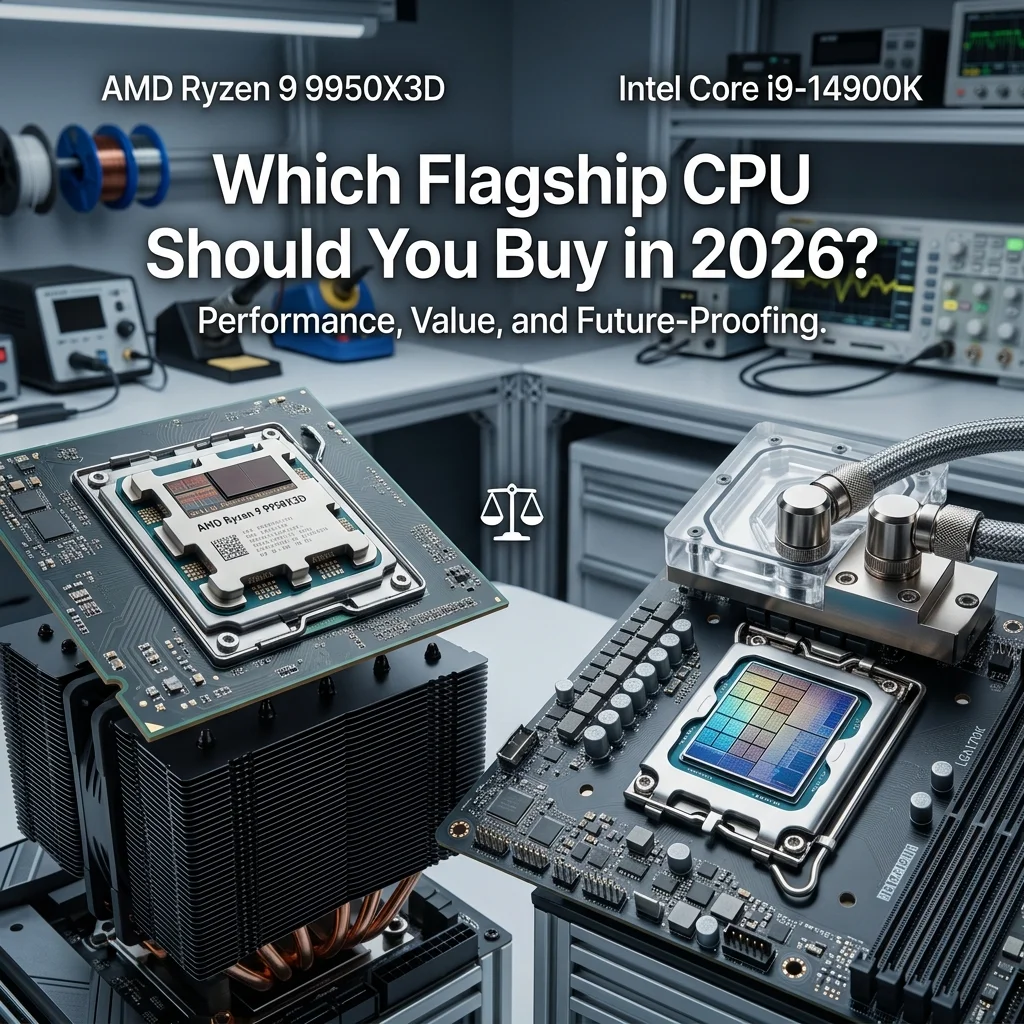
Quick Answer: AMD Ryzen 9 9950X3D vs Intel Core i9-14900K, Which Should You Buy in 2026?
Buy the AMD Ryzen 9 9950X3D if you want the stronger all-round flagship for gaming and heavily threaded work. PassMark reports a CPU Mark score of 70,096 versus 58,240 for the Core i9-14900K, while single-thread performance is effectively comparable. The Intel chip remains attractive at $479.69, however: it is $190.30 cheaper than AMD’s $669.99 processor and supports both DDR4 and DDR5, which can reduce the cost of an existing build.
Winner by Category
| Category | Winner | Evidence |
|---|---|---|
| Power / Processing performance | AMD Ryzen 9 9950X3D | PassMark CPU Mark: 70,096 versus 58,240, giving AMD the higher overall result in the supplied comparison. |
| Gaming performance | AMD Ryzen 9 9950X3D | Its 128MB L3 cache is substantially larger than Intel’s 36MB, and the supplied 2026 gaming comparison says the 9950X3D is faster on average across more than 100 games. |
| Navigation / Ease of use | Intel Core i9-14900K | Intel is compatible with 600- and 700-series motherboards and supports either DDR4 or DDR5, giving owners of suitable older hardware more upgrade flexibility. |
| Runtime / Battery or fuel efficiency | Intel Core i9-14900K | PassMark lists a 125W TDP and estimated yearly running cost of $22.81, compared with AMD’s 170W TDP and $31.03 estimated yearly cost. |
| Noise | No clear winner | manufacturer specifications does not provide controlled noise measurements for either processor. Cooling hardware, power limits and motherboard settings will affect the result. |
| Price & value | Intel Core i9-14900K | The listed Amazon price is $479.69 versus $669.99 for AMD. PassMark’s CPU value figures also favor Intel: 129.7 versus 117.0 in the dated comparison. |

Pros
- 16-core design is well suited to demanding multitasking and production use
- High boost speed up to 5.7 GHz supports strong peak performance
- Built on Zen 5 architecture for a current-generation desktop platform
- Compatible with AM5 systems
Cons
- Requires an AM5-compatible motherboard, so it is not a drop-in upgrade for older platforms
- The manufacturer listing does not include details such as cache, TDP, or bundled cooling
- Its high-end feature set may be more CPU than casual users need for basic computing
Overview: The AMD Ryzen 9 9950X3D is a 16-core desktop processor built on the Zen 5 architecture and designed for gaming and content creation. It comes as a boxed processor for AM5-based desktop systems.
Performance: With a base clock of 4.3 GHz and boost clocks up to 5.7 GHz, this CPU is aimed at users who need both strong multitasking and fast peak performance. The combination of high core count and high boost speed makes it a practical choice for demanding workloads such as gaming, streaming, and creative apps.
Considerations: The listing does not provide key build details such as cache, TDP, or included cooling, so buyers may need to confirm compatibility and cooling plans before purchase. It is also limited to AM5 systems, which may matter for older builds.
Verdict: The Ryzen 9 9950X3D is best for enthusiasts who want a high-end CPU for both gaming and content creation on the AM5 platform. Users with lighter everyday needs may not need this level of processing power.

Pros
- 24 cores (8 P-cores, 16 E-cores) and 32 threads for intense multitasking
- Advertised maximum clock speed reaching up to 6.0 GHz
- Broad compatibility with both DDR4 and DDR5 memory platforms
- Features integrated Intel UHD Graphics 770
Cons
- Requires a potential BIOS update for Intel 600-series motherboards
Specifications Side-by-Side
These are the headline specifications and comparison figures available in the supplied product and research data. The processors use different platforms, so CPU price alone does not determine the total cost of a new PC.
| Specification | AMD Ryzen 9 9950X3D | Intel Core i9-14900K |
|---|---|---|
| Brand | AMD | Intel |
| Product type | Desktop boxed processor | Desktop processor |
| Architecture / generation | Zen 5; Granite Ridge | 14th-generation Core processor |
| Socket | AM5 | FCLGA1700 |
| Physical cores | 16 | 24: 8 P-cores and 16 E-cores |
| Threads | 32 | 32 |
| Base clock | 4.3GHz | 3.2GHz |
| Maximum boost | Up to 5.7GHz | Up to 6.0GHz |
| L3 cache | 128MB | 36MB |
| Processor power / TDP | 170W listed in the comparison data | 125W base processor power |
| Memory support noted in research | AM5 platform; DDR5-oriented platform information was supplied | DDR4 and DDR5 support |
| PCIe support | Not specified in manufacturer specifications | PCIe 5.0 and PCIe 4.0 support |
| Integrated graphics | AMD Radeon Graphics | Intel UHD Graphics 770 |
| Overclocking | Not specified in manufacturer specifications | Unlocked and overclockable K-series processor |
| Listed price | $669.99 | $479.69 |
| Amazon rating | 4.3/5 | 4.2/5 |
Performance
Core Performance
The Ryzen 9 9950X3D is the faster processor in the most useful overall benchmark supplied for this comparison. Its PassMark CPU Mark score is 70,096, while the Core i9-14900K scores 58,240. The research describes this as approximately 20% higher multi-threaded performance for AMD, although the exact gap varies by benchmark and workload. To compare alternative configurations, check our hands-on review of jbl partybox club 120 vs sony srs xv500.
PassMark single-thread results are much closer: 4,738 for the Ryzen and 4,690 for the Core i9. That small difference means neither chip should be selected solely from its maximum advertised clock. Intel reaches 6.0GHz, 5% higher than AMD’s 5.7GHz maximum boost, but AMD has the higher listed base clock at 4.3GHz versus Intel’s 3.2GHz.
AMD also carries 128MB of L3 cache, compared with 36MB on Intel. The 92MB advantage is particularly relevant to games that benefit from additional cache. The supplied 2026 gaming comparison reports that the 9950X3D is faster on average across more than 100 games, while the earlier comparison of the non-X3D Ryzen 9 9950X and Core i9-14900K found Intel ahead in a 1080p gaming test. That distinction matters: results for the 9950X should not be treated as results for the 9950X3D. Users looking for related component recommendations can explore our z890 vs x870e motherboard breakdown.
Handling & Ergonomics
For a desktop processor, handling is mostly about platform selection, installation and cooling rather than the CPU package itself. The Ryzen 9 9950X3D uses AMD’s AM5 socket and belongs to the Zen 5 Granite Ridge family. The Core i9-14900K uses the FCLGA1700 socket and works with Intel 600- and 700-series chipsets.
Intel is easier to integrate into a system that already has compatible DDR4 memory because the 14900K supports DDR4 as well as DDR5. AMD’s supplied platform information identifies the 9950X3D as an AM5 desktop processor, so a buyer moving from an older platform should budget for a compatible motherboard and memory rather than assuming existing parts will transfer. Before finalizing equipment decisions, refer to our comprehensive marshall stanmore iii vs harman kardon onyx studio 8 comparison.
Both are high-end desktop CPUs that need an appropriate cooling solution. manufacturer specifications does not include cooler specifications, operating temperatures or controlled noise readings. Do not choose a cooler based only on the CPU’s advertised boost clock; choose a solution rated for the platform and the sustained workload you expect to run.
Runtime / Fuel & Maintenance
There is no battery runtime for either processor. For electricity use, the comparison data lists AMD at 170W TDP and Intel at 125W base processor power. PassMark’s estimated yearly running-cost figures are $31.03 for the Ryzen 9 9950X3D and $22.81 for the Core i9-14900K. These are estimates rather than a universal household bill: actual use depends on workload, power limits, idle time, cooling and electricity rates. For broader ecosystem context, read through our operational guide on dyson v8 cyclone vs bissell featherweight stick.
The lower Intel figure is useful for buyers who run sustained workloads and prioritize power cost. AMD’s stronger CPU Mark result can be more valuable when a task finishes sooner, but the supplied research does not provide a complete performance-per-watt test for every application. Treat the power figures as a planning guide, not as a promise of identical system consumption.
Best Use Cases
- Ryzen 9 9950X3D: high-end gaming combined with content creation, compiling, rendering and other multi-threaded desktop work.
- Core i9-14900K: demanding gaming and professional content creation when the lower processor price, DDR4 compatibility or 6.0GHz boost specification is important.
- Existing Intel build: the 14900K is the more practical option if the current motherboard is based on a compatible 600- or 700-series Intel chipset.
- New flagship build: AMD is the stronger performance choice in the supplied overall benchmark and has the larger cache reserve for cache-sensitive games.
Maintenance & Running Costs
Neither product has a consumable such as a filter, blade or battery. Ongoing maintenance is therefore centered on keeping the CPU cooler, fans and case airflow clear of dust and ensuring that the motherboard firmware and processor settings are appropriate for the installed chip. The manufacturer listings do not state that either processor includes a bundled cooler, so verify the package contents before buying a separate cooling solution.
Cooling matters for both chips because they are flagship desktop processors, and sustained heavy workloads can expose inadequate cooling quickly. The Core i9-14900K lists 125W base processor power, while the comparison data gives the Ryzen 9 9950X3D a 170W TDP. Those figures help size the system, but they are not direct measurements of every workload’s wall power or fan noise.
On the supplied estimated running-cost figures, Intel has the advantage by $8.22 per year: $22.81 versus $31.03. That difference is modest beside the initial CPU price gap, but it becomes more relevant for a workstation that spends many hours under load. There are no manufacturer specifications points for thermal paste replacement intervals, cooler servicing or warranty repair costs.
Features & Usability
AMD’s main technical advantage here is the combination of Zen 5 architecture, 16 cores, 32 threads and 128MB of L3 cache. The product listing identifies the chip as a gaming and content-creation processor, with a 4.3GHz base clock and boost of up to 5.7GHz. Its AM5 form factor makes it a component for a new compatible desktop platform rather than a drop-in replacement for an Intel system.
Intel takes a different approach with 24 total cores: 8 Performance-cores and 16 Efficient-cores, also providing 32 threads. The 14900K boosts up to 6.0GHz and is unlocked for overclocking. It supports PCIe 5.0 and PCIe 4.0, DDR4 and DDR5 memory, and Intel 600- and 700-series motherboards. Those options are meaningful for builders trying to reuse an existing memory kit or motherboard.
Both processors include integrated graphics according to the PassMark comparison: AMD Radeon Graphics on the 9950X3D and Intel UHD Graphics 770 on the 14900K. manufacturer specifications does not quantify their gaming capability, so buyers should not select between these CPUs on integrated-graphics performance alone.
The buyer-facing Amazon ratings are close, at 4.3/5 for AMD and 4.2/5 for Intel. Ratings can indicate general customer satisfaction, but they do not replace application benchmarks or confirm the behavior of a particular motherboard and cooling setup.
Price & Value Analysis
The listed price changes the decision substantially. The Ryzen 9 9950X3D costs $669.99, while the Core i9-14900K costs $479.69. Intel is therefore $190.30 cheaper, or roughly three-quarters of AMD’s listed price. That comparison covers the processors only; motherboard, memory and cooling costs can alter the total platform value.
AMD is worth the premium when the computer’s priority is maximum CPU performance across gaming and multi-threaded workloads. Its CPU Mark score is 70,096 versus Intel’s 58,240, and its 128MB L3 cache gives it a clear cache-capacity advantage. The supplied benchmark data also shows nearly equivalent single-thread results, so the AMD premium is not buying a major single-thread lead alone.
Intel is worth choosing when the $190.30 saving matters more than the highest overall benchmark score. Its PassMark CPU value figure is 129.7 compared with 117.0 for AMD, and its support for DDR4 can reduce the cost of an upgrade from a compatible system. The lower listed power figures and $22.81 estimated yearly running cost also favor Intel for buyers focused on operating expense.
Which Should You Buy?
Choose AMD Ryzen 9 9950X3D if…
- You want the stronger overall result in the supplied PassMark CPU Mark comparison: 70,096.
- You play CPU-sensitive games and want the benefit of 128MB of L3 cache.
- You combine gaming with rendering, compiling, content creation or other heavily threaded work.
- You are building around AMD’s AM5 platform and do not need to reuse an Intel motherboard.
- The $669.99 listed price fits your budget and performance matters more than the lowest purchase cost.
Choose Intel Core i9-14900K if…
- You want to spend $479.69 rather than $669.99 on the processor.
- You already have a compatible Intel 600- or 700-series motherboard.
- You want the option of using DDR4 or DDR5 memory.
- You value the 6.0GHz maximum boost specification and unlocked K-series design.
- You prioritize the lower supplied processor power and estimated yearly running cost.
Consider a different model if…
- Your workload is primarily gaming and you do not need a 16-core flagship processor; a less expensive gaming-focused CPU may leave more money for the graphics card.
- You are replacing an entire PC and the cost of a new motherboard, memory and cooler makes either flagship exceed your budget.
- You need a processor with documented noise, temperature or application-specific benchmark results that are not included in the supplied comparison.
- You are choosing based on a particular software package; the supplied results show that benchmark leadership can vary by workload.
- For more options at every price point, see our full guide to Best CPUs.
Everything You Need to Know: Ryzen 9 9950x3d Vs Core I9 14900k FAQ
Is the Ryzen 9 9950X3D faster than the Core i9-14900K?
In the supplied PassMark comparison, yes. The Ryzen 9 9950X3D scores 70,096 in CPU Mark versus 58,240 for the Core i9-14900K. Single-thread results are much closer, at 4,738 for AMD and 4,690 for Intel. The exact advantage depends on the application, settings and cooling.
Which processor is better for gaming?
The Ryzen 9 9950X3D is the safer choice from the supplied 2026 gaming research: the comparison says it is faster on average across more than 100 games. Its 128MB L3 cache is also much larger than Intel’s 36MB. Game performance still depends on the graphics card, resolution, memory and game engine.
Which CPU is cheaper to run?
The Core i9-14900K has the lower supplied figures. Its listed base processor power is 125W and PassMark estimates yearly running cost at $22.81. The Ryzen 9 9950X3D is listed at 170W TDP with an estimated yearly cost of $31.03. Actual system consumption will vary with workload and electricity pricing.
Can I use the same motherboard for these processors?
No. The Ryzen 9 9950X3D uses the AM5 socket, while the Core i9-14900K uses FCLGA1700. Intel is compatible with motherboards based on 600- and 700-series chipsets. A buyer changing between these CPUs should plan for the appropriate motherboard, and possibly different memory and cooling requirements.
Related Comparisons
- CPU comparisons and buying guides
- Best gaming PC guides
- PC components comparisons
Processor Background Reading
Desktop processors are complex products built on a long history of electronics engineering and industry guidance. For a general overview of that field, see the American National Standards Institute (ANSI). These chips are not compared there.