Direct Answer: What Is the Best Backpack Blower?
The best backpack blower depends on your property size, power preference, and budget. For professional landscapers and owners of large properties, a gas-powered backpack blower is still the performance leader, with top-tier models pushing past 700 CFM and 170 MPH. For homeowners, a battery-electric backpack blower in the 500 to 650 CFM range is often the smarter choice, delivering enough power for most residential lots with zero emissions, far less noise, and almost no maintenance.
If you need a single piece of practical guidance: residential users with an acre or less should look at battery models from a battery platform they already own; commercial users and anyone clearing large, wet, or dense debris should prioritize a high-CFM gas unit with a comfortable harness and anti-vibration system.
What Is a Backpack Blower and Who Needs One?
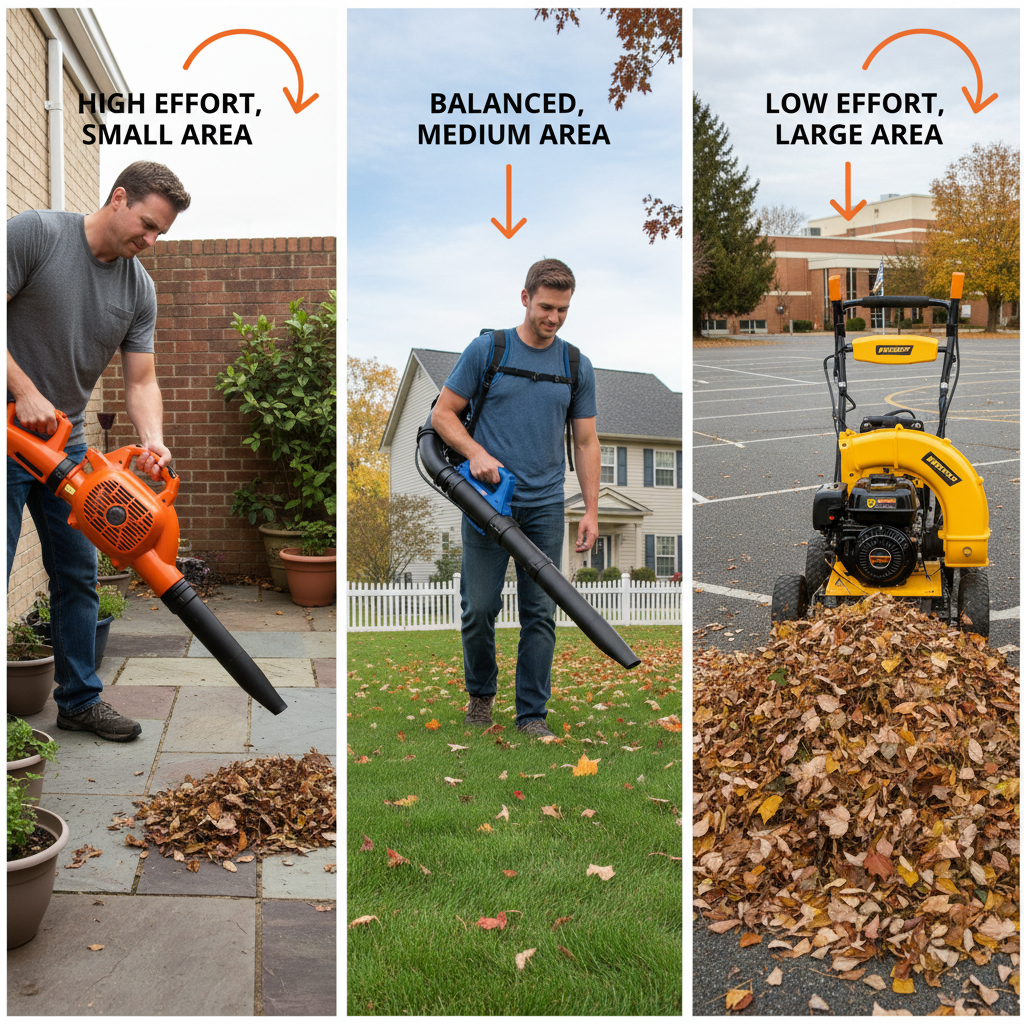
A backpack blower is a leaf and debris blower that is worn on the user’s back via a padded harness, with the engine or motor mounted on the frame and the air delivered through a flexible tube to a nozzle. Unlike a handheld blower, which concentrates all the weight and vibration in your arms, a backpack design transfers the bulk of the load to your hips and shoulders, which makes extended use far less fatiguing.
Backpack vs. Handheld vs. Walk-Behind
- Handheld blowers are light, cheap, and fine for small patios and postage-stamp lawns, but they typically produce lower CFM and cause arm fatigue quickly.
- Backpack blowers are the middle ground most people actually want. They offer professional-level air power with ergonomic weight distribution, suitable for quarter-acre lots up to commercial work.
- Walk-behind blowers are essentially blowers on wheels. They are the most powerful option and make sense for acre-plus properties or commercial crews, but they are expensive, heavy, and overkill for most homeowners.
Who Actually Needs a Backpack Blower?
You are a strong candidate for a backpack blower if you recognize any of these scenarios:
- Your property is roughly a half-acre or larger, or you have many mature trees that dump leaves for months.
- You regularly spend more than 30 minutes at a time blowing leaves, grass clippings, or debris.
- You are a landscaping professional who clears multiple properties daily and needs maximum productivity.
- You have dealt with arm fatigue or wrist strain from handheld blowers.
- You need to move wet, heavy leaves, pine needles, acorns, or gravel from driveways and walkways.
Homeowners on small lots can absolutely get by with a handheld blower. But if you have ever wished your blower had “just a little more power,” a backpack model is the upgrade that ends that thought permanently.
Gas vs. Battery Backpack Blowers: Which Type Is Best for You?
The single biggest decision you will make is gas or battery. This choice eliminates an entire category before you ever compare individual models, so it deserves your attention first.
| Factor | Gas Backpack Blower | Battery Backpack Blower |
|---|---|---|
| Air power | Highest available; top models exceed 700 to 900 CFM | Strong; leading models reach roughly 500 to 650 CFM |
| Noise level | Loud; often 90 to 100+ dB at the operator’s ear | Much quieter; typically 60 to 75 dB |
| Emissions | Burns fuel; produces exhaust and fumes | Zero direct emissions |
| Maintenance | Fuel mixing, air filters, spark plugs, winterization | Minimal; occasional battery and air intake care |
| Runtime | Unlimited as long as you carry fuel | Limited to battery capacity; 20 to 60 minutes typical per charge |
| Upfront cost | Often lower for equivalent power, but add fuel | Higher initial cost; batteries and chargers are expensive |
| Weight | Similar or heavier, plus fuel weight | Now comparable to gas; batteries add heft |
| Best for | Professionals, large properties, wet/heavy debris | Homeowners, noise-sensitive areas, light-to-moderate duty |
Are Battery Backpack Blowers Powerful Enough to Replace Gas?
For many homeowners, yes. Battery technology has improved rapidly. Modern high-voltage brushless blowers move surprising volumes of air, and the convenience of “grab, go, done” operation cannot be overstated. No fuel mixing, no pull-cord starts, no carburetor issues after winter storage.
For professional crews, the answer is still usually no. Commercial landscapers need sustained, wide-open throttle for hours at a time, and the runtime of even the largest batteries falls short. They also routinely move wet leaves and heavy debris where raw CFM wins. Most pros still reach for gas, though hybrid fleets are growing as battery costs drop.
Noise and Emissions Restrictions
This is where battery models have quietly won over many homeowners. Many municipalities have adopted noise ordinances that restrict gas-powered leaf blowers during certain hours or ban them outright in residential zones. Two-stroke gas engines are the usual target. If your community restricts gas blowers, a battery backpack blower is not just a nice option; it may be the only legal one. Even where gas is permitted, battery operation at 60 to 75 dB is dramatically more neighbor-friendly than the 95+ dB scream of a two-stroke engine.
Key Performance Specs That Actually Matter
Blower marketing loves big numbers, and two acronyms dominate every product page: CFM and MPH. You need to understand both, and there is a third metric called air watts that is arguably more useful. Readers comparing setup options can review our technical analysis on marshall stanmore iii vs harman kardon onyx studio 8.
CFM – Cubic Feet per Minute (Air Volume)
CFM measures how much air the blower moves. For moving piles of leaves and heavy debris, CFM is the number that matters most. A blower with high CFM pushes a wide, dense column of air that sweeps leaves away in bunches rather than picking at them one at a time.
- Handheld territory: Under 400 CFM is fine for small cleanup.
- Homeowner backpack range: 450 to 600 CFM handles most residential lots well.
- Professional territory: 700+ CFM is the common rule of thumb for commercial-grade machines that can move wet leaves and debris.
MPH – Miles per Hour (Air Speed)
MPH measures how fast the air is traveling. High speed is useful for dislodging stuck leaves, clearing grass off pavement, and blowing debris out of tight spaces. But MPH without CFM is a classic marketing trap. A narrow tube can produce a high MPH number while moving very little total air, which is useless for bulk leaf clearing. For complementary field maintenance guidelines, examine our breakdown of dyson v8 cyclone vs bissell featherweight stick.
Look for a balance: roughly 150 to 170 MPH is strong for residential use, and 170 to 200+ MPH is typical of professional gas models.
Air Watts – The Single Most Honest Metric
Air watts combine both volume and speed into one number: the actual power of the air stream. It is calculated by combining CFM and MPH into a single measure of work performed. Many experts consider air watts the most reliable spec for comparing blowers because it is harder to inflate with a clever nozzle design. A blower with a higher air watts rating will generally do more real-world work than one with a flashy MPH number. To evaluate matched hardware tolerances, consult our detailed overview of bissell crosswave hydrosteam vs shark stainforce.
Engine Displacement (Gas) and Battery Voltage/Ah (Electric)
For gas models, engine displacement is measured in cubic centimeters (cc). Bigger cc generally means more power, but it also means more weight and fuel consumption. Most homeowner gas backpack blowers sit around 25 to 35 cc; commercial units run 40 to 80 cc.
For battery models, voltage and amp-hours (Ah) tell you about the system’s capability. Higher voltage (36V, 40V, 60V, 80V and beyond) supports higher output, while Ah indicates how long the battery can sustain that output. Two batteries of the same voltage can deliver the same power, but the one with higher Ah runs longer. Also, prefer brushless motors; they are more efficient, quieter, and longer-lived than brushed motors.
How Specs Get Inflated
Manufacturers sometimes cherry-pick their best-case numbers: maximum MPH measured at the nozzle tip with no flex tube, or CFM measured at the fan housing rather than the end output. A blower that looks amazing on paper can feel weak in your hands. This is why independent testing and user reviews matter, and why air watts is a better apples-to-apples comparison than either raw CFM or MPH alone.
Ergonomics, Comfort and Safety Features to Evaluate
Power gets you the sale, but comfort keeps you happy. A backpack blower is strapped to your body; a poorly designed harness can make a 20-minute job feel like a full day of labor.
Harness and Padding
Look for wide, contoured shoulder straps and a padded back panel with breathable mesh. The best harnesses distribute weight onto your hips, not just your shoulders. Adjustable straps let you dial in the fit so the unit doesn’t bounce or sag while you work. Many premium models include a sternum strap and a hip belt, both of which significantly improve stability.
Anti-Vibration Systems
Vibration is not just annoying; prolonged exposure can cause hand-arm vibration syndrome over years of professional use. Most quality blowers now feature anti-vibration mounts that isolate the engine from the frame and tube. The difference is immediately noticeable: your hands stay comfortable long after a cheaper unit would have you shaking out your fingers every few minutes.
Weight and Balance
A typical backpack blower weighs 10 to 12 kg empty (roughly 22 to 26 lb). Battery models are often in the same range once the battery is installed. For a 30-minute session, most users tolerate 22 to 25 lb fine. For multi-hour commercial work, weight and balance become critical, and lighter, well-balanced units justify their premium price.
Cruise Control and Variable-Speed Throttle
This is one feature worth paying extra for. A cruise-control or lock-on throttle lets you set your speed and remove your finger from the trigger, which reduces hand fatigue dramatically during long sessions. Variable-speed triggers give you precise control so you can ramp up for heavy debris and dial back for flower beds. Both are common even on mid-range models today, and they are near-essential for anyone using a blower for more than casual cleanup.
Tube and Nozzle Design
Larger tube diameters (about 10 to 12 cm / 4 to 5 in) allow more air volume to flow, which supports high CFM. Interchangeable nozzles add versatility: a flat wide nozzle for open lawns, a tapered nozzle for hard-to-reach spots, and a concentrator for tough debris. Look for tool-free nozzle changes so you can adapt on the fly.
How to Choose the Best Backpack Blower for Your Specific Situation
Now that you understand the specs and trade-offs, here is a step-by-step framework you can apply directly.
Step 1: Match the Power Type to Your Property and Rules
- Half-acre residential lot: A battery backpack blower in the 500 to 600 CFM range is typically perfect. Unless you are managing a forest of mature maples, this is all you need, and you get quiet, emission-free operation.
- One acre or more, or heavy tree cover: Consider a gas model in the 600 to 700 CFM range, or a battery model with multiple batteries and a fast charger so you can swap and keep going.
- Many local noise/emission restrictions: Go battery. It sidesteps the entire class of legal headaches.
- Commercial/professional use: Prioritize gas, high CFM (700+), commercial-grade build, and an excellent anti-vibration harness. You are buying productivity and durability, not convenience.
Step 2: Consider Your Existing Battery Platform
If you already own a cordless lawn or power tool ecosystem, seriously consider a backpack blower that shares that battery platform. You already own spare batteries and a charger, which effectively lowers the cost and eliminates charger clutter. If you are starting from scratch, compare the batteries themselves: larger Ah batteries are heavy, so a no-compromise 5 Ah pack may be worth the extra weight if you dislike swapping constantly.
Step 3: Set a Realistic Budget
Prices range widely, and you get what you pay for:
- Entry-level gas and battery models run on the lower end of the price spectrum, good for small lots and light use.
- Mid-range models are where most homeowners should look. You get anti-vibration, cruise control, and solid power without commercial pricing.
- Professional/commercial units cost the most but are built for daily abuse, with longer warranties and replaceable parts. If you earn money with your blower, this is not the place to bargain-hunt.
Step 4: Ask the Right Questions Before Buying
- What is the actual CFM and air watts, not just the MPH?
- Does the harness have hip support, a sternum strap, and breathable padding?
- Does it have cruise control or a lock-on throttle?
- Is the motor brushless (for battery models)?
- What does the warranty cover, and how long does it last?
- Are replacement parts (filters, tubes, batteries) readily available?
- Is it CARB-compliant if you live in a state with strict emissions rules?
Maintenance, Longevity and Total Cost of Ownership
The purchase price is only the beginning. Understanding ongoing costs will change how you evaluate “best.”
Gas Backpack Blower Maintenance
Two-stroke gas blowers mix oil and fuel; most require a specific fuel-to-oil ratio (commonly 50:1, but always check your manual). Regular maintenance includes:
- Cleaning or replacing the air filter, typically every 20 to 50 hours of use or more often in dusty conditions.
- Replacing the spark plug annually or as needed.
- Cleaning the fuel system and carburetor, especially if the machine sat unused for months.
- Winterizing: running the carburetor dry or adding fuel stabilizer before storage.
Four-stroke engines eliminate the oil mixing but add oil changes and are less common in backpack form. Either way, a gas blower that is maintained can serve a homeowner for many years and a professional for even longer, with replaceable wear parts keeping it alive well beyond its warranty.
Battery Backpack Blower Maintenance
Battery maintenance is dramatically simpler: keep the air intakes clear of dust, wipe down the unit, and store batteries at moderate temperatures. The main long-term cost is the battery itself. Lithium-ion batteries degrade with charge cycles, and while daily-use battery life can degrade noticeably over a few years, a lightly used homeowner battery can last much longer. Replacement batteries are expensive, so factor that into lifetime ownership. Store batteries partially charged in a cool, dry place, and avoid leaving them on the charger for weeks at a time.
Total Cost of Ownership Over Time
Over several years, the two categories can end up closer in total cost than their price tags suggest. Gas models cost less upfront but require fuel, oil, filters, spark plugs, and occasional carburetor service. Battery models cost more upfront and eventually demand replacement batteries, but they eliminate fuel and most routine service. For light residential use, battery often wins on total cost and convenience. For heavy professional use, gas typically wins on raw cost per hour of work because it never stops for a charge.
Common Mistakes to Avoid When Buying a Backpack Blower
Avoid these traps and you will not be the person re-selling a regret buy on the classifieds next spring.
Mistake 1: Buying on MPH Alone
The marketing-friendly MPH number is the easiest spec to inflate. A high MPH with low CFM means a fast, narrow stream that is miserable for clearing a lawn. Always check CFM and, ideally, air watts before you commit.
Mistake 2: Underpowering a Large Property
Buying a bargain model for a big, tree-heavy lot is the most common regret. The machine struggles, the job takes three times as long, and you end up buying the upgrade you should have bought first. Match the blower to the property, not to the sale price.
Mistake 3: Ignoring Battery Compatibility
Buying a battery blower from a platform you do not own means new batteries, a new charger, and a wall of proprietary gear. If you already own a cordless ecosystem, that is usually the smartest place to stay, even if a competing brand’s specs look slightly better on paper.
Mistake 4: Buying Cheaper Than Quality Allows
Rock-bottom pricing on a backpack blower usually means a flimsy harness, weak anti-vibration, and short-lived components. A cheap gas blower that is constantly in the shop, or a cheap battery blower with 15 minutes of runtime, is not a bargain at any price. Mid-range reputable brands are the sweet spot for most homeowners.
Mistake 5: Ignoring Warranty and Parts Availability
A blower is only as good as its service network. Check the warranty period and coverage, and make sure replacement tubes, filters, and batteries will be available for years. Commercial users should insist on commercial-grade warranties; a model with a short, consumer-only warranty is a red flag for daily work.
Common Questions on Best Backpack Blower Answered
Is a backpack blower worth it for a small yard?
For a small yard under a quarter-acre with few trees, a good handheld blower is usually sufficient and much cheaper. Consider a backpack blower if you find yourself straining with the handheld, if your yard is closer to half an acre, or if you want to minimize arm fatigue and time spent on cleanup. Many owners upgrade and never look back, but it is genuinely unnecessary for the smallest lots.
How many CFM do I need in a backpack blower?
As a rule of thumb: 450 to 600 CFM handles most residential properties well, while 700+ CFM is the common benchmark for professional and commercial use. If you regularly clear wet leaves, pine needles, or heavy debris, lean toward the higher end of the range, and pay more attention to CFM (air volume) than MPH (air speed).
Are battery backpack blowers as powerful as gas?
Not yet at the very top end, but the gap has narrowed dramatically. Leading battery models in the 500 to 650 CFM range genuinely rival entry and mid-range gas machines for most residential work. The remaining advantages of gas are sustained high output for hours at a time and the extreme top-end CFM needed by commercial crews. Battery wins on noise, emissions, and maintenance almost every time.
How long does a backpack blower battery last?
Runtime depends on the battery’s amp-hour rating, the blower’s power draw, and how aggressively you use the throttle. Expect roughly 20 to 60 minutes of continuous use per battery at typical settings. Buying a second battery or a fast charger effectively doubles your working session. Over years of use, lithium-ion batteries gradually lose capacity, so plan on eventual battery replacement as the main long-term cost of a battery blower.

Pros
- Equipped with a 64.8cc 4-MIX gas engine
- Engineered for low vibration levels during prolonged wear
- Adjustable blower tube accommodates varied operator heights
- Durable backpack harness supports heavy-duty outdoor cleanups
Cons
- Weighs over 24 pounds before adding fuel
- Requires ongoing gas engine maintenance and fuel mixing

Pros
- Backpack design distributes weight across the shoulders
- Delivers up to 550 CFM and 160 MPH airflow
- Includes 60V 5.0Ah battery and 6A rapid charger
- Variable-speed control for tailored blowing power
Cons
- Requires recharging once the single 5.0Ah battery depletes

Pros
- Rated at 660 CFM and 165 MPH for heavy cleanup
- Cruise control and thumb-dial speed adjustment
- Includes 5.0Ah battery and rapid 5A charger
- Compatible with over 75 Greenworks 40V tools
Cons
- Large backpack footprint requires more storage space
- Total runtime per charge is not explicitly stated

Pros
- Powerful 79cc 2-cycle engine claims 930 CFM and 184 MPH
- Large 3L fuel tank supports up to 95 minutes of run time
- Cruise control system locks in desired throttle settings
- Shock-absorbing padded backpack harness improves comfort
- Includes earmuffs, mixing bottle, and assembly tools
Cons
- Weighs 29.75 pounds before adding fuel
- Requires manual pull-start and 2-cycle gas/oil mixing

Pros
- 80cc engine produces an impressive rated 900 CFM and 206 MPH
- Large 77.8 oz (2.3 L) fuel tank reduces frequent refills
- Cruise control switch locks throttle for reduced hand fatigue
- Frame-separated suspension system helps dampen engine vibration
- Includes essential maintenance kit, funnel, and oil bottle
Cons
- Heavy construction weighs around 22 pounds
- Requires standard 2-stroke gas and oil fuel blending

Pros
- Manufacturer-stated 984 CFM airflow for large wet leaf piles
- 79.4cc engine listed for properties of one acre or more
- Built-in springs intended to reduce engine vibration during use
- Ventilated, ergonomic shoulder straps for airflow and weight balance
- Listing suggests use for light snow, driveways and workshop sawdust
Cons
- Requires a 25:1 gas and two-stroke oil mixture before each use
- The 1-acre-in-30-minutes claim is manufacturer-stated, not verified

Pros
- Engine produces an advertised 900 CFM air volume
- Generous 2.3-liter fuel tank for extended runtimes
- Carburetor air purge system assists with quick starting
- Variable speed throttle includes cruise control lock
- Padded harness helps manage load across shoulders
Cons
- Heavy dry weight of 29.15 pounds
- Requires 2-stroke gas and oil pre-mixing

Pros
- Powerful 75.6cc 4-stroke engine eliminates fuel mixing
- Produces up to 498 CFM air volume at 7,000 RPM
- Padded backpack harness with shock absorbers for comfort
- Large 0.5-gallon translucent fuel tank for extended runtime
- Cruise control lever maintains selected throttle setting
Cons
- Heavier footprint at 27 pounds dry weight
- Larger frame requires dedicated storage space

Pros
- High-output 62CC 2-stroke engine handles heavy yard waste
- Delivers up to a rated 880 CFM air volume and 320 MPH wind speed
- Padded backpack harness and adjustable straps distribute weight
- Built-in anti-vibration technology reduces operator fatigue
- Adjustable throttle control accommodates light and heavy tasks
Cons
- Relatively heavy unit weighing over 25 pounds
- Requires two-stroke gas and oil fuel mixing
- Gas engine demands regular maintenance and seasonal care

Pros
- Stated 750 CFM airflow and 205 MPH wind speed
- 4-stroke design eliminates the need for mixing fuel
- Tube-mounted throttle with cruise control function
- Large 1.9-liter fuel tank allows longer run intervals
- Adjustable backpack harness helps distribute weight
Cons
- Weighs 24.5 pounds dry before adding fuel
- Bulky overall dimensions require significant storage space

Pros
- 4-stroke engine, no fuel mixing required
- Listed 340 CFM and 130 MPH airflow
- Lightweight handheld design, per listing
- Suited to lawns, driveways and yard edges
Cons
- Title says backpack while features describe handheld use
- Listed weight of 11.33 pounds

Pros
- Stated 84CC 2-stroke engine delivers up to 4.5 kW of power
- High-volume 1,060 CFM rating tackles large yard debris
- Large 2.5-liter fuel tank minimizes refueling stops
- Flexible long outlet tube maneuvers around obstacles
- Padded backpack harness evenly balances the frame
Cons
- Substantial weight of 20 to 22 pounds can cause fatigue
- Requires 2-stroke gas/oil mixing and seasonal maintenance

Pros
- Constant-speed switch reduces need to hold the throttle
- Air outlet adjusts up to 120 degrees vertically and 135 horizontally
- Listed 0.47-gallon fuel tank for longer running between refueling
- Adjustable, breathable backpack straps per the listing
Cons
- Listed at 19.7 lb, which is heavy for extended carrying
- Power, heat, and durability claims are manufacturer-stated

Pros
- 52CC 2-stroke engine delivers a rated 550 CFM airflow
- Backpack harness features adjustable padded shoulder straps
- Includes 5 connecting tube sections for customizable length
- Built with corrosion-resistant metal and high-strength ABS
- Easy-pull start system facilitates smooth engine startup
Cons
- Larger footprint takes up considerable storage space
- Requires ongoing 2-cycle gas and oil mixing
Pros
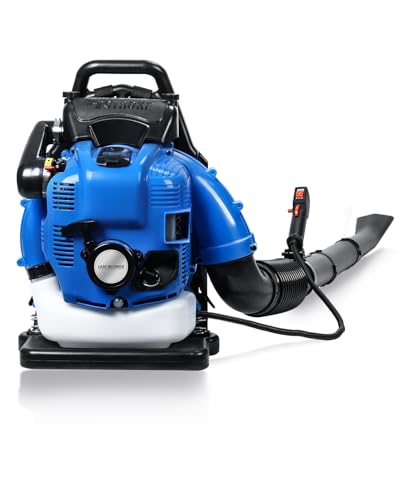
- 75.6cc 4-stroke engine avoids messy gas and oil premixing
- Manufacturer-rated airflow up to 750 CFM and 205 MPH airspeed
- Variable-speed throttle with cruise control for steady operation
- Padded backpack harness helps distribute the unit's weight
- Generous 1.9-liter fuel tank supports extended runtime
Cons
- High 112 dB operating noise level requires ear protection
- Heavy 24.7-pound frame can tire operators during extended jobs
- Manufacturer recommends 92+ octane fuel for operation
Related Maintenance and Operating Guides
To keep your equipment running at peak operating efficiency, explore our related technical walkthroughs and maintenance tutorials:
- Consult our detailed breakdown on blower.
Backpack Blower Safety Background
Backpack blowers put a motor and fuel tank on the operator’s back, so balance and fuel handling both need attention. Fill the tank outdoors and away from ignition sources. Readers looking for a general safety overview of engine powered blowers may begin with American National Standards Institute (ANSI).