Quick Answer: To drive a zero-turn mower safely on hills, keep the maximum slope angle to 15 degrees or less, always travel straight up and down (never across) the slope, and steer with slow, gentle lap-bar inputs. If the mower stalls, slides, or the rear wheels lose traction, release the lap bars to neutral, turn downhill, and drive straight down without braking hard. Never operate a zero-turn on wet grass, and always wear the seat belt with the roll-over protection (ROP) bar raised and locked.
Zero-Turn Mower Slope Safety: The 15-Degree Rule and Traction Physics
Zero-turn mowers are the most dangerous lawn equipment for slope work because their design—two independently driven rear wheels and a pivoting front axle—creates unique rollover and slide risks. Unlike a traditional lawn tractor with front steering, a zero-turn’s center of gravity shifts dramatically the moment you turn the lap bars, especially on an incline. Understanding the physics of traction, weight transfer, and the 15-degree maximum slope angle is the difference between a clean cut and a call to the emergency room.
Slope Angle Diagnostic Matrix: When to Mow vs. When to Walk
On any hill, a zero-turn mower must travel in a straight line perpendicular to the contour lines—meaning directly up or directly downhill. Never, under any circumstance, mow across a slope (traversing) with a zero-turn. The zero-turn’s pivoting front axle provides no lateral stability, and the weight of the deck plus the operator shifts instantly to the downhill wheel, causing the machine to tip sideways or slide uncontrollably downhill.
Mowing Uphill: Traction and Throttle Control
- Raise the deck to its highest cutting position before the climb; a full grass bag adds significant rear weight and destabilizes the climb.
- Approach the slope head-on with both lap bars pushed forward evenly, and increase the throttle to full RPM before engaging the incline.
- Maintain a steady, constant speed. Do not feather or pulse the lap bars—each input changes the drive ratio between wheels and can break rear traction.
- If the rear wheels spin or the machine slows to a crawl, immediately release both lap bars to the neutral position, allow the mower to roll backward to a flat spot, and reassess. Do not push harder; spinning wheels dig ruts and increase rollover risk.
Mowing Downhill: Gravity and the Critical Braking Rule
Downhill operation is statistically where most zero-turn rollover fatalities occur. The machine’s weight shifts forward onto the pivoting front axle, which can turn sharply on its own, and the engine braking of the hydrostatic transmission may not be sufficient to control descent speed.
- Before descending, lower the deck to the ground or to its lowest position. The deck acts as a physical drag brake and increases rear weight distribution, improving traction.
- Keep both lap bars slightly forward of neutral to maintain controlled forward momentum. The mower must drive itself down under power, not coast.
- Never push the lap bars fully backward (reverse) on a downhill slope to brake. This locks or reverses the rear wheels, causing the mower to pivot over the front axle—the classic zero-turn end-over-end rollover.
- If the mower accelerates unacceptably, gently ease the lap bars toward neutral, but keep them in the forward quadrant. Feathering between neutral and slight forward is acceptable downhill; full reverse is never acceptable.
Steering Lap Bars: The Anatomy of Gentle Inputs
The lap bars are not a car steering wheel; they control independent wheel speed differential. A two-inch input difference between the left and right bar can cause a 90-degree pivot at speed on a slope. On flat ground, sharp turns are merely stressful on the turf. On a hill, the same turn initiates a lateral slide or a rollover.
Master the “inch-and-pause” method. To turn at the top of a slope (the only safe turning point), push the inside lap bar backward and outside lap bar forward no more than one inch from their current positions. Pause for two full seconds to feel the mower’s response before adding more input. This technique prevents the “whip” pivot that throws weight to the downhill outside wheel. If you must turn mid-slope due to an obstacle, stop completely, shift to neutral, then turn gently when the mower is fully static.
Preventing Zero-Turn Sliding Downhill: Traction Physics and Recovery
Sliding downhill is a traction failure, not a steering failure. The rear drive wheels lose grip because the weight has transferred away from them (when climbing) or because wet grass/loose soil reduces the coefficient of friction below the force of gravity acting along the slope plane. On dry turf, most zero-turns hold a 15-degree slope. On wet grass, that threshold drops below 8 degrees.
nFor related hardware testing and detailed setup options, explore our Best Zero Turn Mowers Residential Worth Buying In 2026.
nnnFor related hardware testing and detailed setup options, explore our Best Ride On Lawn Mower Worth Buying In 2026.
nnThe Sliding Recovery Protocol
- Recognize the slide: You feel the rear end drift sideways or the mower loses forward progress while the engine RPM stays constant.
- Release to neutral: Immediately pull both lap bars to the neutral center position. Do not attempt to correct into the slide like a car—that kills the mower’s drive and forces a full stop.
- Turn downhill: Once the mower has settled into a straight-line slide, gently push the lap bar on the side you want to turn toward (to face directly downhill) slightly forward. The mower will pivot its rear wheels to aim downhill.
- Drive straight down: Once aimed downhill, ease both bars slightly forward to engage forward drive and let the mower walk itself down under power to the flat bottom.
- Never brake: Engaging the parking brake or pressing the brake pedal during a slide locks the rear wheels und, which converts a controlled slide into a certain rollover.
This “release, turn downhill, power down” protocol is the single most important skill a zero-turn operator must drill before ever touching a hill. Practice on a dry, gentle 8-degree slope until the response is muscle memory.
Roll-Over Protection (ROP) Bar and Seat Belt: Non-Negotiable Life-Saving Hardware
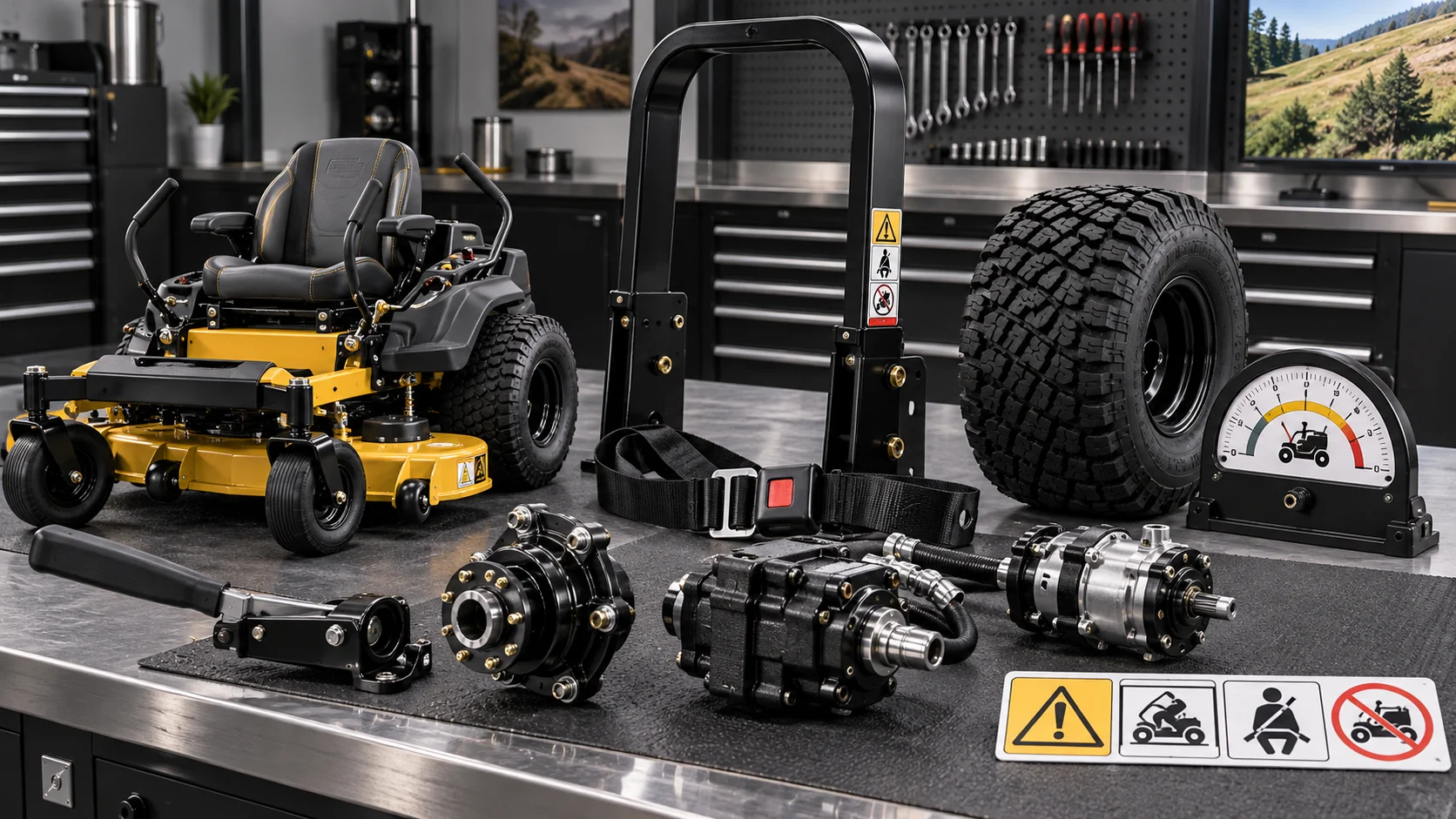
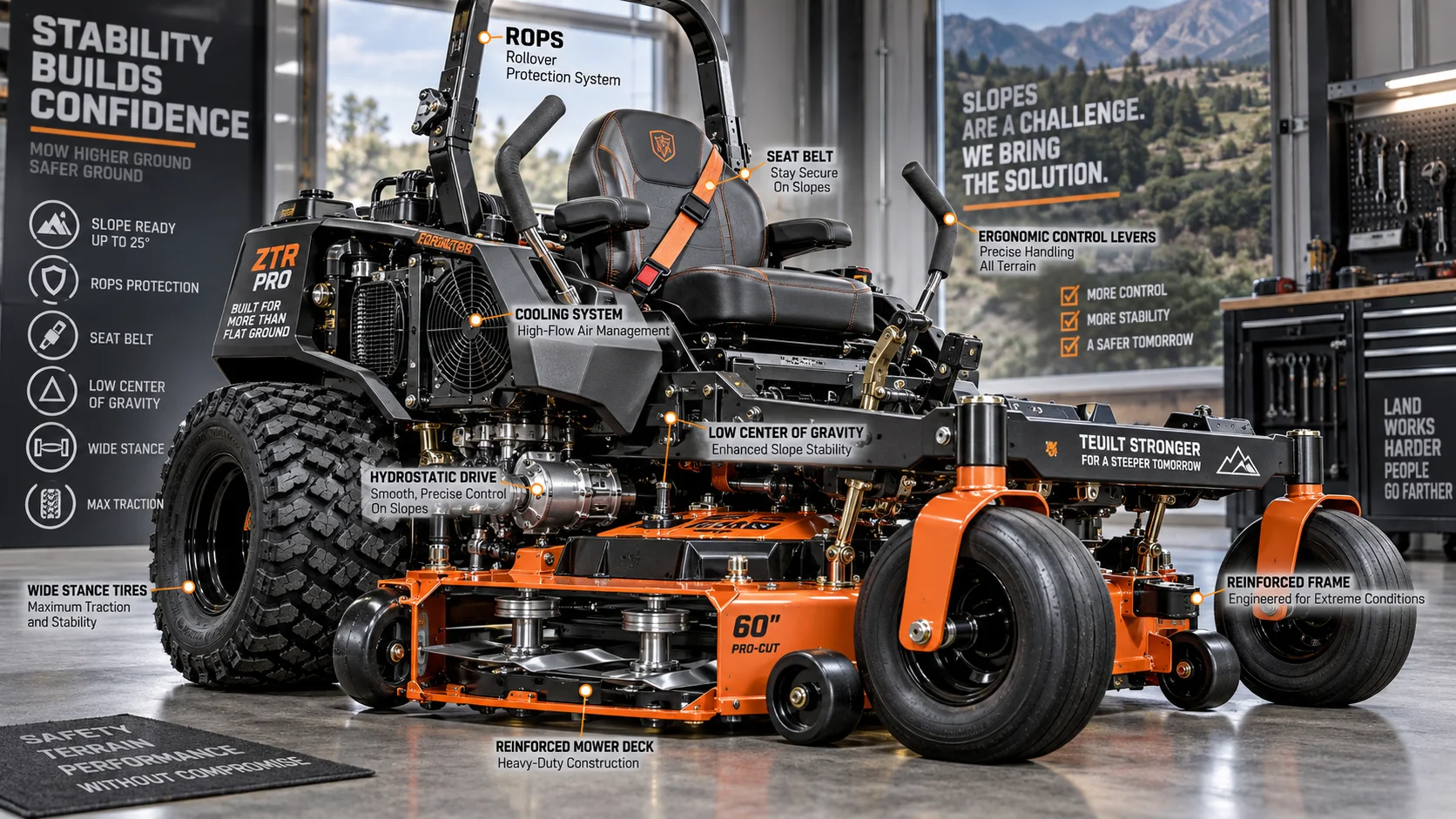
A zero-turn mower without a raised and locked roll-over protection (ROP) bar is a death trap on any slope beyond 10 degrees. The ROP bar—a steel hoop behind the seat—creates a survival cell. If the mower tips, the bar contacts the ground first, keeping the operator’s head and torso from being crushed between the machine and the turf.
However, the ROP bar is only effective if you wear the seat belt. Without the belt, the operator is thrown clear of the seat and lands in the path of the falling mower. The belt keeps you pinned in the protective envelope of the bar. This is not a “safety theater” feature; it is a structural roll cage, and most OEMs void the warranty and liability if the bar is folded down during operation with the belt off.
If your zero-turn lacks a factory ROP bar, you cannot retrofit most aftermarket bars safely—the mounting points must be engineered to the frame. Purchase a model with an integrated bar, or restrict that mower to flat ground permanently.
Rear Weight Distribution on Hills: Ballast Theory and Practical Setup
Preventing zero-turn sliding downhill and front pivot rollovers depends on optimal rear weight distribution. When climbing, weight transfers to the rear wheels, which is good for traction but raises the center of gravity. When descending, weight transfers forward, unloading the drive wheels and loading the pivoting front axle—the worst case for control.
Adding Ballast: The Science
- Why weight helps: Each additional pound of mass over the rear axle increases the normal force on the drive tires, raising the maximum tractive force before slip. On a 15-degree slope, adding a 50-lb. rear ballast kit can increase effective traction by roughly 15–20%.
- Where to place it: Ballast must sit directly over or slightly behind the rear axle, ideally in factory bracket locations on the frame. Never hang weights on the lap-bar structure or the steering column.
- Common ballast types: OEM rear ballast kits (steel plates), liquid tire ballast (wheel weights or windshield-washer fluid inside the tires), or a heavy rear-mounted counterweight accessory approved by the manufacturer.
- The danger of over-ballasting: Too much weight raises the center of gravity too high, turning a stable mower into a tippy one. Follow the OEM’s maximum ballast specification exactly. A full grass catcher bag is NOT ballast—it is an unstable, forward-shifting load that increases rollover risk.
Critical note on tire pressure: Check rear tire pressure before every slope session. Over-inflated tires (above the 10–14 PSI typical on mower tires) reduce the contact patch and dramatically lower traction. Under-inflated tires cause sidewall flex and could allow the rim to slip on the bead.
Next Step & Hardware Pairing: For recommended machine configurations and real-world durability tests, see our buyer guide on slope-rated riding mowers.
Pre-Mow Inspection and Environmental Conditions Checklist
Slope conditions change daily based on weather, time of day, and grass moisture. Adopt this 60-second pre-flight check before every slope pass:
- Grass moisture: If you see morning dew, rain in the last 24 hours, or sprinkler runoff, do not attempt slopes over 10 degrees.
- Traction check: At the bottom of the hill, do a quick “launch test”—push both lap bars forward hard from a dead stop. If either rear wheel spins on flat, dry grass, you have zero chance on the hill.
- Debris scan: Walk the slope for wet leaves, fresh-cut clippings, exposed roots, or mole holes. Any of these create a localized traction loss trigger point.
- ROP bar verification: Confirm the roll-over protection bar is fully raised, locked into its detent, and the seat belt retracts freely and clicks securely.
- Mow high: Set the deck one notch higher than normal for the first pass on an unfamiliar slope; taller grass holds more moisture and reduces traction.
- Fuel level: Run with a full tank—slope mowing burns fuel faster, and running low shifts weight abruptly. <!– /wp