

For homeowners and property caretakers clearing large lawns or long driveways, a wheeled walk behind gas leaf blower delivers massive clearing volume without straining your back or shoulders, though pushing a heavy steel frame across steep slopes or tight garden beds requires noticeable physical effort.

Pros
- 50.2-cc 2.1-HP X-Torq engine
- Rated blowing force of 692 CFM and 180 MPH
- LowVib technology dampens machine vibrations
- Air purge primer simplifies engine starts
- Ergonomic harness with offset control handle
Cons
- Weighs 22 pounds before fuel is added
- Requires ongoing two-stroke fuel mixing

Pros
- Powerful 7HP 212cc 4-stroke OHV gas engine
- Heavy-duty 13.5-inch metal impeller
- 360° front swivel wheel and 10-inch rear wheels
- 90° adjustable airflow output angle
- Rust-resistant powder-coated steel frame
Cons
- Engine oil is not included upon unboxing
- Manual push operation requires physical effort
- Gasoline and oil maintenance required

Pros
- Delivers up to 972 CFM and 236 MPH air output
- 66-cc 4-HP X-Torq 2-cycle engine
- Load-reducing backpack harness with wide shoulder straps
- Air purge system and cruise control for easier operation
Cons
- Heavier build weighs 24.5 pounds
- Requires 2-cycle gas and oil fuel mixing

Pros
- Lightweight design at only 4.4 pounds
- 7-Amp motor rated up to 180 MPH and 180 CFM
- Built-in cord retention prevents unplugging
- Zero emissions with instant push-button start
- Simple, low-maintenance corded design
Cons
- Extension cord is not included
- Operating range is limited by cord reach
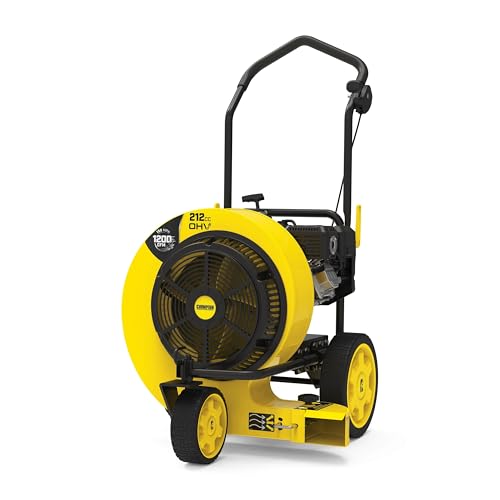
Pros
- Rated for up to 1200 CFM of air volume
- 3-position wind vane plus forward air attachment
- Large 12-inch never-flat rear wheels
- Lockable 360-degree front swivel wheel
- Ergonomic handle features height adjustment
Cons
- Weighs 104 pounds without power propulsion
- Gas engine requires fuel and oil upkeep
- Bulky frame requires ample storage space

Pros
- 28-cc 2-cycle engine rated at 470 CFM and 170 MPH
- Includes vac kit with mulching knives and bag
- Cruise control feature simplifies extended use
- Auto-return stop switch automatically resets to on
Cons
- Weighs 9.6 pounds before fuel and collected debris
- Requires 2-cycle gas and oil fuel mixing

Pros
- High-volume clearing with a rated 3000 CFM and 207 MPH
- Electric start eliminates manual pulling effort
- Standard clevis pin hitch connects easily to ATVs and tractors
- Adjustable vertical airflow discharge for directed blowing
- Durable steel frame construction with large wheels
Cons
- Requires a towing vehicle like an ATV or lawn tractor
- Weighs 291 pounds and demands significant storage space
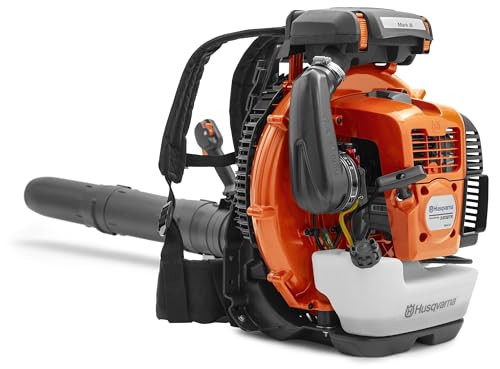
Pros
- Strong rated output of 1000 CFM, 220 MPH, and 47 N blow force
- Ventilated ergonomic harness with load-distributing hip belt
- Two-stage intake air filtration protects engine in dusty jobs
- Intuitive tube-mounted throttle control
Cons
- Substantial 34-pound weight can lead to operator fatigue
- Requires ongoing 2-cycle fuel mixing and maintenance

Pros
- 51cc 2-cycle engine produces up to 765 CFM and 270 MPH
- Padded harness and hip belt provide balanced load distribution
- Air purge system removes fuel line air for easier starting
- Variable speed throttle includes cruise control functionality
- Proven X-Torq engine technology maintains high clearing force
Cons
- Heavier 22-pound build can cause fatigue on extended jobs
- Requires routine 2-cycle gas and oil fuel maintenance

Pros
- Produces up to 1270 CFM airflow and 150 MPH wind speed
- Runs on standard unleaded 87-octane gasoline with no oil mixing
- 360-degree front swivel wheel and 12-inch rear wheels for steering
- 90-degree adjustable flow angle directs debris where needed
- Convenient handle-mounted controls for speed adjustment
Cons
- Manual push design requires physical effort on uneven ground
- Bulky footprint requires dedicated garage or shed storage
When a Walk-Behind Gas Leaf Blower Outperforms Backpack Models
A wheeled walk-behind blower is built for high-volume, flat-ground leaf clearing where carrying equipment causes physical fatigue. Moving massive amounts of fallen leaves across an open lawn or parking lot benefits from high CFM output supported entirely by ground wheels.
The primary advantage of push blowers like the Champion Power Equipment 212cc 1200 CFM or the Landworks Leaf Blower Wheeled Walk Behind Jet is operator ergonomics. Instead of bearing 20 to 30 pounds on your back, the equipment rests on rugged rear wheels. However, the trade-off is limited agility: push machines cannot easily navigate narrow garden paths, stairways, or steep ditch banks where backpack blowers excel. For broader perspectives on buying styles, explore our guide to finding the best leaf blower.
Comparing Airflow: Wheeled Push Units vs. Heavy-Duty Backpacks
Walk-behind blowers focus on broad air volume to sweep broad swaths, whereas commercial backpacks often deliver higher wind speeds to dislodge stubborn debris.
Looking at manufacturer ratings, walk-behind options like the SuperHandy Walk Behind Leaf Blower advertise 1270 CFM at 150 MPH from a 209cc engine. In contrast, heavy-duty commercial backpacks like the Husqvarna 580BTS Gas Backpack Leaf Blower provide an advertised 1000 CFM at 220 MPH using a 75.6-cc 2-cycle engine, yielding 47 Newtons of blowing force. While the walk-behind moves a wider volume of air per minute to clear broad lawns faster, the backpack’s higher velocity offers superior concentrated force for wet, stuck leaves.
Maneuverability and Wheel Hardware Across Walk-Behind Units
Smooth operation on a walk-behind blower depends heavily on wheel diameter and front swivel mechanics, which determine how smoothly you turn at the edge of a property.
Both the SuperHandy Walk Behind Leaf Blower and the Champion Power Equipment 212cc 1200 CFM feature large 12-inch rear wheels combined with 360-degree front swivel casters. Champion also allows operators to lock the front wheel in place for straight-line runs across bumpy lawns. The Landworks Leaf Blower Wheeled Walk Behind Jet utilizes slightly smaller 10-inch rear wheels alongside an 8-inch front swivel wheel. Smaller rear wheels can make rolling through deep thatch or soft ground slightly more demanding.
SuperHandy vs. Landworks: Evaluating 4-Stroke Walk-Behind Options
Both SuperHandy and Landworks offer 7HP 4-stroke walk-behind blowers sharing identical 1270 CFM airflow ratings, but subtle differences in wheel sizing and control placement set them apart.
The Landworks unit pairs a 212cc engine with a 13.5-inch metal impeller, rated for 150 to 200 MPH depending on operating RPMs, running on 10-inch rear wheels. The SuperHandy walk-behind utilizes a 209cc engine with 12-inch rear wheels and highlights handle-mounted controls to adjust engine speed without stooping. If your yard has rough, uneven terrain, the larger 12-inch wheels on the SuperHandy provide easier pushing, while the Landworks offers a robust steel frame and metal impeller construction for rugged durability.
Adjustable Flow Control and Forward Chutes for Difficult Debris
Air direction dictates whether leaves pile up neatly along a tree line or blow back across your cleared path, making chute adjustability essential.
The Champion Power Equipment 212cc 1200 CFM provides advanced directional control with a 3-position adjustable wind vane that angles output 15 degrees up or down, plus a forward-flow attachment that switches clearing from side discharge to straight ahead. Meanwhile, the Landworks Leaf Blower Wheeled Walk Behind Jet and SuperHandy Walk Behind Leaf Blower feature 90-degree adjustable flow angles. If you frequently clear curbs, retaining walls, or long paved driveways, directing air straight ahead reduces excessive maneuvering. Check our recommendations on leaf blowers for driveways to see how directional airflow impacts hard surfaces.
Walk Behind Gas Leaf Blower FAQ
What fuel do 4-stroke walk-behind blowers require?
Supplied manufacturer specifications for models like the Landworks and SuperHandy walk-behind units recommend unleaded 87-octane gasoline with 10 percent ethanol or less. Additionally, 4-stroke engines require crankcase oil to be added prior to initial startup.
Can a walk-behind blower direct airflow forward?
Certain models offer directional attachments or vanes. For example, the Champion Power Equipment 212cc blower includes a 3-position adjustable wind vane (tilting 15 degrees up or down) along with a forward flow attachment to push leaves straight ahead rather than only out the side.
Choosing the Right Leaf Blower for Your Yard Layout
Selecting the right blower comes down to property acreage, obstacle density, and your physical preference between pushing weight or carrying it.
For large, open turf areas where you want to move wide piles without physical strain on your back, the Champion Power Equipment 212cc 1200 CFM is our recommended walk-behind choice thanks to its lockable swivel wheel, height-adjustable handle, and versatile directional air chutes. Its main drawback is its bulk, making it cumbersome in tight landscaped beds or on steep grades. For properties featuring steep slopes, tight garden paths, or steps, an alternative like the backpack-mounted Husqvarna 580BTS Gas Backpack Leaf Blower provides superior pinpoint maneuverability and 220 MPH velocity at the cost of carrying the engine weight on your shoulders.





