For homeowners managing heavy, wet leaves or large yards, the strongest battery leaf blower options deliver high-volume airflow that rivals small gas units, though sustained top-speed operation depletes single batteries quickly. Selecting the right model requires balancing manufacturer-advertised CFM ratings against platform ecosystem reliability and battery capacity.
Pros
- Brushless motor provides strong 200-MPH and 800-CFM performance for efficient debris removal
- 15 percent lighter weight design reduces user fatigue during extended operation
- Quiet zero-emission operation suitable for eco-conscious residential use
- Includes full 40V 7.5 Ah battery and charger kit for out-of-box readiness
- Compatible 40V battery system works across Husqvarna handheld tools
Cons
- Battery-powered design requires recharging and offers finite runtime unlike gas alternatives
- Handheld form may still cause fatigue on very large properties despite the lighter build
- Battery appearance may vary from images as noted in the product details
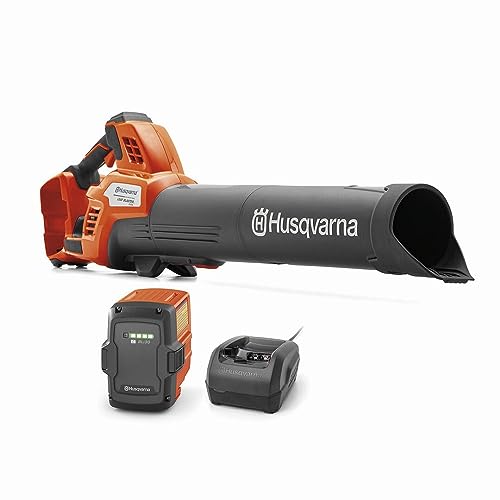
The Husqvarna Leaf Blaster 350iB is a battery-powered cordless leaf blower that arrives as a complete kit with a 40V lithium-ion 7.5 Ah battery and charger. Its brushless motor construction and focus on reduced weight create an immediate impression of a modern, user-friendly tool built for regular lawn maintenance and outdoor cleanup tasks.
In performance, this model generates wind speeds up to 200 MPH with 800 CFM airflow to move leaves and debris effectively while remaining quiet and producing zero emissions. Simple keypad controls allow instant starts, cruise control supports hands-free convenience, and the power boost mode adds 20 percent more power along with a built-in debris scraper for wet or sticky material. The shared 40V battery further increases value by working with other Husqvarna handheld tools.
Considerations include the inherent limits of cordless operation, which depends on battery charge and requires recharging between uses. Even with the 15 percent lighter design, the handheld style can lead to arm fatigue over very large areas, and battery appearance may vary from promotional images.
Overall, the Husqvarna Leaf Blaster 350iB delivers excellent value for homeowners, fathers, or outdoor workers seeking a powerful yet quieter alternative to traditional blowers, particularly those who appreciate the convenience of a full battery kit and ecosystem compatibility.

Pros
- High-volume airflow rated up to 680 CFM
- Includes two 21V batteries and a charger
- 5-speed variable control for delicate or heavy debris
- Lightweight build at just 3.6 pounds
- Ergonomic handle with anti-slip grip
Cons
- Battery life drops faster at maximum speed
- Requires swapping and charging batteries

Pros
- Delivers up to 500 CFM and 130 MPH with Turbo mode
- Includes two 4.0Ah batteries and a dual-port fast charger
- Icon-based display screen shows speed level and battery life
- Weighs 7.58 lbs with dual batteries and includes a shoulder strap
- Manufacturer claims up to 100-minute runtime on Gear 1
Cons
- Requires both batteries installed together to operate
- Turbo mode limited to 15-second intervals
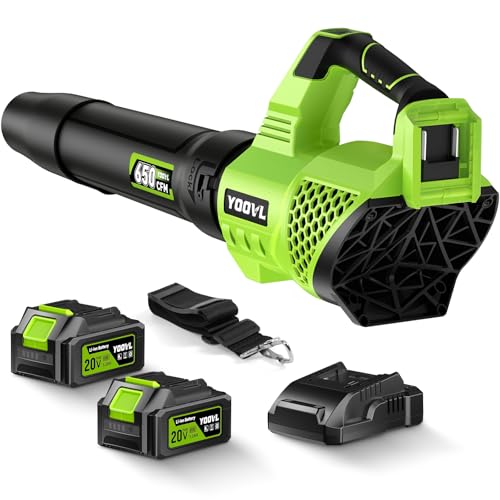
Pros
- Airflow rated up to 650 CFM using advanced turbo technology
- Comes with two high-capacity 20V 5.2Ah batteries and fast charger
- Three selectable speed modes for delicate to heavy-duty jobs
- Includes an adjustable shoulder strap to reduce arm fatigue
- Includes blower tube and extension nozzle attachments
Cons
- Maximum 150-minute runtime applies only to low-speed mode
- Heavier battery packs may add weight during prolonged handheld use

Pros
- Turbo mode pushes up to 765 CFM and 200 MPH
- Cruise control dial for speeds from 260 to 580 CFM
- Includes a 5.0Ah 56V battery and fast charger
- High-efficiency brushless motor for smooth performance
- Comes with both tapered and spread nozzles
Cons
- Turbo output significantly reduces total operating runtime
- Total tool weight reaches 9.5 pounds

Pros
- Includes two 21V 4.0Ah batteries for extended runtime
- Delivers up to 420 CFM airflow and 150 MPH air speed
- Lightweight design weighs under 3 lbs bare tool for low fatigue
- Comes with both round and flat interchangeable nozzles
- Two adjustable speed settings for varying cleanup tasks
Cons
- Limited to two preset airflow speeds
- Best suited for dry leaves and light debris rather than heavy wet waste

Pros
- Brushless motor delivers rated airflow up to 650 CFM and 180 MPH
- Includes two 20V 4.0Ah batteries and a fast charger
- Six adjustable speed settings ranging from 80 to 180 MPH
- Comes with an ergonomic shoulder strap and two detachable nozzles
- Includes a storage bag to keep components organized
Cons
- Stated 30-minute runtime is restricted to low-speed operation
- High-speed settings will deplete battery charge more rapidly

Pros
- Delivers up to a stated 930 CFM airflow and 197 MPH
- Includes two 4.0Ah batteries and a fast charger
- Six variable-speed settings with a constant-speed lock
- Tool-free assembly with included blower tubes
Cons
- Stated dual-battery runtime is limited to 30–60 minutes

Pros
- Claims up to 450 CFM and 150 MPH for efficient debris clearing
- Lightweight 3.8-pound body reduces arm fatigue
- Includes two batteries and a charger for extended sessions
- Two selectable speed modes match different cleaning tasks
- Simple assembly requiring only nozzle and battery attachment
Cons
- Runtime reaches up to 30 minutes per battery only on low speed
- High-speed battery consumption significantly shortens run times

Pros
- 1200W brushless motor delivers up to 700 CFM and 200 MPH
- Includes two 5.2Ah batteries and a fast charger
- Three speed modes adapt to dusting or heavy clearing
- Claimed runtime reaches up to 160 minutes on low speed
Cons
- Weighs 7.7 pounds, which may tire arms during long tasks
- Runtime drops to 40 minutes at maximum speed setting
CFM vs. Airspeed: What Defines True Cordless Blowing Force?
Raw clearing strength depends on a balance between air volume, measured in cubic feet per minute (CFM), and air speed, measured in miles per hour (MPH). High CFM moves broad piles of dry leaves across open turf, while high MPH provides the concentrated force needed to lift matted, wet debris from pavement.
Among verified options, manufacturer ratings span widely. The Husqvarna Leaf Blaster 350iB lists an advertised 800 CFM and 200 MPH using its brushless motor and power boost function, while the EGO POWER+ LB7654 advertises 765 CFM and 200 MPH in turbo mode. Budget units like the RAXONE cordless blower advertise up to 930 CFM and 197 MPH. However, because manufacturer ratings are self-reported and testing conditions are not standardized across third-party labs, buyers should view standalone peak numbers cautiously. If you frequently clear hard surfaces, also consider our guide on leaf blowers for driveways to see how nozzle shape alters effective blowing power.
Premium 40V–56V Platforms vs. Budget High-Output Kits
Premium outdoor power equipment brands invest heavily in unified battery ecosystems and sustained motor efficiency, whereas entry-level multi-battery kits offer lower upfront costs with less established platform support.
The Husqvarna Leaf Blaster 350iB is priced at $379.00 and includes a high-capacity 40V 7.5 Ah lithium-ion battery designed to work across Husqvarna’s entire handheld lineup. Similarly, the EGO POWER+ LB7654 ($299.00) operates on EGO’s established 56V ARC Lithium platform, featuring a 5.0 Ah battery compatible with lawn mowers, string trimmers, and chainsaws. In contrast, value-focused brands like RAXONE ($69.98) and YOOVL ($89.98) provide two smaller battery packs in the box to deliver high claimed specs at a fraction of the initial investment. While budget kits provide attractive entry pricing, long-term replacement battery availability and tool ecosystem expansion remain major trade-offs compared to established manufacturers. If you are deciding between top platforms, read our overview on what leaf blower is the best for broader platform evaluations.
Managing Battery Drain Under Maximum Output
Running a cordless leaf blower on turbo or maximum throttle consumes battery reserves rapidly, often reducing continuous runtimes to a fraction of their low-speed ratings.
Manufacturers frequently advertise maximum runtimes achieved only at lowest output levels. For instance, the YOOVL 650CFM blower advertises up to 150 minutes across two 5.2Ah batteries, while the WOLFBOX MT500 lists up to 100 minutes on Gear 1 using two 20V 4.0Ah packs. However, when demanding maximum power to shift heavy piles, high-discharge brushless motors deplete packs significantly faster. The EGO POWER+ LB7654 addresses this with a variable-speed cruise control dial spanning 260 to 580 CFM, reserving its 765 CFM burst mode for short, stubborn jobs. Buyers tackling properties larger than half an acre should plan on having spare packs ready or cycling batteries through fast chargers during cleanup.
Weight, Ergonomics, and Handling Heavy Battery Packs
A more powerful battery leaf blower generally requires a larger, heavier battery pack, which increases overall tool weight and can cause arm strain during extended sessions.
The Husqvarna 350iB pairs an 800 CFM output with a substantial 7.5 Ah pack, utilizing cruise control and an advertised lightweight design to offset user fatigue. To counter heavy dual-battery setups, models like the WOLFBOX MT500 (weighing 7.58 lbs with dual batteries installed) and the YOOVL 650CFM include adjustable shoulder straps to transfer weight off the operator’s wrists. If your routine maintenance primarily involves clearing light porch dust or small patios rather than heavy lawn debris, a compact alternative from our review of small cordless blowers may offer far superior comfort over massive, high-output blowers.
Frequently Asked Questions About High-Power Battery Leaf Blowers
Does a higher advertised CFM always mean a blower is stronger?
Not necessarily. CFM measures the total volume of air pushed, but clearing force also depends on air velocity (MPH) and nozzle diameter. Furthermore, manufacturer-advertised specs are not independently verified across uniform standards, so real-world performance depends heavily on motor design and battery discharge rates.
Can I use batteries from other power tools in these blowers?
Cross-compatibility depends strictly on the brand platform. Established brands like Husqvarna and EGO Power+ use proprietary battery ecosystems that interchange across their respective 40V or 56V tool lines. Budget and standalone brands often use proprietary or unstandardized battery connections that do not fit tools from other manufacturers.
Choosing the Strongest Battery Leaf Blower for Your Yard
Determining the right high-power cordless blower requires matching your yard’s debris density and acreage against tool weight and platform longevity. High CFM claims are appealing, but reliable power delivery, accessible customer support, and durable battery design dictate long-term satisfaction.
For buyers who prioritize verified brand reliability, heavy-duty performance, and cross-tool battery compatibility, the Husqvarna Leaf Blaster 350iB is our primary recommendation. It combines an advertised 800 CFM and 200 MPH with an expansive 40V 7.5 Ah battery, making it well-suited for demanding suburban cleanups, though its $379.00 price tag represents a substantial upfront investment. For shoppers seeking high output on a strictly limited budget, the RAXONE 930CFM kit provides dual batteries and strong advertised output at $69.98, accepting the trade-off of a less established platform and unverified third-party lab metrics.