For typical suburban driveways and patios, the SENIX 4QL 26.5cc 4-Cycle Handheld Gas Leaf Blower eliminates the chore of mixing oil and gas while staying lightweight, though its 410 CFM airflow struggles with heavy, waterlogged debris over expansive lawns.

Pros
- 4-cycle engine eliminates fuel and oil mixing
- Delivers up to 410 CFM and 125 MPH clearing power
- Automatic compression release for easier pull starts
- Lubricates in all directions without stalling or leaks
Cons
- Not available for purchase or delivery in California
- Requires routine gas engine maintenance and oil checks

Pros
- 75.6CC 4-stroke engine requires no fuel pre-mixing
- 2600W motor runs at up to 7000 RPM
- Cruise control lever enables one-handed operation
- Thickened backpack harness shields user from heat
- Internal shock-absorbing springs reduce vibration
Cons
- Gas-powered design requires periodic maintenance
- Large form factor can be cumbersome in tight areas

Pros
- 75.6CC 4-stroke engine requires no fuel mixing
- Produces up to 750 CFM and 205 MPH air velocity
- Large 1.9-liter fuel capacity reduces refills
- Padded backpack harness balances operational weight
- Includes funnel and basic tool kit in the package
Cons
- Substantial physical footprint for storage
- Requires standard engine maintenance and fresh gas

Pros
- 75.6cc 4-stroke engine eliminates fuel-oil premixing
- Generates up to 900 CFM air volume and 210 MPH air speed
- Large 1,900 ml fuel tank reduces refueling interruptions
- Ergonomic padded backpack harness and cruise control handle
- Tube-mounted throttle with variable speed control
Cons
- Substantial footprint takes up noticeable storage space
- Requires routine 4-stroke engine upkeep like oil checks

Pros
- 75.6cc 4-stroke engine requires no oil mixing
- Delivers up to 615 CFM and 179 MPH airflow
- Large 1.8-liter fuel tank for longer runs
- Padded backpack harness dampens vibration
- Simple 4-step engine starting process
Cons
- Heavy bare machine weight at 28.44 pounds
- Large footprint requires substantial storage

Pros
- Produces up to 1270 CFM airflow and 150 MPH wind speed
- Runs on standard unleaded 87-octane gasoline with no oil mixing
- 360-degree front swivel wheel and 12-inch rear wheels for steering
- 90-degree adjustable flow angle directs debris where needed
- Convenient handle-mounted controls for speed adjustment
Cons
- Manual push design requires physical effort on uneven ground
- Bulky footprint requires dedicated garage or shed storage
Pros
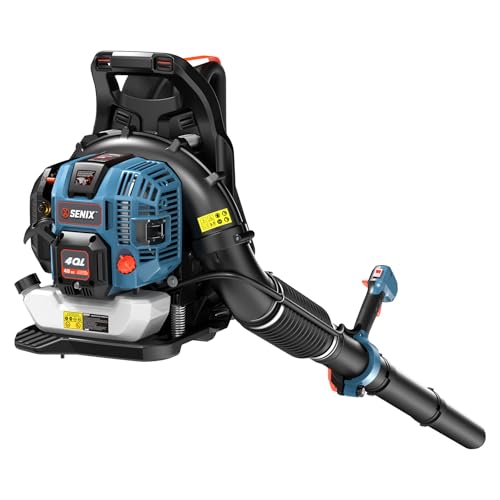
- 4-cycle engine eliminates the need to mix oil and gas
- Produces lower emissions than typical 2-cycle models
- Variable-speed throttle with convenient cruise control
- Lightweight backpack build at just 18.2 pounds
Cons
- Lower output at 425 CFM and 195 MPH than larger blowers

Pros
- Delivers up to a rated 880 CFM and 320 MPH air velocity
- Ergonomic backpack harness with padded straps and anti-vibration build
- Large 1.8-liter fuel tank supports up to 180 minutes of runtime
- Cruise-control throttle lock for steady, continuous operation
Cons
- Heavier design at approximately 25 pounds before fueling
- Requires 2-cycle gas and oil mixing
Handheld Convenience Versus Heavy-Duty Backpack Clearing
Handheld four-stroke blowers provide immediate agility for small jobs, whereas backpack configurations trade total portability for the displacement needed to shift heavy debris. Handheld tools rely on compact engines that keep the total tool weight in your arm, making quick sidewalk sweeping effortless. In contrast, backpack blowers rest the engine block across your shoulders, transferring the physical burden away from your wrists so you can carry a larger engine.
For example, the SENIX 4QL 26.5cc 4-Cycle Handheld Gas Leaf Blower features a 26.5cc engine delivering an advertised 410 CFM and 125 MPH. Because the entire unit is carried by hand, it remains simple to store and maneuver around tight patio furniture. However, clearing an entire tree line of wet leaves with a 26.5cc engine requires repeated passes. Stepping up to a frame like the SENIX 49CC 4-Cycle Gas Powered Backpack Leaf increases air speed to 195 MPH with 425 CFM, while 75.6cc backpack blowers jump well beyond 600 CFM. If you are deciding between formats or evaluating where to shop, reviewing where can I buy A leaf blower helps clarify local and online availability.
Backpack Airflow Differences Across 75.6cc Engines
Displacement alone does not dictate clearing speed, as housing design and air nozzles create substantial differences in manufacturer-advertised CFM and airspeed among 75.6cc engines. While all units in this displacement class feature four-cycle operation with dedicated oil sumps, their stated performance envelopes vary dramatically depending on tube constriction and fan design.
Comparing specific models reveals these manufacturer-reported performance spreads:
- VEVOR 75.6CC 4-Stroke Backpack Leaf Blower Gas: Advertises 615 CFM and 179 MPH air velocity, paired with a 1.8-liter fuel tank.
- Lefitap 4 Stroke Backpack Leaf Blower- 75.6CC: Claims 750 CFM and 205 MPH wind speed, featuring a 1.9-liter fuel tank and a flexible 66-inch tube assembly.
- 75.6CC 4-Stroke Backpack Gas Leaf Blower (iondelce): Advertises an output of 900 CFM and 210 MPH from a 5 HP full-crank engine, also utilizing a 1900 ml fuel capacity.
- 4-Stroke Gasoline Backpack Leaf Blower (LpqOxnm): Claims a 2600W output and an air volume metric of 498 cubic feet per second, alongside an infinitely variable cruise control handle.
While these higher CFM ratings suggest faster leaf movement, independent lab benchmarks for these specific ratings are not documented in the manufacturer specs. The primary trade-off across all 75.6cc backpack blowers is dry weight and physical bulk, which requires proper harness adjustment to avoid shoulder fatigue during extended yard work.
Walk-Behind Clearing Power for Large Flat Properties
Walk-behind blowers provide massive air volume without placing any weight on the operator’s back, making them ideal for wide paved areas or multi-acre properties with open terrain. By moving the motor onto a wheeled platform, manufacturers can install significantly larger powerplants than could ever be carried comfortably.
The SuperHandy Walk Behind Leaf Blower utilizes a 209cc 4-stroke engine producing 7 HP, delivering an advertised 1270 CFM at 150 MPH. It features two 12-inch rear wheels, an 8-inch 360-degree front swivel wheel, and a 90-degree adjustable flow angle controlled directly from the handlebar. While this machine moves deep piles of leaves and light snow rapidly, its rigid steel construction and wheeled footprint make it unsuitable for steep slopes, narrow landscape beds, or rough woodland terrain where a backpack or handheld unit excels.
Eliminating Fuel Mixing and Managing Engine Weight
The primary advantage of choosing a four-stroke blower over traditional two-stroke equipment is the separate oil and gasoline reservoirs, which completely removes the risk of improper fuel-to-oil ratios. Two-cycle engines require premixing two-stroke oil into gasoline; failing to measure accurately risks engine seizure or severe spark plug fouling. Four-stroke engines draw straight regular unleaded gasoline from the tank, running a separate internal crankcase oil lubrication system.
The compromise inherent in four-stroke outdoor tools is added mechanical complexity and engine weight. Four-cycle designs incorporate internal valves, a camshaft, and dedicated oil sumps, which generally make the engine block heavier than a comparable two-cycle counterpart. When exploring overall equipment options in the broader leaf blowers category, buyers must balance the convenience of pure gasoline against the added physical mass of four-stroke equipment.
Frequently Asked Questions About Four-Stroke Blowers
Do four-stroke leaf blowers require oil and gas mixing?
No. Four-stroke engines feature separate chambers for engine oil and fuel. You fill the fuel tank with straight unleaded gasoline and maintain oil separately in the engine crankcase, eliminating the need for premix containers.
Can a four-stroke handheld blower be operated at different angles without leaking oil?
Certain handheld units, such as those equipped with SENIX 4QL technology, are engineered for all-directional lubrication to prevent oil leakage and engine stalls during tilted use. Always check the specific manufacturer guidelines, as standard four-cycle engines can suffer oil starvation if operated upside down.
How do four-stroke blowers compare in emissions to two-stroke models?
Manufacturers consistently design four-stroke engines to achieve lower exhaust emissions and improved fuel economy compared to traditional two-cycle engines, because they do not combust lubricating oil as part of the normal fuel burn.
Choosing the Right Four-Stroke Blower for Your Yard
Selecting the best four-stroke model depends primarily on the physical size of your yard, the type of debris you encounter, and how much weight you are comfortable carrying. For urban homes with standard driveways and deck areas, heavy backpack units add unnecessary storage strain and bulk, while multi-acre estates quickly overwhelm entry-level handheld blowers.
For most homeowners seeking freedom from fuel mixing on mid-sized residential lots, the VEVOR 75.6CC 4-Stroke Backpack Leaf Blower Gas provides a balanced combination of 615 CFM clearing power, simple four-step starting, and a generous 1.8-liter tank. Its main limitation is its substantial backpack bulk, which can be cumbersome to maneuver through tight landscaping borders. Homeowners with smaller cleanup spaces and lighter maintenance needs will be better served by the compact SENIX 4QL 26.5cc 4-Cycle Handheld Gas Leaf Blower, which sacrifices commercial-level airflow for lightweight, one-handed operation.