Quick Verdict: The AMD Ryzen 9 9950X3D is a 16-core Zen 5 processor with 3D V-Cache that delivers leading gaming performance and strong multi-threaded throughput for content creation. Its dual-CCD layout and cache allocation make it the most balanced high-end AM5 option for hybrid workloads in 2026.
Pros
- Very powerful specification set for AI, rendering, and other compute-intensive tasks.
- Large 256GB memory capacity is well suited to professional multitasking and oversized projects.
- Fast NVMe storage improves responsiveness for booting, loading, and transferring files.
- Preloaded Windows 11 Pro and latest drivers reduce setup time for professional use.
Cons
- The dual-RTX 5090, 256GB RAM configuration is likely excessive for casual users or general office work.
- No monitor, keyboard, mouse, or other peripherals are listed in the manufacturer listing.
- The 1600W dual-GPU design may require careful power and thermal planning in the workspace.
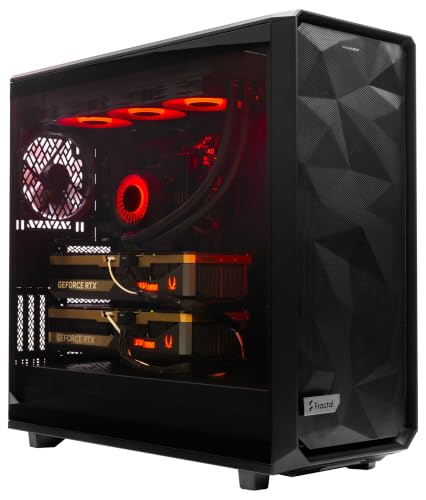
Overview & Design: The ArsenalPC MES2X is a custom-built tower workstation designed around very high-end desktop hardware. It combines a Ryzen 9-9950X3D2 processor, dual GeForce RTX 5090 GPUs, 256GB of DDR5 memory, and liquid cooling in a professionally assembled system with cable management.
Performance & Key Features: This configuration is aimed at AI development, 3D rendering, simulation, and other demanding workflows that benefit from both CPU and GPU power. The 8TB NVMe SSD boot and storage setup should help with fast startup times and quick access to large project files, while Windows 11 Pro and preinstalled drivers make it ready to use out of the box.
Drawbacks & Considerations: The main limitations are its extremely specialized nature and likely high power and cooling demands. It is also not a compact or entry-level machine, and the manufacturer listing does not list peripherals, dimensions, or other extras.
Verdict: This is best suited to professionals who need maximum workstation performance for AI, content creation, or compute-heavy production work. For mainstream users, the specification level is more than necessary, but for advanced workloads it offers a very capable hardware foundation.
Zen 5 Microarchitecture and Core Design
The Ryzen 9 9950X3D is built on AMD’s Zen 5 microarchitecture, fabricated on a TSMC 4nm process node for the compute chiplets (CCDs) and a 6nm node for the I/O die. The processor integrates 16 physical cores and 32 threads, distributed across two Core Complex Dies of eight cores each. Zen 5 introduces a wider front end with an improved branch predictor, a larger micro-op cache, and a full 512-bit datapath implemented as a double-pumped 256-bit execution path for AVX-512 instructions. Per-clock instruction throughput improvements over Zen 4 are generally cited in the low double-digit percentage range in vendor-published workloads, with the most pronounced gains appearing in branch-heavy integer code and vector-friendly floating-point loops.
Within the broader AM5 ecosystem, the 9950X3D sits at the top of the stack. Readers comparing platform options can review our overview of best am5 cpus : to see how this part positions against lower-core-count siblings. The architectural decisions here prioritize sustained all-core performance while preserving the latency characteristics that matter for interactive and gaming workloads.
3D V-Cache Implementation and Cache Allocation
The defining feature of the 9950X3D is its stacked L3 cache. AMD bonds an additional 64MB of SRAM vertically onto one of the two CCDs, bringing that die’s L3 capacity to 96MB, while the second CCD retains its standard 32MB. The total L3 capacity is therefore 128MB. This asymmetric configuration is a deliberate trade-off. The cache-enhanced CCD benefits latency-sensitive, cache-resident workloads such as many game engines, simulation kernels, and large-dataset database queries, while the frequency-optimized CCD achieves higher sustained clocks for lightly threaded and highly parallel tasks that do not rely on large working sets.
Scheduling this asymmetry requires coordination between the chipset driver, the operating system scheduler, and the firmware. AMD’s optimization software steers processes toward the appropriate CCD based on workload classification. Engineers evaluating scheduling behavior should note that thread placement errors can reduce effective cache hit rates and introduce cross-CCD latency penalties, which is why driver and BIOS currency matters more on this part than on uniform-cache designs. For related discussion of how cache-heavy designs compare across generations, see our analysis of intel core ultra 9, which takes a different architectural approach to on-die memory hierarchy.
Thermal Behavior and Throttling Limits
The thermal design of the 9950X3D is governed by a maximum junction temperature (Tjmax) of approximately 89 to 95 degrees Celsius, depending on the reported platform specification revision. The processor’s Precision Boost Overdrive and Package Power Tracking mechanisms continuously adjust frequency and voltage to remain within power, current, and thermal envelopes. The stacked cache die introduces a thermal consideration: heat generated by the compute die must conduct through the cache layer, which constrains how aggressively the cache-enhanced CCD can sustain peak frequency under heavy all-core loads. Throttling behavior is therefore more load-dependent on this part than on monolithic designs.
In practical terms, sustained all-core workloads such as long video encodes or large compilation jobs will settle at a frequency plateau determined by cooler capacity and ambient conditions rather than reaching maximum boost clocks. Users who want to reduce acoustic output while maintaining a stable thermal envelope can tune their cooler response using a custom cpu fan curve, which typically yields a better balance between temperature headroom and noise than default fan profiles.
Memory Controller and Bandwidth Characteristics
The integrated memory controller supports dual-channel DDR5 with official support extending to DDR5-5600 at the JEDEC baseline, while enthusiast memory kits operating at higher effective data rates are commonly validated on AM5 motherboards. The memory controller resides on the I/O die, and the Infinity Fabric interconnect links it to each CCD. Fabric clock (FCLK) and memory clock (UCLK) synchronization is a critical determinant of effective bandwidth and latency. Operating with a 1:1 relationship between memory and fabric clocks generally yields the lowest inter-CCD and memory access latency, though the exact optimal ratio depends on the specific silicon sample and board firmware.
Effective memory bandwidth for the 9950X3D scales with DDR5 transfer rate, but the cache-enhanced CCD reduces the frequency of main-memory accesses for working sets that fit within its 96MB L3. This means that memory speed improvements translate into measurable gains primarily for workloads that exceed the aggregate cache capacity, such as large-array scientific computation and certain render engines. Standardization of memory interface behavior and signal integrity is discussed in the IEEE Microprocessor Standards framework, which provides useful context for evaluating platform memory compliance.
Workstation Throughput and Multi-Threaded Performance
For workstation applications, the 16-core, 32-thread configuration provides strong parallel throughput across rendering, compilation, and simulation tasks. Multi-threaded scaling is generally favorable in renderers and encoders that distribute work evenly across threads, and the full-width AVX-512 support benefits vectorized kernels in scientific and audio processing software. Single-threaded performance remains competitive with the top of the AM5 segment, which matters for interactive applications such as CAD viewports and IDE responsiveness.
Creative professionals working in color grading, photo editing, and 3D preview should also consider how workload type maps to CCD placement. Our guide to best cpus for graphic design workflows discusses which processor characteristics most affect real-time viewport responsiveness versus batch export times, a distinction that is directly relevant to the 9950X3D’s dual-CCD topology.
Gaming Performance and Cache-Sensitive Workloads
Gaming performance is where the stacked cache design delivers its most consistent advantage. Titles with large, frequently accessed data structures, including open-world simulations and physics-heavy engines, tend to benefit from the 96MB cache die when the scheduler correctly assigns game threads to it. Frame-time consistency, measured through 1% and 0.1% low metrics, often improves more than average frame rate, because cache misses that would otherwise stall the pipeline are reduced. Results vary by title, resolution, and GPU pairing, so readers should interpret vendor and independent benchmark data within the context of their specific graphics hardware.
Technical Specifications Overview
The following table summarizes the key engineering specifications derived from manufacturer documentation and platform data sheets.
| Specification | AMD Ryzen 9 9950X3D |
|---|---|
| Architecture | Zen 5 |
| Physical Cores / Threads | 16 / 32 |
| Core Complex Dies (CCDs) | 2 (8 cores each) |
| Compute Die Process Node | TSMC 4nm |
| I/O Die Process Node | 6nm |
| Total L3 Cache | 128MB (96MB on V-Cache CCD, 32MB on standard CCD) |
| Socket | AM5 (LGA 1718) |
| Memory Support | Dual-channel DDR5 |
| Instruction Set Extensions | AVX-512 (double-pumped 256-bit datapath) |
| Maximum Junction Temperature | Approximately 89 to 95 degrees Celsius |
| Thermal Management | Precision Boost Overdrive, Package Power Tracking |
Verdict and Buyer Considerations
The Ryzen 9 9950X3D is an engineering-focused processor for users who need both high-frequency single-thread responsiveness and substantial multi-threaded capacity in a single package. Its asymmetric cache design rewards workloads with large working sets and correctly scheduled threads, while its 16-core compute capacity serves demanding workstation pipelines. Buyers should plan for an adequate cooling solution, current firmware and chipset drivers, and memory configured to validated speeds. For users whose workloads are dominated by lightly threaded tasks or who are constrained by budget, lower-core-count AM5 options may offer a better cost-to-performance ratio. Evaluate the processor against your specific software profile rather than headline core counts alone.