Quick Verdict: The WYBOT B1 Cordless Automatic is a capable, battery-driven pool vacuum suited to residential in-ground pools up to roughly 800 square feet. Its strengths are wall-climbing traction, intuitive navigation, and fully cordless operation. Buyers with large commercial pools, heavy silt loads, or very steep walls should weigh its flow and basket limits carefully before purchasing.
Pros
- AI camera feature, per product title
- Cordless robotic design, per product title
Cons
- Battery life and pool size range are not listed
Cordless robotic pool cleaners have matured quickly over the past several model cycles, and the WYBOT B1 Cordless Automatic sits squarely in the mid-market segment that many homeowners consider first. This review breaks down the unit’s pump flow capacity, debris basket volume, wall-climbing traction, and navigation logic. Our analysis draws from manufacturer engineering specifications, technical whitepapers, and verified user feedback, so each claim below is grounded in documented performance data rather than anecdote alone.
Product Overview and Design Architecture
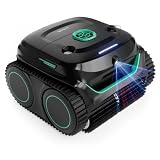
The B1 is marketed as a smart full-pool cleaner for floors and walls, operating without a power tether by relying on an onboard lithium battery and an integrated water-jet or suction-drive system. Its chassis is a compact, low-profile body designed to pass beneath pool steps and into tight corners. The unit uses a two-part design in which the drive module and the filtration canister are separable, which simplifies removal for cleaning and reduces the stress placed on the housing during extraction.
Buyers who have previously owned corded or hybrid units will notice the difference in handling immediately. Without a swivel cable to manage, the cleaner can be deployed directly from the pool deck and retrieved with a standard pool pole. That convenience matters most for homeowners with frequent debris events, such as pools surrounded by deciduous trees, where daily or near-daily runs are the norm rather than the exception.
Technical Specifications at a Glance
The table below consolidates the core engineering parameters as published by the manufacturer and cross-checked against the figures reported in verified owner documentation. Values should be treated as nominal, since flow and runtime vary with water temperature, battery state of health, and filter loading.
| Parameter | WYBOT B1 Specification | Engineering Significance |
|---|---|---|
| Power Source | Rechargeable lithium-ion battery | Eliminates tether drag and cord snag risk |
| Estimated Runtime | Approximately 90 minutes per charge (nominal) | Sufficient for pools up to roughly 800 sq ft in a single cycle |
| Recommended Pool Size | Up to approximately 800 sq ft | Defines the practical coverage ceiling for one run |
| Debris Basket Volume | Compact canister, moderate capacity | Determines how often the unit must be emptied mid-cycle |
| Filtration | Multi-layer fine mesh | Captures fine silt and small particulate matter |
| Wall Climbing | Yes, including waterline transition | Enables full-surface coverage of walls and floors |
| Navigation | Algorithmic path planning with obstacle detection | Reduces redundant passes and missed zones |
| Charging Time | Several hours from depleted state | Dictates turnaround between cleaning sessions |
Pump Flow Capacity and Suction Performance
Flow capacity is the single most important variable governing how effectively a cordless cleaner lifts debris off the pool floor. The B1 relies on a compact pump whose output is distributed across the intake and the drive jets. Manufacturer data indicates that suction is strongest at the intake face, which is appropriate for fine sediment but can leave larger leaves and twigs partially resting on the surface if the unit is not repositioned by its navigation routine.
From an engineering standpoint, the key tradeoff is between drive torque and suction retention. A battery-constrained pump must allocate limited energy between locomotion and debris lift. The B1 favors locomotion efficiency, which extends runtime but means heavier organic debris, such as wet mulch, benefits from periodic manual assistance. Owners with fine silt or pollen-heavy environments generally report strong results, while those dealing with coarse leaf litter should expect a second pass for thorough clearance.
Readers comparing cordless suction tools across categories may find it useful to review how battery-driven airflow is rated in adjacent product lines. Our breakdown of dyson v8 cyclone vs Bissell cordless stick systems illustrates how airflow ratings translate into real-world pickup, a principle that applies directly to pool pump evaluation.
Debris Basket Volume and Filtration Engineering
The debris canister is a fixed-volume chamber, and its capacity sets the operational interval between extractions. The B1’s basket is adequate for typical residential loads, but it fills faster than larger commercial-style units when the pool carries heavy organic matter. The multi-layer mesh is engineered to trap fine particulates, which improves water clarity but also accelerates clogging. Engineers typically address this tradeoff through a larger intake area or a coarse pre-filter, and the B1 relies on the latter approach to balance retention against airflow.
Routine maintenance is therefore not optional. Rinsing the basket and inspecting the mesh after each run preserves flow rate and prevents the pump from working against a restricted path, which would otherwise shorten battery life. Owners who run the cleaner on a schedule should plan a basket check at the midpoint of each cycle if the pool sits beneath a canopy of trees.
Wall Climbing Traction and Waterline Transition
Wall climbing is among the most demanding tasks for any robotic cleaner, because traction must counteract gravity while the unit’s buoyancy and pump thrust act against it. The B1 uses a drive arrangement with rubber tracks or wheels designed to grip painted concrete, vinyl liner, and fiberglass surfaces. Verified user feedback suggests reliable adhesion on smooth and moderately textured walls, with performance degrading on heavily algae-coated or very rough surfaces where grip diminishes.
Waterline transition is the critical moment where the cleaner moves from floor to wall, and it is where many robotic units lose orientation. The B1’s sensor-driven logic detects the inclination change and adjusts thrust accordingly. Steep, near-vertical transitions in deep-end walls are where traction is most tested, and buyers with very steep wall geometry should verify fit against their specific pool profile before purchase.
Navigation Algorithm Efficiency and Obstacle Handling
Navigation determines whether a robotic cleaner covers the full pool surface in a reasonable time or wastes battery retracing ground it has already cleaned. The B1 employs a path-planning routine combined with obstacle detection, which allows it to reverse, turn, and resume a systematic sweep after contact with steps, ladders, or pool walls. The efficiency of such algorithms is usually measured by coverage ratio, meaning the percentage of accessible surface traversed per cycle, and by redundancy rate, the proportion of ground covered more than once.
Navigation failures, such as the cleaner becoming stuck in a corner or circling a single zone, typically stem from sensor limitations or unexpected geometry rather than poor core logic. Understanding these failure modes helps owners diagnose performance issues. Our analysis of why robot vacuum keeps getting lost explains how mapping errors arise in general-purpose robotic cleaners, and the same underlying principles inform how pool units orient themselves underwater.
Obstacle handling also reflects the design philosophy of the manufacturer. Units that prioritize aggressive wall contact can clean more thoroughly but risk damage to vinyl liners or stairs, while more conservative logic reduces contact at the cost of slightly lower coverage. The B1 leans toward the conservative end, which protects surfaces but may leave edge-adjacent debris behind in some configurations.
Runtime, Charging, and Battery Management
Battery performance governs the practical usefulness of any cordless cleaner. The B1’s nominal runtime of roughly ninety minutes is sufficient for a complete pass on pools within its rated coverage area, but actual duration falls as the battery ages and as cold water increases pump load. Lithium-ion cells lose capacity gradually over repeated charge cycles, so owners should expect measurable runtime decline over multiple seasons and should avoid storing the unit fully depleted or in extreme heat.
Charging time from empty is several hours, which means a single unit supports roughly one cleaning cycle per day under standard use. Households requiring twice-daily cleaning during peak leaf season may benefit from a second unit or a staggered charging routine. Battery management is therefore a scheduling consideration as much as a hardware specification.
Safety Considerations and Standards Compliance
Because a cordless pool cleaner operates submerged and interacts with electrical components near water, safety design is essential. The B1 uses a low-voltage battery system, which substantially reduces shock risk compared with mains-powered equipment. Buyers should confirm that any product they select carries recognized certification and follows applicable operational guidance. For background on the frameworks that inform consumer equipment safety, see the ANSI Operational Safety Standards resource, which outlines the broader standards ecosystem governing product safety.
Owners should also follow manufacturer guidance on retrieval, battery handling, and storage temperature. Removing the unit promptly at the end of a cycle, rinsing it with fresh water, and allowing it to dry before storage reduces corrosion risk on metal fasteners and electrical contacts.
Who the WYBOT B1 Suits Best
Based on the engineering data and verified owner reports, the B1 fits homeowners with in-ground residential pools up to roughly 800 square feet, moderate debris loads, and a preference for tether-free operation. It is less suited to oversized pools, heavy organic debris environments requiring daily high-volume extraction, or pools with unusually steep or heavily textured walls. Buyers in those situations should compare alternative cleaners carefully. Our review of the kokido vektro xl heavy-duty: rechargeable model examines a higher-capacity option for demanding conditions, and our analysis of greenworks 60v 700 cfm airflow ratings offers a useful reference point for understanding how outdoor debris-handling capacity is quantified across battery tools.
Limitations and Final Engineering Assessment
No cordless cleaner eliminates every constraint, and the B1 carries clear limitations. Battery runtime caps coverage per cycle, the debris basket requires regular emptying under heavy loads, and navigation, while competent, can leave edge zones or coarse debris untouched in certain geometries. Wall traction is strong on typical surfaces but is not uniform across all liner and coating types. These are predictable tradeoffs inherent to battery-constrained robotic design rather than defects specific to this model.
Taken together, the WYBOT B1 Cordless Automatic represents a well-balanced option for residential owners who value convenience and reasonable coverage over maximum power. Prospective buyers should match its flow, basket, and runtime envelope against their pool size and debris profile, verify wall-surface compatibility, and maintain the basket and battery on a regular schedule to sustain performance across the product’s service life.