Quick Answer: Choosing the Best Snow Blower
Direct Answer: The best snow blower depends on your specific conditions. Light-to-moderate snow regions suit single-stage or electric cordless models for simplicity and low cost. Heavy snow areas require two-stage or three-stage gas-powered units for power and capacity. Budget-conscious buyers should compare electric options, while commercial users need industrial-grade equipment. Match your choice to annual snowfall, property size, driveway dimensions, and maintenance preferences.
What Makes a Snow Blower ‘Best’ for Your Situation?
The question “What is the best snow blower?” doesn’t have a single answer because “best” depends entirely on your circumstances. Before evaluating specific features or models, answer these clarifying questions:
- Climate zone: Do you experience light snow (under 10 inches annually), moderate snow (10 to 30 inches), or heavy snow (30+ inches)?
- Area to clear: Is it a small patio, average residential driveway, long driveway, or commercial parking area?
- Budget range: Are you working with under $300, $300-$1,000, $1,000-$3,000, or $3,000+?
- Operational preference: Do you prioritize ease of use and minimal maintenance (electric), or maximum power for severe conditions (gas)?
- Storage and space: Can you store a larger unit year-round, or do you need a compact model?
Your answers to these questions will narrow the field significantly and help you avoid expensive mistakes.
Understanding Snow Blower Types: Single-Stage, Two-Stage, and Three-Stage
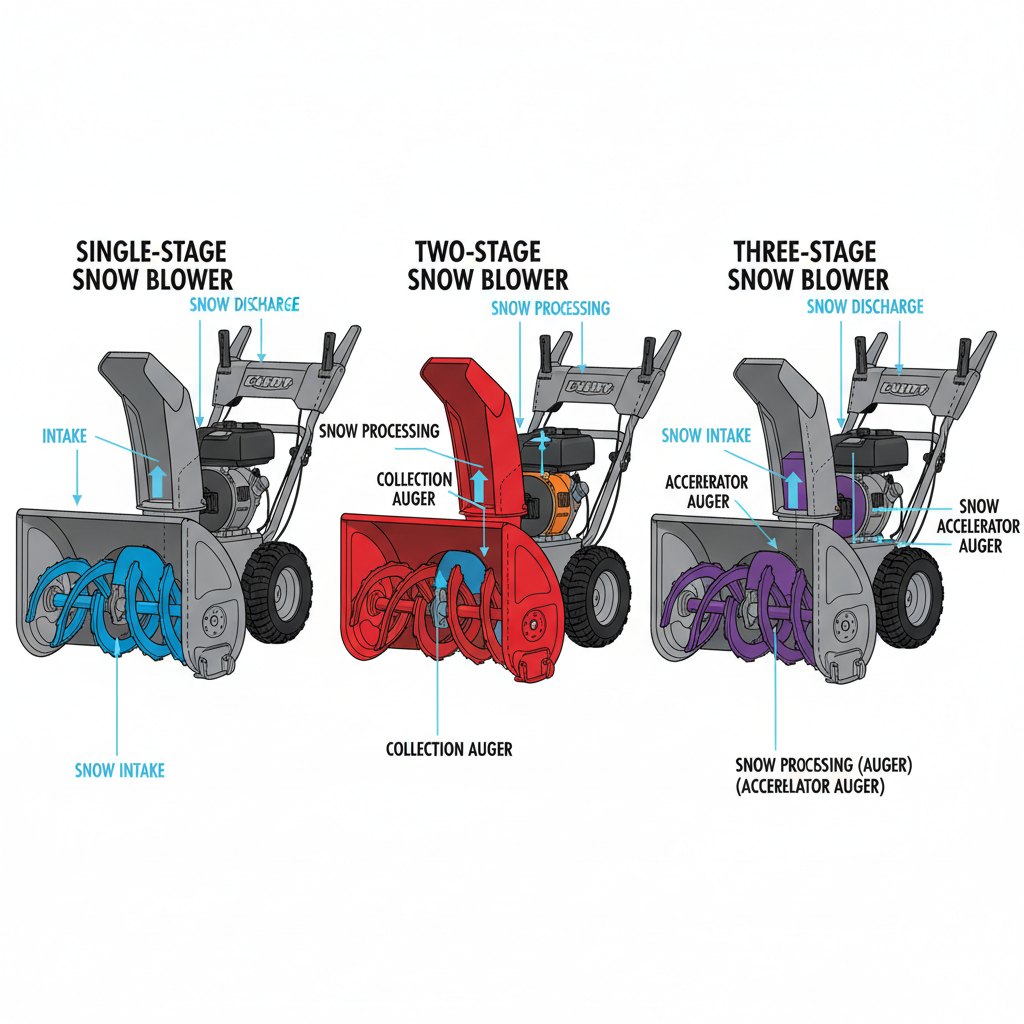
Snow blowers are categorized by how many stages (or auger systems) they use to intake, break up, and discharge snow. Each type is designed for specific snow conditions and property sizes. For broader ecosystem context, read through our operational guide on jbl partybox club 120 vs sony srs xv500. For complementary hardware performance, examine our breakdown on riding lawn mower.
Single-Stage Snow Blowers
Single-stage models use one auger that both scoops snow and propels it out through the chute. These machines are lightweight, compact, and ideal for:
- Light, powdery snow (less than 6 inches)
- Small residential driveways and walkways
- Frequent, preventive clearing (clearing after each snowfall rather than accumulation)
- Operators who prioritize ease of storage and operation
Single-stage blowers typically have clearing widths of 18 to 24 inches and are affordable ($200-$800). They are ineffective in heavy, wet, or packed snow because the single auger cannot break up denser snow effectively.
Two-Stage Snow Blowers
Two-stage models use one auger to scoop and break up snow, then a separate impeller to discharge it forcefully through the chute. This design is the workhorse for residential properties and handles:
- Moderate to heavy snow (6 to 20+ inches)
- Wet, dense, or partially packed snow
- Average to long residential driveways
- Regular clearing on a weekly or seasonal basis
Two-stage blowers typically have clearing widths of 24 to 30 inches, throw distances of 30 to 50 feet, and cost $800-$3,000. They are powerful enough for most homeowners in areas with significant seasonal snowfall and offer better control than single-stage models.
Three-Stage Snow Blowers
Three-stage models add an accelerator stage that further processes snow before discharge, enabling them to handle the most demanding conditions:
- Very heavy snow (20+ inches in a single event)
- Extremely wet, slushy, or icy snow
- Commercial or large residential properties
- High-frequency clearing operations
Three-stage blowers have clearing widths of 28, 36 inches or larger, throw distances exceeding 50 feet, and cost $2,500, $6,000+. They are overkill for most homeowners but essential for commercial applications and regions with severe winter weather. Readers comparing setup options can review our technical analysis on marshall stanmore iii vs harman kardon onyx studio 8.
Power Source Comparison: Gas, Electric, and Cordless
The choice between gas, electric plug-in, and cordless electric models impacts maintenance, runtime, operational cost, and performance in cold weather.
Gas-Powered Snow Blowers
- Maximum power and performance in extreme conditions
- Unlimited runtime (limited only by fuel tank capacity)
- Operate reliably in very cold temperatures
- Available in all three stage types and clearing widths
- Established repair infrastructure and parts availability
Disadvantages:
- Require seasonal maintenance (oil changes, carburetor cleaning, spark plug replacement)
- Generate exhaust emissions and noise (typically 80 to 90 decibels)
- Need fuel storage and winterization before storage
- Start-up challenges in extreme cold without proper preparation
- Higher operating cost per hour than electric models
Electric Cordless Snow Blowers
- Minimal maintenance (no oil changes, spark plugs, or winterization)
- Quiet operation (60 to 75 decibels), suitable for early morning or evening clearing
- Zero emissions and environmentally friendly
- Instant starting without pull cords or warm-up time
- Low operating cost (electricity cheaper than gasoline)
Disadvantages:
- Limited runtime on a single charge (typically 60 to 120 minutes depending on battery capacity and snow conditions)
- Reduced performance in very heavy or wet snow compared to gas models
- Battery performance degrades in extreme cold
- Clearing widths typically limited to 20 to 24 inches
- Higher upfront cost for battery and charger system
Cordless electric models are ideal for homeowners with small-to-medium driveways, light-to-moderate snowfall, and a willingness to invest in quality batteries. Many manufacturers (Ego, Greenworks, Toro) offer battery-sharing ecosystems, so a single battery set can power multiple tools.
Plug-In Electric Snow Blowers
Plug-in corded models offer unlimited runtime but require access to an outdoor electrical outlet and restrict movement due to the cord. They are rare in the residential market and suitable only for very small, near-house snow clearing.
Key Specifications to Evaluate When Comparing Snow Blowers
Once you’ve narrowed down the stage type and power source, evaluate these technical specifications:
Clearing Width
Measured in inches, clearing width determines how much snow you scoop with each pass. Optimal widths depend on your driveway:
- Small driveway (under 10 feet): 18 to 21 inches
- Average driveway (10 to 15 feet): 22 to 28 inches
- Long driveway (15+ feet) or commercial: 28 to 36+ inches
Wider clearing widths reduce the number of passes needed but may be harder to maneuver in tight spaces or require more power.
Engine Power or Motor Output
Gas-powered models are rated in horsepower or engine displacement (cubic centimeters, or cc). Electric models list motor wattage. Higher power handles thicker, denser snow more efficiently:
- Single-stage (gas): Typically 2 to 5 HP or 50 to 100 cc
- Two-stage (gas): Typically 4 to 11 HP or 100 to 300+ cc
- Three-stage (gas): Typically 8+ HP or 250+ cc
- Cordless electric: Typically 1.5 to 3 kW (comparable to 2 to 4 HP gas)
Throw Distance and Chute Control
Throw distance is how far the snow is discharged from the chute, typically 30 to 60+ feet. Longer throw distance reduces snow accumulation on cleared areas. Chute direction (180° rotation, tilt angle) allows you to aim snow away from windrows and property lines.
Weight and Handling
Heavier, more powerful units (up to 300+ pounds) are more difficult to maneuver but provide better traction and stability. Lighter models (under 150 pounds) are easier to steer but may slip or bounce in deep snow. Consider your physical capability and terrain.
Drive System
Forward-propelled snow blowers reduce operator fatigue. Single-speed drive is simpler; variable-speed or dual-speed drive allows you to adjust pace based on snow conditions. All-wheel drive and tracked systems improve traction but add cost and complexity.
Residential vs. Commercial Use: Are Your Needs Different?
Residential snow blowers are designed for personal use on home properties, typically used 5 to 15 times per season. Commercial equipment is built for continuous heavy use and higher durability standards.
| Factor | Residential | Commercial |
|---|---|---|
| Frequency of use | 5 to 15 times seasonally | Daily or weekly during winter |
| Typical clearing area | Single residential driveway | Multiple properties, parking lots, walkways |
| Build quality | Designed for seasonal use | Reinforced frame, heavy-duty components |
| Warranty period | 1 to 3 years | 1 to 5 years, with extended support |
| Maintenance schedule | Pre-season and post-season checks | Regular mid-season service and inspections |
| Average lifespan | 8 to 15 years with proper care | 15 to 25 years; components may be replaced |
| Typical price range | $200-$3,000 | $3,000-$10,000+ |
Homeowners using a snow blower infrequently or in light snow regions should purchase residential-grade equipment. Contractors, property management companies, and commercial operators should invest in commercial-grade models to ensure durability and warranty support.
Budget and Value: Finding the Best Snow Blower for Your Price Range
Price-to-performance relationships vary significantly by budget tier:
Under $300
Single-stage electric or gas models with 18 to 20 inch clearing width. Suitable for small residential areas and light snow only. Low power and durability.
$300-$800
Entry-level two-stage gas or premium single-stage electric models. Clearing widths of 20 to 24 inches. Appropriate for small-to-medium driveways with moderate snowfall. Good balance of cost and capability.
$800-$2,000
Mid-range two-stage gas or premium cordless electric systems. Clearing widths of 24 to 28 inches, variable speed, good throw distance. Suitable for average residential properties with regular seasonal snow.
$2,000-$3,500
High-end two-stage or entry-level three-stage gas models. Larger clearing widths, powerful engines, advanced features like power steering. Appropriate for large residential driveways and frequent use.
$3,500+
Three-stage commercial or professional-grade models. Maximum power and durability for heavy use and severe conditions. Necessary for commercial operators only.
Higher upfront costs are justified by longevity and reduced maintenance. A $1,500 two-stage blower used for 10+ seasons is more economical than replacing a $400 single-stage model every 5 years.
Climate-Specific Considerations: Wet Snow vs. Powder vs. Ice
Snow consistency varies by region and temperature, affecting equipment selection:
Light Powder
Dry, light snow typical of cold climates. Single-stage or two-stage blowers handle this easily. Lower power requirements.
Wet, Heavy Snow
Dense, moisture-laden snow common in mild winter regions or near oceans. Requires more power to break up and discharge. Two-stage or three-stage models recommended. Clearing widths should be narrower to manage weight.
Packed or Icy Snow
Pre-compacted or freeze-thaw cycles create hard-packed conditions. Requires significant engine power and auger force. Three-stage models or high-HP two-stage units recommended. Regular salt treatment hardens snow further, necessitating more aggressive clearing strategies.
Regions with mixed snow types benefit from mid-to-high power two-stage models capable of adapting to variable conditions.
Ease of Use and Maintenance: Can You Operate and Maintain Your Choice?
Even the best snow blower is ineffective if you cannot operate or maintain it properly.
Operator Controls and Physical Demands
Look for:
- One-handed or two-handed chute control (personal preference and physical ability)
- Power steering on large models to reduce arm strain
- Fuel priming and easy starting (pull cord, electric start, or keyless ignition)
- Vibration isolation on the handles to reduce fatigue
- Clear visibility and intuitive control placement
Seasonal Maintenance
Gas models require:
- Pre-season inspection: oil change, spark plug, air filter, fuel treatment
- Mid-season maintenance: belt inspection, auger adjustment
- Post-season shutdown: fuel stabilizer, oil drain (optional), carburetor cleaning
Electric models require:
- Pre-season battery check and charger testing
- Post-season battery storage in a cool, dry location
- Annual inspection of motor and mechanical auger components
Gas models demand significantly more maintenance but have more established repair networks and part availability. Electric models are simpler but rely on specialized battery systems and chargers.
Step-by-Step: How to Choose the Best Snow Blower for Your Needs
- Define your snow conditions and property size: Calculate average annual snowfall and measure your driveway width. Determine if you’re in a light, moderate, or heavy snow zone.
- Select power source: Decide between gas (maximum power, more maintenance) or cordless electric (simplicity, limited runtime). Consider local noise ordinances and emissions standards.
- Choose stage type: Single-stage for light snow and small areas; two-stage for moderate-to-heavy snow and average properties; three-stage for extreme conditions or commercial use.
- Determine clearing width and throw distance: Match to your driveway size. Wider is faster but harder to control; narrower is more maneuverable.
- Set realistic budget: Allocate funds for the equipment tier that matches your climate and frequency of use. Remember that higher upfront costs provide longer lifespan and lower operating costs.
- Verify local support: Confirm that warranty service, replacement parts, and repair shops are accessible in your region. This is critical for gas models in particular.
Buyer FAQs: Best Snow Blower Solved
Is a more powerful snow blower always better?
No. More power increases cost, weight, fuel consumption, and complexity. For light snowfall and small areas, an underpowered model wastes money and creates storage challenges. Match power to your typical conditions, not worst-case scenarios. You can always clear more frequently with a smaller blower rather than overbuying.
Can electric cordless models handle the same snow conditions as gas?
Electric models excel in light-to-moderate snow but struggle with heavy, wet, or packed snow due to lower torque and limited runtime. They are ideal for homeowners in mild climates or those who clear frequently (before snow accumulates). Gas models remain superior for extreme conditions and long, infrequent clearing sessions.
What is the ideal throwing distance for a residential driveway?
For most residential driveways (10 to 20 feet wide), a throw distance of 30 to 40 feet prevents snow from accumulating in the cleared zone. Longer throw distances are beneficial for narrow driveways or parking areas where snow needs to be ejected further away. Throw distance matters less on properties with wide open areas where snow can be piled nearby.
Should you buy a snow blower before winter or during the season?
Buy before winter begins. Pre-season purchasing allows you to research, compare options, and have equipment ready for the first snowfall. Buying during the season limits selection, increases prices due to high demand, and you may miss early-season snow. However, off-season or spring sales (March-May) offer discounts if you’re flexible with timing.

Pros
- Fully autonomous 24/7 operation with auto-mapping AI vision and RTK GPS for precise day and night navigation.
- 2-stage design with powerful motor effectively handles heavy wet dense and hard-packed snow.
- Wide 24-inch clearing path and 12-inch depth cover large areas efficiently in one pass.
- Durable high-strength Q355 steel frame and components engineered for severe weather reliability.
- OTA continuous upgrades keep the system improving with new features and performance enhancements.
Cons
- Heavy approximately 220 lb unit requires 2-3 adults for assembly and careful handling.
- Shipped in 4 separate boxes which can complicate initial setup and requires watching the installation video.
- Remote control is not included and must be purchased separately for optional manual use.
The YARBO Snow Blower Robot is a modular cordless 2-stage autonomous robotic snowblower built around high-strength Q355 steel for durability in complex winter conditions. It includes snow tracks for stability a docking station battery and related accessories delivering a premium immediate impression as a complete hands-free snow clearing system.
In real-world performance the robot clears a 24-inch path up to 12-inch depth while throwing snow 6-40 feet. AI vision RTK GPS and auto-mapping enable reliable navigation and smart scheduling that activates at the first snowfall for continuous 24/7 operation. The 2-stage system with upgraded motor efficiently manages heavy wet and hard-packed snow across large driveways sidewalks and parking lots.
Key considerations include the roughly 220 lb weight that requires 2-3 adults for assembly plus shipment in 4 boxes. Users need a 120 degree unobstructed sky view for the data center set and should watch the installation video first. The remote control is sold separately.
This product offers strong value for homeowners with expansive outdoor areas who want to eliminate manual snow shoveling through autonomous technology durable construction and ongoing OTA improvements.
Pros
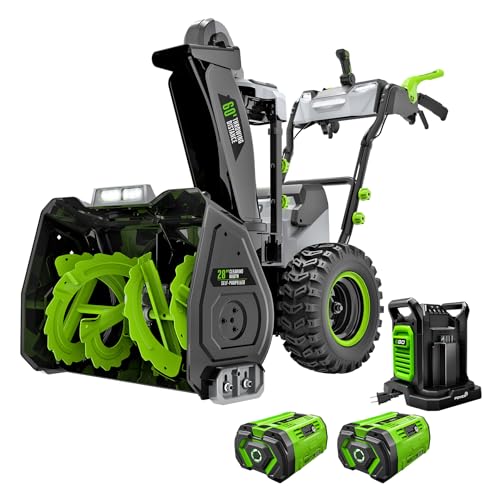
- Two 12.0Ah batteries and dual-port charger listed as included
- Trigger-controlled steering assists turning
- Joystick controls 200-degree chute rotation and deflection
- Heated handle grips listed for cold, snowy conditions
- 16- x 5-inch snow tires add traction, per listing
Cons
- 60-foot throw distance is a manufacturer claim
Pros
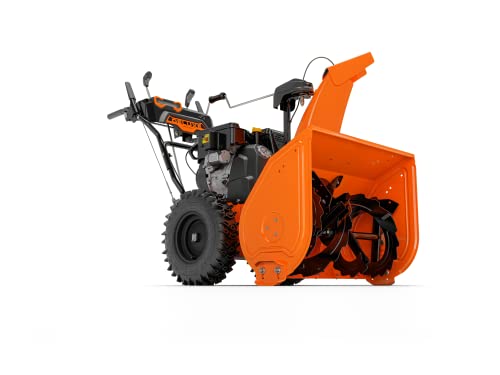
- 28-inch two-stage model, per product title
- Electric start listed in product title
Cons
- Listed weight of 267.5 pounds limits maneuverability
- Supplied feature details are minimal

Pros
- Listed 212cc engine with electric start and recoil backup
- 24-inch clearing width and 21-inch clearing height, per listing
- Six forward and two reverse speeds for adjustable pace
- LED lights listed for use during nighttime operation
- 13-inch tires and adjustable skid shoes for varied surfaces
Cons
- Listed weight of 187 pounds may be hard to maneuver

Pros
- Ribbon auger mixes air into snow for easier handling
- 21-inch intake height listed for clearing performance
- 3-year bumper-to-bumper warranty, per listing
- 5-year engine-only warranty, per listing
- All-steel chute and molded console, listed for durability
Cons
- 173-pound weight makes it heavy to move and store

Pros
- Peak Power tech pairs two 56V batteries for manufacturer-stated gas-like power
- Variable auger speed and 180-degree chute for adjustable snow placement
- 6-inch steel auger rated for packed snow and icy conditions
- Adjustable skid shoes for gravel driveways and uneven terrain
- Gas-free, quieter operation with no fumes and less routine maintenance
Cons
- Coverage claims (10-car driveway, 8 inches per charge) are manufacturer-stated
- Runtime depends on battery charge, so large storms may need recharging
- Large 51 x 22 x 40 inch footprint may be a challenge for tight storage

Pros
- Two 20V 4Ah batteries and dual-port charger listed as included
- 30-foot throw distance and 17.5-foot height, per listing
- 3-level LED charge indicator for monitoring battery life
- Listed charging time of around 1 hour
- 1-year limited warranty covers defects, including batteries and charger
Cons
- Listing positions it for moderate snow depth only
- Throw and power figures are manufacturer claims
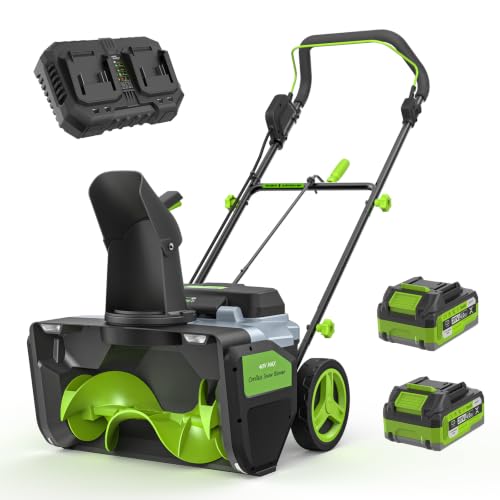
Pros
- 20-inch clearing path listed for driveways and patios
- 180-degree adjustable chute to direct discharge away from walkways
- 2500 RPM brushless motor, per manufacturer
- Folds into a compact profile for storage, per listing
- Two 20V 4.0Ah batteries listed for the 40V platform
Cons
- Runtime of 15 to 35 minutes varies with snow and conditions
- Listed weight of 31.9 pounds
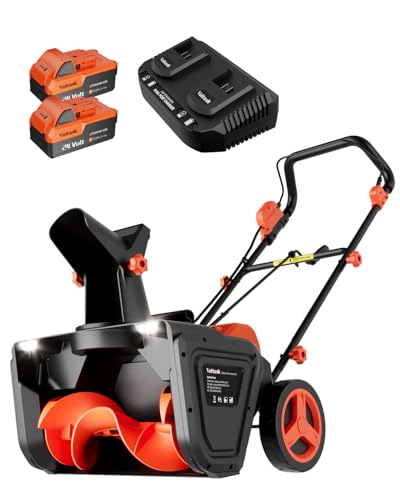
Pros
- Cordless operation with two included 24V batteries and dual charger
- Clears a 20-inch wide and 10-inch deep path per pass
- 180-degree directional chute throws snow up to 25 feet
- Dual LED lights assist in low-light morning or evening clearing
- Relatively lightweight at 22.93 pounds for easy maneuvering
Cons
- Rated runtime is limited to approximately 30 minutes per charge
- 10-inch intake depth may require multiple passes in deep snow

Pros
- Includes one 5Ah battery according to the listing
- Adjustable 180-degree chute for directing snow
- 16-inch clearing path stated in the features
- Listed for sidewalks, driveways, patios and decks
Cons
- Cold-start tip suggests the battery may need warming before use
- Snow depth and run time claims are manufacturer-stated

Pros
- 15-amp motor clears a 22-inch wide by 13-inch deep path per pass
- Rubber-tipped steel auger protects surfaces on decks and walkways
- 180-degree directional chute throws snow up to 25 feet
- Dual LED headlights assist with low-light snow removal
- 7-inch snow-grabbing wheels and soft-grip handle improve control
Cons
- Requires an outdoor-rated extension cord for continuous power
- Corded setup limits reach to areas near an electrical outlet

Pros
- 15-amp, 1800W motor clears up to 680 pounds of snow per minute
- 20-inch wide clearing width with a 10-inch snow intake depth
- 180-degree adjustable chute throws snow up to 25 feet
- Rubber-tipped steel auger prevents scratches on porches and decks
- Dual LED headlights illuminate dark winter mornings and evenings
Cons
- Tethered cord limits overall range and mobility
- 10-inch intake depth requires multiple passes during deeper storms
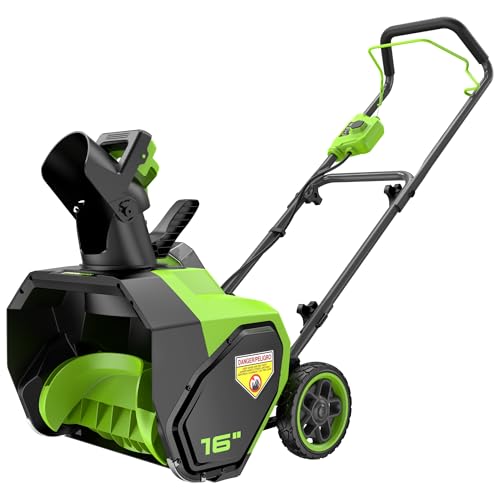
Pros
- 16-inch clearing path for sidewalks, driveways, and decks
- Adjustable 180-degree chute to direct snow where you want it
- 40V Li-ion platform, per manufacturer listing
- Manufacturer lists 10-inch snow depth capacity
Cons
- Battery and charger are not included with this listing
- Performance claims come from the manufacturer, not tested results
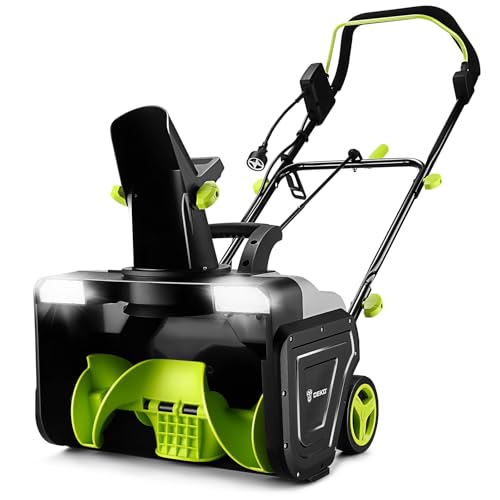
Pros
- 21-inch clearing width, 12-inch depth (stated)
- 180-degree adjustable chute, up to 25-foot throw (stated)
- Dual LED headlights for low-light clearing
- Safety lock must be pressed before trigger activation
Cons
- Corded design limits reach to available power cord length
- Snow rate and throw distance are manufacturer-stated

Pros
- Manufacturer lists 20-inch clearing width and 10-inch intake depth
- Integrated LED headlight listed for after-dark use
- 180-degree rotating chute with adjustable deflector
- Listed at 35 pounds with foldable handles
Cons
- Corded design requires access to a nearby outlet
- Clearing rate and throw distance are manufacturer-stated, not verified
Related Maintenance and Operating Guides
To keep your equipment running at peak operating efficiency, explore our related technical walkthroughs and maintenance tutorials:
- Consult our detailed breakdown on residential zero-turn lawn mower guide.
- Consult our detailed breakdown on durable ride-on lawn tractor guide.
Snow Blowers for Heavy Winter Work
Snow blowers range from compact single-stage units to large two-stage machines built for deep drifts. Matching clearing width and throwing range to your driveway keeps clearing times reasonable. Before the first storm, take a look at general cold-weather safety guidance from American National Standards Institute (ANSI).