Quick Answer
The best riding lawn mower is the one that matches your yard size, terrain, and budget. A lawn tractor suits a flat, open lawn of 1 to 2 acres, while a zero-turn mower cuts faster on larger properties with many obstacles. A rear-engine rider works well for small, simple lawns.


Pros
- Brushless motor system delivers gas-equivalent power without emissions or excessive noise
- High-capacity battery kit enables cutting coverage of up to 4.4 acres per charge set
- Durable 10-gauge steel deck and constant high blade tip speed handle dense grass effectively
- Premium seating and lighting features support comfortable extended operation
- 4-year warranty provides strong protection for the investment
Cons
- Runtime tops out around 4.4 acres depending on conditions, requiring recharges for bigger properties
- Electric design depends on charging infrastructure and battery management rather than simple refueling
- Height adjustment is noted only basically without extensive position details in available specs
The Greenworks 60V MaximusZ Zero Turn Riding Lawn Mower is a commercial-grade electric machine built for large lawns. Its primary construction centers on a heavy-duty 60-inch 10-gauge fabricated steel deck that prioritizes durability and airflow, paired with premium comfort elements including an adjustable suspension seat with lumbar support and foldable armrests for a solid first impression of quality and user focus.
Performance shines through an intelligent brushless motor system offering power equivalent to a 31HP gas engine with zero emissions. Three high-torque brushless hub motors sustain a constant 17,900 FPM blade speed, while SmartCut Technology auto-adapts to prevent bogging in thick or wet grass. The complete kit supplies (2) 20.0Ah suitcase batteries plus (4) 8.0Ah batteries and a 1.5kW fast charger for up to 4.4 acres of cutting. Additional capabilities include a 4-in-1 deck for mulching, bagging, rear and side discharge, 300 lb towing capacity with front/rear hitch, dual LED headlights, and an LCD display.
Drawbacks and considerations include the practical need to recharge the battery set after maximum runtime, which can interrupt work on properties exceeding 4.4 acres. Being fully electric means reliance on power sources for recharging instead of fuel, and height adjustment is referenced only in basic terms without more granular position data in the specifications.
In verdict, the Greenworks 60V MaximusZ delivers the most value to homeowners and professionals managing medium-to-large properties who want quiet, emission-free commercial power, versatile cutting options, and the security of a 4-year warranty in a comfortable zero-turn package.

Pros
- Commercial-grade electric performance with instant torque and no gas engine maintenance.
- Large included battery package and fast charger improve runtime and turnaround time.
- Heavy-duty 54-inch fabricated deck is built for durability and wider coverage per pass.
- Comfort-focused operator features are better than many basic riding mowers in this class.
- Backed by a 4-year limited warranty for added purchase confidence.
Cons
- At 848.78 pounds, it is very heavy and will be difficult to move manually or transport without proper equipment.
- The large footprint, with dimensions of 76.77 x 73.23 x 56.3 inches, requires substantial storage space.
- The premium feature set and battery system may be more than many small-yard owners need.
Overview & Design: The Greenworks 80V 54" MaximusZ Zero Turn Riding Lawn Mower is a commercial-style electric mower built for large residential properties. Its 54-inch 10-gauge fabricated steel deck, zero-turn layout, and premium operator seat give it a serious, heavy-duty feel right away.
Performance & Key Features: This model is positioned as a 41HP gas-equivalent machine with instant torque, a constant 17,900 FPM blade speed, and SmartCut technology that adapts to changing grass conditions. The included battery kit with (2) 16.0Ah and (4) 6.0Ah batteries is designed to support up to 4+ acres per charge, while the 1.5kW fast charger helps reduce downtime.
Drawbacks & Considerations: The mower is extremely heavy at 848.78 pounds, so it is not easy to move or store in tight spaces. It is also a major investment and may be excessive for smaller yards or users who do not need the runtime and power of a large battery-electric zero-turn.
Verdict: This is a strong fit for homeowners with large lawns who want powerful, low-maintenance mowing performance and premium comfort features. Buyers who need a wide cutting deck, long runtime, and electric operation will likely get the most value from it.
What Exactly Is a Riding Lawn Mower?
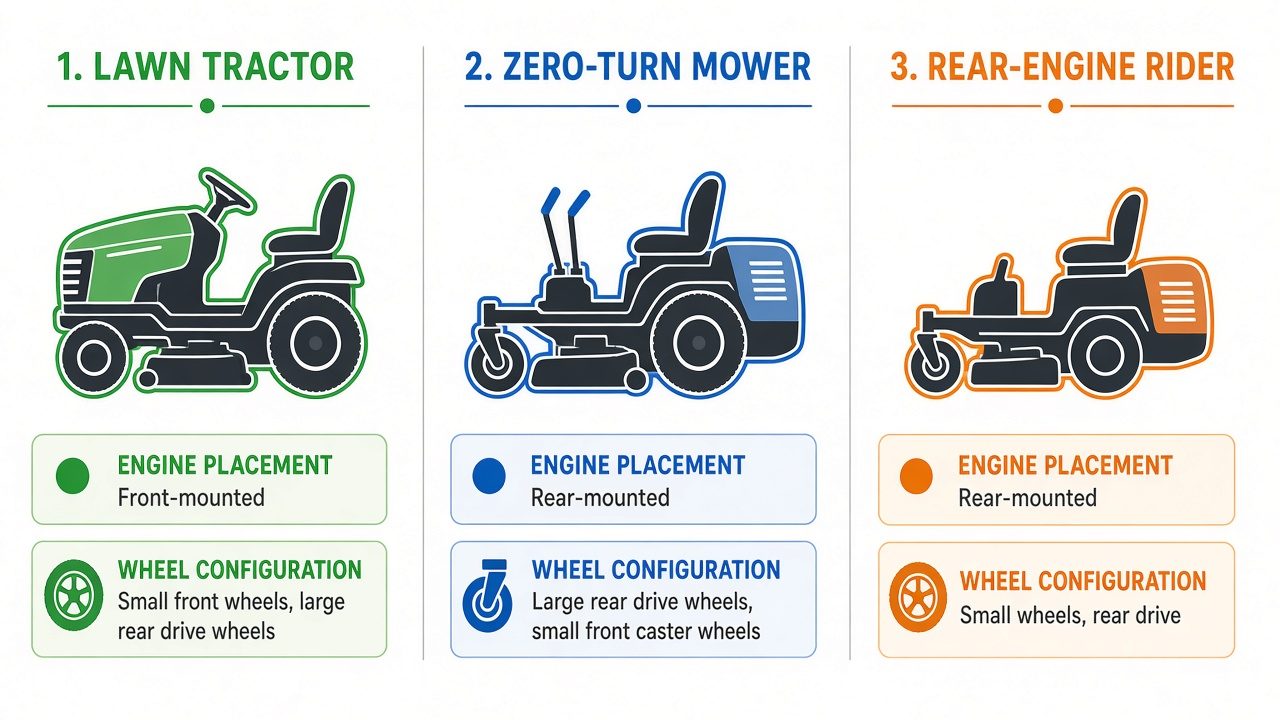
Riding lawn mowers are machines you sit on while mowing, designed to reduce physical effort and save time on medium to large lawns. However, the term covers several different categories, and each one serves a different purpose. Understanding these categories is the first step in answering the question of which mower is best for you.
Lawn Tractors
Lawn tractors are the most common type of riding mower. They have a front-mounted engine and a cutting deck positioned between the front and rear wheels. The steering wheel controls the front wheels, giving you predictable, car-like handling. Lawn tractors are ideal for flat or gently sloping yards of 1 to 2 acres. They are also the most versatile category because many models accept attachments such as baggers, mulching kits, carts, and even snow blades.
Zero-Turn Mowers
Zero-turn mowers use two levers to control the rear drive wheels independently. This allows the mower to pivot in place, turning 180 degrees without leaving uncut grass. Zero-turn mowers cut faster and are far more maneuverable around trees, flower beds, and landscaping features. They are the best choice for large, open lawns over 2 acres, but they typically cost more than lawn tractors and can be less stable on steep slopes.
Rear-Engine Riders
Rear-engine riders are smaller, lighter, and less expensive than lawn tractors. The engine sits behind the driver, and the cutting deck is positioned in front. These machines are designed for small yards under 1 acre and are easier to store because they take up less space. They generally have smaller decks, less powerful engines, and fewer attachment options, but for a modest lawn they can be the most practical and budget-friendly riding option.
How to Choose the Right Riding Mower for Your Yard
Before comparing brands or models, evaluate your property. The three most important factors are your yard size, the terrain, and the number of obstacles you need to navigate. Answering these questions will narrow your options dramatically. To evaluate matched hardware tolerances, consult our detailed overview of tractor supply riding lawn mower.
Match Deck Width to Your Lawn Size
The cutting deck width determines how much grass you cut in a single pass. A wider deck means fewer passes, which means less time on the mower. As a general guideline:
- Under 1 acre: A 30 to 38-inch deck on a rear-engine rider or compact lawn tractor is sufficient.
- 1 to 2 acres: A 42 to 46-inch deck on a standard lawn tractor is the most common and practical choice.
- 2 to 3 acres: A 48 to 54-inch deck, often on a larger lawn tractor or entry-level zero-turn mower, will save significant time.
- Over 3 acres: A 54 to 72-inch deck on a commercial-style zero-turn mower is recommended.
Keep in mind that a wider deck is harder to maneuver in tight spaces and may scalp uneven ground. If your lawn has many curves, flower beds, or narrow gates, a slightly smaller deck may be more practical than the widest option available. When planning workspace deployment, consider the engineering criteria outlined in our marshall stanmore iii vs harman kardon onyx studio 8 guide.
Consider Engine Horsepower and Torque
Engine power is measured in horsepower, and it affects how well the mower handles thick, wet, or tall grass. For most residential lawns, 15 to 22 horsepower is plenty. Larger decks and heavier mowers require more power, especially if you plan to use a bagger or pull attachments. If your yard has dense grass or you regularly mow in damp conditions, choose a model with a higher-horsepower engine. If your lawn is simple and well-maintained, a smaller engine will save you money and fuel.
Understand Hydrostatic Transmissions
The transmission is what transfers engine power to the wheels. Older mowers use manual gear shifts, but nearly all modern riding mowers use a hydrostatic transmission. A hydrostatic transmission allows you to change speed smoothly without shifting gears by pressing a pedal or moving a lever. This makes mowing far easier, especially when you need to slow down around obstacles and speed up on straight stretches. When comparing mowers, look for models with a hydrostatic transmission rather than a manual gearbox, as it is more convenient and easier to use. For additional operational safety benchmarks, see our published testing notes on dyson v8 cyclone vs bissell featherweight stick.
Evaluate Your Terrain and Slope
Terrain is a major factor in choosing between mower types. For flat or gently rolling yards, both lawn tractors and zero-turn mowers work well. For steep slopes, a lawn tractor with a low center of gravity is generally safer and more stable than a zero-turn mower. Zero-turn mowers can become unstable on hills because their design places more weight on the rear wheels. If your property has significant slopes, look for a mower with a wide wheelbase, large rear tires, and a reputation for hill stability. Never mow sideways on a steep slope with any riding mower; always mow up and down the slope instead.
Key Factors to Consider Before Buying
Beyond the basic categories, several technical and practical features determine how well a mower performs and how much you will enjoy using it. These factors also explain why two mowers with the same deck size can differ significantly in price. To compare alternative configurations, check our hands-on review of bissell crosswave hydrosteam vs shark stainforce.
Cutting Quality and Deck Construction
The cutting deck is the most important part of the mower. Most residential decks are stamped steel, which is affordable but can dent and rust over time. Fabricated decks are made from thicker, welded steel and are more durable, though they usually appear on higher-end models. Deck design also affects airflow, which influences how evenly grass is cut and how well clippings are discharged or collected. A well-designed deck with good airflow produces a cleaner cut and fewer clumps.
Mulching vs. Bagging vs. Side Discharge
Think about how you want to handle grass clippings. Mulching finely chops clippings and returns them to the lawn, which provides natural fertilizer. Many mowers come with a mulching kit or a mulch plug that blocks the discharge chute. Bagging collects clippings for disposal or composting, which is useful if you prefer a tidy lawn or have grass that grows very quickly. Side discharge simply throws clippings out to the side and is the fastest method, but it can leave windrows of grass on the lawn. If you plan to switch between modes, choose a mower that makes the change quick and easy.
Gas-Powered vs. Battery-Powered Riding Mowers
Most riding mowers are gas-powered, and they remain the most common choice because they offer long runtimes and quick refueling. However, battery-powered riding mowers are becoming more popular. They produce no exhaust emissions, are quieter, and require less maintenance because there is no oil to change, no spark plug to replace, and no fuel system to clean. The main trade-offs are higher upfront cost, limited runtime, and longer charging times. Battery-powered models are best suited to smaller properties where the battery range is sufficient to complete the entire lawn in one charge. For larger properties, gas-powered mowers are still the more practical choice.
Comfort and Ergonomics
Since you will spend hours on the mower each season, comfort matters. Look for a high-back seat with padding, adjustable armrests, and easy height adjustment. A comfortable seat reduces fatigue and makes mowing more enjoyable. Also consider the position of the controls, the ease of engaging the blades, and whether the mower has a smooth ride over bumps. Some models offer cruise control, which is a valuable feature on large, open lawns.
Maintenance Expectations
All riding mowers require regular maintenance. Expect to check the oil, clean or replace the air filter, sharpen the blades, and keep the deck free of grass buildup. Gas-powered mowers also require fuel system care, especially if the mower will be stored for the winter. Battery-powered mowers reduce some of these tasks but still need blade maintenance and battery care. Before buying, consider the availability of service centers and replacement parts. Sticking with a well-known brand like John Deere, Husqvarna, Cub Cadet, Troy-Bilt, or Craftsman generally makes it easier to find parts and authorized service.
Price Ranges by Category
Riding mowers span a wide price range. Rear-engine riders are the most affordable, typically starting in the lower price bracket and appealing to budget-conscious buyers with small lawns. Lawn tractors occupy the middle range, with prices varying based on engine size, deck width, and features. Zero-turn mowers are the most expensive category, especially when you move into larger decks and higher-end engines. As a general rule, expect to pay more for a wider deck, a more powerful engine, a more durable fabricated deck, and a brand with a strong dealer network. Set a realistic budget before shopping, but also remember that a slightly more expensive mower with a better transmission or stronger deck may last longer and cost less over time.
Direct Answer: Matching Your Needs to a Mower Type
With the technical details covered, here is a practical summary of which mower type is best for the most common situations. Use this as a starting point, then compare specific models within the category that fits your needs.
Best Overall Value for Most Homeowners
For the typical homeowner with a flat or gently rolling 1 to 2 acre lawn, a mid-range lawn tractor from a reputable brand is generally the best overall value. These mowers combine a comfortable ride, a 42 to 46-inch deck, a hydrostatic transmission, and enough engine power for most conditions. They are also versatile enough to handle bagging, mulching, and light hauling with attachments. This category offers the best balance of price, performance, and long-term reliability.
Best for Large, Open Lawns
If you have more than 2 acres of open, relatively flat grass, a zero-turn mower is the best choice. The ability to pivot in place and maintain higher ground speed dramatically reduces mowing time. Look for a model with a 48 to 54-inch fabricated deck and a hydrostatic drive system. The faster cutting speed and superior maneuverability justify the higher price when you are covering a large area every week.
Best for Small Yards and Tight Spaces
For a small yard under 1 acre, a rear-engine rider or a compact lawn tractor is the most practical option. These machines are easier to store, less expensive, and perfectly adequate for modest lawns. If your yard has narrow gates, tight corners, or limited storage space, a rear-engine rider may be the better fit. If you want the versatility of a lawn tractor but have a small lawn, choose a compact model with a smaller deck rather than overspending on a large machine.
Best for Hills and Uneven Terrain
For sloped or uneven properties, a lawn tractor is generally the safer and more stable choice compared to a zero-turn mower. Look for a model with a wide stance, large rear tires, and a lower center of gravity. A hydrostatic transmission is especially helpful on hills because it allows smooth speed control without sudden gear changes. Always check the manufacturer’s recommended maximum slope rating, and never mow across a steep slope, regardless of the mower type.
Brand Considerations Without Product Reviews
While this guide does not rank specific models, brand reputation is still worth considering. John Deere is known for its extensive dealer network and strong resale value. Husqvarna offers a wide range of lawn tractors and zero-turn mowers with strong cutting performance. Cub Cadet is recognized for durable construction and comfortable features. Troy-Bilt and Craftsman are popular choices for budget-conscious buyers who want reliable performance at a lower price point. The best approach is to choose a brand with local dealer support, then compare the specific specifications of the models within your budget. A well-maintained mower from any of these brands can provide many years of service.
Frequently Asked Questions About Best Riding Lawn Mower
What is the difference between a lawn tractor and a zero-turn mower?
A lawn tractor has a steering wheel and front-wheel steering, making it stable and car-like to operate. A zero-turn mower uses two levers to control the rear wheels independently, allowing it to turn in place. Zero-turn mowers are faster and more maneuverable but cost more and can be less stable on slopes. Lawn tractors are more versatile for attachments and are generally better for hills.
How do I determine the right deck width for my lawn?
Match the deck width to your lawn size. For under 1 acre, choose a 30 to 38-inch deck. For 1 to 2 acres, a 42 to 46-inch deck is ideal. For 2 to 3 acres, consider a 48 to 54-inch deck. For over 3 acres, a 54 to 72-inch deck on a zero-turn mower will save the most time. A wider deck cuts faster but is harder to maneuver in tight spaces.
Is a battery-powered riding mower worth it?
Battery-powered riding mowers are worth considering if you have a smaller lawn, want quieter operation, and prefer to avoid gas and oil maintenance. They have higher upfront costs and limited runtime compared to gas mowers. For larger properties, a gas-powered mower remains the more practical choice because it offers unlimited runtime and faster refueling.
What maintenance does a riding mower require?
Regular maintenance includes checking and changing the engine oil, cleaning or replacing the air filter, sharpening or replacing the blades, and cleaning grass buildup from the underside of the deck. Gas mowers also need fuel system care, especially before long-term storage. Battery mowers require less maintenance but still need blade care and proper battery storage. Always consult your owner’s manual for the recommended maintenance schedule.
Riding Mower Safety Resources
Riding mowers carry more weight and speed, so slopes and turns call for extra attention. Use seat belts or operator presence features where fitted, and read the manual before the first ride. Outside reference material on riding equipment can be found at American National Standards Institute (ANSI).