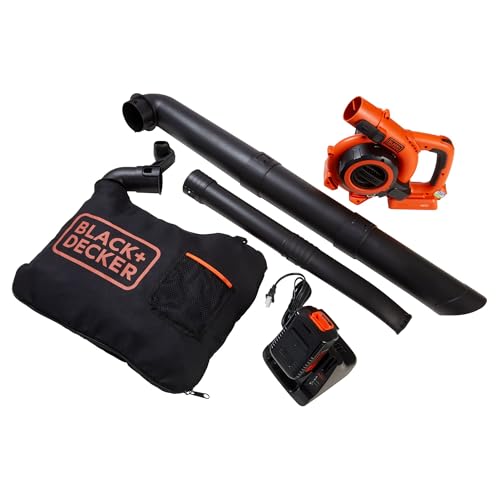
The BLACK+DECKER Corded Leaf Blower Leaf Vacuum suits homeowners who need continuous power and 3-in-1 yard collection without waiting on battery recharges, but its operating range is strictly tethered to an extension cord.

Pros
- Tool-free conversion among blow, vac, and mulch modes
- Air speeds up to 230 mph with 2-speed settings
- Vortex impeller grinds up to 10 bags down to 1
- Built-in cord retainer helps prevent accidental unplugging
- Includes concentrator, blow/vacuum tubes, and bag
Cons
- Requires constant extension cord tether
- Two fixed speeds offer less fine-tuned control
What Yard Clearing Power Does a 12-Amp Electric Motor Provide?
A 12-amp electric motor delivers continuous, consistent output that handles standard seasonal lawn debris, paved surface sweeping, and flower bed clearing without the power fade of battery equipment. Unlike rechargeable units, corded motors maintain steady RPM as long as they remain plugged in, making them well suited for sustained clearing sessions on driveways and patios, as outlined in our guide on choosing a leaf blower for driveway maintenance.
The BLACK+DECKER Corded Leaf Blower Leaf Vacuum pairs its 12-amp motor with advertised air speeds reaching up to 230 mph across two distinct speed settings. The lower speed allows gentle sweeping around delicate garden beds and mulch, while the higher setting tackles matted foliage. However, air speed alone does not capture total clearing volume, as the manufacturer leaves air volume (CFM) unverified in its published specifications. For buyers with extensive acreage or deeply piled, wet debris, a dedicated high-powered leaf blower may offer broader airflow than a standard handheld corded combo.
How the 3-in-1 Blower, Mulcher, and Vacuum System Operates
The 3-in-1 design switches between blowing, vacuuming, and mulching without specialized hand tools, giving buyers a consolidated tool for clearing and collecting yard waste. The package provides dedicated components for each configuration, including a blow tube, concentrator nozzle, vacuum tube, and a collection bag.
When operating in vacuum mode, the tool pulls dry leaves through an anti-clog vortex impeller. The manufacturer claims this mulching mechanism can grind up to 10 bags of loose leaves down into a single bag of fine mulch. While this dramatically decreases the volume of waste bags required for seasonal clean-up, the trade-off is mechanical vulnerability. Grinding damp debris, dense twigs, or pinecones increases the chance of clogs and impeller wear, meaning users must keep debris dry and uniform for reliable operation. Users looking for related component recommendations can explore our small rechargeable leaf blower breakdown.
Managing Extension Cords and Yard Mobility Practicalities
A built-in cord retainer prevents the extension cord from accidentally unplugging during sudden tugs, but working with a corded electric leaf blower requires deliberate cable management across the lawn. Because corded motors require continuous connection to a 120-volt outlet, your working perimeter depends entirely on cord gauge and length.
Operating a 12-amp motor at distances up to 100 feet requires a properly rated 14-gauge or 12-gauge outdoor cord to prevent dangerous voltage drops and motor overheating. The trade-off is physical maneuvering: navigating around trees, fences, and ornamental garden borders requires constantly guiding the cord out of the working path. When planning where to purchase your equipment, reviewing where can I buy A leaf blower can help you source suitable heavy-duty cords alongside the machine.
Frequently Asked Questions About Corded Electric Leaf Blowers
Does the BLACK+DECKER Corded Leaf Blower Leaf Vacuum come with an extension cord?
No. The unit includes the BV3600 blower vac, concentrator, blow tube, vacuum tube, and collection bag, but you must supply your own outdoor-rated extension cord suitable for a 12-amp motor.
Can this corded leaf vacuum pick up wet leaves and heavy twigs?
The manufacturer advertises two speeds and an anti-clog vortex impeller for matted leaves, but vacuuming wet debris or large sticks increases the risk of clogs and impeller strain. It performs most reliably with dry lawn foliage.
Choosing the Right Corded Electric Leaf Blower for Your Yard
Deciding on a corded electric leaf blower comes down to property size, proximity to outdoor power outlets, and whether you value unlimited run time over untethered movement. Corded models avoid the recurring expense and finite run time of battery packs, but they demand an organized approach to cord routing.
For small to medium suburban properties with accessible exterior outlets, the BLACK+DECKER Corded Leaf Blower Leaf Vacuum is the recommended choice because of its multi-function mulching capabilities and dependable 12-amp motor. Its main limitation is the physical reach of the power cord, which restricts use along distant fence lines. Homeowners who need complete freedom to roam across larger lots should consider an untethered cordless battery leaf blower instead, accepting the trade-off of finite battery runtimes per charge.
Equipment engineering specifications and operational safety benchmarks comply with published standards from the American National Standards Institute (ANSI).