A gasoline powered leaf blower is the standard choice for homeowners and groundskeepers dealing with thick autumn blankets of leaves, yet backpack models carry significant weight while compact handheld blowers trade clearing volume for easier maneuvering.

Pros
- Lightweight 9.4-pound design offers easy handheld maneuvering
- Reduced-resistance recoil system eases engine pull starts
- Translucent fuel tank allows quick monitoring of gas levels
- Cushioned anti-vibration handle helps dampen arm strain
- Capable of up to 380 CFM and 180 MPH airflow
Cons
- Requires mixing 2-cycle gas and oil at a 50:1 ratio
- Modest 380 CFM output is best suited for lighter debris

Pros
- Delivers up to 550 CFM and 230 MPH for moving wet yard debris
- Lightweight 17-pound backpack design with cushioned straps
- Thumb throttle includes cruise control for steady blowing
- 33.8 fl oz fuel tank yields up to 45 minutes of run time
- Operating temperature range spans 14°F to 104°F
Cons
- Requires 2-cycle fuel mixing and engine maintenance
- 550 CFM is modest for a backpack-class gas blower

Pros
- 4-cycle engine eliminates fuel and oil mixing
- Delivers up to 410 CFM and 125 MPH clearing power
- Automatic compression release for easier pull starts
- Lubricates in all directions without stalling or leaks
Cons
- Not available for purchase or delivery in California
- Requires routine gas engine maintenance and oil checks
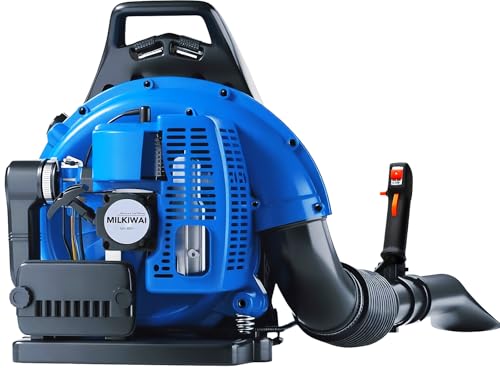
Pros
- Rated output reaches up to 665 CFM and 205 MPH wind speed
- Padded backpack harness with 3-point spring stabilization system
- Variable speed throttle includes cruise control for steady operation
- Manufacturer claims up to 50 minutes of runtime at full throttle
Cons
- Substantial 19-pound unit weight can tire users during prolonged work
- Requires manual 2-stroke gas and oil mixing for engine operation

Pros
- 2.7kW 63cc two-stroke engine delivers up to 6,800 RPM
- Multi-directional air outlet adjusts vertically and horizontally
- 0.47-gallon fuel tank enables long runs between top-offs
- Constant speed switch holds chosen throttle effortlessly
- Backpack harness features heat-insulating back padding
Cons
- Substantial 22-pound dry weight adds strain on long sessions
- Requires manual two-stroke oil and gasoline mixing

Pros
- 28cc 1.1-HP 2-stroke gas engine
- Rated up to 280 MPH and 490 CFM
- Quick-start ignition mechanism
- 0.65-liter translucent fuel tank
- Lightweight 9.5-pound bare tool weight
Cons
- Requires 2-cycle gas and oil mixing
- Produces engine noise and emissions

Pros
- 28cc 2-stroke engine up to 200 MPH
- Rated air volume up to 475 CFM
- Weighs under 10 pounds for one-hand use
- Variable speed trigger provides adjustable output
- Durable plastic and metal construction
Cons
- Requires ongoing gas and oil mixing
- Produces standard small-engine emissions

Pros
- Claims up to 1,110 CFM airflow and 220 MPH air speed
- Generous 1.89-liter fuel tank allows 50 to 60 minutes of runtime
- Padded harness and shock-absorption system reduce vibration
- Cruise control locks throttle for continuous operation
- Includes earmuffs, maintenance tools, and fuel mixing bottle
Cons
- Heavy 26.46-pound total weight can fatigue operators
- Requires mixing 2-cycle gas and oil fuel

Pros
- 51cc 2-cycle engine produces up to 765 CFM and 270 MPH
- Padded harness and hip belt provide balanced load distribution
- Air purge system removes fuel line air for easier starting
- Variable speed throttle includes cruise control functionality
- Proven X-Torq engine technology maintains high clearing force
Cons
- Heavier 22-pound build can cause fatigue on extended jobs
- Requires routine 2-cycle gas and oil fuel maintenance

Pros
- 28-cc engine delivers up to 470 CFM and 170 MPH
- Cruise control function enables comfortable sustained operation
- Air purge system removes air from carburetor for easier starting
- Auto-return stop switch automatically resets to the on position
- Adjustable soft-grip handle engineered to reduce strain
Cons
- Requires 2-cycle fuel and oil mixing
- Produces engine exhaust emissions and engine noise
Handheld vs. Backpack Blowers: Weighing Ergonomics Against Clearing Power
Choosing between a handheld and backpack configuration comes down to the physical footprint of your property and your tolerance for carrying weight on your arm versus your shoulders. Handheld models such as the Husqvarna 125B (rated at 470 CFM and 170 MPH) or the 9.5-pound Elementool 28 CC unit prioritize single-handed agility. They excel when directing airflow around delicate flowerbeds, steps, and tight patio corners. The compromise is arm fatigue; supporting 9 to 10 pounds in one hand while fighting engine torque tires your wrist during extended clearing sessions.
Backpack designs shift that mechanical burden to your torso. Units like the Thalorus 52cc (weighing 17 pounds) and the HASANEN 63CC (weighing 19.7 pounds) utilize padded harnesses and hip supports to disperse weight across your back. This format allows manufacturers to mount larger displacement engines that deliver significantly higher output, such as 550 to 850 advertised CFM. However, backpack units are bulkier to store, slower to mount and dismount, and may feel like overkill when you simply need a leaf blower for driveway sweep-downs.
Two-Stroke vs. Four-Stroke Engines: Managing Fuel Mixtures and Simplicity
Engine mechanics dictate your ongoing refueling routine. Most gasoline powered leaf blowers rely on two-stroke (2-cycle) engines, including the Getell 26cc and the Milkiwai 63CC. These engines provide an excellent power-to-weight ratio and rev quickly, but they require a strict ratio of gasoline to two-cycle engine oil (commonly 50:1). Forgetting to mix oil into the fuel will permanently seize the engine, making fuel management an active chore every autumn.
By comparison, four-stroke engines offer a cleaner refueling routine. The SENIX 4QL 26.5cc blower uses a patented 4-cycle design that eliminates pre-mixing entirely: regular fuel goes into the tank, while engine oil stays in its own crankcase reservoir. This engine type reduces smoke and lowers operating emissions, though it trades off maximum air velocity (rated at 125 MPH, compared to 180 to 280 MPH seen on comparable 2-cycle handhelds). Homeowners asking what leaf blower is the best should consider whether fuel-mixing convenience outweighs top-end airspeed.
Understanding Air Volume and Airspeed for Wet Yard Debris
Evaluating blower specifications requires balancing CFM (cubic feet per minute) and MPH (miles per hour). CFM represents the volume of air flowing out of the nozzle, which dictates how large an area you sweep with each pass. MPH represents the velocity of the air stream, which provides the impact force needed to dislodge sticky, soaked leaves or compacted dirt.
For example, the Getell 26cc blower produces 380 CFM at 180 MPH, whereas the Elementool 28 CC claims up to 490 CFM at 280 MPH. While higher numbers theoretically allow faster yard coverage, manufacturer ratings represent peak lab figures rather than standardized field tests. A blower with high MPH but lower CFM creates a narrow, high-pressure jet capable of prying up wet debris, but it moves smaller piles at a time. Conversely, a high-CFM backpack model creates a wide sweeping wall of air that corrals large mounds across expansive turf.
Husqvarna 150BT vs. Budget 63cc Backpacks: Long-Term Value vs. Raw Specs
A direct comparison between the Husqvarna 150BT ($399.00) and high-displacement import blowers like the Milkiwai 63CC ($129.99) or VEVOR 63CC ($169.90) highlights the contrast between brand engineering and raw advertised power. On paper, the budget units boast larger 63cc engines and advertised outputs reaching 665 to 1,110 CFM. The VEVOR even includes bundled accessories like earmuffs and mixing bottles.
In contrast, the Husqvarna 150BT features a 51cc X-Torque engine rated at 765 CFM and 270 MPH. While Husqvarna demands a higher upfront financial investment, buyers receive commercial-grade harness engineering, an integrated air purge system for reliable starting, and wide dealer support for replacement parts. Budget 63cc options offer compelling displacement for the price, but long-term durability and parts availability remain an unverified trade-off compared to established commercial brands.
Frequently Asked Questions About Gasoline Leaf Blowers
Do all gasoline leaf blowers require mixing oil and fuel together?
No. Two-cycle (or two-stroke) engines require a precise gas-and-oil mixture—such as 50:1—to lubricate the engine. In contrast, four-cycle engines like the SENIX 4QL utilize separate oil and fuel reservoirs, allowing you to pour straight gasoline into the tank without pre-mixing.
Are all gas-powered leaf blowers legal for sale in every state?
Not necessarily. Environmental emissions standards vary by state. For instance, the SENIX 4QL 26.5cc explicitly notes that it is not available for sale in California due to local regulatory restrictions.
How do CFM and MPH differ when clearing yard debris?
CFM (cubic feet per minute) measures the total volume of air emitted, which determines how wide a swath of leaves you can push at once. MPH (miles per hour) measures the velocity of that air, which provides the sheer force necessary to break free wet or matted debris.
Choosing the Right Gasoline Powered Leaf Blower for Your Property
Matching a blower to your property requires choosing between sweeping capacity, tool weight, and maintenance demands. If your routine consists of clearing pine needles, wet leaves, or light snow across a quarter-acre or more, the physical leverage and higher airflow of a backpack unit prevent exhaustion. For modest suburban lots or quick garage and sidewalk upkeep, a compact handheld model keeps operation quick and lightweight.
For large yards requiring dependable all-season clearing, the Husqvarna 150BT is our recommended gasoline powered leaf blower for demanding homeowners who want an ergonomic harness and proven engine performance, despite its higher initial cost. For suburban buyers seeking routine driveway and lawn maintenance without the chore of mixing two-cycle fuel, the SENIX 4QL 26.5cc 4-Cycle Handheld Gas Leaf Blower serves as an affordable, user-friendly alternative.