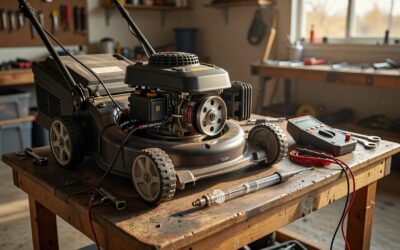
To test a lawn mower ignition coil, disconnect the spark plug wire, set your multimeter to ohms (Ω), and measure resistance on the primary winding (typically 0.4–2 ohms) and secondary winding (typically 6,000–12,000 ohms). Compare readings to your mower’s owner’s manual specifications; out-of-range or no continuity indicates a faulty coil. For a quick alternative, perform a spark test by grounding the spark plug against the engine block, connecting the plug wire, pulling the starter rope, and looking for a strong blue spark. Weak or absent spark suggests coil failure, though the spark plug, plug wire, or wiring may also be responsible.
What Does a Lawn Mower Ignition Coil Do and When Should You Test It?
The ignition coil is an electromagnet that converts low-voltage current from the engine’s magneto or battery into the high voltage needed to fire the spark plug. When the engine’s flywheel rotates, it triggers the coil to generate a spark inside the combustion chamber, which ignites the fuel-air mixture.
Test the coil when you notice symptoms of ignition system failure:
- Hard starting or failure to start
- Misfiring or rough running
- Engine stalling under load or at idle
- No spark when you ground the spark plug against the engine
These symptoms can also stem from a faulty spark plug, damaged plug wire, bad kill switch, or incorrect flywheel air gap. Testing the coil with a multimeter helps isolate the ignition coil as the source before you replace it.
Tools and Materials You’ll Need
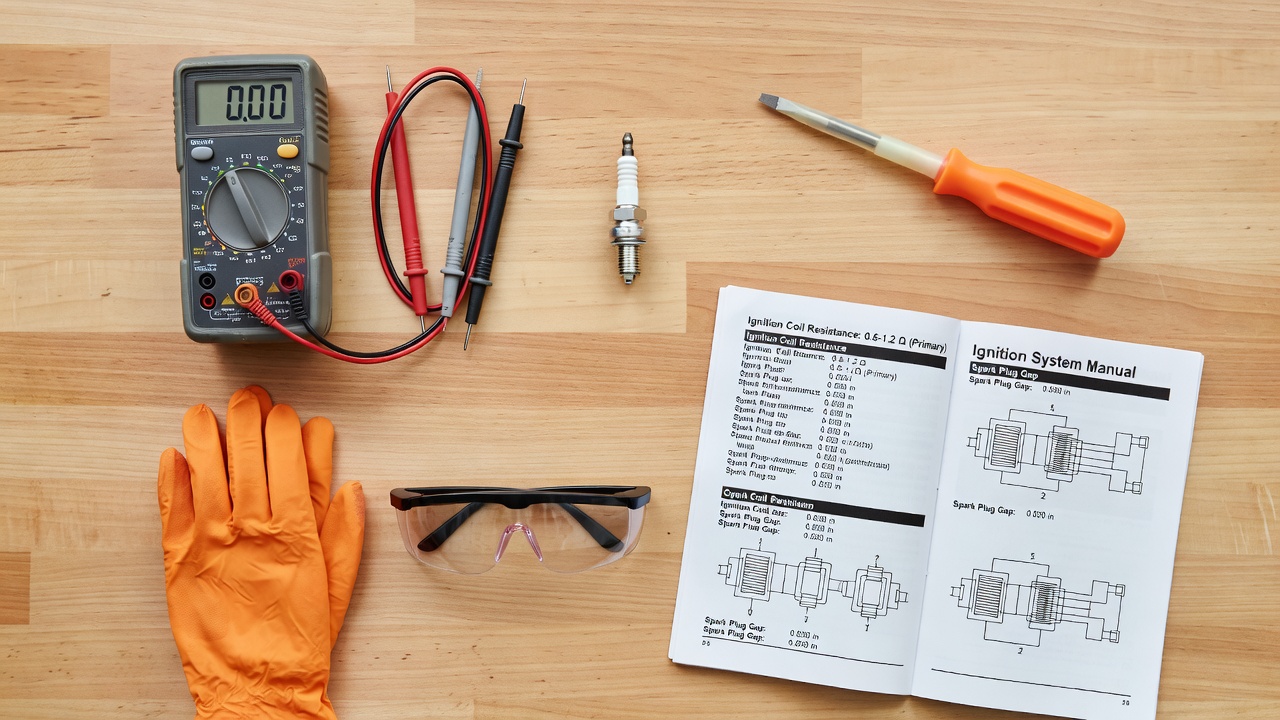
Prepare the following before testing:
- Digital multimeter with an ohms (Ω) setting
- Insulated screwdriver (if you need to remove the coil or disconnect wires)
- Work gloves and safety glasses
- The mower’s owner’s manual or service manual (to find the correct resistance specifications for your coil)
- A clean, well-lit workspace
You do not need to remove the coil to test it; most coils can be tested in place on the engine.
Critical Safety Steps Before You Begin
The ignition system in a lawn mower can deliver a dangerous electric shock when the engine is cranked or the flywheel spins. Follow these precautions:
- Disconnect the spark plug wire — Remove it from the spark plug and move it away from the spark plug terminal so it cannot accidentally ground and fire.
- Remove the spark plug — This prevents the engine from starting accidentally and allows you to move the plug away from the cylinder head during testing.
- Allow the engine to cool — Work only on a cold engine to avoid burns.
- Avoid contact with the ignition system while the engine is cranked — Do not touch the coil, wires, or spark plug while someone else pulls the starter rope or turns the key.
- Work on a stable surface — Place the mower on a flat, level work area and, if testing a riding mower, engage the parking brake.
How to Test the Ignition Coil with a Multimeter
Testing the Primary Winding
The primary winding is the coil of wire closest to the engine’s magneto or battery circuit. Here’s how to measure its resistance:
- Set your multimeter dial to the ohms (Ω) setting, typically marked with the Greek omega symbol. If your multimeter has multiple ohm ranges, start with the lowest range (e.g., 20Ω).
- Locate the coil’s primary terminal, which is where the kill switch wire (or magneto lead) connects to the coil.
- Attach one multimeter probe to the primary terminal and the other probe to the coil’s metal mounting bracket or a solid engine ground point (such as a bolt on the engine block).
- Read the resistance value on the multimeter display.
- Compare the reading to your owner’s manual. Typical primary winding resistance ranges from 0.4 to 2 ohms, though exact specs vary by engine brand and model. Check your manual for the correct range.
If the reading is within the specified range, the primary winding is likely good. If the reading is zero or infinite (open circuit), the coil is faulty.
Testing the Secondary Winding
The secondary winding is the coil of wire that delivers high-voltage current to the spark plug. Follow these steps:
- Keep your multimeter set to ohms (Ω). If your multimeter has a high-ohm range (e.g., 200kΩ or higher), switch to it for this test because secondary winding resistance is much higher than primary winding resistance.
- Locate the spark plug wire connector on the coil. This is where the spark plug wire boot attaches, or on some coils, it is a metal terminal inside the boot.
- Attach one multimeter probe to the spark plug wire terminal and the other probe to the coil’s ground (the metal mounting bracket or engine ground).
- Read the resistance value.
- Compare the reading to your owner’s manual. Typical secondary winding resistance ranges from 6,000 to 12,000 ohms, but check your manual for the exact specification for your coil.
A secondary reading within spec indicates a functioning secondary winding. A very high or infinite reading suggests an open circuit in the secondary winding, and a very low or zero reading suggests a shorted winding.
What to Do if Your Readings Are Out of Range
If either the primary or secondary resistance reading is outside the specified range, or if you see no continuity (infinite resistance), the coil is faulty and should be replaced. Do not attempt to repair an ignition coil; replacement is the appropriate remedy.
Quick Spark Test Without a Multimeter
If you do not have a multimeter, you can perform a visual spark test to check whether the coil is producing ignition voltage:
- Reconnect the spark plug wire to the spark plug.
- Remove the spark plug from the engine and position it outside the engine, with the threaded end grounded firmly against an unpainted metal part of the engine block (such as a bolt or bracket). This completes the ground circuit for the spark.
- Have a helper pull the starter rope firmly while you observe the spark plug electrode. Alternatively, on riding mowers or mowers with electric start, have the helper turn the ignition key while you watch.
- Look for a spark jumping the gap at the spark plug electrode.
A strong, bright blue spark indicates the coil is generating adequate high voltage. A weak, orange, or yellow spark, or no spark at all, suggests the coil may be faulty—though a bad spark plug, damaged plug wire, faulty kill switch, or incorrect flywheel air gap can also prevent spark.
Important: Do not perform a spark test if fuel has spilled on or near the engine; the spark can ignite fuel vapors.
How to Interpret Your Results and Troubleshoot Further
Good Multimeter Readings
If both primary and secondary winding resistances fall within the ranges specified in your owner’s manual, the coil is likely functioning correctly. If you still have starting or spark issues, check the following:
- Spark plug: Test the spark plug resistance or replace it with a new one of the correct type and heat range.
- Spark plug wire: Inspect for cracks, corrosion, or loose connections at both ends.
- Kill switch and wiring: Verify that the kill switch wire is securely connected and not corroded. A faulty kill switch can prevent ignition even if the coil is good.
- Flywheel air gap: On small engines, the gap between the flywheel magnet and the coil must be within a specified range (often 0.008–0.012 inches). Consult your manual to measure and adjust the gap if necessary.
Out-of-Range or No Continuity Readings
If your multimeter readings are outside the specified range or show no continuity (infinite resistance), the coil has failed internally:
- Open circuit: A break in one of the coil’s windings prevents current from flowing and stops spark generation.
- Short circuit: A damaged winding that touches the coil’s case or frame causes abnormally low resistance and prevents proper voltage buildup.
In either case, replace the ignition coil.
Good Spark Test Results
A strong blue spark during a spark test usually indicates the coil is producing adequate voltage. If your mower still will not start or runs rough, investigate other ignition system components:
- Check that the spark plug is firing inside the combustion chamber by removing the plug, cleaning or replacing it, and testing again.
- Verify fuel is reaching the carburetor and combustion chamber (a fuel system issue can cause no-start despite good spark).
- Inspect the engine’s compression and valve timing if the spark is good and fuel is present.
Weak or No Spark
A weak, orange, or absent spark during a spark test can indicate coil failure, but also check:
- Spark plug condition: A worn or fouled spark plug can prevent spark visibility. Replace it and test again.
- Plug wire condition: Cracks, corrosion, or a loose connection in the spark plug wire can reduce spark intensity or block it entirely.
- Flywheel air gap: If the gap is too wide, the coil will not generate enough voltage. Check and adjust per your manual.
- Kill switch: A stuck or shorted kill switch can bleed off ignition voltage and weaken the spark.
If these components test good and spark remains weak, the coil is likely faulty and should be replaced.
Frequently Asked Questions
Can I test the ignition coil without removing it from the mower?
Yes. Most ignition coils can be tested in place using a multimeter. You only need to access the coil’s primary terminal (where the kill switch wire connects) and the secondary terminal (where the spark plug wire connects), then attach the multimeter probes and compare your readings to the manual. Removal is not necessary unless you need to replace the coil or physically inspect it for damage.
Do resistance specifications differ between push mowers and riding mowers?
No—the ignition coil testing method is the same for both. However, the exact resistance specification for the coil depends on the engine brand and model (Briggs & Stratton, Kohler, Honda, and others have different specifications), not on whether the mower is a push mower or riding mower. Always consult your mower’s owner’s manual for the correct primary and secondary winding resistance values for your specific engine.
What if my multimeter shows continuity (any reading) but the engine still won’t start?
A multimeter reading indicates the coil’s windings are electrically intact, but the coil may still be defective if it is not producing the correct voltage magnitude. Also, a coil that tests marginally good may fail under the heat and load of engine operation. If you have confirmed good primary and secondary readings but no spark appears during a spark test, or if the spark is very weak, try replacing the spark plug, spark plug wire, and checking the flywheel air gap before replacing the coil. If those components are good and spark remains absent or weak, the coil is the likely culprit.
Where do I find the correct resistance values for my coil?
Consult your mower’s owner’s manual or service manual, which usually includes a section on ignition system specifications. The manual will list the primary and secondary winding resistance ranges for your specific engine. If you do not have a manual, contact the mower’s manufacturer with your model number, or search the manufacturer’s website for a downloadable manual. Briggs & Stratton, Kohler, Honda, and other engine makers publish manuals online.
Is it safe to pull the starter rope while testing the coil?
Yes, as long as you follow safety precautions. Always disconnect the spark plug wire and remove the spark plug before testing. The spark plug wire must not be in contact with the spark plug during your test. If a helper is pulling the starter rope or turning the ignition, make sure they understand not to do so until you are ready, and keep your hands away from the spark plug electrode and engine during cranking.