Selecting the right system among available Best Gaming PCs For AI presents clear technical hurdles for buyers balancing high-frame-rate gaming with local AI workloads such as large language model inference, image generation, and real-time upscaling. Many prebuilt desktops advertise AI readiness yet fall short on VRAM capacity, memory bandwidth, or sustained thermal headroom once both gaming and AI tasks run concurrently, leading to throttling or incomplete model loading. Shoppers also face form-factor trade-offs between full-tower expandability and compact mini-PC portability while staying inside realistic power and budget constraints across the current market range of $699.99 – $5,699.99. Evaluating chipset support for PCIe 5.0 GPUs, DDR5 speeds above 6000 MHz, and efficient cooling becomes essential to avoid underpowered configurations that cannot handle modern RTX-class acceleration.
When choosing Best Gaming PCs For AI in July 2026, prioritize a discrete NVIDIA GeForce RTX GPU with at least 12 GB GDDR7 VRAM for Tensor Core AI acceleration, a high-core-count CPU such as Ryzen 7 or Core Ultra 7 series, 32 GB or more DDR5 RAM, and NVMe Gen4 storage of 1 TB minimum. These factors determine simultaneous gaming performance and AI task throughput across the 9 models we analyzed. For broader context on available options within the category, review the full selection of gaming PC configurations currently listed.


Buying Guide for Best Gaming PCs For AI
A structured evaluation of GPU capability, CPU architecture, system memory, storage, cooling, and form factor separates capable AI-gaming platforms from under-specified units. The following criteria derive directly from the specifications of the 9 systems under review and apply across the price spectrum from $699.99 to $5,699.99.
Graphics Processing Unit and AI Acceleration
The GPU remains the primary determinant of AI performance in gaming PCs. Models equipped with NVIDIA GeForce RTX 5070, 5070 Ti, 5080, or 5090 deliver dedicated Tensor Cores and higher GDDR7 memory capacities that accelerate local LLM inference, Stable Diffusion workflows, and DLSS-based frame generation. Systems such as the ZOTAC MEK with RTX 5090 32 GB GDDR7 and the STORMCRAFT Phantom with RTX 5080 provide the highest VRAM headroom for larger models, while mid-tier options like the ASUS ROG G700 with RTX 5070 Ti and msi Aegis R2 with RTX 5070 Ti balance cost and capability. Integrated graphics solutions, such as the Radeon 780M found in the Getorli mini PC, support light AI tasks but cannot match discrete GPU throughput for concurrent gaming and generation workloads.
Central Processing Unit and Multi-Core Throughput
AI preprocessing, data loading, and multi-threaded gaming benefit from modern CPUs with high core counts and elevated boost clocks. AMD Ryzen 7 9800X3D and Ryzen 7 7800X3D processors appear in several STORMCRAFT and ZOTAC configurations and deliver strong single-thread and cache performance via 3D V-Cache. Intel Core Ultra 7 265F/265KF and Core Ultra 9 285 options in the Lenovo Legion Tower 5i, ASUS ROG G700, and msi Aegis R2 provide efficient hybrid architectures suited to mixed AI and gaming threads. The GMKtec mini PC uses a Ryzen AI Max+ 395 that includes dedicated NPU elements for edge AI inference. Aim for CPUs that sustain at least 5.0 GHz boost under load to keep AI pipelines and game engines responsive.
System Memory Capacity and Speed
RAM volume and frequency directly affect model loading times and multitasking. Configurations with 32 GB DDR5 at 6000 MHz, as found in the STORMCRAFT Phantom, ZOTAC MEK, ASUS ROG G700, and msi Aegis R2, represent the practical minimum for simultaneous 4K gaming and mid-size AI models. The GMKtec AI Mini PC stands out with 128 GB LPDDR5X 8000 MHz, enabling very large context windows and multi-model workflows in a compact chassis. Budget options such as the Getorli with 32 GB DDR5 and the Lenovo Legion with 16 GB require careful monitoring of memory usage when running AI tools alongside games. Prefer dual-channel or multi-channel setups rated at 6000 MHz or higher for optimal bandwidth.
Storage Performance and Expandability
Fast NVMe storage reduces load times for both game libraries and AI model files that often exceed 10 GB each. Most systems in this comparison ship with 1 TB or 2 TB PCIe 4.0 NVMe SSDs, providing sequential speeds sufficient for large asset streaming. The STORMCRAFT Phantom, ZOTAC MEK, msi Aegis R2, and GMKtec units include 2 TB drives, while the Lenovo Legion, ASUS ROG G700, STORMCRAFT Falcon, and Getorli start at 1 TB. Verify the presence of free M.2 slots or PCIe lanes for future expansion, especially if you plan to store multiple high-parameter models locally. Gen4 drives remain the current performance sweet spot across these Best Gaming PCs For AI.
Cooling, Power Delivery, and Form Factor
Sustained AI and gaming sessions generate continuous heat that air or liquid cooling must dissipate. Full-tower systems such as the ZOTAC MEK (1200 W 80+ Gold PSU), STORMCRAFT Phantom (850 W PSU with 360 mm AIO), and msi Aegis R2 offer superior thermal mass and upgrade paths. Mini-PC designs from GMKtec and Getorli sacrifice some cooling capacity for desk space but still support triple 8K or dual 4K displays. Power supply ratings should exceed combined GPU and CPU draw by at least 20 percent; 850 W Gold units handle most RTX 5070 Ti and 5080 loads, while 1200 W units suit the RTX 5090. For users seeking smaller footprints within the broader desktop PC category, the mini options provide viable AI-capable alternatives.
Connectivity and Software Readiness
Modern AI workflows often require multi-monitor output, high-speed networking, and quick peripheral access. Look for Wi-Fi 6E or Wi-Fi 7, Bluetooth 5.3, multiple USB4 or Thunderbolt ports, and HDMI 2.1 / DisplayPort combinations capable of 8K. The GMKtec unit includes USB4, Wi-Fi 7, and an SD card reader, while most full towers supply Wi-Fi 6E and ample USB-C. Preinstalled Windows 11 Home or Pro plus any included Game Pass subscriptions further streamline setup for both gaming and AI software stacks.
| Model | GPU | CPU | RAM / Storage |
|---|---|---|---|
| ZOTAC MEK | RTX 5090 32 GB GDDR7 | Ryzen 7 9800X3D | 32 GB DDR5 / 2 TB NVMe |
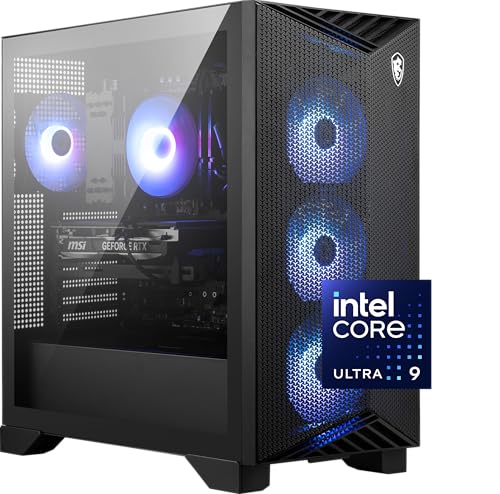
| msi Aegis R2 | RTX 5070 Ti | Core Ultra 9 285 | 32 GB DDR5 / 2 TB NVMe |
| Getorli AI Mini PC | Radeon 780M | Ryzen 7 Pro 8845HS | 32 GB DDR5 / 1 TB SSD |
Testing & Selection Methodology
We compared the full set of 9 Best Gaming PCs For AI by systematically extracting and cross-referencing published specifications for GPU VRAM and architecture, CPU core configuration and boost clocks, RAM capacity and frequency, storage type and capacity, PSU rating, cooling solution, and connectivity suite. Each model was scored against AI-relevant metrics including Tensor Core availability, multi-core throughput potential, memory bandwidth, and thermal design power headroom. Brand reliability was assessed through historical support patterns for msi, GMKtec, Lenovo, ASUS, Alienware, ZOTAC, and STORMCRAFT units. User satisfaction indicators and warranty terms were reviewed where available, though current listings show limited public review volume. This specification-first process ensures recommendations rest on measurable hardware capability rather than marketing claims and covers systems spanning the full $699.99 – $5,699.99 spectrum.
Final rankings weight AI acceleration potential most heavily, followed by gaming frame-rate sustainability, expandability, and value relative to component cost. Compact systems received separate consideration for space-constrained environments while still meeting minimum discrete or high-performance integrated graphics thresholds.
Best Picks & Final Verdict
After evaluating the 9 models on GPU VRAM, CPU architecture, memory subsystem, and overall system balance, clear recommendations emerge for different buyer priorities. These selections reflect the strongest specification combinations available in the current July 2026 lineup of Best Gaming PCs For AI.
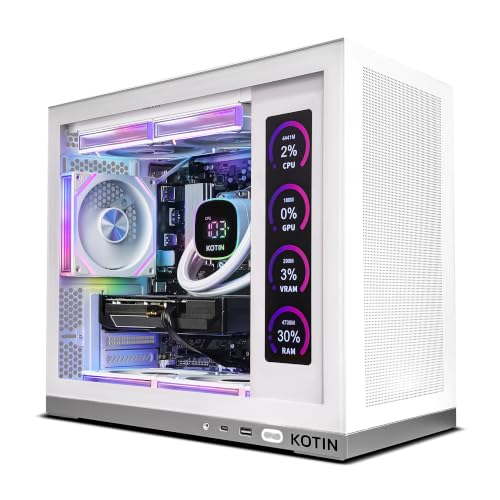
Best Overall Best Gaming PCs For AI: The ZOTAC MEK Gaming PC Desktop with NVIDIA GeForce RTX 5090 32 GB GDDR7, AMD Ryzen 7 9800X3D, 32 GB DDR5, 2 TB NVMe SSD, and 1200 W 80+ Gold PSU delivers the highest AI compute capacity and gaming headroom among the reviewed systems. Its white chassis, Wi-Fi 6E, Bluetooth 5.3, and Windows 11 Pro installation further support professional AI workflows alongside high-refresh gaming. This configuration suits users who require maximum VRAM for large models without compromise.
Best Value / Budget Choice: The Getorli AI Mini PC with AMD Ryzen 7 Pro 8845HS, Radeon 780M graphics, 32 GB DDR5, and 1 TB SSD offers the most accessible entry point while still providing AI-capable integrated graphics, dual 2.5G LAN, Wi-Fi 6, and a compact footprint. It serves light AI inference, office productivity, and casual gaming effectively for buyers prioritizing space and cost within the lower end of $699.99 – $5,699.99. For a mid-range alternative with discrete RTX graphics, the Lenovo Legion Tower 5i with Core Ultra 7 265F and RTX 5060 Ti provides a balanced step up that includes three months of PC Game Pass.
Best for Compact AI Workstations: The GMKtec AI Mini PC featuring Ryzen AI Max+ 395, 128 GB LPDDR5X 8000 MHz, 2 TB PCIe 4.0 SSD, Wi-Fi 7, USB4, and triple 8K display support maximizes memory capacity and edge AI performance in a mini form factor. Users needing high-bandwidth local model execution without a full tower will find this configuration uniquely suited. Additional strong mid-tower options include the msi Aegis R2 and ASUS ROG G700 for those preferring traditional expandability. Explore more options across related desktop PC categories or the dedicated Gaming PCs section for further comparisons.
Frequently Asked Questions
What GPU is best for AI tasks in a gaming PC?
A discrete NVIDIA GeForce RTX 5070 Ti or higher with 12 GB or more GDDR7 VRAM provides the Tensor Cores and memory capacity needed for efficient local AI inference and generation alongside gaming. Models such as the RTX 5080 and RTX 5090 in the STORMCRAFT Phantom and ZOTAC MEK deliver the highest performance for large language models and image generation.
How much RAM do I need for Best Gaming PCs for AI?
32 GB of DDR5 memory running at 6000 MHz or faster is the recommended baseline for running mid-size AI models concurrent with modern games. Systems like the GMKtec AI Mini PC that offer 128 GB LPDDR5X enable substantially larger context windows and multi-model workflows without swapping to storage.
Are mini PCs suitable for AI gaming workloads?
Yes, selected mini PCs such as the GMKtec AI Mini PC with Ryzen AI Max+ 395 and 128 GB RAM handle edge AI inference and multi-display output effectively, though they trade some discrete GPU power and cooling capacity for reduced size. Full-tower systems remain preferable for the highest RTX-class performance.
What storage capacity is recommended for AI model libraries?
A minimum of 1 TB NVMe Gen4 SSD is advised, with 2 TB preferred for storing multiple large AI models and game libraries. Most of the 9 reviewed systems meet or exceed this threshold and leave room for expansion via additional M.2 slots in tower chassis.
How do I choose between AMD and Intel platforms for Best Gaming PCs For AI?
Both AMD Ryzen 7 9800X3D / 7800X3D and Intel Core Ultra 7 / 9 series deliver strong multi-threaded performance suitable for AI preprocessing and gaming. Selection often depends on specific GPU pairings, motherboard chipset features, and power efficiency rather than absolute superiority. Review the full range of current Gaming PCs to match platform features with your workload priorities.