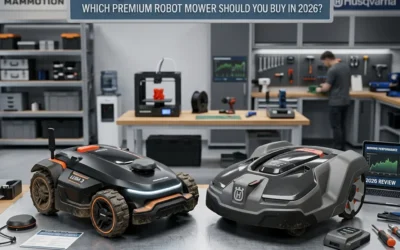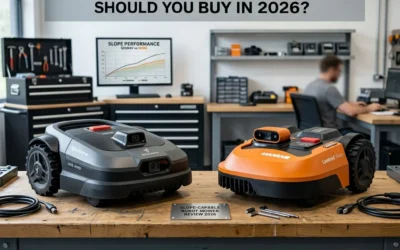
Quick Answer: Choosing the Best Robotic Mowing
When evaluating robotic mowing systems in 2026, the most critical factors are navigation technology (wire-based versus wire-free RTK, LiDAR, or vision-based), mowing coverage capacity in acres or square feet, maximum slope gradient the unit can handle, and the depth of app-based zone management.

Pros
- Bundles the mower with a weatherproof garage shelter
- No perimeter wire setup, per listing
- Cloud RTK positioning listed with no local antenna installation
- Vision AI obstacle avoidance described in listing
- App-based zone editing and no-go areas listed
Cons
- Performance and durability claims lack independent verification
- Shade navigation and quarter-acre coverage are manufacturer claims

Pros
- 360° LiDAR mapping, listed as independent of satellite signal
- No boundary wire or RTK antenna needed for setup
- Cutting height adjustable across nine levels
- Listed noise level of 58 dB or less
- Anti-theft GPS and app-based no-go zone controls
Cons
- Listed runtime is about 40 minutes per charge on flat turf
- Slope capability is listed as 24°; check your yard's grade

Pros
- Wire-free virtual boundaries eliminate the need for buried wires and simplify installation and reconfiguration
- RTK + Vision AI navigation provides accurate path planning and reliable coverage across residential layouts
- Offset blade ride-on-edge design reduces post-mowing trimming along borders and hardscapes
- Camera and ultrasonic Vision AI sensing enables effective obstacle detection and route adjustment
- App-based multi-zone control offers convenient scheduling and progress tracking for front and back yards
Cons
- Limited to lawns of 0.3 acre maximum, making it unsuitable for larger properties beyond small to medium suburban yards
- Setup and operation depend entirely on the companion app and virtual boundary creation without physical wire fallback
- No detailed battery runtime or weather resistance specifications provided, requiring users to verify suitability for their climate
The SUNSEEKER X3 Plus is a wire-free robotic lawn mower built for residential yards up to 0.3 acre or 13,000 sq ft. It targets suburban homeowners with front yards, backyards, and multi-area layouts who want modern automation without traditional perimeter wires. The design emphasizes clean app-driven setup and smart navigation for everyday convenience.
In performance, AONavi RTK positioning paired with visual mapping helps the mower follow planned paths and maintain consistent coverage across typical residential layouts. Vision AI obstacle avoidance combines camera and ultrasonic sensing to detect common lawn objects and adjust routes automatically. The offset blade ride-on-edge cutting reaches closer along fences, walkways, and hardscapes, while full app control handles schedules, multi-zone management, cutting height, and progress tracking for front, back, and side yards.
Considerations include its clear focus on small to medium yards only, so larger properties fall outside its capacity. All boundaries and no-go zones rely on the app for virtual creation, and detailed runtime or environmental protection data is not listed in the core specifications. Users should confirm signal reliability for RTK and camera performance in their specific yard conditions.
Overall, the SUNSEEKER X3 Plus delivers strong value for homeowners with lawns under 0.3 acre seeking a wire-free robotic mower with advanced RTK Vision AI navigation, obstacle avoidance, and edge cutting. It is an excellent fit for tech-comfortable suburban users who prioritize multi-zone app control and reduced manual trimming.

Pros
- No boundary wires or RTK setup, per the listing
- AI vision listed for edges and over 300 obstacle types
- Three selectable mowing path patterns
- App control with schedules and over-the-air updates
- Memory resume after pauses, per manufacturer
Cons
- Navigation and slope claims are manufacturer-stated, not tested
- No customer reviews shown yet
Pros
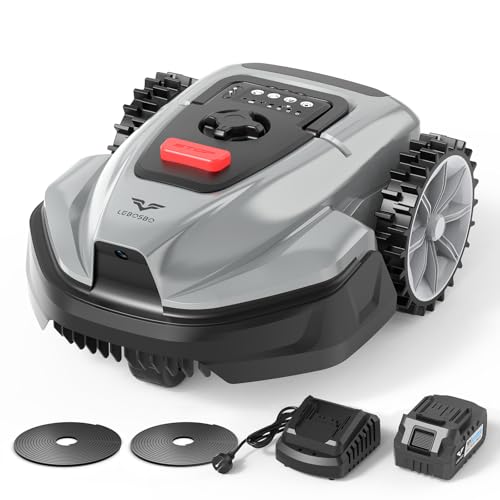
- AI vision navigation is designed to recognize obstacles and lawn areas
- Includes a 32FT magnetic strip for setting up no-go zones
- No boundary wire installation; charge and start mowing
- Adjustable mowing height for seasonal or lawn care needs
- Smart app for mowing schedules, modes, and mower status
Cons
- The 32FT strip may not cover larger no-go areas without extra strip
- No customer reviews are provided to verify real-world performance
Navigation Technology and Boundary Setup
Navigation technology is the single most important differentiator in the robotic mowing market. Three primary systems exist: perimeter wire-based navigation (older, requires physical installation), visual or camera-based navigation (mid-range, uses onboard cameras to distinguish grass from obstacles), and wire-free precision positioning using RTK (Real-Time Kinematic GPS), LiDAR (Light Detection and Ranging), or a combination of both. Wire-free systems eliminate the labor-intensive process of burying boundary cables around your lawn’s perimeter. RTK positioning delivers centimeter-level accuracy by comparing GPS signals against a fixed reference station, while LiDAR builds a real-time three-dimensional point cloud of the yard. The Husqvarna Automower iQ Series uses EPOS (Exact Positioning Operating System) for centimeter-accurate data, while the Mammotion LUBA 3 AWD line combines 360-degree LiDAR with dual-camera AI vision and NetRTK corrections for a tri-fusion approach. For smaller lawns, the YARDCARE V100 uses a camera-based visual recognition system paired with a 32-foot magnetic strip for no-go zone creation, which is a practical, low-cost alternative to full RTK setups.
Coverage Capacity and Mowing Efficiency
Coverage capacity is specified in square feet or acres and must be matched to your actual lawn size with a realistic buffer. Manufacturers typically rate coverage under optimal flat conditions, so if your lawn has significant slopes, dense obstacles, or irregular shapes, reduce the rated capacity by 15-25% for planning purposes. The YARDCARE V100 handles up to 1,600 sq ft, suitable for compact urban yards. The YARDCARE N1600 PRO steps up to 0.4 acres (approximately 17,424 sq ft). The Husqvarna 410iQ covers 0.5 acres, the 420iQ handles 1 acre, and the 440iQ manages 2 acres. The Mammotion LUBA 3 AWD 1500H covers 0.37 acres, while the LUBA 3 AWD 3000H extends to 0.75 acres. Mowing speed also matters: the LUBA 3 AWD 3000H covers approximately 500 square meters per hour, while the 1500H covers around 400 square meters per hour. Multi-zone management, available on the Mammotion and Husqvarna iQ series, allows you to define separate mowing areas and schedules, which is essential for lawns divided by driveways or pathways. To compare how robotic options stack up against remote-operated alternatives, our remote controlled lawn mower comparison provides additional context.
Slope Handling and Terrain Capability
Slope rating is expressed as a percentage gradient or degree angle, and it is a non-negotiable specification for any yard with inclines. A 45% slope equals approximately 24 degrees, while an 80% slope reaches approximately 38.6 degrees – a substantial difference in real-world terrain handling. The Husqvarna iQ Series (410iQ, 420iQ, 440iQ) is rated for slopes up to 45%, which covers most residential lawns. The Mammotion LUBA 3 AWD models push this to 80% slopes using four independent motors and an adaptive suspension system capable of stepping over 50mm curbs, roots, and thresholds. The YARDCARE N1600 PRO handles slopes up to 20 degrees (approximately 36%), and the YARDCARE V100 is designed for relatively flat small lawns. If your property has steep banks or uneven terrain, the Mammotion AWD platform is the technically superior choice. Wheel size, motor torque, and suspension design all contribute to real-world slope performance beyond the headline percentage figure.
Obstacle Avoidance and Safety Features
Obstacle avoidance capability ranges from basic bumper-contact detection on entry models to sophisticated AI-driven multi-sensor systems on premium units. The Mammotion LUBA 3 AWD series identifies over 300 obstacle types using an upgraded AI processor that the manufacturer states doubles perception and decision-making speed compared to previous generations. The Husqvarna iQ Series uses onboard radar alongside its EPOS positioning to detect and avoid obstacles. The YARDCARE N1600 PRO uses 3D sensors for obstacle detection, while the V100 relies on a high-definition camera with collision detection. For households with pets, children’s toys, garden furniture, and irregular landscaping features, the ability to detect and navigate around diverse object types is a genuine safety and operational reliability concern, not just a convenience feature. Anti-theft alarms and GPS tracking are standard on the Husqvarna iQ Series, which also carries a 4-year warranty – the strongest warranty coverage in this product group.
Cutting System and Height Adjustment
Cutting motor power, blade configuration, and adjustable height range determine the quality of the finished cut. The Mammotion LUBA 3 AWD 3000H uses two 165W motors with 6-blade discs, automatically adjusting speed and power based on grass density detected by AI vision. The LUBA 3 AWD 1500H uses two 88W motors with the same 6-blade disc configuration. Both Mammotion models offer a cutting height range of 2.2 to 4.0 inches. The Husqvarna iQ Series provides the widest adjustable cut height range in this group at 1 to 4 inches, controlled via the Husqvarna Connect app. The YARDCARE N1600 PRO features a brushless motor with adjustable cutting height, and the V100 offers a manual height adjustment knob ranging from 0.8 to 2.4 inches. All models in this review use mulching, returning fine clippings to the lawn as natural fertilizer, which eliminates the need for a grass collection bag and reduces fertilizer requirements over time. For troubleshooting and reliability insights, consult our in-depth roborock rockmow x120h vs mammotion yuka mini 2 report.
Battery Life and Charging Behavior
Battery capacity directly determines how much area a robotic mower can cover per charge cycle and how frequently it returns to its docking station. The Mammotion LUBA 3 AWD 3000H uses a 12Ah lithium battery delivering up to 175 minutes of runtime. The LUBA 3 AWD 1500H uses a 9.4Ah battery for 135 minutes of runtime. The YARDCARE V100 operates on an 18V 4Ah battery, with the option to add a second battery for extended coverage. The Husqvarna iQ Series automatically returns to the charging station when the battery is low and resumes mowing from where it stopped – a feature also present on the YARDCARE N1600 PRO. For large properties, this auto-resume capability is essential because a single charge cycle will not complete the full mowing area in one pass. Charging time, while not specified for all models in the available data, should be factored into your weekly mowing schedule planning.
| Model | Navigation Type | Max Coverage | Max Slope | Cutting Height Range | Price Tier |
|---|---|---|---|---|---|
| YARDCARE V100 | Visual Camera + Magnetic Strip | 1,600 sq ft | Not Specified | 0.8 – 2.4 in | Budget |
| YARDCARE N1600 PRO | RTK + AI Vision | 0.4 Acre | 20 degrees (approx. 36%) | Adjustable (Not Specified) | Mid-Range |
| Husqvarna 410iQ | EPOS + Radar | 0.5 Acre | 45% | 1 – 4 in | Premium |
| Husqvarna 420iQ | EPOS + Radar | 1 Acre | 45% | 1 – 4 in | Premium |
| Husqvarna 440iQ | EPOS + Radar | 2 Acres | 45% | 1 – 4 in | Premium |
| Mammotion LUBA 3 AWD 1500H | 360° LiDAR + Dual-Camera AI Vision | 0.37 Acre | 80% (38.6°) | 2.2 – 4.0 in | Premium |
| Mammotion LUBA 3 AWD 3000H | 360° LiDAR + NetRTK + AI Vision | 0.75 Acre | 80% (38.6°) | 2.2 – 4.0 in | Premium |
Selection Basis for Robotic Mowing
Product data from manufacturers, Amazon listings and buyer ratings form the basis for these robotic mowing picks. Price tier, maximum coverage, navigation type and cutting height range appear together in the table, so readers can see how each option fits a lawn of a given size.
Readers who want a side-by-side look at a particular pair of robots can start with ecovacs goat o1000 vs worx landroid s, while automatic robot lawn mower options is a sensible next step for a broader view of the category.
Our Final Editorial Take on Robotic Mower
Best Overall Robotic Mowing System: Husqvarna Automower 420iQ. For most homeowners with lawns up to 1 acre, the Husqvarna Automower 420iQ represents the most complete package of precision, reliability, and long-term support. Its EPOS centimeter-accurate positioning, wire-free virtual boundary setup via the Husqvarna Connect app, 45% slope capability, and the widest cut height range (1-4 inches) in this review combine with a 4-year warranty and US-based customer support that no competitor in this group matches. The app provides full schedule control, multiple mowing patterns (random, striped, checkerboard), and real-time GPS anti-theft tracking. For buyers who want a set-and-forget system with institutional-grade reliability backing, the 420iQ is the benchmark. The 440iQ extends coverage to 2 acres for larger properties, and the 410iQ covers 0.5 acres at a lower price point within the same proven platform.
Best Value Wire-Free Robotic Mowing: YARDCARE N1600 PRO. At $659.99, the YARDCARE N1600 PRO delivers RTK combined with AI visual navigation, multi-zone virtual boundary management via app, 3D obstacle avoidance, auto-resume charging, and brushless motor performance for 0.4-acre coverage – all without boundary wires. For buyers who want genuine wire-free precision positioning without stepping into the $2,500-plus premium tier, the N1600 PRO offers a technically credible specification set at a fraction of the cost of the Husqvarna or Mammotion flagship models. The cost-to-feature ratio is strong for mid-sized suburban lawns with moderate complexity. Best for Extreme Terrain: Mammotion LUBA 3 AWD 3000H. For properties with steep slopes, dense obstacles, or complex multi-zone layouts, the Mammotion LUBA 3 AWD 3000H is the most capable system in this review. Its tri-fusion navigation (360-degree LiDAR, NetRTK, dual-camera AI vision), 80% slope rating, 300-plus obstacle type recognition, adaptive suspension, 30-zone management, and 165W dual-motor cutting system address scenarios that other mowers in this group cannot reliably handle. The included garage adds weather protection for year-round deployment. For buyers comparing robotic systems to other autonomous outdoor equipment categories, our lawn cutter robot guide covers additional product types worth considering.
What is the difference between wire-based and wire-free robotic mowing?
Wire-based robotic mowing requires burying a physical perimeter cable around the lawn’s boundary to guide the mower, which involves significant installation labor. Wire-free systems use GPS-based positioning (RTK), LiDAR, or camera vision to create virtual boundaries via a smartphone app, eliminating physical installation entirely. All premium models reviewed here, including the Husqvarna iQ Series, YARDCARE N1600 PRO, and Mammotion LUBA 3 AWD line, use wire-free technology.
How do I know what coverage capacity I need for my lawn?
Measure your total mowable lawn area in square feet or acres and add a 15-25% buffer to account for obstacles, slopes, and irregular shapes that reduce effective coverage. A lawn of 1,600 sq ft or less is well-served by the YARDCARE V100, while lawns up to 0.4 acres suit the YARDCARE N1600 PRO, and properties up to 2 acres require the Husqvarna 440iQ or equivalent. Always use the manufacturer’s stated coverage as a maximum under ideal conditions, not a guaranteed real-world figure.
Can robotic mowers handle steep slopes safely?
Yes, but slope capability varies significantly by model. The Husqvarna iQ Series handles slopes up to 45%, which covers most residential inclines. The Mammotion LUBA 3 AWD models handle slopes up to 80% (38.6 degrees) using four independent motors and adaptive suspension. For lawns with slopes steeper than 25%, verify the specific slope rating of any model before purchasing, as underpowered mowers on steep terrain risk slipping, stalling, or delivering uneven cuts. Our remote mower comparison also covers operator-controlled options for extreme terrain where autonomous systems may have limitations.
Do robotic mowers work in rain or wet conditions?
Most robotic mowers include rain sensors that automatically return the unit to its charging station when precipitation is detected, resuming mowing when conditions improve. The mowers themselves are generally weather-resistant but not designed for submersion. Protective covers, such as the Easecos 600D Oxford fabric cover reviewed here, provide additional protection for the charging station and mower during extended storage or severe weather periods.
What maintenance does a robotic mowing system require?
Routine maintenance for robotic mowing systems includes periodic blade replacement (blade sets are included with the Mammotion LUBA 3 AWD models and Husqvarna iQ Series), cleaning the chassis and sensors (the Husqvarna iQ Series is hose-washable), and checking the charging station contacts for dirt or corrosion. Software updates are delivered over-the-air via the companion app on all smart models reviewed here. Battery longevity depends on charge cycles and storage conditions – storing batteries at 75% charge during extended non-use periods, as recommended by YARDCARE, is good practice across all lithium-battery robotic mowers.
Robotic Mowing Safety Overview
Mowing done without a person present still needs planning, including clear pathways and reliable stop controls. Helpful guidance on robotic outdoor equipment safety can be found at American National Standards Institute (ANSI).