Quick Answer: Self Propelled vs Push Mowers Overview
Quick Answer: Choose a self-propelled mower if your lawn has slopes, long distances, or you want to reduce physical strain; choose a push mower for flat, small yards under ¼ acre. For hills, prioritize rear-wheel drive (RWD) for traction and control. All-wheel drive (AWD) is best for steep slopes over 15 degrees. Push mowers are lighter, cheaper, and easier to maintain.

Pros
- 21-inch steel deck listed for tall grass
- Push-button start with no pull cord
- Seven-position height adjustment
- Works with 75+ Greenworks 80V tools per listing
Cons
- Listed weight of 90 pounds limits portability
- Coverage and power claims are manufacturer-stated

Pros
- Lightweight 37.47 lb build facilitates easy maneuvering in tight spaces
- Brushless motor provides efficient cordless cutting performance
- 2-in-1 design supports both mulching and rear bagging
- 6-position cutting height adjustment from 1.5 to 3.15 inches
- Battery is compatible with the Greenworks 60V tool ecosystem
Cons
- Narrow 17-inch deck requires more passes on larger lawns
- Up to 40-minute stated runtime may limit single-session coverage
- 90-minute battery recharge time pauses mowing if depleted
What to Look for When Choosing Self Propelled Vs Push Mowers
| Feature | Push Mower | Self-Propelled (RWD) | Self-Propelled (AWD) |
|---|---|---|---|
| Best Yard Size | Under ¼ acre | ¼ to ½ acre | ¼ to ½ acre (steep) |
| Slope Capability | Up to 10 degrees (flat) | Up to 15-20 degrees | Up to 25+ degrees |
| Physical Effort | High (you push everything) | Low (machine drives wheels) | Lowest (all wheels pull) |
| Weight | 30-60 lbs | 60-90 lbs | 70-100 lbs |
| Price Range | $150 – $400 | $350 – $700 | $500 – $900 |
| Maintenance Complexity | Low | Moderate (drive cables, transmission) | Higher (more moving parts) |
| Maneuverability | Excellent (light, agile) | Good (drive adds weight) | Fair (heaviest) |
Understanding the Core Mechanics: What Makes a Mower “Self-Propelled”?
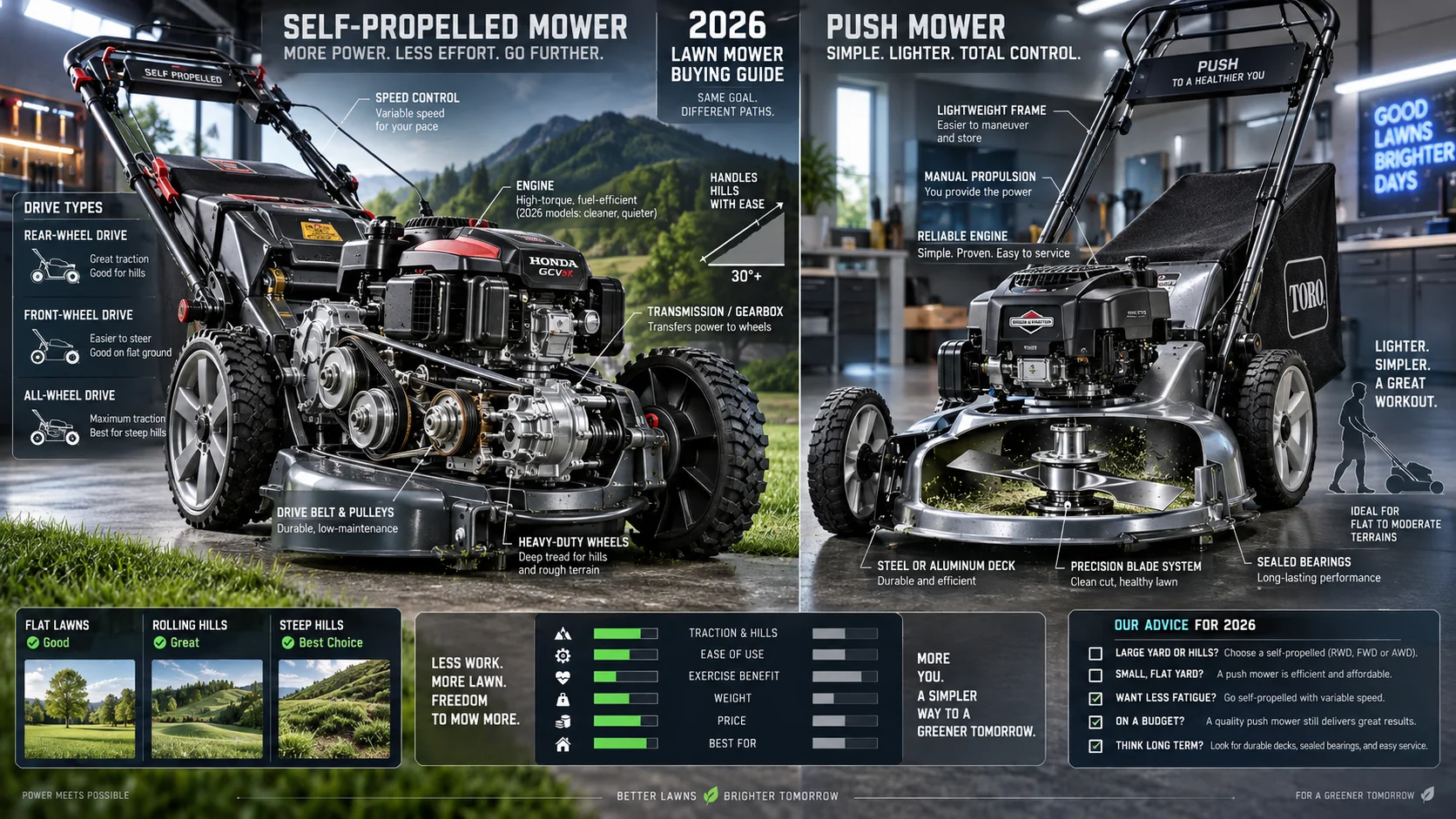
A self propelled lawn mower uses a transmission connected to the engine to drive one or more wheels. The engine powers both the blade and the drive system. You control the speed with a lever or by squeezing a bail bar against the handle. When you release the bar, the drive disengages, and the mower stops moving forward.
A push mower, by contrast, has no transmission. The engine only spins the blade. You provide all the forward motion with your own muscle power. This fundamental difference drives every other comparison: weight, cost, maintenance, and hill performance.
The Drive System Anatomy: What You Are Actually Paying For
- Transmission: Converts engine power into wheel rotation. Can be gear-driven or hydrostatic.
- Drive Cables: Connect the speed control lever to the transmission. These stretch and require adjustment.
- Wheel Gears: Transfer power from the transmission to the wheels.
- Bail Bar / Drive Lever: The safety mechanism that engages and disengages the drive.
Each of these components adds weight and complexity. This is why a self-propelled mower typically weighs 20-30 pounds more than an equivalent push model. That extra weight is the price you pay for not having to push.
Front Wheel vs Rear Wheel Drive: Which Is Right for Your Lawn?
This is the most critical specification to understand before buying. The drive wheel location determines how the mower behaves on slopes and how it maneuvers around obstacles.
Rear-Wheel Drive (RWD): The Hill-Climbing Standard
Rear wheel drive mowers are the industry standard for hilly terrain. The drive wheels are positioned directly under the engine, which is the heaviest part of the mower. This weight distribution presses the drive wheels into the ground, giving you maximum traction on slopes.
When climbing a hill, the mower’s weight shifts backward. With RWD, that weight shift pushes the drive wheels harder into the turf, improving grip exactly when you need it. RWD also allows the front wheels to pivot freely, making it easier to turn the mower at the end of a row.
Best for: Yards with slopes, uneven terrain, and any situation where traction is your primary concern.
Front-Wheel Drive (FWD): The Flat-Lawn Specialist
Front-wheel drive mowers pull themselves forward from the front axle. This design is lighter and cheaper to manufacture, which translates to a lower purchase price. On perfectly flat ground, FWD works fine and is easier to maneuver because the drive wheels are closer to your hands.
However, FWD has a critical weakness on hills. When climbing, the mower’s weight shifts to the rear, lifting weight off the front drive wheels. This reduces traction precisely when you need it most. The front wheels can also lose grip on wet grass or when the deck is full of clippings.
Best for: Flat, small lawns where price is the primary concern and slopes are minimal. Readers comparing setup options can review our technical analysis on how to change lawn mower oil.
All-Wheel Drive (AWD): The Steep-Slope Solution
An all wheel drive mower powers all four wheels simultaneously. This is the premium solution for the most challenging terrain. AWD distributes traction across every wheel, preventing the front wheels from sliding sideways on steep slopes and maintaining grip even when the deck is full.
The trade-off is weight, cost, and complexity. AWD mowers are the heaviest and most expensive option. They also have more moving parts that can fail. However, if you have a yard with slopes exceeding 15 degrees, AWD is the only reliable solution that prevents you from having to push the mower backward up the hill. For complementary field maintenance guidelines, examine our breakdown of litheli vs worx compact mower.
Best for: Steep slopes, wet climates, and yards with significant elevation changes.
Variable Speed Drive Systems: Matching Pace to Terrain
A variable speed drive system allows you to adjust the mower’s ground speed independently of the engine throttle. This is a major ergonomic feature that separates premium self-propelled mowers from budget models. To evaluate matched hardware tolerances, consult our detailed overview of ego vs greenworks battery mower showdown.
Single-Speed vs Variable-Speed: The Practical Difference
Budget self-propelled mowers often have a single fixed drive speed. You engage the drive, and the mower moves at one pace. This is fine on flat ground but problematic on hills where you need to slow down for control or speed up on flat stretches for efficiency.
Variable-speed systems use a lever on the handlebar that you push forward or pull back to change speed continuously. This lets you walk at your natural pace rather than adjusting your stride to the mower. On slopes, you can slow the drive to maintain control without disengaging it entirely.
Key Buying Tip: If you are buying a self-propelled mower for a hilly yard, a variable-speed drive is not optional. It is essential for safe, controlled operation on slopes. Fixed-speed mowers are dangerous on hills because you cannot slow down quickly enough to maintain control.
Choosing the Best Mower for Steep Hills: A Decision Framework
Finding the best mower for steep hills requires matching the machine to your specific slope angle. Here is a diagnostic framework to determine what you need.
Step 1: Measure Your Slope Angle
Use a simple digital inclinometer app on your phone or a physical level to measure the steepest section of your yard. Place the device on the slope and record the angle in degrees.
| Slope Angle | Recommended Drive Type | Safety Notes |
|---|---|---|
| 0 – 10 degrees | Push mower or FWD self-propelled | No special requirements |
| 10 – 15 degrees | RWD self-propelled | Use variable speed for control |
| 15 – 20 degrees | RWD or AWD self-propelled | Mow across the slope, not up/down |
| 20+ degrees | AWD self-propelled | Consider a string trimmer for extreme sections |
Step 2: Assess Your Physical Condition
Be honest about your physical capabilities. A self-propelled mower reduces the effort of moving forward, but you still have to steer, turn, and manage the mower’s weight. If you have joint issues, back problems, or limited grip strength, prioritize a mower with ergonomic handles and a variable-speed drive that requires minimal force to operate.
Step 3: Consider Your Yard Size and Layout
For yards under ¼ acre that are completely flat, a push mower is the logical choice. You save money, reduce maintenance, and get a lighter machine that is easier to store. For yards over ¼ acre, the time savings of a self-propelled mower become significant. You will finish faster and with less fatigue.
Push Mower Advantages: When Simplicity Wins
Push mowers are not obsolete. They remain the best choice for a specific set of conditions. Here is why you might choose a push mower even if you can afford a self-propelled model.
- Lower Cost: Push mowers cost $150-$400 versus $350-$900 for self-propelled models.
- Lighter Weight: 30-60 pounds makes them easy to lift into a truck or store on a wall hook.
- Simpler Maintenance: No transmission, cables, or drive gears to fail. Just sharpen the blade and change the oil.
- Better Exercise: Pushing a mower burns 250-350 calories per hour, providing genuine cardiovascular benefit.
- Superior Maneuverability: The lighter weight and lack of drive components make push mowers easier to turn in tight spaces.
Self-Propelled Mower Advantages: When Power Pays Off
The self-propelled category exists because pushing a mower is genuinely exhausting on larger properties. Here is what you gain by spending the extra money.
- Reduced Fatigue: The machine does the forward work, letting you focus on steering and cutting quality.
- Hill Capability: RWD and AWD systems maintain traction on slopes where a push mower would stall or slide.
- Consistent Cutting Speed: You maintain a steady pace, producing a more uniform cut than a push mower where speed varies with fatigue.
- Time Savings: On a ½ acre lot, a self-propelled mower can save 15-20 minutes per mowing session.
Recommended Hardware & Essential Equipment
Based on the drive-type analysis above, we have selected two verified units that solve the two most common terrain problems. The first is a rear-wheel-drive self-propelled mower with a variable-speed system, ideal for yards with moderate slopes up to 15 degrees. The second is an all-wheel-drive model engineered for steep terrain where front-wheel traction is critical. Both units feature commercial-grade transmissions and ergonomic handle systems to reduce operator fatigue.
Buyer FAQs: Self Propelled Vs Push Mowers Solved
Is a self-propelled mower worth the extra money?
Yes, if your yard exceeds ¼ acre or has slopes over 10 degrees. The reduced physical effort and consistent cutting speed justify the $200-$500 price premium. For flat yards under ¼ acre, a push mower is the more economical and practical choice.
Can I use a push mower on a hill?
You can use a push mower on slopes up to about 10 degrees, but it requires significant physical effort and can be dangerous on steeper terrain. The mower can slide backward or sideways if you lose your footing. For slopes over 10 degrees, a rear-wheel-drive self-propelled mower is strongly recommended for safety.
What is the difference between front-wheel and rear-wheel drive mowers?
Front-wheel drive (FWD) mowers pull from the front axle, making them lighter and cheaper but prone to traction loss on hills. Rear-wheel drive (RWD) mowers push from the rear axle, placing drive wheels under the engine’s weight for superior hill-climbing traction. RWD is the standard choice for sloped yards.
How steep of a hill can a self-propelled mower handle?
A rear-wheel-drive self-propelled mower can handle slopes up to 15-20 degrees when mowing across the slope. An all-wheel-drive mower extends this capability to 25 degrees or more. For safety, always mow across slopes rather than up and down, and never operate any mower on slopes exceeding 25 degrees.
Do I need variable speed on a self-propelled mower?
Variable speed is essential for hilly terrain because it lets you slow down for control on descents and speed up on flat sections. On perfectly flat yards, a single-speed system is acceptable. However, variable speed also lets you match the mower’s pace to your natural walking speed, reducing fatigue on any terrain.
Final Buying Verdict for 2026
Your decision comes down to three questions. Is your yard flat? Is it under ¼ acre? Do you want the exercise? If you answered yes to all three, buy a push mower. If your yard has any slope, exceeds ¼ acre, or you want to minimize physical strain, buy a self-propelled mower with rear-wheel drive and variable speed. If your slopes exceed 15 degrees, invest in an all-wheel-drive model. Match the machine to your terrain, and you will get years of reliable service.
Mower Type Safety Overview
Self propelled and push mowers each have their own handling habits, so reviewing the owner’s manual matters. For a wider overview of lawn and garden power tools, American National Standards Institute (ANSI) is a balanced reference.