Quick Answer: Choosing the Best Small Battery Powered Blower
If you need a lightweight tool for quickly clearing dry leaves, dust, and grass clippings from porches or walkways, a compact cordless unit with dual batteries offers cord-free convenience, though it cannot match the heavy debris clearing power of full-sized commercial sweepers.

Pros
- 66-inch clearing width (manufacturer-stated)
- Honda 22 HP engine included with the unit
- Designed for UTV use according to the listing
- Listed as EPA compliant
Cons
- Few product details such as weight and mounting specs
- No customer reviews available to evaluate

Pros
- True modularity allows quick switches between lawn mowing and leaf blowing tasks on a single robot base
- Autonomous features including obstacle avoidance enable hands-free operation for large yards
- Weather-resistant design with IPX5 rating supports use in varied outdoor conditions
- Expandable system supports additional modules for snow and other seasonal duties
Cons
- Full dual functionality requires separate module purchases beyond the base unit
- Advanced robotic setup may present a learning curve for first-time users
- Sparse independent long-term feedback limits insight into durability over multiple seasons
The YARBO Robot Lawn Mower and Leaf Blower is a multi-purpose smart yard robot built around a modular core body that pairs with detachable attachments. Its primary design focuses on automation and versatility for outdoor maintenance, giving an immediate impression of a high-tech solution aimed at simplifying large-property care rather than a traditional single-function tool.
Performance and Key Features: In real-world use the system functions as both a lawn mower and leaf blower by simply swapping modules on the same base. It operates autonomously with advanced obstacle avoidance and all-terrain capability, while features such as IPX5 waterproofing and wireless auto-recharging support continuous seasonal work without constant oversight. This modular approach turns one robot into a complete yard solution for mowing grass and clearing leaves efficiently.
Drawbacks and Considerations: Buyers should note that achieving full dual functionality typically involves acquiring the specific modules separately, and the sophisticated robotics can require an initial learning period for mapping and setup. With limited long-term user reports available, prospective owners may want to evaluate coverage needs and module costs carefully before committing.
Verdict: This product delivers the most value to tech-oriented homeowners managing sizable yards who want a single expandable robot for mowing and leaf blowing instead of multiple machines. It is especially suited for those prioritizing hands-free operation and future module upgrades for year-round use.

Pros
- Fully autonomous operation powered by AI vision and RTK GPS navigation for genuine hands-free use.
- High-output 2000W motor that clears heavy and wet debris more effectively than typical handheld models.
- Modular design that supports conversion between leaf blowing, mowing, and snow blowing functions.
- Comprehensive app control with scheduling, no-go zones, and multi-area mapping capabilities.
- Strong performance on steep slopes up to 70 percent for versatile terrain handling.
Cons
- Lawn mower and snow blower modules are sold separately and not included with the leaf blower unit.
- 70-minute runtime may require recharging or multiple sessions for very large properties.
- Full functionality depends on initial app-based mapping and setup of the intelligent control system.
The YARBO Robot Leaf Blower is a fully autonomous cordless electric leaf blower that uses AI vision and RTK GPS for navigation. Its modular design and cordless freedom create an immediate impression of advanced innovation aimed at reducing manual yard work for modern homeowners.
Performance and key features center on the 2000W variable-speed motor that generates strong airflow to clear thick leaf piles and wet debris far more effectively than average handheld units. Real-world utility is enhanced by the 70-minute runtime, ability to handle 70 percent steep slopes, and app-based controls that let users set schedules, define no-go zones, and map up to 100 areas for precise autonomous operation.
Drawbacks and considerations include the fact that lawn mower and snow blower modules must be purchased separately for multi-season use. The 70-minute runtime may also prove limiting on expansive properties, and optimal results rely on careful initial mapping and app setup.
Verdict: This robot leaf blower delivers the most value to tech-oriented homeowners with medium to large yards who want hands-free leaf management and the option to expand into other seasonal tasks. Those seeking a single modular base for year-round care will appreciate its autonomy and power, provided they budget for additional modules as needed.

Pros
- Fully autonomous 24/7 operation with auto-mapping AI vision and RTK GPS for precise day and night navigation.
- 2-stage design with powerful motor effectively handles heavy wet dense and hard-packed snow.
- Wide 24-inch clearing path and 12-inch depth cover large areas efficiently in one pass.
- Durable high-strength Q355 steel frame and components engineered for severe weather reliability.
- OTA continuous upgrades keep the system improving with new features and performance enhancements.
Cons
- Heavy approximately 220 lb unit requires 2-3 adults for assembly and careful handling.
- Shipped in 4 separate boxes which can complicate initial setup and requires watching the installation video.
- Remote control is not included and must be purchased separately for optional manual use.
The YARBO Snow Blower Robot is a modular cordless 2-stage autonomous robotic snowblower built around high-strength Q355 steel for durability in complex winter conditions. It includes snow tracks for stability a docking station battery and related accessories delivering a premium immediate impression as a complete hands-free snow clearing system.
In real-world performance the robot clears a 24-inch path up to 12-inch depth while throwing snow 6-40 feet. AI vision RTK GPS and auto-mapping enable reliable navigation and smart scheduling that activates at the first snowfall for continuous 24/7 operation. The 2-stage system with upgraded motor efficiently manages heavy wet and hard-packed snow across large driveways sidewalks and parking lots.
Key considerations include the roughly 220 lb weight that requires 2-3 adults for assembly plus shipment in 4 boxes. Users need a 120 degree unobstructed sky view for the data center set and should watch the installation video first. The remote control is sold separately.
This product offers strong value for homeowners with expansive outdoor areas who want to eliminate manual snow shoveling through autonomous technology durable construction and ongoing OTA improvements.

Pros
- Commercial-grade GX390 OHV engine, per listing
- Electric key start, listed for cold-weather starts
- Dual track drive with sure-gripping cleats
- Hydrostatic self-propelled drive, no shifting
- Auger height control with variable positions
Cons
- Listed weight is missing; dimensions read 0 x 0 x 0 inches
Pros
- Manufacturer-stated commercial-grade Honda GX390 OHV engine
- Automotive-style DC electric key start for easier starting
- Dual rubber tracks with cleats for traction on inclines and ice
- Hydrostatic self-propelled drive with no shifting required
- Manufacturer-stated 3-year residential warranty
Cons
- No customer reviews or independent performance data are supplied
- Requires pre-use oil and fuel checks and manual-based maintenance
Pros
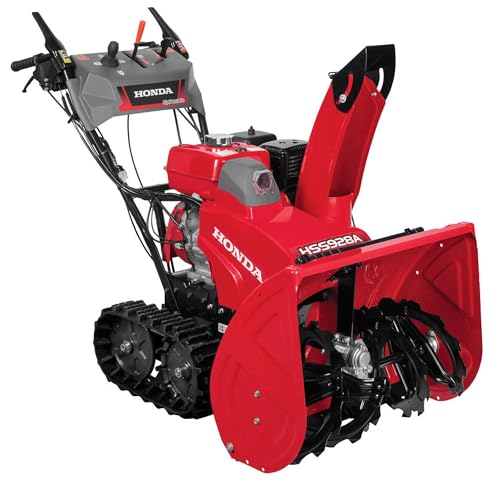
- Electric key start with commercial-grade GX270 engine
- Dual track drive with cleats for traction, per listing
- Hydrostatic self-propelled drive with no shifting
- Auger height control lever with variable positions
- 3-year residential warranty, per listing
Cons
- Listed weight is 358 pounds
- Listed dimensions read 0 x 0 x 0 inches, so size is unverified

Pros
- Commercial-grade GX390 OHV engine, per listing
- Dual track drive with sure-gripping cleats
- Hydrostatic self-propelled drive, no shifting
- Auger height control with variable positions
- Ready to use out of box, no assembly, per listing
Cons
- Specs list only product group; no weight or dimensions
CFM vs. Airspeed: What Moves Leaves on Patios and Driveways?
Airflow volume (measured in cubic feet per minute, or CFM) determines how much debris a blower can push across an area, while air speed (measured in miles per hour, or MPH) dictates the force that dislodges stuck material. For hard surfaces like porches and carports, higher air speed loosens dirt, but clearing broad expanses of grass requires substantial CFM to move piles efficiently.
Among compact options, the leaf blower category shows distinct variations in these metrics. The Electric Leaf Blower Cordless with Battery from VIBOGEN advertises up to 420 CFM paired with a 150 MPH top speed, making it particularly capable for general residential sweeping across driveways and garage floors. In contrast, the Leaf Blower Cordless with 2X 4.0Ah Batteries from PULITUO delivers an advertised 150 MPH but lists a lower air volume of 180 CFM. Similarly, the Leaf Blower Cordless with 2.0Ah Battery & Charger from JAGROM generates 130 MPH at 180 CFM. A blower with 180 CFM works well for localized dust and sidewalk edges, but pushing wider drifts across lawns will feel noticeably slower compared to a 420 CFM design.
Battery Capacity Trade-Offs: 2.0Ah Packs vs. 4.0Ah Runtimes
Choosing between 2.0Ah and 4.0Ah battery packs directly impacts how long you can blow debris before stopping to swap or recharge, balanced against the physical weight hanging from the handle. Higher amp-hour ratings deliver more operational stamina, but larger cell configurations add bulk to what should be an ultra-portable tool. For broader ecosystem context, read through our operational guide on small rechargeable leaf blower.
Models like the Leaf Blower Cordless Handheld Blower with 2×4.0Ah from laapee and the Cordless Leaf Blower Lightweight Handheld Blowers from TNELTUEB bundle two 4.0Ah (or 4000mAh) battery packs, each advertising up to 30 minutes of runtime on low settings. PULITUO also includes two 4.0Ah packs, claiming up to 60 minutes on low speed and 30 minutes on high speed, though the manufacturer notes its overheat protection requires a 20- to 30-minute cool-down period before recharging. On the other hand, more compact kits like the Cub Tik Cordless Leaf Blower,150MPH 20V Handheld and the Leaf Blower Cordless, Leaf Blower with Battery from RYAHT utilize dual 2.0Ah batteries. While lighter to carry, 2.0Ah packs drain quicker when operated at maximum output, requiring frequent battery swaps during larger cleanup routines.
Tool Weight and Handling: When Extra Ounces Matter
Overall tool weight dictates whether you can comfortably operate a blower overhead or single-handedly for extended cleanup sessions. Because these handheld tools are frequently chosen by users wanting to avoid heavy gas blowers, small weight variations make a tangible difference during routine tasks like blowing gutters or cleaning vehicle interiors.
The laapee cordless blower is listed at an exceptionally low bare weight of 1.12 pounds and includes a shoulder strap for added ergonomics. In comparison, the JAGROM cordless blower weighs 2.6 pounds, while the VIBOGEN blower stands at 2.74 pounds (measured without the battery attached). The YUQUESEN Cordless Leaf Blower checks in at 2.8 pounds, and the Cub Tik unit weighs 2.9 pounds. At the heavier end of the compact tier, the RYAHT and PULITUO blowers both weigh roughly 3.4 pounds. While 3.4 pounds remains manageable for most adults, those seeking minimal arm fatigue or easy one-handed reach across outdoor furniture often gravitate toward tools in the 2-pound class. If you are comparing weights across different yard designs, exploring our guide to small cordless blowers provides additional perspective on balance and ergonomics.
Speed Settings and Nozzle Attachments for Precision Clearing
Adjustable airspeed controls and specialized nozzle tips allow a small blower to adapt between delicate tasks, such as clearing dry leaves from mulch beds without scattering soil, and blasting wet clippings off concrete paths. A single fixed speed often proves either too weak for stubborn spots or too aggressive for delicate landscaping.
Speed control mechanisms vary considerably among these compact models:
- Stepless adjustment: The laapee blower uses a pressure-sensitive trigger with a stepless design and safety lock, allowing minute adjustments based on finger pressure.
- Multi-stage dials: The TNELTUEB cordless blower features 6 distinct speed settings (ranging from advertised 100 MPH breezes up to 200 MPH turbo bursts) alongside a 180° rotating handle for awkward angles. The PULITUO offers 3 selectable speed levels (90, 120, and 150 MPH).
- Dual-speed switches: Models such as VIBOGEN, RYAHT, and Cub Tik stick to a basic two-speed switch (low and high), prioritizing simplicity over fine-grained throttle control.
Nozzle designs also affect output pattern. The Plymax Cordless Leaf Blower and the VIBOGEN blower both supply dual nozzles: a concentrated round/jet nozzle for focused blasting in seams and vehicle grilles, and a wide flat nozzle to sweep broader swathes of driveway. If your clearing involves extended paved surfaces, checking our analysis of leaf blowers for driveways can help clarify wide-nozzle utility.
Frequently Asked Questions About Small Battery Powered Blowers
Can a small battery powered blower handle wet leaves and heavy debris?
Most compact battery blowers are engineered primarily for dry debris, sawdust, grass clippings, and patio sweepings. For instance, Cub Tik explicitly notes in its specifications that its compact unit is not suitable for wet leaves, heavy gravel, or large tree branches. While some units claim top speeds up to 150 to 200 MPH, their compact air volume (often under 200 to 420 CFM) limits their ability to lift saturated, matted yard waste.
Are the included lithium batteries interchangeable with other power tool brands?
Generally, off-brand cordless blowers use proprietary slide-on battery form factors that do not fit major power tool platforms. One documented exception is the PULITUO cordless blower, which the manufacturer states is compatible with Makita 18V batteries when paired with a matching Makita charger. Always confirm pin configurations and voltage before attempting cross-brand battery use.
Which Small Battery Powered Blower Fits Your Routine?
Selecting the right compact blower comes down to balancing air volume, battery longevity, and handling weight against the specific surface areas you intend to clean. Light patio maintenance requires far less continuous current and bulk than sweeping an entire multi-car driveway after seasonal mowing.
For buyers needing balanced performance with meaningful air volume on paved surfaces, the Electric Leaf Blower Cordless with Battery from VIBOGEN is our primary recommendation. It pairs an advertised 420 CFM airflow with two 4.0Ah 21V battery packs and dual nozzles, making it versatile across walkways and garages. Its main limitation is its modest two-speed control switch, which lacks the fine-tuned precision of multi-step or stepless triggers. For users who prioritize the absolute lightest tool possible for brief car-drying or deck dusting, the ultra-lightweight Leaf Blower Cordless Handheld Blower with 2×4.0Ah from laapee serves as a nimble alternative with stepless speed regulation, even if its compact form factor offers less broad-sweeping coverage. If you are still weighing overall blower sizes, consult our guide on what leaf blower is best to determine whether a compact handheld or higher-capacity tool matches your property size.
Small Battery Blower Reference
Small battery powered blowers are often bought for balconies and decks, where tight spaces raise the stakes for bystanders. American National Standards Institute (ANSI) is a useful general reference.