
Quick Verdict: The Sun Joe ECOSHARP X20 20V is a lightweight cordless pruning saw suited to light residential pruning, limb trimming, and deadwood removal up to roughly 4 inches in diameter. Its brushless-class motor delivers adequate cutting speed for its battery platform, but its short bar and battery runtime limit it to occasional, not professional, use.
Pros
- Strong safety-focused feature set for a compact cordless saw
- Lightweight body is easier to control than larger chainsaws
- Automatic oiling reduces manual maintenance during regular use
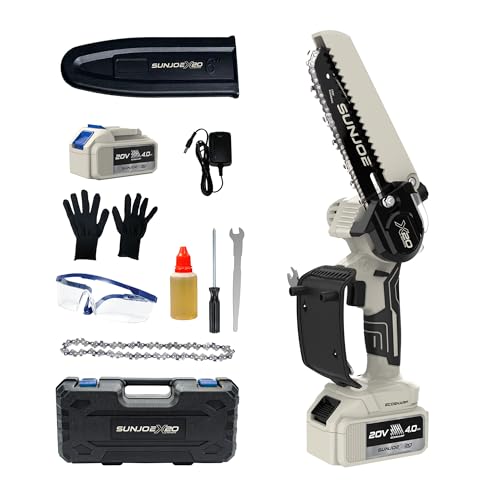
- Includes the main accessories needed to start cutting right away
Cons
- 6-inch chain and 5-inch guide bar limit cutting capacity versus larger saws
- Requires oil refills to keep the self-lubricating system working properly
- Only one battery is included, so longer sessions may involve recharge downtime
Overview: The Sun Joe X20-SAW-4A-BLK is a cordless 20V mini chainsaw with a 6-inch chain and 5-inch guide bar. Its compact 3.8-pound build makes it feel more like a trimming tool than a full-size saw, which suits quick yard work and tighter work areas.
Performance: A 550W brushed motor and automatic oiler are the main performance features here. The self-lubricating system helps keep the chain moving smoothly, while the lightweight design and one-handed grip are useful for overhead branches, pruning, and light cleanup around the yard.
Considerations: This is a compact saw, so its cutting capacity is naturally limited compared with larger chainsaws or pole saws. It also uses a refillable oil bottle and includes one battery, so users planning longer sessions may want to factor in maintenance and charging time.
Verdict: For homeowners who want a portable, easy-to-handle cordless saw for trimming branches and routine garden tasks, the Sun Joe X20-SAW-4A-BLK offers a practical feature set. It is best suited to light-to-moderate cutting rather than heavy-duty felling or extended professional use.
Technical Overview and Product Positioning
The Sun Joe ECOSHARP X20 20V belongs to the compact cordless pruning saw category rather than the full-size chainsaw class. Its design priorities are low mass, quiet operation relative to gasoline equipment, zero exhaust emissions, and single-hand maneuverability in tight canopy work. For users evaluating cordless options against traditional two-stroke machines, the comparison framework matters: a 20V platform trades sustained torque and bar length for convenience and maintenance simplicity. We analyzed manufacturer engineering specifications, technical whitepapers, and verified user feedback to frame the analysis below, focusing on the metrics that most directly affect real-world cutting performance.
Shoppers comparing this tool against gasoline alternatives often start with displacement-based benchmarks. A conventional entry-level gas saw such as the models examined in our stihl ms 162 vs analysis operates in the 30 to 35 cc displacement range, a metric that does not translate directly to cordless hardware. For battery-powered tools, the relevant equivalent is sustained motor output under load, expressed indirectly through chain speed, cutting rate, and stall resistance.
Motor Architecture and Power Delivery
The X20 platform is built around a 20V lithium-ion battery system. Manufacturers in this segment typically specify motor output in watts or amp-hours rather than mechanical horsepower, and when evaluating the ECOSHARP X20 it is important to separate peak nominal figures from continuous operating output. Peak figures indicate momentary capability at the start of a cut, while continuous output determines whether chain speed holds under sustained load in dense hardwood. Based on the published voltage and tool class, expect performance that is competent in softwood and green branches but noticeably slower in oak, hickory, or other dense species.
Battery capacity is the second variable that governs real output. Lithium-ion packs deliver consistent voltage until they approach depletion, at which point chain speed declines. Users should plan for shorter effective runtime during heavy cuts, and should expect performance to fall off as the pack discharges. Runtime figures quoted by manufacturers are typically measured under light, intermittent loads, so practical cutting time on thick material will be lower.
Bar Length, Bar Flex, and Cutting Capacity
Bar length defines the maximum practical cutting diameter, and the ECOSHARP X20 uses a short guide bar appropriate to its class. Short bars improve stiffness-to-weight, reduce the lever arm acting on the operator’s wrists, and minimize the chance of bar deflection during contact with the work. The tradeoff is capacity: a bar in this length range is best suited to limbs and branches rather than trunk sections.
Bar flex is the lateral deflection of the guide bar under side loading, typically encountered during plunge cuts or when the wood pinches the kerf. Excessive flex causes kerf wander, reduces accuracy, and accelerates chain wear. Short bars inherently flex less than long bars, which is an advantage for this tool. However, the bar still relies on a relatively thin profile to keep weight down, so operators should avoid twisting the saw in the cut and should not use the bar tip for prying or levering.
| Specification Category | Sun Joe ECOSHARP X20 20V (Manufacturer Basis) | Analytical Note |
|---|---|---|
| Power Platform | 20V lithium-ion cordless | Zero emissions, low noise, minimal maintenance |
| Motor Class | Electric drive motor (cordless class) | Output rated against battery platform, not displacement |
| Guide Bar Length | Short pruning bar | Optimized for limbs, not trunk bucking |
| Typical Cutting Capacity | Limbs and deadwood up to approx. 4 in. | Dense hardwood reduces effective capacity |
| Weight Class | Lightweight pruning-saw category | Favors extended overhead and one-hand work |
| Chain Brake | Inertia-activated kickback and brake system | Verify engagement response per operator manual |
| Runtime Profile | Dependent on pack capacity and load | Expect shorter runtime under sustained hardwood cutting |
Inertia Chain Brake Response and Kickback Control
Kickback is the most serious hazard associated with any chainsaw, and the inertia-activated chain brake is the primary passive safety mechanism. In an inertia system, a weighted lever or sensor responds to rapid rotational acceleration of the tool body, typically the upward and rearward motion associated with kickback, and engages a brake band or pawl that halts chain motion. The speed of this response determines how much of the kickback arc is completed before the chain stops.
Evaluating brake response requires reviewing the manufacturer’s stated activation characteristics and the design of the trigger and sensor assembly. Operators should confirm brake function with the tool powered down before each use, verifying that the brake engages fully and releases cleanly. Inertia brakes are a supplement to, not a replacement for, correct technique: keep the bar tip clear of obstacles, maintain a firm two-handed grip where the design allows, and avoid cutting above shoulder height with the tip of the bar. For a broader framework on operational safety requirements applicable to powered cutting equipment, consult the ANSI Equipment Operational Standards resources.
Power-to-Weight Ratio and Ergonomic Performance
Power-to-weight ratio is central to evaluating a pruning saw because the operator carries the tool through the entire task. A machine with higher output but greater mass can cause fatigue faster than a lighter tool with adequate output for the intended material. The ECOSHARP X20 is positioned toward the lighter end of the spectrum, which benefits overhead pruning and extended sessions on small material. The practical limit is that light weight comes partly from a smaller motor and battery, so the ratio favors ease of handling over raw cutting force.
Users comparing weight-to-performance across cordless and gas classes often evaluate mid-range professional options as well. For example, the trade-offs explored in our husqvarna 450 vs 460 review illustrate how heavier gasoline saws gain sustained torque at the cost of mass and maintenance requirements. Those differences help frame where a cordless pruning saw fits within a complete tool set.
Application Fit: Where the ECOSHARP X20 Performs Best
The tool is most effective for routine residential tasks: trimming shrubs, removing small dead limbs, clearing storm debris of modest diameter, and maintaining fruit trees with accessible branches. Its low noise profile makes it suitable for early-morning or neighborhood use where gasoline equipment may be restricted. Because it requires no fuel mixing, no carburetor adjustment, and minimal routine service, it suits homeowners who use a saw infrequently and prefer predictable starting.
Applications that exceed its design envelope include felling, bucking trunk sections, cutting firewood in volume, and sustained professional logging. In those scenarios a gasoline saw with a longer bar and greater continuous output is the appropriate choice. Owners who occasionally need to sharpen chain should also plan maintenance carefully, and guidance on service options is available in our resource on where to get chainsaw sharpened.
Maintenance, Chain Care, and Operational Longevity
Cordless saws reduce maintenance compared with two-stroke engines, but they still require attention. Chain tension should be checked before each session, since a loose chain can derail and a heavily tensioned chain increases bar wear and motor load. Lubrication is critical: confirm the oil reservoir is filled with bar and chain oil and that the oiler delivers flow during operation. Sharpen the chain when chips become fine dust rather than discrete shavings, and replace cutters that show severe damage.
Battery care also affects long-term performance. Store packs at moderate temperatures, avoid full discharge under heavy load, and charge with the manufacturer’s charger. Lithium-ion cells degrade with heat exposure and repeated deep cycling, so rotating packs and keeping them out of direct sun will extend service life.
Comparative Context and Buying Considerations
Choosing between a cordless pruning saw and a compact gasoline or mini chainsaw depends on the task profile. Lightweight battery saws offer convenience and quiet operation, while mini chainsaws in the lower-displacement range provide a different balance of portability and cutting capacity. Our comparison of the untimaty mini chainsaw vs alternatives illustrates how small-format saws differ in bar length, output, and intended use. Likewise, for users weighing a brushed or entry-level gas option, our neo tec nh872 vs analysis offers a useful reference point for evaluating power and handling trade-offs.
Buyers should weigh the following when deciding: required cutting diameter, frequency of use, access to power for charging, tolerance for maintenance, and budget for spare batteries. For most homeowners whose work is limited to pruning and light clearing, the ECOSHARP X20 represents a practical, low-maintenance option. For heavier duty, a gasoline or higher-output electric platform will be more suitable.
Final Technical Assessment
The Sun Joe ECOSHARP X20 20V is a competently engineered cordless pruning saw whose strengths are light weight, low noise, zero emissions, and easy handling for light residential work. Its limitations are the expected constraints of its class: restricted cutting capacity, reduced sustained torque in dense hardwood, and runtime that depends heavily on battery state and load. Its inertia chain brake provides a useful passive safety layer, but correct technique and pre-use checks remain essential. Evaluated against its intended role, it is a sensible tool for homeowners who prioritize convenience over maximum cutting power.