Quick Answer: Choosing the Best Easiest Chainsaw To Start
When selecting the easiest chainsaw to start in 2026, evaluate Smart Start or electric push-button systems, engine displacement between 25-cc and 58-cc for balanced power, bar lengths of 12 to 20 inches matched to task size, and features like air purge or automatic oilers. These factors ensure minimal startup resistance while supporting durability and safety during wood cutting. For…

Pros
- Efficient X-Torq engine that lowers emissions and improves fuel efficiency
- Smart Start system for effortless and reliable startups
- LowVib technology that reduces vibrations for more comfortable handling
- Air Injection filtration that extends engine life by keeping debris out
- Inertia-activated chain brake that enhances operator safety
Cons
- As a 2-cycle gas engine it requires proper fuel-oil mixing which adds preparation steps compared to electric models
- Gas operation means regular maintenance such as filter cleaning and fuel system care that electric saws often avoid
- The 18-inch bar suits homeowner use but may feel limited for larger professional felling jobs
The Husqvarna 440 gas chainsaw delivers a slimmer saw body and lightweight build that make it approachable for wood cutting and tree trimming around the home. Immediate impressions focus on its balanced design and practical features aimed at everyday users who need dependable performance without excess bulk.
In real-world cutting the 40-cc 2.4-HP X-Torq engine provides solid power while reducing emissions up to 60 percent and raising fuel efficiency up to 20 percent. Smart Start technology allows easy ignition with minimal effort, Air Injection technology expels larger dust and debris before it reaches the filter for longer engine life, and LowVib dampeners keep vibrations low for comfortable handling. The inertia-activated chain brake further supports safer operation during kickback events.
Potential drawbacks center on its 2-cycle gas nature. Users must mix fuel and oil correctly, store gas carefully, and perform routine maintenance that pure electric chainsaws largely eliminate. The fixed 18-inch bar also suits residential tasks best and may not cover heavy commercial work.
Overall the Husqvarna 440 offers the best value for homeowners and DIY enthusiasts who want a reliable gas chainsaw for occasional firewood cutting, pruning, and property maintenance where unrestricted runtime and solid power matter most.
Pros
- Lightweight and compact enough for pruning and close-quarters cutting.
- Includes several safety-oriented controls and protective accessories.
- Designed for easier starting with both hot and cold engine conditions.
- Comes with a broad accessory bundle, which improves setup convenience.
Cons
- The 12-inch bar limits cutting capacity compared with larger chainsaws.
- As a gas-powered 2-cycle saw, it requires fuel mixing and routine maintenance.
- The top-handle design is often better suited to experienced users than to complete beginners.
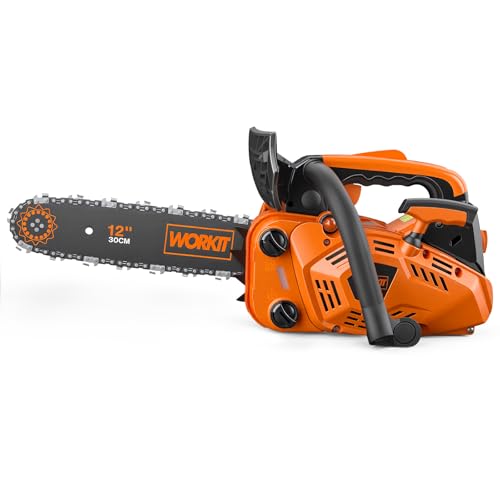
Overview: The WORKIT 25.4CC Gas Powered Chainsaw is a compact 12-inch top-handle saw designed for pruning, trimming, and general wood cutting. Its 8.2 lb build and reinforced body give it a practical, work-ready feel for users who need control in tight spaces.
Performance: The 2-cycle Xtreme Engine is positioned for strong cutting performance, including harder wood and thicker logs. OptiSpark Ignition is intended to support reliable starts in both cold and hot conditions, while the auto oiler, chain brake, dual safety locks, and shock-absorbing handle add day-to-day usability.
Considerations: This is still a gas chainsaw, so it will require fuel mixing, maintenance, and more upkeep than a battery model. The 12-inch bar is well suited to pruning and smaller jobs, but it is not the best choice for large-diameter cutting or extended heavy-duty felling.
Verdict: The WORKIT 25.4CC is a good fit for buyers who want portable gas power, a compact format, and a strong set of safety features. It offers the most value for tree pruning, property maintenance, and light-to-medium cutting tasks.
Key Technical Factors to Consider Before Buying
Choosing the easiest chainsaw to start hinges on matching ignition technology, power delivery, and handling traits to your cutting frequency and wood density. Prioritize systems that eliminate multi-pull frustration while delivering adequate torque within the entry-level to premium spectrum offered by brands such as leading manufacturers. When planning workspace deployment, consider the engineering criteria outlined in our stihl ms 162 vs husqvarna 120 mark ii guide. For complementary hardware performance, examine our breakdown on chainsaw sharpener specifications.
Starting System Technology
The core of any easiest chainsaw to start lies in its ignition method. Gas models with Smart Start and air purge technology, as found on the Husqvarna 435 and Husqvarna 440, reduce pull force by priming fuel automatically and minimizing compression resistance for near first-pull reliability. Electric options like the Toro Flex Force 60-Volt Max eliminate pulls entirely through a simple button-and-trigger sequence powered by a brushless motor. Replacement recoil starters from SaferCCTV, BlueStars, Dofank, and GFJZN upgrade older Stihl or Husqvarna units with smoother rewind mechanisms and durable ropes, restoring easy starts without full saw replacement. Select based on whether you prefer gas portability or battery convenience.
Engine Displacement and Power Output
Engine size directly influences starting ease and cutting capacity. Compact 25-cc to 25.4-cc two-stroke units, such as the WORKIT and V-MODEST top-handle models, start with less resistance due to lower compression and suit pruning or light yard work. Mid-range 40-cc X-Torq engines on the Husqvarna 435 (2.2-HP) and Husqvarna 440 (2.4-HP) balance efficient fuel use with enough power for 6-inch timber while incorporating emission reductions up to 60 percent. Heavier 58-cc designs like the Snoonwee deliver 3.6 HP for farm or ranch firewood yet still emphasize easy-start carburetors. Battery platforms such as the Toro 60-Volt Max provide consistent torque without fuel mixing. Match displacement to your primary wood diameter to avoid overworking a small engine or struggling with excess weight on a large one.
Bar Length and Chain Compatibility
Bar length determines reach and maneuverability for the easiest chainsaw to start. Twelve-inch bars on the WORKIT and V-MODEST keep overall weight low (around 5.5 pounds for the latter) and reduce kickback risk during pruning. Sixteen-inch bars, standard on the Toro Flex Force and Husqvarna 435, handle most homeowner timber up to 50 cuts per charge on the Toro. Eighteen- to twenty-inch bars on the Husqvarna 440 and Snoonwee extend capacity for larger logs but require stronger handling. Look for low-kickback chain and automatic oilers that maintain lubrication without manual intervention, ensuring the bar stays free and the engine starts cleanly after idle periods. Compatible replacement starters often specify models like Stihl MS170 or Husqvarna 450 Rancher for precise fit.
Weight, Vibration Control, and Ergonomics
Low weight and dampened vibration make prolonged use of the easiest chainsaw to start far less fatiguing. Top-handle gas saws such as the V-MODEST at 5.5 pounds and WORKIT 12-inch models excel for overhead or extended pruning. Husqvarna units incorporate LowVib technology with dampeners that isolate the engine from the handles, reducing operator strain during repeated starts and cuts. The Toro Flex Force adds pro-style chain tensioning with on-board tool storage for quick field adjustments. When evaluating full saws versus recoil assemblies, confirm the starter handle design allows a natural grip and easy retract. These traits keep the tool responsive even after multiple sessions.
Safety Features and Long-Term Reliability
Inertia-activated chain brakes on the Husqvarna 435 and 440 instantly stop the chain during kickback, a critical safeguard for any easiest chainsaw to start. Automatic oilers prevent dry running that can seize components and complicate future starts. Centrifugal air cleaning systems expel debris before it reaches the filter, extending engine life on gas models. Replacement recoils from BlueStars (compatible with Stihl MS210/MS230/MS250) and SaferCCTV (for MS170/MS180) use sturdy materials for reliable retract and simple installation. Brand reputation from Husqvarna and Toro, combined with available ratings of 4.7 and 4.5, supports confidence in sustained performance. Review the full Chainsaws category for complementary safety accessories.
The following table compares three high-performing options across key attributes that influence starting ease and overall utility:
| Model | Start System | Bar Length | Engine / Power Specs |
|---|---|---|---|
| Husqvarna 435 | Smart Start with Air Purge | 16 Inch | 40-cc 2.2-HP X-Torq |
| Toro Flex Force 60-Volt | Electric Button and Trigger | 16 Inch | 60-Volt Brushless Motor |
| Husqvarna 440 | Smart Start | 18 Inch | 40-cc 2.4-HP X-Torq |
Use this comparison to align your primary cutting tasks with the simplest ignition path. For further model overviews, see our detailed chainsaw specification guide.
Start Systems and Engine Power
Starting ease is the question here, and the start system column answers it. Start system details come from manufacturer specifications, while model and bar length are confirmed against Amazon product data. Customer ratings and reviews are shown where listed, giving a buyer view of starting effort. The start system sits beside engine and power specifications, so a reader can see how a given starter pairs with the power on offer. Bar length appears alongside them for context on the saw’s size.
Wrap-Up: Which Model Delivers True Value?
After analyzing the full set of specifications, three standout recommendations emerge for different buyer needs. These picks emphasize proven starting technology, practical power delivery, and dependable construction drawn directly from the product data.
Best Overall Easiest Chainsaw To Start: The Husqvarna 435 Gas Chainsaw earns the top position with its Smart Start system, air purge, 40-cc 2.2-HP X-Torq engine, and 16-inch bar. Inertia-activated chain brake and LowVib technology deliver both safety and comfort for general wood cutting and tree trimming. It balances efficient emissions reduction with reliable first-pull capability for most users. Users looking for related component recommendations can explore our husqvarna 450 vs 460 rancher breakdown.
Best Value / Budget Choice: The WORKIT 25.4CC Gas Powered Chainsaw or a BlueStars recoil starter assembly provides accessible entry into easy-start performance. The WORKIT offers a 12-inch top-handle design with easy-start two-cycle engine suitable for pruning, while BlueStars and similar recoils restore older Stihl units at minimal cost. Both maximize cost-to-performance within the lower end of available options.
Best for Battery and Quiet Operation: The Toro Flex Force 60-Volt Max 16-inch model stands out with its brushless motor and pure electric start requiring only a button press and trigger pull. Automatic chain oiling, on-board tool storage, and compatibility with the broader Flex-Force lineup make it ideal for residential users seeking zero fuel mixing and reduced noise. Refer to the Chainsaws category overview and our related expert reviews for complementary tools.
Frequently Asked Questions About Easiest Chainsaw To Start
What features define the easiest chainsaw to start?
Smart Start technology with air purge, electric push-button ignition, and smooth-retract recoil assemblies define the easiest chainsaw to start by minimizing pull force and priming resistance. Models incorporating these elements, such as the Husqvarna series or Toro Flex Force, achieve reliable ignition with far less effort than standard carburetors. Before finalizing equipment decisions, refer to our comprehensive greenworks 40v 18 vs ego cs1800 comparison.
Is a gas or battery chainsaw easier to start?
Battery chainsaws are generally easier to start because they rely on a simple button and trigger rather than pull cords or fuel priming. Gas models with Smart Start systems close the gap significantly, offering near-instant ignition when properly maintained, while pure electric designs eliminate cold-weather flooding issues entirely.
How do replacement recoil starters improve starting ease?
High-quality replacement recoils from brands such as SaferCCTV, BlueStars, Dofank, and GFJZN restore smooth rope retract and consistent spring tension on compatible Stihl and Husqvarna models. They replace worn OEM assemblies that have become stiff or frayed, returning the saw to easy first-pull operation without requiring a full unit purchase.
What bar length works best with an easy-start chainsaw?
A 12- to 16-inch bar pairs optimally with most easiest chainsaw to start models for balanced weight and control during pruning or firewood prep. Longer 18- to 20-inch bars suit larger timber but increase leverage demands, so match length to the majority of cuts you perform while confirming the starter system can handle the associated engine size.
How should I maintain an easy-start chainsaw for lasting performance?
Keep the air filter clean, use fresh fuel mix on gas models, and verify chain oil levels before each session to preserve starting reliability. For recoil units, inspect the rope and spring periodically; for electric models, store batteries at proper charge. Additional maintenance tips appear throughout the Chainsaws category resources.
Easy Starting and Safe Habits
Ease of starting is a useful feature, but a consistent starting routine still matters for safety. Shoppers comparing compact models can read more about makita mini chainsaw as a companion topic.
General safety reading for power tools is a sensible next step, and the American National Standards Institute (ANSI) is one place to begin. Pull the cord with a firm grip and keep your other hand off the bar.