What Oil Does Your Lawn Mower Need?
Quick Answer: Most 4-stroke lawn mowers use SAE 30 or 10W-30 motor oil. Capacity typically ranges from 15 oz (push mowers) to 64 oz (riding mowers). 2-stroke mowers don’t take separate oil—they require fuel pre-mixed with oil. Always check your owner’s manual for your specific model’s requirements.
Understanding Your Mower’s Engine Type
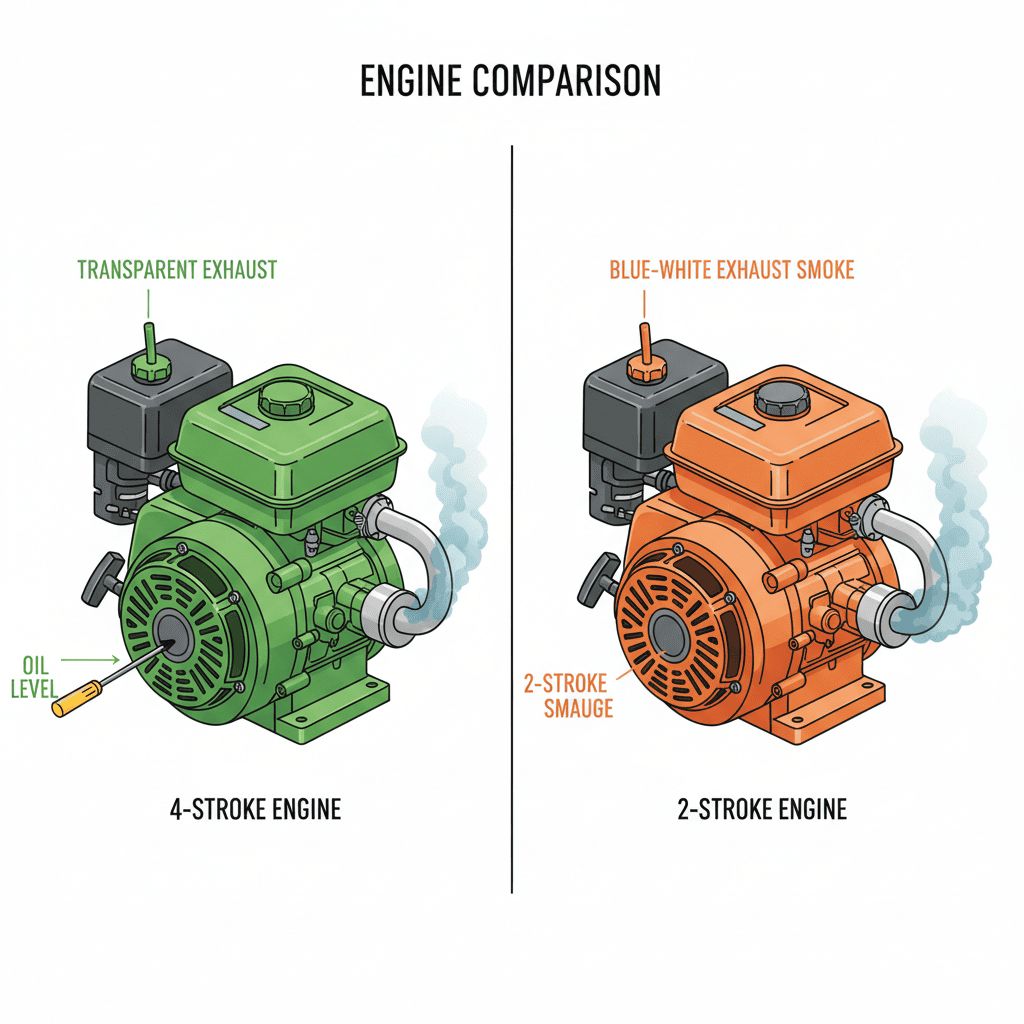
Before choosing oil, you need to identify whether your lawn mower has a 4-stroke or 2-stroke engine. This distinction is critical because the two engine types handle oil completely differently.
4-Stroke Engines (Most Common)
Four-stroke engines are found in most modern push mowers, riding mowers, and zero-turn mowers. These engines have a separate oil reservoir and require regular oil additions and changes, similar to a car engine. The oil circulates through the engine, lubricates internal components, and is drained during maintenance.
How to identify a 4-stroke:
- Has a visible oil dipstick or oil fill cap
- Produces cleaner exhaust with no blue smoke
- Does not require mixing oil into the fuel tank
- Typically quieter operation
2-Stroke Engines (Older or Specialty Equipment)
Two-stroke engines are less common in residential lawn mowers but found in some older models, handheld equipment, and specialty mowers. These engines burn oil as part of the fuel mixture rather than maintaining a separate oil reservoir.
How to identify a 2-stroke:
- No oil dipstick or separate oil compartment
- Produces visible blue/white exhaust smoke
- Requires mixing oil directly into the fuel tank
- Generally louder engine noise
- Owner’s manual specifies a fuel-to-oil ratio (commonly 50:1 or 40:1)
Oil Types and Specifications for 4-Stroke Mowers
Understanding SAE Grades
Oil viscosity is rated using the SAE (Society of Automotive Engineers) system. The number indicates the oil’s thickness—higher numbers mean thicker oil. For lawn mowers, you’ll most commonly encounter these specifications:
| Oil Grade | Best For | Temperature Range |
|---|---|---|
| SAE 30 | Warm climates; most common specification | Above 50°F (10°C) |
| 10W-30 | Cold climates; year-round use | -4°F to 100°F (-20°C to 38°C) |
| 5W-30 | Very cold climates | -22°F to 100°F (-30°C to 38°C) |
| SAE 10W | Cold-climate areas with short mowing seasons | Below 32°F (0°C) |
The “W” in 10W-30 stands for “winter.” The number before W indicates how the oil flows in cold temperatures, while the number after indicates viscosity at operating temperature. A 10W-30 oil flows like a 10-weight oil when cold but maintains the protection of a 30-weight oil when hot.
Conventional vs. Synthetic Oil
Both conventional and synthetic oils meet SAE specifications, but they differ in composition and performance:
Conventional Motor Oil
- Refined from crude oil
- Lower cost
- Adequate for most mowers; requires more frequent changes
- Typical change interval: every 50-100 hours of operation
Synthetic Motor Oil
- Chemically engineered for consistent performance
- Higher cost (2-3x more expensive)
- Superior performance in extreme temperatures
- Extended change intervals (up to 200+ hours for some newer mowers)
- Better oxidation resistance and engine protection
For older mowers or basic maintenance, conventional SAE 30 oil is perfectly adequate. Newer mower models, especially commercial or premium residential units, may specify synthetic or synthetic-blend oils for extended intervals and better performance.
How to Find Your Mower’s Oil Requirements
Check the Owner’s Manual
The most reliable source for oil specifications is your mower’s manual. Manufacturer recommendations account for engine design, climate recommendations, and warranty requirements.
To locate your manual:
- Check the physical manual if you have the original documentation
- Search the manufacturer’s website using your mower’s model number
- Visit sites like ManualsLib.com, which hosts free digital manuals for many brands
- Contact the manufacturer’s customer service with your model number
- Check the mower’s deck or engine housing for a label listing specifications
Locate the Oil Capacity
Oil capacity varies significantly by mower type:
- Push mowers: 15–20 oz (typically)
- Riding mowers: 32–48 oz
- Zero-turn mowers: 48–64 oz
- Commercial mowers: Specifications vary; consult manual
The oil fill cap or dipstick is usually located on top of or to the side of the engine. Some mowers have a dedicated oil sight glass showing minimum and maximum fill levels.
2-Stroke Mowers: Oil and Fuel Mixing
If you own a 2-stroke mower, you don’t add oil to a separate reservoir. Instead, you mix oil directly into the fuel tank at a specific ratio.
Common Fuel-to-Oil Ratios
The most common ratios are:
- 50:1 (1 part oil to 50 parts fuel) — Most common for modern 2-stroke mowers
- 40:1</strong (1 part oil to 40 parts fuel) — Older or high-performance 2-stroke equipment
Your manual will specify the exact ratio. Using the wrong ratio can damage the engine: too little oil causes inadequate lubrication and engine wear, while too much oil creates excessive smoke and carbon buildup.
Pre-Mixing Guide
To create the correct fuel-oil mixture:
For a 50:1 ratio (most common):
- 5 gallons of fuel + 12.8 oz of 2-stroke oil
- 1 gallon of fuel + 2.56 oz of 2-stroke oil
For a 40:1 ratio:
- 5 gallons of fuel + 16 oz of 2-stroke oil
- 1 gallon of fuel + 3.2 oz of 2-stroke oil
Best practice: Mix in a separate container before adding to the mower’s fuel tank. Shake or stir thoroughly to ensure even distribution.
Oil Types for 2-Stroke Engines
Use only 2-stroke engine oil, which is specifically formulated to burn cleanly in the combustion chamber. Do not use 4-stroke oil in a 2-stroke engine, as it will create excessive smoke and carbon deposits.
Climate and Seasonal Considerations
Cold Weather Oil Selection
If you’re in a climate where temperatures regularly drop below 50°F (10°C), use a multi-grade oil like 10W-30 instead of straight SAE 30. The lower viscosity at cold temperatures ensures the oil flows freely, allowing your mower to start more easily and ensuring proper engine lubrication during cold-weather startup.
Seasonal Oil Changes
If you store your mower during winter months:
- Change to appropriate oil before the last mowing of the season
- If using 10W-30, no change is necessary—it performs in both warm and cold conditions
- If using SAE 30 in a cold climate, switch to 10W-30 before winter storage
- Some users prefer changing back to SAE 30 in spring for optimal warm-weather performance, though this is optional
Step-by-Step: Checking and Changing Oil
Checking Oil Level
Check oil before each mowing session or at least weekly during the mowing season:
- Place your mower on level ground
- Locate the dipstick (usually has a yellow or orange handle)
- Pull the dipstick straight out and wipe clean with a paper towel
- Reinsert fully and pull out again to read the level
- Oil should be between the minimum and maximum marks
- If low, add small amounts of the correct oil type until it reaches the maximum mark
Never overfill: Too much oil can damage seals, create excessive smoke, and reduce engine performance.
Oil Change Intervals
Change frequency depends on mower type and oil type:
- Conventional oil (SAE 30 or 10W-30): Every 50-100 hours of operation or annually (whichever comes first)
- Synthetic oil: Every 100-200+ hours depending on mower specifications and oil quality
- First oil change on new mowers: After 5-10 hours to remove factory residue
How to Change Oil
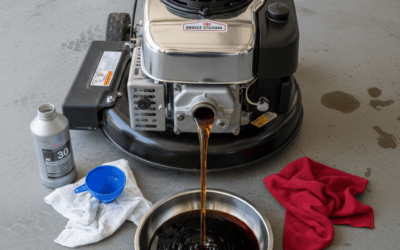
- Warm up the engine briefly (2-3 minutes) to thin the oil, then shut it off and wait 5 minutes
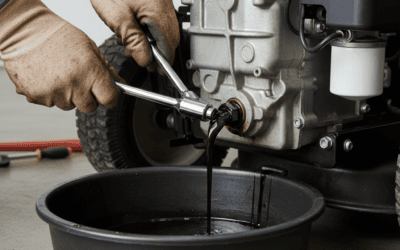
- Locate the drain plug (usually at the bottom of the engine or sump)
- Place a drain pan underneath to catch old oil
- Remove the drain plug carefully and let oil drain completely (10-15 minutes)
- Replace the drain plug and hand-tighten; do not over-tighten
- Remove and replace the oil filter if your mower has one (many small mowers do not)
- Add new oil slowly, checking the dipstick after each addition
- Fill to the maximum mark on the dipstick
- Run the engine for 1-2 minutes to circulate new oil, then shut off and wait 5 minutes
- Check the level again and top up if needed
- Dispose of old oil properly at a recycling center or auto parts store (never pour down drains)
Common Oil Mistakes to Avoid
- Using car engine oil in a lawn mower: While many mower manufacturers approve standard automotive motor oils, they’re formulated for different engine designs. Always follow your manual’s recommendation.
- Mixing 2-stroke and 4-stroke oils: Using the wrong type will damage your engine.
- Overfilling the oil reservoir: Excess oil causes smoke, seal damage, and poor engine performance.
- Ignoring the manual: Manufacturer specifications always take precedence over general guidance.
- Using old or contaminated oil: Oil breaks down over time and becomes less effective; replace according to your manual’s schedule.
- Storing the mower with old oil: Before winter storage, consider changing to fresh oil to prevent sludge buildup.
Frequently Asked Questions
Can I use 10W-30 instead of SAE 30 in my lawn mower?
In most cases, yes. If your manual specifies SAE 30, 10W-30 is often an acceptable alternative, especially if you live in a cooler climate or want year-round compatibility. However, always check your owner’s manual first. Some older or commercial mowers may require straight SAE 30 for optimal performance. If the manual says “SAE 30 only,” don’t substitute without contacting the manufacturer.
How much oil does a typical lawn mower hold?
Capacity depends on mower type: push mowers typically hold 15–20 ounces, riding mowers 32–48 ounces, and zero-turn mowers 48–64 ounces. Check your specific manual or the dipstick markings for exact capacity. Running low on oil can cause serious engine damage, so check levels regularly.
What if I can’t find my lawn mower’s manual?
Search the manufacturer’s website using your model number, which is usually stamped on the engine or mower frame. If that fails, visit ManualsLib.com or similar manual repositories. You can also contact the manufacturer directly with your model number, or visit an authorized dealer who can provide specifications. As a temporary measure, SAE 30 or 10W-30 will work in most 4-stroke mowers, but verify before relying on this long-term.
Is synthetic oil worth the extra cost for a lawn mower?
For homeowners with basic push or riding mowers used occasionally, conventional oil is perfectly adequate and significantly cheaper. Synthetic oil makes more sense if you: mow frequently (high operating hours), live in extreme temperatures, own newer equipment that specifies synthetic, or want to extend oil change intervals. For commercial or heavy-use equipment, synthetic oils provide better engine protection and justify the additional expense.