Quick Answer: What Oil Your Lawn Mower Needs
Most residential lawn mowers require SAE 30 motor oil (for warm climates) or 10W-30 (for variable temperatures). However, the correct oil type depends on three factors: your engine type (4-stroke or 2-stroke), your local climate, and your manufacturer’s specifications. The single most reliable source is your owner’s manual—it contains the exact viscosity grade and oil type your mower engine was designed to use. If you’ve lost your manual, you can find it online using your mower’s model number or contact the manufacturer directly.
Check Your Owner’s Manual First

Before buying any oil, your owner’s manual is the definitive authority on what your specific lawn mower requires. The manual lists the exact SAE viscosity grade, oil type (synthetic vs. mineral), and quantity needed for your engine.
How to locate oil specifications in your manual:
- Look in the maintenance or service section, typically labeled “Fuel and Oil” or “Engine Oil”
- Find your mower’s model number on the chassis or engine block
- Search for the manual online using the brand name and model number
- Contact the manufacturer’s customer service if you need clarification
If you’ve misplaced your manual, most manufacturers offer free digital downloads on their websites. Keeping this information handy prevents buying the wrong oil and ensures your engine operates correctly.
Understanding Oil Viscosity Grades: What SAE Numbers Mean
Oil viscosity refers to how thick or thin the oil is. The SAE (Society of Automotive Engineers) rating tells you the oil’s thickness at different temperatures. For lawn mowers, you’ll typically see single-grade oils like SAE 30 or multi-grade oils like 10W-30.
Common lawn mower oil grades explained:
| Oil Grade | Best For | Temperature Range |
|---|---|---|
| SAE 30 | Warm climates, consistent temperatures above 50°F | 50°F and above |
| 10W-30 | Variable climates, year-round use in temperate regions | Below 32°F to 100°F |
| 5W-30 | Cold climates, winter storage areas | Below 0°F to 100°F |
| SAE 10W | Very cold climates only | Below -4°F to 32°F |
The “W” in 10W-30 stands for “winter.” The number before the W indicates how the oil flows in cold temperatures; the number after indicates thickness at operating temperature. Multi-grade oils like 10W-30 adapt to temperature changes, making them suitable for most homeowners who mow in spring, summer, and fall.
4-Stroke vs 2-Stroke Engines: Different Oil Requirements
The type of engine in your lawn mower determines oil requirements more than anything else. Most modern residential lawn mowers use 4-stroke engines, but some older or specialty models use 2-stroke engines. These engines require fundamentally different oil systems.
4-Stroke Engine Oil Requirements
Four-stroke engines have a separate crankcase with an oil reservoir. Oil circulates continuously to lubricate moving parts. These engines require regular oil changes—typically every 50 to 100 operating hours, depending on the model.
- Use: SAE 30 or 10W-30 motor oil (small engine oil, not automotive oil)
- Oil capacity: Usually 0.5 to 1.5 quarts per engine
- Change interval: Every 50-100 hours of use or annually
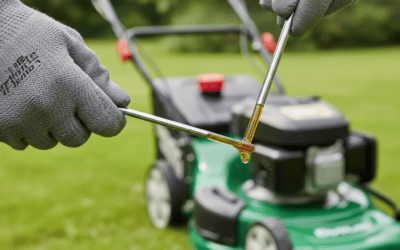
- Check level: Use the dipstick before each use
2-Stroke Engine Oil Requirements
Two-stroke engines do not have a separate oil system. Instead, you mix oil directly into the fuel tank at a specific ratio (typically 1 part oil to 50 parts fuel, though some use 1:32 or 1:25—always check your manual). The oil lubricates the engine as the fuel burns.
- Use: 2-stroke engine oil (different from 4-stroke oil), mixed with gasoline
- Oil-to-fuel ratio: Commonly 1:50, but verify in your manual
- No separate oil changes: The oil burns with the fuel
- No dipstick: You only need to mix oil into fresh fuel
How to identify your engine type:
- Check for an oil dipstick or fill cap on the engine (4-stroke)
- Look for a fuel tank with a fuel cap only (2-stroke)
- Consult your owner’s manual or the manufacturer’s website
Using the wrong oil type damages engines. Never use 2-stroke oil in a 4-stroke engine, and never use 4-stroke oil in a 2-stroke mower.
Synthetic vs Mineral Oil for Lawn Mowers
You’ll find both synthetic and mineral oil options for lawn mowers. The choice affects cost, performance, and maintenance intervals.
Mineral Oil
- Made from refined crude oil
- Lower upfront cost
- Requires more frequent changes (every 50 hours or annually)
- Adequate for most residential lawn mowers
- Thickens in cold weather, thinning in heat
Synthetic Oil
- Laboratory-engineered for consistent performance
- Higher upfront cost (2-3 times more than mineral)
- Longer drain intervals (some 4-stroke engines can go 100+ hours)
- Better cold-weather flow and heat resistance
- Benefits largest for high-use commercial mowers
For typical homeowners mowing once weekly, mineral oil meets all requirements and provides better value. Synthetic oil offers advantages if you operate your mower frequently or in extreme temperatures. Your owner’s manual may specify one type or allow either—follow the manufacturer’s guidance.
Climate and Seasonal Oil Selection
Temperature affects oil performance. Thicker oils (higher SAE numbers) are better in heat; thinner oils (lower SAE or W numbers) flow better in cold.
Warm climate recommendations (consistently above 50°F): SAE 30 performs well and costs less. Use throughout the mowing season without seasonal changes.
Variable/temperate climates (spring through fall use, 32°F to 90°F): 10W-30 handles temperature swings. Most homeowners in northern and central regions use 10W-30 for the entire season.
Cold climate recommendations (winter storage or pre-spring use): If you start your mower in early spring when temperatures are still cold, or if you use it year-round, 5W-30 or 5W-40 provide better cold-start performance. The lower “W” rating ensures the oil flows freely when the engine is cold.
Seasonal oil changes are rarely necessary for homeowners. Unless you store your mower indoors through winter and use it heavily in both spring and fall, one oil grade per year is sufficient. Commercial operations or those in extreme climates may change oil seasonally.
Small Engine Oil vs Automotive Oil: Why It Matters
Lawn mower engines require small engine oil, not standard automotive oil. While both are motor oils, small engine oil is specifically formulated for the higher RPMs and air-cooling systems of small engines.
Differences:
- Small engine oil: Contains additives for air-cooled engines; protects at higher temperatures
- Automotive oil: Designed for liquid-cooled, lower-RPM car engines; may cause deposits in small engines
Using automotive motor oil in a small engine can cause carbon buildup and shorten engine life. Always buy oil labeled “small engine oil” or “lawnmower oil.” These are readily available at hardware and garden stores.
How to Change Your Lawn Mower Oil
Regular oil changes keep your mower running smoothly. Here’s the basic process for 4-stroke engines:
What you need:
- The correct oil type and grade (from your manual)
- A wrench or socket for the drain plug
- A container for old oil disposal
- Rags or paper towels
- A funnel
Steps:
- Warm the engine by running it for a minute (warm oil drains faster)
- Disconnect the spark plug wire to prevent accidental starting
- Tilt or position the mower to access the drain plug
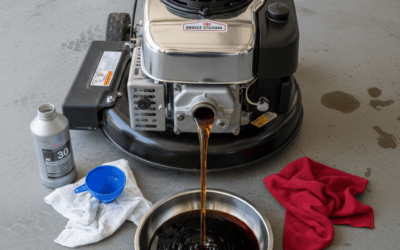
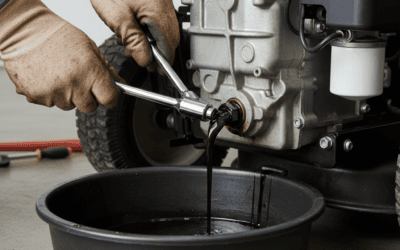
- Remove the drain plug and let old oil drain into a container (5-10 minutes)
- Wipe the drain plug clean and reinstall it snugly
- Locate the oil fill cap (usually on top of the engine)
- Use a funnel to pour new oil slowly until the dipstick shows “full”
- Wipe the dipstick, reinstall it, and recheck the level
- Reconnect the spark plug wire
Never overfill oil. Too much oil can damage the engine and cause smoking or loss of power. If you overfill, drain the excess until the level is correct.
Dispose of old oil responsibly. Most service stations and recycling centers accept used motor oil free or for a small fee. Never pour it down drains or into the ground.
Common Oil Mistakes to Avoid
- Using automotive motor oil: Always use small engine oil formulated for lawnmowers
- Overfilling the crankcase: Follow the dipstick markings; more oil isn’t better
- Neglecting regular checks: Check oil levels before each use to prevent running low
- Mixing oil types: Don’t switch between mineral and synthetic mid-season or mix brands
- Using 4-stroke oil in 2-stroke engines: This causes severe engine damage; always verify your engine type
- Running on old oil: Follow the recommended change interval (typically 50-100 hours annually)
Frequently Asked Questions
Can I use 10W-40 or other grades not in my manual?
No. Your manual specifies the viscosity grade your engine was engineered for. Using a different grade can affect lubrication, cooling, and engine performance. Some manufacturers permit a range (e.g., “SAE 30 or 10W-30”), but never deviate beyond what your manual allows.
What if my lawn mower is very old and I can’t find the manual?
Search online using your mower’s brand and model number—most manufacturers provide free digital manuals. If unavailable, contact the manufacturer’s customer service with your model number. As a fallback, SAE 30 is the standard for most vintage residential mowers. When in doubt, consult a small engine repair shop.
How often should I check my oil level?
Check the oil level before each use, especially at the start of the season. This takes 30 seconds and prevents running on low or empty oil, which causes rapid engine wear. Always check when the engine is cold and on level ground for an accurate reading.
Can I use the same oil for my lawn mower, snow blower, and other small engines?
Yes, if all your small engines are the same type (4-stroke or 2-stroke) and your manual permits it. SAE 30 or 10W-30 small engine oil works for most 4-stroke equipment. However, always verify each manual—some engines have specific requirements or prohibitions (e.g., some require synthetic, others forbid it).
Key Takeaways
Your lawn mower’s oil type is determined by three factors: engine type (4-stroke vs 2-stroke), climate, and manufacturer specifications. Most homeowners use SAE 30 or 10W-30 small engine oil in 4-stroke mowers. Always consult your owner’s manual first—it’s the definitive guide for your specific model. Regular oil checks and changes keep your engine running efficiently and extend its lifespan. When in doubt about oil type, contact the manufacturer or a small engine specialist.