Direct Answer: A reciprocating saw is a versatile power tool that uses a push-and-pull (reciprocating) motion of a blade to cut through a variety of materials, including wood, metal, plastic, and drywall, making it ideal for demolition, pruning, and rough cutting tasks. Its handheld design and aggressive cutting action make it the go-to tool for contractors and homeowners tackling demolition work, remodeling projects, and challenging cuts that other saws struggle to handle.
What Is a Reciprocating Saw and How Does It Work?
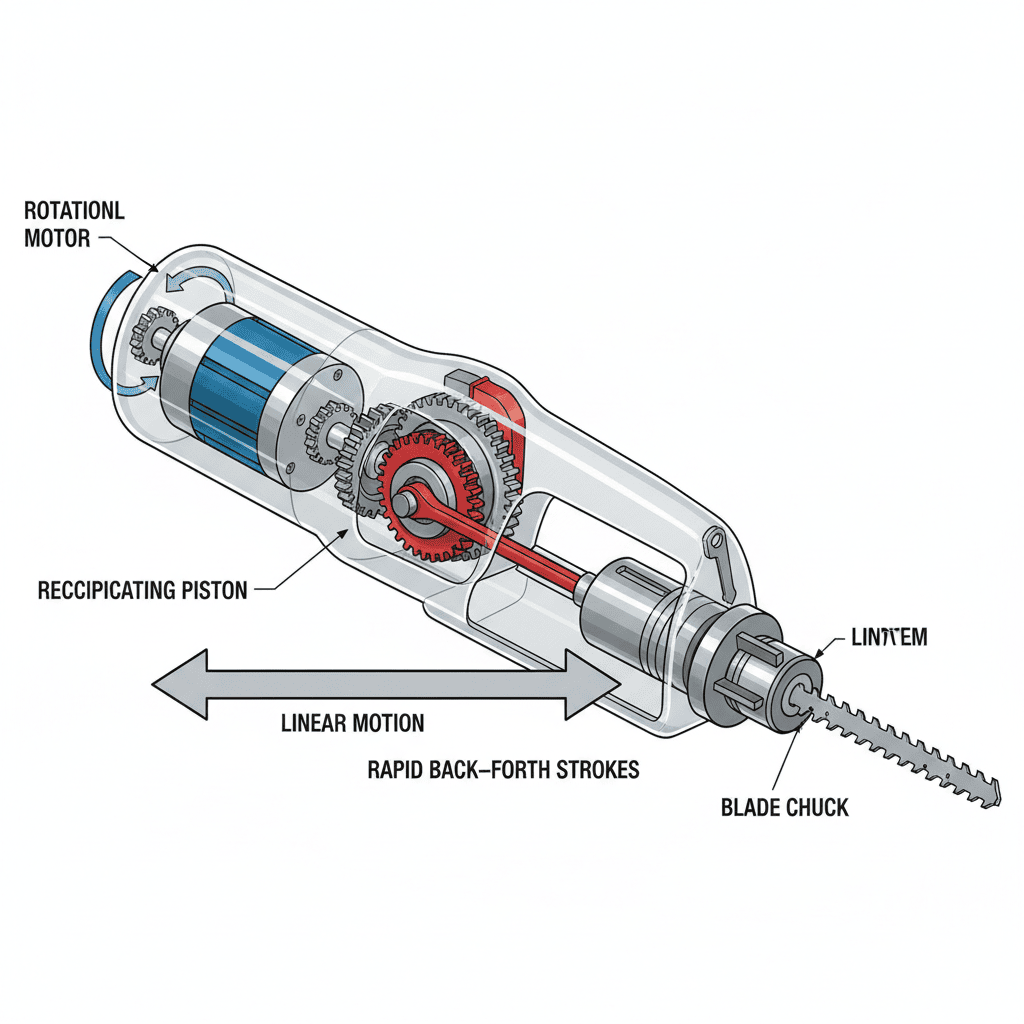
A reciprocating saw, often called a “reciprocating saw” or commonly referred to by the brand name “Sawzall,” is a handheld power tool designed for cutting through tough materials quickly. The tool operates by converting rotational motor energy into rapid, linear back-and-forth blade motion—this is where the name “reciprocating” comes from. The blade moves at speeds typically ranging from 2,500 to 3,000 strokes per minute, delivering aggressive, efficient cuts.
The fundamental mechanism is straightforward: the motor drives a piston that pushes and pulls the blade in a linear motion while you guide the tool along your cutting line. This push-and-pull action is what distinguishes a reciprocating saw from rotary tools like circular saws. The blade is held in a chuck at the front of the tool, and you can swap blades quickly to match different materials and cutting needs.
Reciprocating saws are designed to cut through an impressive range of materials:
- Wood: Including framing lumber, thick beams, branches, and tree limbs
- Metal: Steel pipes, aluminum, copper, and sheet metal with the right blade
- Plastic: PVC pipes, plastic sheets, and composite materials
- Drywall: Wallboard and plasterboard
- Masonry: Concrete, brick, and stone (with specialized blades)
Their lightweight, handheld design makes them portable and easy to maneuver, especially in tight spaces where larger stationary saws won’t fit. Most reciprocating saws weigh between 7 and 10 pounds, allowing for extended use without excessive fatigue.
Primary Uses and Common Applications
The reciprocating saw earns its reputation as a workhorse tool because it excels in situations where other saws fall short. Understanding where to use one is key to working efficiently on various projects.
Demolition Work
Demolition is perhaps the most iconic use for a reciprocating saw. When contractors need to tear down walls, remove old cabinets, or strip out plumbing and electrical fixtures, the reciprocating saw’s aggressive cutting action makes quick work of the job. Its ability to cut at any angle—horizontally, vertically, or overhead—and to handle multiple materials in a single project makes it invaluable during renovation and demolition phases. The tool’s cutting speed means fewer strokes and less time spent on destructive tasks.
Construction and Remodeling
In construction environments, reciprocating saws handle rough cutting tasks that require speed over precision. Carpenters use them to cut wall openings for windows and doors, trim door frames, and make rough cuts in framing lumber. Unlike a circular saw that requires a flat surface for proper operation, a reciprocating saw can cut in confined spaces, against edges, and in positions where other saws cannot reach. This makes it essential for remodeling work where existing structures limit tool placement.
Pruning and Landscaping
Reciprocating saws are highly effective for outdoor pruning and landscaping tasks. Landscapers use them to trim tree limbs, remove fallen branches, and cut thick vegetation. The tool is particularly useful for cutting branches that are too thick for handheld pruners but still within the reciprocating saw’s capability. Some models are designed specifically for outdoor work and feature weather-resistant components.
Plumbing and Electrical Work
When plumbers and electricians need to cut through pipes, conduit, and structural materials to route their lines, a reciprocating saw provides the speed and versatility they need. It can cut through metal pipes, PVC, and framing materials without needing to reposition the tool or change your approach. This makes it faster than setting up a more traditional saw or using handheld cutting tools.
Salvage and Recycling
The reciprocating saw’s ability to cut through mixed materials makes it ideal for salvage operations where you need to separate different components. Whether cutting through metal fasteners embedded in wood or separating materials in salvage operations, the reciprocating saw handles the job efficiently.
Key Features That Differentiate It from Other Saws
Understanding how a reciprocating saw compares to other common saw types helps explain why contractors and homeowners choose it for specific jobs.
Reciprocating Saw vs. Circular Saw
A circular saw uses a rotating blade that spins in a circle, ideal for straight, crosscutting rips through dimensional lumber. The circular saw requires a stable work surface and is best for projects requiring straight, precise cuts. In contrast, a reciprocating saw uses push-and-pull blade motion and excels at cutting at various angles without needing a flat surface. The reciprocating saw sacrifices precision for versatility and aggressive cutting power, making it better for demolition and rough work where a circular saw would be limiting.
Reciprocating Saw vs. Jigsaw
A jigsaw features a small, fine-toothed blade that moves in a push-and-pull motion and is designed for curved, intricate cuts in thinner materials. Jigsaws are precision tools for detailed work like cutting curves in plywood or making decorative cuts. Reciprocating saws have larger, coarser blades and are built for raw power and speed, not precision. A reciprocating saw would be excessive for jigsaw work, just as a jigsaw would be inadequate for cutting through thick beams or demolition tasks.
Lightweight and Handheld Design Advantages
The lightweight, handheld design of a reciprocating saw provides significant advantages:
- Portability: Easy to carry up ladders, into tight spaces, and between job sites
- One-Handed Operation (in some cases): Smaller models can be operated with one hand, freeing your other hand to hold materials or stabilize your position
- Overhead Cutting: You can hold a reciprocating saw above your head to cut ceiling materials or overhead framing without needing a stable work platform
- Tight Space Access: Where larger stationary saws cannot fit, a handheld reciprocating saw can access confined areas like crawlspaces, between studs, or inside walls
Why the Brand Name “Sawzall” Stuck
Milwaukee Electric Tool introduced the reciprocating saw in 1951 under the brand name “Sawzall,” and the name became so associated with the tool type that many people use it generically, similar to how “Kleenex” is used for tissues. The Sawzall brand name became synonymous with the reciprocating saw category because Milwaukee was the original innovator and market leader. Today, many manufacturers make reciprocating saws, but the Sawzall name persists in casual conversation and jobsite vocabulary.
What to Consider When Using a Reciprocating Saw
Effective and safe use of a reciprocating saw requires understanding blade selection, safety practices, and advanced features that enhance performance.
Choosing the Right Blade for Different Materials
The blade is critical to the reciprocating saw’s performance. Different materials require different blade characteristics:
| Material | Blade Type | Teeth Per Inch (TPI) | Considerations |
|---|---|---|---|
| Wood | Wood-cutting blade | 6-10 TPI | Coarser teeth for faster cutting; expect rougher edges |
| Metal | Metal-cutting blade | 14-32 TPI | Finer teeth; cut slower to avoid overheating; use cutting fluid |
| Plastic/PVC | Fine-tooth blade | 14-18 TPI | Prevents melting and chipping; slower feed speed recommended |
| Drywall | Coarse blade | 6-8 TPI | Fast cutting; blades wear quickly on drywall due to abrasiveness |
| Concrete/Masonry | Carbide-grit blade | Varies | Specialized blade; slower cutting speed; generates significant dust |
Blade length also matters—longer blades are necessary when you need to cut through thicker materials or when you’re working in confined spaces where the motor housing cannot get close to your cutting line. Most reciprocating saw blades range from 4 to 12 inches long.
Safety Considerations
Operating a reciprocating saw safely requires attention to several key practices:
- Secure Your Workpiece: Always clamp or stabilize materials before cutting to prevent the tool from pushing the material or binding unexpectedly
- Maintain Firm Grip: Use both hands on the tool (with corded models) or maintain a secure grip to control the tool’s movement and prevent accidental contact with the blade
- Wear Appropriate PPE: Safety glasses protect against flying debris; ear protection guards against noise from the motor and blade; work gloves provide grip and protection
- Check for Obstructions: Before cutting, identify what’s behind or inside the material—hidden nails, electrical wires, or pipes can cause injury or property damage
- Let the Tool Do the Work: Don’t force the saw through material; excessive pressure can cause tool stalling or binding, which can jerk the tool unexpectedly
- Keep Hands Clear: Your hands should never be directly in line with the blade; position yourself to the side of the cutting line
Understanding Orbital Action
Many modern reciprocating saws feature “orbital action,” which adds a slight side-to-side or curved motion to the blade’s push-and-pull stroke. This orbital motion helps the blade clear sawdust more effectively and increases cutting speed, particularly in wood. Orbital action typically offers multiple settings (often labeled 0-3 or Low-High):
- No Orbital Motion (0): Pure back-and-forth motion; best for metal and plastic where a cleaner, more controlled cut is needed
- Low Orbital (1): Slight orbital motion; good for composite materials and when you want a balance of speed and finish
- Medium Orbital (2): Good general-purpose setting for mixed-material demolition work
- High Orbital (3): Maximum cutting speed; best for thick wood where cutting speed is prioritized over surface finish
Higher orbital settings create more aggressive cutting and faster blade wear, so adjust the setting based on your material and desired finish quality.
Power Source Options: Corded vs. Cordless
Reciprocating saws are available in both corded and cordless (battery-powered) versions, each with distinct advantages:
Corded Models: Provide unlimited runtime and consistent power without battery management concerns. They’re typically less expensive and are ideal for extended demolition work or jobsite use where you’re near power outlets. The trade-off is reduced portability due to the power cord.
Cordless Models: Offer superior portability and freedom of movement, making them ideal for climbing ladders, working in tight spaces, or moving between multiple locations. Modern lithium-ion batteries provide sufficient power for most residential tasks, though runtime depends on the battery capacity and cutting intensity. Battery-powered models are more expensive upfront but eliminate cord management hassles.
Frequently Asked Questions
Can a reciprocating saw be used for detail work or precision cuts?
A reciprocating saw is not designed for precision or detail work. Its aggressive blade motion, minimal blade stability, and design focus on speed over accuracy make it unsuitable for detailed projects. For detail work requiring curved cuts or fine edges, a jigsaw or band saw is the appropriate choice. A reciprocating saw is a “rough cutting” tool meant for speed and versatility, not precision.
What is the difference between a reciprocating saw blade length?
Blade length affects how deep you can cut and how close the tool’s housing can get to your cutting line. Longer blades (8-12 inches) allow you to cut through thicker materials and reach cutting lines far from the tool’s motor housing. Shorter blades (4-6 inches) are more maneuverable in tight spaces and more rigid, resulting in less vibration and straighter cuts. Your choice depends on your specific application: use longer blades for deep cuts and shorter blades for confined spaces where precision matters.
Are reciprocating saws good for cutting metal?
Yes, reciprocating saws are effective at cutting metal when you use the right metal-cutting blade with fine teeth (14-32 TPI) and operate the tool at slower feed speeds. Metal cutting generates significant heat, so you should use cutting fluid to cool the blade and extend its life. The cut will be slower than cutting wood, but a reciprocating saw is still faster than using a handheld hacksaw for similar tasks. Metal-cutting blades wear faster than wood-cutting blades, so plan for more frequent blade changes.
What maintenance does a reciprocating saw require?
Basic maintenance includes keeping the tool clean of sawdust and debris, checking the blade chuck for wear and proper blade seating, and inspecting the power cord (for corded models) for damage. For cordless models, maintain the battery according to manufacturer instructions—avoid completely draining batteries and store them in a cool, dry place. Replace blades when they become dull or damaged; a dull blade requires excessive pressure and generates unnecessary heat. Periodically check that all fasteners remain tight, as vibration can loosen components over time.