What Is the Best Commercial Zero Turn Mower for Your Business?
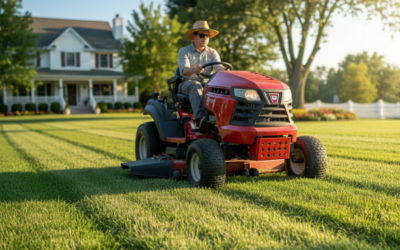
The best commercial zero turn mower depends on your operation’s scale, property types, and budget. For small residential contractors ($8k–$12k), mid-deck models (48–52″) from Hustler or Toro offer durability and maneuverability on varied terrain. Mid-size landscapers ($12k–$18k) benefit from 60–72″ decks with commercial-grade engines (23–28 HP) that sustain 8–10 hours of daily operation. Large grounds maintenance services ($18k–$30k+) should prioritize 72–96″ zero turns with advanced suspension, fuel efficiency (4–6 hours per tank), and extended warranties (3–5 years). The key is matching deck width, hourly fuel costs, turning radius, and dealer support to your typical workload.
What Makes a Zero Turn Mower “Commercial”?
Commercial zero turn mowers differ from residential models in several fundamental ways. Residential mowers are designed for occasional use—typically 5–10 hours per week—with engines rated for 500–1,000 annual operating hours. Commercial models are engineered for daily operation, often 8–12 hours per day, with engine lifespans exceeding 2,000–3,000 hours.
Engine power is the first distinction. Residential zero turns typically run 15–20 HP; commercial models start at 23 HP and extend to 32 HP or more. This extra horsepower drives larger cutting decks (60″–96″ versus 42″–54″) and supports sustained operation on tougher grass, dense weeds, and uneven terrain without engine strain.
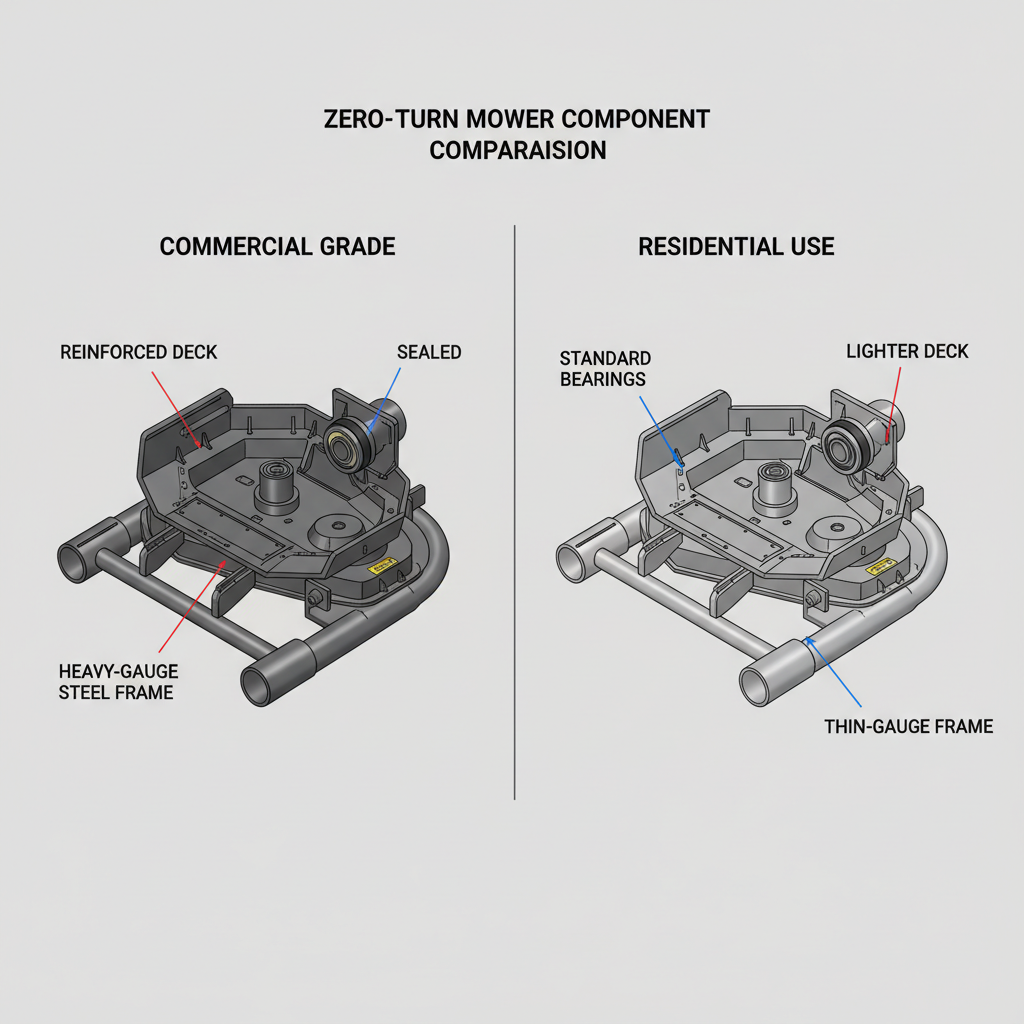
Frame and drivetrain durability set commercial units apart. Commercial zero turns feature reinforced decks, heavier-gauge steel, sealed bearings, and commercial-grade hydrostatic transmissions designed to cycle thousands of times daily without failure. Residential models use lighter components optimized for lower duty cycles.
Warranty coverage reflects this durability gap. Residential mowers typically carry 2-year warranties; commercial models offer 3–5 year warranties on engines and frames, signaling manufacturer confidence in longevity.
Key Factors to Consider Before Buying
Cutting Width and Property Size
Cutting deck width directly affects productivity and profitability. A 48″ deck requires significantly more passes than a 72″ deck on a 2-acre property, increasing fuel consumption, labor time, and wear. However, wider decks sacrifice maneuverability in confined spaces, tight between shrubs, and on narrow residential lots.
Small contractors (residential properties under 1 acre) typically use 48–52″ decks, balancing speed with the ability to navigate driveways and around obstacles.
Mid-size landscapers (1–5 acre properties) favor 60–66″ decks as a sweet spot: they maintain reasonable maneuverability while cutting mowing time by 30–40% compared to 48″ decks.
Large grounds services (5+ acres, golf courses, municipalities) deploy 72–96″ decks to maximize pass efficiency, though these require wider property gates and open layouts.
Daily Operating Hours and Fuel Efficiency
Commercial mowers must sustain consistent performance across 8–10 hour workdays. Fuel consumption is a direct cost multiplier: a mower burning 1.5 gallons per hour at $3.50/gallon costs $5.25 per operating hour in fuel alone. Over a 1,000-hour season, that’s $5,250—a material difference between profitability and loss.
Most commercial zero turns burn 0.8–1.5 gallons per hour depending on engine size, terrain, and mowing speed. Larger decks and higher horsepower increase consumption, but efficiency gains (fewer passes, less idling) often offset this on spacious properties. Fuel tank capacity ranges from 6 gallons (48″ models) to 12–16 gallons (72″+), typically providing 4–8 hours of runtime before refueling.
Calculate hourly operating costs by dividing fuel cost per gallon by your mower’s fuel consumption rate. Brands like Kubota and Toro are known for fuel-efficient engines; budget accordingly if your operation runs tight margins.
Turning Radius and Maneuverability
Zero turn mowers can pivot on their axis—turning radius is typically 0″ for premium models. However, real-world maneuverability depends on deck overhang, frame geometry, and operator control sensitivity. A 72″ deck with a 20″ overhang effectively occupies 20″ more space sideways than a 60″ model, critical when trimming between trees or navigating narrow gates.
Test-drive machines before purchasing if possible. Tight radius capability matters on residential lots; less so on sprawling commercial grounds.
Warranty and Manufacturer Support
Commercial warranties typically cover engine, transmission, and frame for 3–5 years or a set number of hours (e.g., 1,500 hours). Deck and wear items often carry shorter coverage. A comprehensive warranty reduces downtime risk—critical for contractors who lose revenue when equipment fails mid-season.
Equally important: dealer proximity and parts availability. A $15,000 mower sitting idle awaiting service parts costs far more than premium warranty pricing. Research local John Deere, Kubota, Toro, and Hustler dealers before buying to confirm parts stock and service turnaround times.
Commercial Zero Turn Mower Selection by Business Scale
Small Residential Contractors (Under 1 Acre per Property)
Specs: 48–52″ deck, 18–23 HP, 4–6 gallon fuel tank, $8,000–$12,000
Why it fits: Smaller decks maneuver easily around residential obstacles—driveways, landscaping beds, parked cars—where larger machines create damage risk. These models sustain 6–8 hour workdays comfortably, handle varied grass density, and fit in standard trailers and sheds.
Operating advantage: Fuel costs remain modest ($4–6 per hour), and initial capital is manageable for owner-operators or small crews. Resale value holds relatively well due to broad market appeal.
Mid-Size Landscaping Companies (1–5 Acres per Property)
Specs: 60–66″ deck, 23–28 HP, 8–10 gallon fuel tank, $12,000–$18,000
Why it fits: These models are the productivity workhorses. A 60″ deck cuts mowing time by approximately 25% versus a 48″ model on open areas, while retaining enough maneuverability for most residential and small commercial properties. Fuel consumption remains economical at 1.0–1.2 gallons per hour, supporting cost-effective hourly rates.
Operating advantage: Mid-deck models balance speed and precision, enabling crews to service more properties per day without sacrificing quality. They handle dense fescue and transition zones between mowed and unmowed areas reliably.
Large Grounds Maintenance Services (5+ Acres)
Specs: 72–96″ deck, 25–32 HP, 12–16 gallon fuel tank, $18,000–$30,000+
Why it fits: These machines are engineered for high-volume production on open terrain—golf courses, sports fields, municipal parks, and large commercial campuses. A 72″ deck reduces passes by 50% compared to a 48″ model, proportionally cutting labor hours and fuel burn on a per-acre basis.
Operating advantage: Hourly productivity gains justify the premium purchase price. On 10+ acre properties, fuel cost per acre often drops despite higher consumption, because efficiency gains dominate. Advanced suspension and heavier frames absorb terrain shock, reducing maintenance wear.
Durability, Maintenance, and Total Cost of Ownership
Engine lifespan: Commercial zero turn engines, properly maintained, typically deliver 2,000–3,500 operating hours before major overhaul is required. This translates to 5–7 seasons for a 400–500 hour per-season operation (small contractor) or 2–4 seasons for 1,000+ hour operations (large grounds service).
Routine maintenance: Commercial mowers require oil and filter changes every 50–100 hours, air filter inspections every 25–50 hours, and blade sharpening or replacement every 10–25 hours depending on grass type and debris. Budget 2–4 hours of maintenance per 100 operating hours—critical to prevent catastrophic failures.
Wear items: Belts, bearings, and seals degrade with use. Commercial decks are subject to impact from rocks, stumps, and debris. Budget 5–10% of the mower’s purchase price annually for wear-item replacement and repairs. A $15,000 machine may require $750–$1,500 in annual maintenance.
Total cost of ownership (TCO): Calculate TCO over 5 years by adding purchase price, annual maintenance, fuel (based on hours per season), and depreciation. A $12,000 mid-deck mower might total $25,000–$30,000 in TCO over 5 years. A $20,000 large-deck model might total $35,000–$45,000. Divide by acres serviced to assess profitability; efficient mowers reduce hourly costs, supporting higher profit margins.
Fuel Efficiency and Hourly Operating Costs
| Mower Class | Deck Width | Typical HP | Fuel Consumption (gal/hr) | Hourly Fuel Cost* ($3.50/gal) |
|---|---|---|---|---|
| Small Contractor | 48–52″ | 18–23 | 0.9–1.1 | $3.15–$3.85 |
| Mid-Size Landscaper | 60–66″ | 23–28 | 1.0–1.3 | $3.50–$4.55 |
| Large Grounds Service | 72–96″ | 25–32 | 1.2–1.6 | $4.20–$5.60 |
*Hourly fuel cost assumes $3.50/gallon diesel or gasoline. Actual costs vary by fuel type, region, and engine efficiency.
Fuel efficiency varies significantly between brands. Kubota engines are known for fuel economy; Briggs & Stratton engines in commercial models typically consume slightly more but offer competitive pricing. Hybrid or eco-mode features on premium models can reduce consumption by 10–15%, meaningful on 1,000+ hour seasons.
Dealer Support and Resale Value
Dealer availability: John Deere, Kubota, and Toro operate the broadest dealer networks across the U.S., typically offering same-day or next-day parts and 5-day service turnaround. Hustler and Bobcat dealers are regionally concentrated; verify local availability before committing to an unfamiliar brand.
Resale value: Commercial zero turns retain 40–60% of purchase price after 5 years, depending on condition, hours, and brand reputation. John Deere and Kubota models typically hold value better due to brand recognition and dealer availability. Well-maintained 48–66″ models with under 1,500 hours often sell for $8,000–$12,000 on secondary markets.
Parts cost: Replacement decks, belts, and bearing kits vary widely. Budget $200–$600 for a deck repair, $50–$150 for belt replacement, and $100–$300 for transmission servicing. Brands with extensive dealer networks typically offer better parts pricing due to competition.
How to Choose: Decision Framework
Step 1: Define your typical property size and workload. Average property size (under 1 acre, 1–5 acres, or 5+ acres) determines ideal deck width.
Step 2: Calculate seasonal operating hours. If you mow 40 properties at 2 hours each per week for 25 weeks, that’s 2,000 annual hours—requiring a durable, fuel-efficient model.
Step 3: Set budget and warranty expectations. Determine capital available and acceptable payback period (typically 3–5 years for commercial equipment).
Step 4: Verify local dealer support. Visit dealerships, check parts inventory, and ask about service turnaround times.
Step 5: Test-drive finalists. Operate multiple models on varied terrain to assess comfort, control, and maneuverability.
Step 6: Compare total cost of ownership. Factor in purchase price, warranty, estimated maintenance, and fuel costs over 5 years to identify true value.
Frequently Asked Questions
Q: What’s the difference between a commercial zero turn and a residential model?
A: Commercial models feature reinforced frames, higher-horsepower engines (23+ HP), larger decks (60–96″), extended warranties (3–5 years), and durability rated for 2,000+ operating hours. Residential mowers are lighter-duty, designed for occasional use (500–1,000 hours annually), with 15–20 HP engines and 42–54″ decks. Commercial models cost 40–60% more but deliver 2–3x the lifespan under heavy use.
Q: What size deck do I need for my landscaping business?
A: Match deck width to typical property size and terrain. Under 1 acre: 48–52″ (residential contractor standard). 1–5 acres: 60–66″ (mid-size landscaper productivity sweet spot). 5+ acres: 72–96″ (large grounds service efficiency threshold). Wider decks reduce mowing time but sacrifice maneuverability. Test-drive multiple sizes before deciding.
Q: How much should I budget for annual maintenance?
A: Plan for 5–10% of the mower’s purchase price annually. A $15,000 machine should budget $750–$1,500 for oil changes, filter replacements, blade sharpening, belt service, and bearing maintenance. Neglecting routine maintenance can halve equipment lifespan and create costly downtime during peak season.
Q: Which commercial zero turn brands have the best dealer support?
A: John Deere, Kubota, and Toro operate the broadest U.S. dealer networks, offering reliable parts availability and service. Hustler and Bobcat are strong but regionally concentrated. Verify local dealer proximity and parts stock before purchasing an unfamiliar brand, as downtime costs significantly exceed warranty savings from discount brands.