Quick Answer: Husqvarna 445 vs Husqvarna 455 Rancher, Which Should You Buy in 2026?
Choose the Husqvarna 445 if you mainly cut firewood, trim trees, and want a more manageable gas saw for $449. The Husqvarna 455 Rancher costs $589, or $140 more, but gives you a larger 55-cc engine, 3.5 horsepower, and a 20-inch bar for heavier cutting and land clearing. For occasional homeowner work, the 445 is the better value; for larger logs and repeated demanding cuts, the 455 Rancher is worth the premium.

Pros
- Strong gas-powered performance for cutting branches, logs, and general property maintenance.
- Efficient X-Torq engine helps reduce fuel use and emissions compared with standard two-stroke designs.
- Smart Start and combined choke/stop controls simplify startup and reduce flooding risk.
- Ergonomic handling features improve control for users working with recommended 13 to 20-inch bars.
Cons
- As a gas chainsaw, it requires fuel, two-cycle oil, and regular engine maintenance.
- The 18-inch size may be more tool than occasional users need for very light trimming tasks.
- The product data does not list exact weight, dimensions, or included accessories, which can make comparison harder.
Overview & Design: The Husqvarna 445 is an 18-inch gas chainsaw designed for wood cutting and tree trimming. It uses a slimmer saw body for easier handling, and the overall layout focuses on mobility, control, and practical everyday use.
Performance & Key Features: Its 50-cc, 2.8-HP X-Torq engine provides solid cutting power while improving fuel efficiency and reducing emissions. Smart Start, the combined choke/stop control, Air Injection technology, and the inertia-activated chain brake are all aimed at easier operation, cleaner performance, and added safety.
Drawbacks & Considerations: This is a gas-powered saw, so it is less convenient than a cordless option for users who want minimal maintenance. The 18-inch format is versatile, but it may be more than some casual homeowners need for light-duty pruning.
Verdict: The Husqvarna 445 is best for homeowners, landowners, and DIY users who want dependable gas-powered cutting performance with easier handling features. It offers a strong mix of power, safety, and efficiency, but buyers should be comfortable with gas engine upkeep.

Pros
- Strong 3.5-HP X-Torq engine delivers reliable power for demanding outdoor cuts
- Smart Start and ergonomic grip make the saw easy to start and maneuver
- Air Injection system helps prolong engine life by keeping the filter cleaner
- Safety-focused inertia chain brake and LowVib design reduce user fatigue and risk
- Automatic oiler supports consistent operation without frequent manual lubrication
Cons
- As a 2-cycle gas engine it requires fuel mixing and more regular maintenance than electric alternatives
- Limited to recommended bar lengths of 13 to 24 inches which may not suit all heavy-duty needs
- Gas-powered design produces typical noise and emissions associated with 2-cycle chainsaws
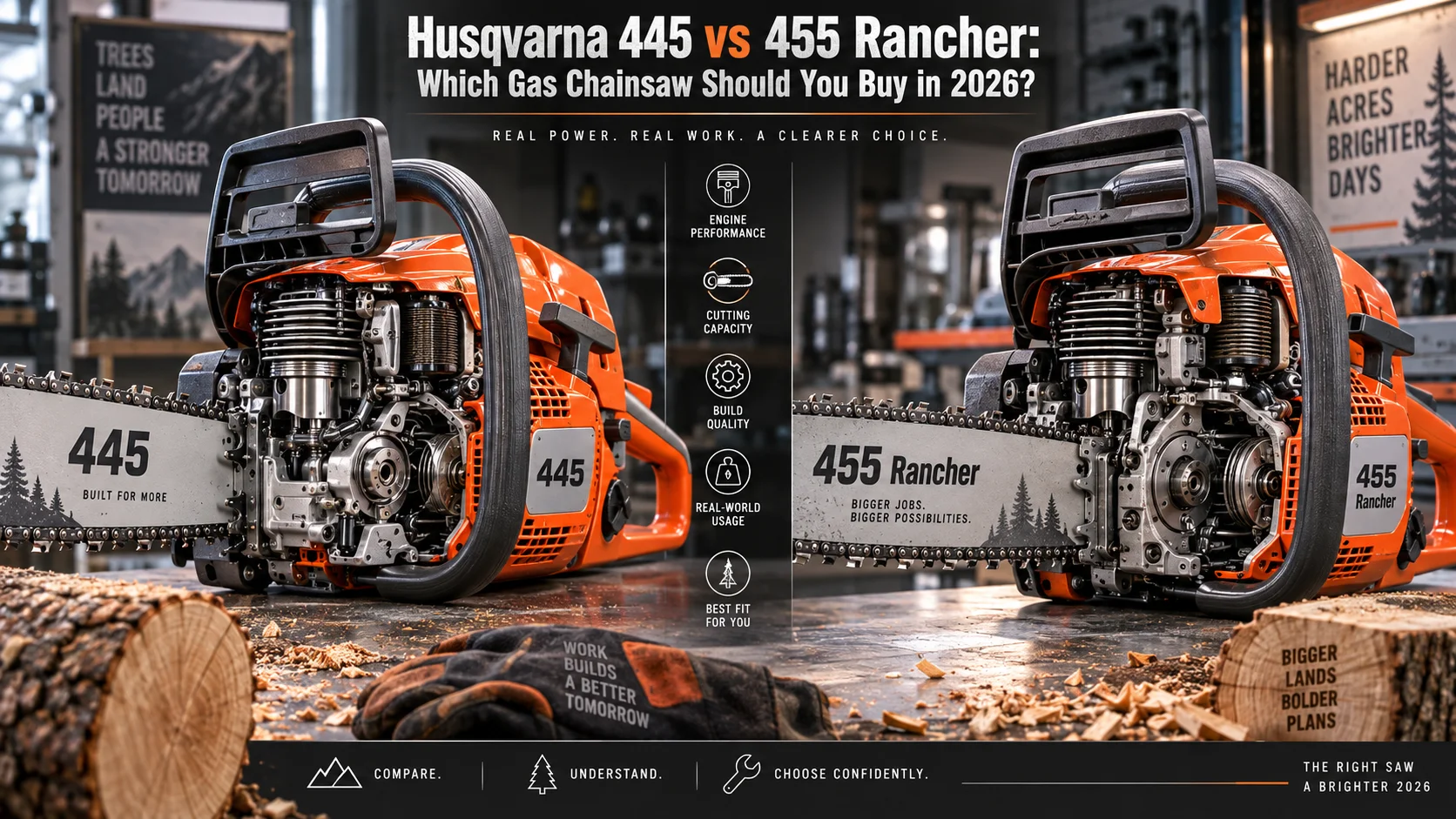
The Husqvarna 455 Rancher is a gas-powered handheld chainsaw built around a 55-cc 3.5-HP 2-cycle X-Torq engine paired with a 20-inch bar. Its design emphasizes ergonomic handling with a 7 degree offset front handle and improved grip for better mobility during wood cutting, tree trimming and land clearing. The overall build focuses on combining power with user-friendly features for both residential and more demanding outdoor work.
In performance the patented X-Torq engine technology maximizes power output even at low RPMs while Smart Start allows quick and easy ignition with minimal effort. The centrifugal Air Injection system expels larger dust and debris particles before they reach the filter to support longer engine life. An automatic oiler keeps the chain lubricated during use and LowVib technology with dampeners reduces vibrations for smoother handling across recommended 13 to 24-inch bars. The inertia-activated chain brake further enhances safety by limiting kickback risks.
Potential drawbacks stem from the 2-cycle gas engine which requires proper fuel mixing and ongoing maintenance that electric models avoid. The saw is optimized only for bar lengths between 13 and 24 inches so users needing longer bars will find it restrictive. As with most gas chainsaws it also generates more noise and emissions than battery-powered options.
Overall the Husqvarna 455 Rancher delivers strong value for homeowners, property owners and professionals who need a capable gas chainsaw for medium to heavy outdoor cutting tasks. It is especially well suited as a reliable tool for land clearing and tree work or as a practical gift for men who tackle yard and property maintenance.
Winner by Category
| Category | Winner | Evidence |
|---|---|---|
| Power/Suction | Husqvarna 455 Rancher | The 455 Rancher has a 55-cc, 3.5-HP engine, compared with the 445’s listed 50-cc, 2.8-HP engine. |
| Cutting performance | Husqvarna 455 Rancher | The 455 includes a 20-inch bar and is intended for wood cutting, tree trimming, and land clearing. The 445 comes with an 18-inch bar and is aimed at wood cutting and tree trimming. |
| Navigation/Ease of use | Tie | Both use Smart Start, an automatic oiler, and an inertia-activated chain brake. The 445’s slimmer body favors mobility, while the 455 is designed with ergonomic handling features. |
| Vibration/Handling | Husqvarna 445 | The 445 is described as having a slimmer saw body for easier handling and mobility. Both models include vibration damping in the available Rancher comparison data. |
| Runtime/Fuel efficiency | Tie | Both are 2-cycle X-Torq gas chainsaws, but manufacturer specifications does not provide a directly comparable runtime figure for either model. |
| Noise | Husqvarna 455 Rancher, narrowly | The available comparison data lists the 455 at 104 dB. A directly comparable 445 noise figure was not supplied, so this is not a meaningful quietness advantage. |
| Price & value | Husqvarna 445 | The 445 is $140 less at the supplied prices and still provides a gas engine, an 18-inch bar, Smart Start, automatic oiling, and a chain brake. |
Specifications Side-by-Side
The most important difference is not the brand or engine type: both are Husqvarna 2-cycle X-Torq chainsaws. The practical gap is size. The 455 Rancher adds engine displacement, horsepower, and bar length, while the 445 keeps the package slimmer and less expensive. The table below uses the manufacturer listings first, with additional comparison details included only where the research provides them.
| Specification | Husqvarna 445 | Husqvarna 455 Rancher |
|---|---|---|
| Product type | Gas chainsaw | Gas chainsaw |
| Engine | 2-cycle X-Torq | 2-cycle X-Torq |
| Engine displacement | 50 cc listed in the product title | 55 cc listed in the product title; comparison research lists 55.5 cc |
| Power | 2.8 HP | 3.5 HP |
| Included bar length | 18 inches | 20 inches |
| Recommended bar range | 13 inches minimum to 20 inches maximum | 13 inches minimum to 24 inches maximum |
| Oiling | Automatic oiler | Automatic oiler |
| Starting system | Smart Start | Smart Start |
| Chain-brake system | Inertia-activated chain brake | Inertia-activated chain brake |
| Safety purpose of brake | Designed to reduce the likelihood of injury from kickback | Designed to reduce the likelihood of injury from kickback |
| Vibration control | Vibration damping is listed in the comparison research | Vibration damping is listed in the comparison research |
| Sound level | No directly comparable figure supplied | 104 dB in the available comparison table |
| Weight | No weight supplied for this product listing | 12.8 lb excluding cutting equipment in the available comparison table |
| Price | $449.00 | $589.00 |
| Product rating | 4.8/5 | 4.5/5 |
Performance
Core Performance
The Husqvarna 455 Rancher is the performance winner because it has more engine behind the chain. Its listed 55-cc engine produces 3.5 HP, while the 445 is listed with a 50-cc engine producing 2.8 HP. That difference matters when the chain is engaged deeply in a log or when the saw is used for a long sequence of cuts. The research describes the 455’s 55.5-cc engine as suitable for demanding wood cutting and extensive firewood work.
The 445 is not a light-duty electric trimmer. It is a full gas chainsaw with an 18-inch bar and enough capacity for common homeowner jobs such as cutting firewood, trimming trees, and processing branches. Its recommended bar range runs from 13 to 20 inches, so the supplied 18-inch setup leaves room for the type of general-purpose work the model is designed to handle. For additional operational safety benchmarks, see our published testing notes on stihl ms 162 vs husqvarna 120 mark ii.
The 455 Rancher arrives with a 20-inch bar and supports a stated range from 13 to 24 inches. That longer included bar gives it more reach and cutting capacity for larger pieces of wood. It is also specifically marketed for land clearing, in addition to wood cutting and tree trimming. The extra power should make it less likely to feel overmatched when the cut demands more torque, although the supplied research does not provide a direct cut-speed test between these two models.
Handling & Ergonomics
Handling favors the 445 when portability and movement around a property matter more than maximum cutting capacity. Its product description highlights a slimmer saw body, easier handling, and better mobility. That makes the 445 the more appealing choice for a homeowner who will carry the saw between trees, reposition it frequently, or spend more time trimming and limbing than felling. To compare alternative configurations, check our hands-on review of ryobi ry40550 vs greenworks 40v gen2.
The 455 Rancher is built around a larger engine and longer bar, so it is the more substantial tool. The available comparison data gives the 455 a powerhead weight of 12.8 lb excluding cutting equipment. Once the bar, chain, fuel, and oil are added, the operator has more mass to control than the bare powerhead figure suggests. That is not a flaw, but it is a reason to avoid buying the 455 solely because it is the larger model.
Both saws include vibration damping according to the comparison research. The 455 comparison data lists vibration levels of 2.6/2.6 m/s² at the front handle and 3.7/3.7 m/s² at the rear handle, but a matching 445 measurement was not supplied. Therefore, the 445’s handling advantage comes from its slimmer design and lower stated power class, not from a verified vibration measurement advantage. Users looking for related component recommendations can explore our echo cs 355t vs makita xcu06z breakdown.
Runtime / Fuel & Maintenance
Both models use a 2-cycle X-Torq engine, so neither is a push-button battery saw or a maintenance-free tool. Each needs gasoline mixed with the correct two-cycle oil, chain oil, chain sharpening, air-filter attention, and normal engine care. Both listings include an automatic oiler, which helps deliver chain oil during operation without requiring the operator to manually apply oil to the chain.
The manufacturer listing does not include a controlled tank-to-tank runtime test for either the 445 or the 455 Rancher. It would be misleading to promise a particular number of cuts or hours per fuel tank. In practical terms, the 455’s larger engine is the choice for maintaining cutting ability under heavier load, while the 445’s lower power class may be the more sensible fit when the work is intermittent and the saw is frequently being carried or repositioned. Before finalizing equipment decisions, refer to our comprehensive husqvarna 450 vs 460 rancher comparison.
Research on the related Rancher comparison lists the 455 with a 14.88-fluid-ounce fuel tank, a 0.7-US-pint oil tank, an automatic oil pump, and an adjustable oil pump. Those figures are useful context for the 455 family, but the product listing supplied for this comparison does not repeat tank capacities for either product. The safest buying conclusion is that fuel consumption and runtime should not be used as a deciding factor without confirming the exact specification for the version being purchased.
Best Use Cases
The 445 is best suited to property maintenance, occasional firewood cutting, tree trimming, and general cleanup where an 18-inch bar is adequate. Its 13-to-20-inch recommended bar range gives it flexibility, while its slimmer body and lower price make it easier to justify for homeowners who do not routinely clear large areas.
The 455 Rancher is better for heavier firewood production, larger wood, repeated cutting, and land-clearing work. Its 20-inch bar and 13-to-24-inch recommended range give it more reach, and its 3.5 HP engine provides a larger reserve than the 445’s 2.8 HP output. It is the model to choose when the saw will regularly be asked to work hard rather than simply remain available for occasional jobs.
Maintenance & Running Costs
The ownership costs of these saws extend beyond the purchase price. Because both are gas-powered 2-cycle models, owners need fuel, two-cycle oil, chain oil, replacement chains, and sharpening supplies. The exact ongoing cost will depend on cutting frequency, fuel use, chain wear, and whether sharpening is done at home or by a service shop. Neither listing supplies a maintenance-cost schedule, so there is no reliable basis for assigning a dollar amount to long-term operation.
- Fuel: Both engines require the appropriate gasoline and two-cycle oil mixture. Follow the manufacturer’s specified ratio and fuel guidance rather than guessing from general chainsaw advice.
- Chain oil: Both products have an automatic oiler, but the oil reservoir still needs regular checking and refilling.
- Chain condition: A dull or damaged chain reduces cutting performance and increases effort. Sharpen the chain or replace it when needed.
- Air and engine care: Gas chainsaws require attention to the air-filter and engine systems. Dusty cutting conditions make routine inspection especially important.
- Bar and tension: Check chain tension, bar condition, and lubrication before use. A longer bar and larger engine do not remove the need for correct adjustment.
- Safety components: Both include an inertia-activated chain brake. Confirm that the brake and other controls function correctly before cutting.
The 455 may consume more fuel during demanding work simply because it has the larger engine and more cutting capacity, but the supplied research does not provide a directly comparable 445-versus-455 fuel-consumption test. The 445 therefore has the clearer cost advantage at purchase, while neither model can be declared the runtime winner from the available data.
Features & Usability
Smart Start is the most important shared convenience feature. Both listings describe it as helping the saw start quickly and easily with minimal effort. That does not turn either chainsaw into an electric-start tool, but it addresses one of the common frustrations of gas equipment: repeated difficult pulls before the engine runs.
The automatic oiler is another shared feature. It supplies chain oil during operation, reducing the need for manual oil application. The operator still has to monitor the oil level and verify that the chain is being lubricated. Automatic oiling improves usability, but it is not a substitute for inspection.
Both saws also have an inertia-activated chain brake intended to reduce the likelihood of injury from kickback. This is an important safety system, but it does not make either saw risk-free. Proper protective equipment, stable footing, correct cutting technique, and attention to the manufacturer’s instructions remain essential.
The 445’s usability advantage is its slimmer body and mobility-focused design. The 455’s advantage is its broader cutting capability: the supplied model comes with a 20-inch bar and can be used with bars from 13 to 24 inches according to the listing. In other words, the 445 is easier to rationalize for routine property work, while the 455 is easier to rationalize when the job itself is the priority.
Price & Value Analysis
At the supplied prices, the Husqvarna 445 costs $449 and the Husqvarna 455 Rancher costs $589. The difference is $140, making the 455 approximately one-third more expensive than the 445 based on the listed prices. The price gap is substantial enough that buyers should not automatically upgrade to the larger saw unless they expect to use its extra power and longer bar.
The 445 is the better value for a typical homeowner who needs a dependable gas chainsaw for trimming, firewood, and cleanup. It has a 2.8-HP engine, an 18-inch bar, Smart Start, automatic oiling, and an inertia-activated chain brake. It also has a higher supplied product rating of 4.8/5 compared with the 455 Rancher’s 4.5/5, although ratings alone do not measure cutting performance.
The 455 Rancher is worth the additional $140 when the work includes larger wood, extended firewood cutting, repeated heavy cuts, or land clearing. Its 3.5 HP output is meaningfully above the 445’s 2.8 HP, and the included 20-inch bar adds reach. Those advantages can reduce the need to push a smaller saw through work better suited to a larger powerhead.
Do not pay extra for the 455 simply because its specifications look better on paper. A larger gas chainsaw also means a more substantial tool to carry and control. If most cuts are modest and the saw will spend more time in storage than in use, the 445 keeps more money in your budget without giving up the core features shared by both models.
Which Should You Buy?
Choose Husqvarna 445 if…
- You want to spend less; the supplied price is $449 versus $589 for the 455 Rancher.
- Your work is mainly tree trimming, firewood cutting, and general property cleanup.
- An 18-inch bar is appropriate for the wood you normally cut.
- You value a slimmer body and easier mobility when moving around a property.
- You want Smart Start, an automatic oiler, and an inertia-activated chain brake without stepping up to the larger model.
- You prefer the higher supplied product rating of 4.8/5, while recognizing that ratings are not a substitute for job-specific performance.
Choose Husqvarna 455 Rancher if…
- You regularly cut larger or harder-to-process wood and want more engine reserve.
- You need the supplied 20-inch bar for added reach and cutting capacity.
- You are clearing land or producing firewood rather than doing occasional light maintenance.
- You want 3.5 HP from a 55-cc-class 2-cycle X-Torq engine instead of the 445’s 2.8 HP and 50-cc listing.
- The additional $140 fits your budget and will be justified by frequent heavy use.
- You need a saw that supports a stated bar range up to 24 inches, subject to using the correct compatible cutting equipment.
Consider a different model if…
- You want quiet, push-button operation and minimal engine maintenance; these are gasoline-powered 2-cycle chainsaws.
- You need verified battery runtime, cut counts, or fuel-consumption figures before purchasing; those measurements were not supplied for this comparison.
- You primarily prune small branches and do not need the capacity of an 18-inch or 20-inch gas saw.
- You plan professional, continuous logging work and need specifications or service support beyond the homeowner-oriented information available here.
- You are uncomfortable mixing two-cycle fuel, maintaining a chain, or handling a full-size gas chainsaw.
Not sure between these two? Our complete guide to Best Chainsaws covers more options at every price point.
Buyer FAQs: Husqvarna 445 Vs 455 Rancher Solved
Is the Husqvarna 455 Rancher more powerful than the 445?
Yes. manufacturer specifications lists the 455 Rancher at 55 cc and 3.5 HP, while the 445 is listed at 50 cc and 2.8 HP. The larger 455 engine is the better choice for demanding cuts, larger wood, and land clearing.
Which saw has the longer bar?
The Husqvarna 455 Rancher comes with a 20-inch bar. The Husqvarna 445 comes with an 18-inch bar. The listed recommended range is 13 to 24 inches for the 455 and 13 to 20 inches for the 445.
Do both chainsaws have automatic oiling and Smart Start?
Yes. Both product listings identify an automatic oiler and Smart Start. Both also include an inertia-activated chain brake. The oiler still needs to be checked and refilled, and Smart Start does not eliminate normal gas-engine maintenance.
Is the Husqvarna 445 worth buying instead of the 455 Rancher?
Yes, if your work is mostly trimming, firewood cutting, and property cleanup. It costs $140 less, has a slimmer body, and retains the main convenience and safety features. Buy the 455 instead when its 3.5 HP engine and 20-inch bar will be used regularly for heavier work.
Related Comparisons
- Best Chainsaws and Outdoor Power Tools
- Gas Chainsaw Buying Guides
- Battery Chainsaw Comparisons
Chainsaw Safety Background Reading
Chainsaws are powerful tools that call for careful handling and sensible protective gear. Power tool safety in general is covered at the American National Standards Institute (ANSI). It does not assess these saws.