Quick Answer: Husqvarna 120 Mark III vs Husqvarna 130, Which Should You Buy in 2026?
Buy the Husqvarna 120 Mark III if you want the lower-cost entry gas chainsaw for occasional wood cutting, pruning, and general home or garden work. It costs $219.99, which is $45 less than the Husqvarna 130 at $264.99. Choose the 130 if its extra engine output and slightly higher customer rating justify the premium. Both use a 38-cc, 2-cycle X-Torq engine, a 16-inch bar, automatic oiling, and features intended to make starting easier.

Pros
- Effortless start-up system reduces flooding risk and simplifies ignition.
- Efficient X-Torq engine delivers reliable cutting power for wood tasks.
- LowVib dampeners lessen vibrations for more comfortable handling.
- Air cleaning system helps prolong overall engine durability.
- Integrated chain brake adds important safety protection against kickback.
Cons
- As a 2-cycle gas model it requires fuel mixing and ongoing engine maintenance.
- Gasoline operation generates noise and emissions unsuitable for quiet or enclosed spaces.
- Lacks the instant readiness of electric models since fuel prep is always needed.
The Husqvarna 120 Mark III is a portable gas-powered chainsaw aimed at homeowners for wood cutting and tree pruning. It pairs a 38-cc 2-cycle X-Torq engine with a 16-inch bar and automatic oiler, creating a practical tool that feels approachable for everyday property work.
Performance stands out through the air purge system and combined choke/stop control that make starting simpler and less prone to flooding. Air Injection Technology removes larger debris before it hits the filter for better engine longevity, while LowVib technology cuts vibrations to ease operator fatigue. The inertia-activated chain brake further supports safer use during demanding cuts.
Drawbacks center on the realities of 2-cycle gas power. Users must mix fuel correctly and perform regular maintenance, and the saw produces typical noise and emissions that limit its suitability for quiet neighborhoods or frequent light jobs where electric options might feel more convenient.
The verdict is clear for occasional users and homeowners who need a dependable gas chainsaw for pruning and firewood prep. The Husqvarna 120 Mark III offers solid power, thoughtful ease-of-use features, and safety elements that deliver good value for light to medium outdoor tasks.

Pros
- Easy starting system with fuel pump and choke/stop control simplifies use for homeowners
- X-Torq engine provides efficient power with reduced fuel consumption and emissions
- Air Injection technology improves engine longevity by cleaning intake air early
- LowVib dampeners deliver easier handling and less fatigue on 14-16 inch bars
- Built-in safety chain brake helps protect against kickback during operation
Cons
- Two-cycle gas engine requires precise fuel-oil mixing and ongoing maintenance unlike battery models
- Restricted to maximum 16-inch bar length so it suits only lighter home pruning and cutting jobs
- Gas operation produces more noise and requires fuel storage compared to electric alternatives
The Husqvarna 130 gas powered chainsaw arrives as a practical handheld tool built around a 38-cc 2-HP X-Torq engine and 16-inch bar. Its design prioritizes homeowner accessibility with an automatic oiler and safety-focused chain brake, giving an immediate impression of a reliable yard companion rather than a heavy professional saw.
In performance the unit shines through its X-Torq technology that maintains strong cutting power at lower RPMs while cutting fuel use and emissions. Real-world tasks such as tree pruning and firewood cutting benefit from the centrifugal Air Injection system that protects the engine from debris, the LowVib dampeners that reduce hand fatigue, and the easy-start fuel pump that minimizes flooding. These features combine to deliver controlled, efficient results on bars between 14 and 16 inches.
Drawbacks center on its gas nature: the 2-cycle engine demands correct fuel mixing and regular upkeep, and the bar length limit keeps it from larger felling jobs. Users seeking silent cordless convenience may find the noise and fuel storage less appealing.
Overall the Husqvarna 130 offers solid value for homeowners and casual users who need dependable wood cutting and pruning power without stepping up to commercial equipment. It makes an especially practical choice as a gift for men who maintain their own outdoor spaces.
Winner by Category
| Category | Winner | Evidence |
|---|---|---|
| Power/Suction | Husqvarna 130 | Both have a 38-cc X-Torq engine, but the 130 is listed at 2 HP versus 1.8 HP for the 120 Mark III. |
| Cutting performance | Husqvarna 130 | Both use a 16-inch chainsaw, while the 130 provides the higher listed horsepower output. |
| Navigation/Ease of use | Tie | Both are described as easy to start and easy to handle, and both include an inertia-activated chain brake and combined choke/stop control. |
| Handling | Tie | The available product information describes both as portable, easy-to-handle saws for home and garden tasks. |
| Runtime/Fuel efficiency | Tie | Both use a 2-cycle X-Torq engine, but manufacturer specifications does not give fuel-tank capacity, fuel consumption, or runtime for either model. |
| Noise | Tie | No model-specific noise measurement is provided for either chainsaw. |
| Price & value | Husqvarna 120 Mark III | At $219.99, it costs $45 less than the Husqvarna 130 and still has the same displacement, bar length, engine family, and automatic oiler. |
Specifications Side-by-Side
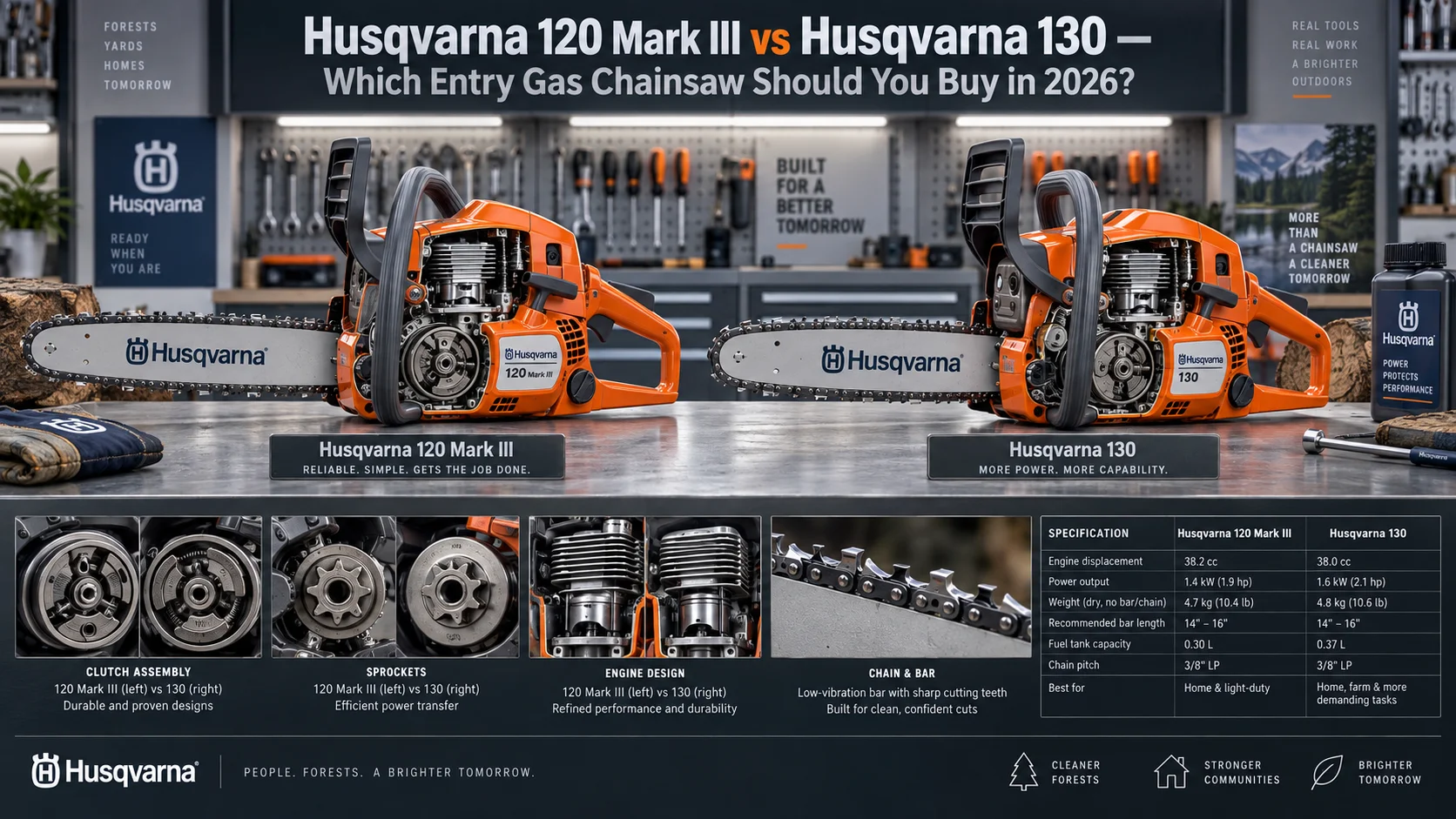
The two saws are closely matched on their basic platform. The principal published difference is engine output: the Husqvarna 130 is listed at 2 HP, while the Husqvarna 120 Mark III is listed at 1.8 HP. The product listings identify both as 38-cc, 2-cycle Husqvarna chainsaws with 16-inch cutting equipment and automatic oilers.
| Specification | Husqvarna 120 Mark III | Husqvarna 130 |
|---|---|---|
| Brand | Husqvarna | Husqvarna |
| Model | 120 Mark III | 130 |
| Product identifier | 970739616 | Not provided in manufacturer specifications |
| Amazon ASIN | B0D1GXMQRJ | B07RC1SN2Z |
| Price | $219.99 | $264.99 |
| Customer rating | 4.3/5 | 4.5/5 |
| Engine displacement | 38 cc | 38 cc |
| Engine type | 2-cycle X-Torq | 2-cycle X-Torq |
| Listed power | 1.8 HP | 2 HP |
| Bar length | 16 inches | 16 inches |
| Recommended bar length | Not provided in manufacturer specifications | 14 inches minimum to 16 inches maximum |
| Oiling system | Automatic oiler | Automatic oiler |
| Starting features | Air purge system; combined choke/stop control | Fuel pump; combined choke/stop control |
| Safety feature | Inertia-activated chain brake | Inertia-activated chain brake |
| Stated use | Wood cutting and tree pruning; home and garden tasks | Wood cutting and tree pruning; home and garden tasks |
Performance
Core Performance
The Husqvarna 120 Mark III and Husqvarna 130 occupy the same basic entry-level gas chainsaw class. Each has a 38-cc, 2-cycle X-Torq engine and a 16-inch bar, so the cutting setup is very similar on paper. The 120 Mark III is listed at 1.8 HP, while the 130 is listed at 2 HP. That gives the 130 a 0.2-HP advantage, or a modestly higher published output from the same stated displacement.
In practical terms, the 130 is the better choice between these two when your work regularly places the engine under load. Its higher listed horsepower should give it more reserve for wood cutting, although the supplied research does not include controlled cutting-speed tests, torque measurements, or a maximum log diameter. It would therefore be misleading to assign a specific cutting advantage beyond the documented 2-HP versus 1.8-HP difference. Readers comparing setup options can review our technical analysis on stihl ms 162 vs husqvarna 120 mark ii.
The 120 Mark III is not a fundamentally different size of saw. Its 16-inch bar and 38-cc engine make it suitable for the same general categories of work identified in the listing: wood cutting, tree pruning, and home or garden tasks. Its lower price is the stronger reason to choose it, rather than a different bar or engine configuration.
Handling & Ergonomics
Both products are described as portable, easy to start, and easy to handle. That makes either model a plausible fit for a homeowner who needs a gas saw for periodic outdoor work rather than a documented professional-production application. However, manufacturer specifications does not include the weight of either saw, vibration measurements, handle dimensions, balance details, or a specification for the powerhead without cutting equipment. For complementary field maintenance guidelines, examine our breakdown of ryobi ry40550 vs greenworks 40v gen2.
The 16-inch cutting equipment gives both saws a similar physical bar length. The Husqvarna 130 listing specifically recommends bar lengths from 14 inches to 16 inches, with 16 inches as the included size. No recommended bar-length range is supplied for the 120 Mark III, so buyers should not assume that the two models have identical approved bar options without checking the manufacturer’s documentation.
Controls are designed around straightforward starting and stopping. On the 120 Mark III, the air purge system works with the combined choke/stop control to make starting easier and reduce the risk of engine flooding. The 130 uses a fuel pump and the same type of combined choke/stop control for the corresponding purpose. Neither listing provides a quantified starting-time result or a user-adjustable vibration specification. To evaluate matched hardware tolerances, consult our detailed overview of echo cs 355t vs makita xcu06z.
Runtime / Fuel & Maintenance
These are gasoline-powered 2-cycle chainsaws, so operation requires the appropriate fuel mixture and routine care associated with that engine type. Both use an X-Torq engine and an automatic oiler. The automatic oiler is important because the chain needs lubrication while cutting, but manufacturer specifications does not state oil-tank capacity, fuel-tank capacity, fuel consumption, or measured runtime for either model.
Because no fuel-consumption test is provided, the 130 cannot be called more fuel-efficient than the 120 Mark III. The extra 0.2 HP may make it the more capable option under load, but efficiency and runtime are separate questions. Buyers should base this comparison on the listed power, price, and intended workload rather than an unsupported runtime estimate. When planning workspace deployment, consider the engineering criteria outlined in our husqvarna 450 vs 460 rancher guide.
Both saws also have an automatic chain oiler, which reduces the need to manually apply bar-and-chain oil during normal operation. It does not eliminate checks: the operator still needs to keep the oil supply filled and verify that the chain is lubricating correctly. Exact refill intervals are not included in the supplied research.
Best Use Cases
The Husqvarna 120 Mark III is best aligned with occasional homeowner jobs such as pruning and cutting wood around a property. Its 38-cc engine, 1.8-HP output, and 16-inch bar provide a compact entry point into gas-powered cutting, while its $219.99 price limits the initial investment.
The Husqvarna 130 is better suited to the buyer who wants the stronger of these two closely related options for recurring wood cutting and pruning. Its 2-HP listing and 4.5/5 rating give it a small performance and customer-feedback edge. It remains an entry-level 38-cc saw with a 16-inch bar, however, and the available information does not establish it as a professional or heavy-duty production saw.
Maintenance & Running Costs
Ownership costs for both models extend beyond the purchase price. As 2-cycle gas chainsaws, they need fuel prepared for the engine, bar-and-chain oil for the automatic oiler, and regular attention to the cutting system. The chain must remain sharp and correctly tensioned, while the bar and sprocket should be inspected as part of normal chainsaw care. The manufacturer listings do not specify the required fuel ratio, oil capacity, replacement-chain price, or service intervals.
The automatic oiler is standard on both saws and is a useful convenience feature, but it is not a maintenance-free system. Before cutting, check the oil level and confirm that oil is reaching the chain. After use, clean the saw and inspect the bar, chain, chain brake, and controls. These steps matter for either model and do not create a meaningful maintenance advantage for one over the other based on the available data.
The two starting systems differ in name: the 120 Mark III uses an air purge system, while the 130 uses a fuel pump. Both have a combined choke/stop control designed to simplify starting and reduce flooding risk. Neither product listing provides enough service information to conclude that one starting system will have lower long-term repair costs.
Safety equipment should be treated as part of the running-cost decision. Both models have an inertia-activated chain brake intended to reduce the likelihood of injury due to kickback. That feature does not replace safe operating technique. Use appropriate protective equipment, follow the owner’s manual, and choose a saw size that matches the work instead of judging solely by price or horsepower.
Features & Usability
At the feature level, the Husqvarna 120 Mark III and Husqvarna 130 are unusually similar. Each has a 16-inch bar, automatic oiler, 38-cc 2-cycle X-Torq engine, and inertia-activated chain brake. Each is marketed for wood cutting and tree pruning and is described as easy to start and easy to handle for home and garden tasks.
- Husqvarna 120 Mark III: Its air purge system and combined choke/stop control are intended to make starting easier and reduce the chance of flooding. The inertia-activated chain brake adds a safety feature associated with kickback response.
- Husqvarna 130: Its fuel pump and combined choke/stop control are intended to support easier starting and reduce flooding risk. It also has an inertia-activated chain brake and a stated recommended bar range of 14 to 16 inches.
- Shared platform: Both use an automatic oiler, so chain lubrication is handled automatically during operation rather than by manual oil application.
Neither listing provides features such as tool-free chain adjustment, a side-mounted tensioner, an anti-vibration rating, an included carrying case, or a fuel gauge. Those omissions do not mean the saws lack a particular feature; they mean manufacturer specifications does not establish it. Buyers who care about any of those details should verify them before ordering.
The 130’s 4.5/5 rating is higher than the 120 Mark III’s 4.3/5 rating in the supplied marketplace data. Ratings can help indicate buyer satisfaction, but they are not a substitute for a controlled test. The listings do not provide review counts, cutting-speed measurements, noise measurements, or long-term durability results, so the rating difference should be considered supporting evidence rather than proof of a major usability gap.
Price & Value Analysis
The Husqvarna 120 Mark III is listed at $219.99, while the Husqvarna 130 is listed at $264.99. The difference is $45. The 130 therefore costs more, but the premium is tied to a fairly narrow specification advantage: both engines are listed at 38 cc, while the 130 is rated at 2 HP compared with 1.8 HP for the 120 Mark III.
At $219.99, the 120 Mark III offers the stronger value case for light or occasional work. You receive the same stated displacement, the same 16-inch bar length, the same X-Torq engine family, automatic oiling, and an inertia-activated chain brake. If your main requirement is a straightforward gas saw for seasonal pruning and general property cleanup, saving $45 is meaningful.
At $264.99, the 130 is worth considering when the saw will be used more frequently or when the extra listed horsepower is useful to you. The 2-HP output gives it the paper advantage for cutting performance, and its 4.5/5 rating is above the 120 Mark III’s 4.3/5 rating. The 130 is the sensible upgrade if you prefer the stronger specification and are comfortable paying more for it.
Neither model can be declared the better value for every buyer. The 120 Mark III wins on purchase price and retains most of the clearly documented feature set. The 130 wins on listed power and rating. Since the provided research does not include fuel economy, runtime, weight, cutting-speed testing, or service-cost figures, those factors cannot be used to justify a larger price difference than the documented $45.
Which Should You Buy?
Choose Husqvarna 120 Mark III if…
- You want the lower upfront price: $219.99 versus $264.99 for the 130.
- Your work is mainly occasional pruning, wood cutting, and general home or garden tasks.
- You want a 38-cc gas chainsaw with a 16-inch bar and automatic oiler without paying for the 130’s additional listed output.
- You value an air purge system and combined choke/stop control for easier starting.
- You do not need a documented power advantage beyond the 1.8 HP listed for this model.
Choose Husqvarna 130 if…
- You prefer the higher listed output: 2 HP versus 1.8 HP.
- You expect to cut wood more regularly and want the stronger option within this comparison.
- You want the model with the higher supplied customer rating, 4.5/5 versus 4.3/5.
- You specifically want a chainsaw listed for 14-inch to 16-inch bar lengths.
- You are willing to spend $45 more for the extra listed power and the 130’s feature package.
Consider a different model if…
- You need a chainsaw for professional production work, extensive land clearing, or cutting jobs beyond the home-and-garden use described in these listings.
- You require verified information about weight, vibration, sound level, fuel consumption, runtime, torque, or cutting speed before buying.
- You want a battery-powered or corded saw instead of a 2-cycle gasoline model.
- You need a bar length outside the 16-inch setup supplied with these products, or outside the 130’s stated 14-inch-to-16-inch recommendation.
- You are not prepared to handle fuel mixing, bar-and-chain oil, chain sharpening, and routine gas-saw maintenance.
- For more options at every price point, see our full guide to Best Chainsaws.
Common Questions on Husqvarna 120 Mark Iii Vs 130 Answered
Is the Husqvarna 130 more powerful than the 120 Mark III?
Yes, according to manufacturer specifications. Both use a 38-cc, 2-cycle X-Torq engine, but the Husqvarna 130 is listed at 2 HP and the Husqvarna 120 Mark III at 1.8 HP. The difference is 0.2 HP. No controlled cutting-speed or torque test was provided, so the documented conclusion is limited to the higher listed output.
Do both Husqvarna chainsaws have a 16-inch bar?
Yes. manufacturer specifications lists a 16-inch chainsaw for both the Husqvarna 120 Mark III and Husqvarna 130. The 130 is specifically listed as recommended for bar lengths from 14 inches minimum to 16 inches maximum. A recommended range for the 120 Mark III is not provided in manufacturer specifications.
Which one is easier to start?
Both are marketed as easier-starting saws, and neither has a proven starting advantage in the supplied research. The 120 Mark III uses an air purge system and combined choke/stop control. The 130 uses a fuel pump and combined choke/stop control. Both systems are described as helping reduce the risk of engine flooding.
Is the Husqvarna 130 worth $45 more?
It is worth the extra $45 if you want the higher listed 2-HP output, the 4.5/5 rating, and the stated 14-inch-to-16-inch bar recommendation. The Husqvarna 120 Mark III is the better value for buyers focused on occasional home and garden work because it costs $219.99 and shares the 38-cc engine size, 16-inch bar, automatic oiler, and chain-brake features.
Related Comparisons
- Best Chainsaws for Homeowners
- Best Gas Chainsaws
- Outdoor Power Tools Buying Guides
Reading on Small Chainsaws
Small chainsaws suit light pruning and firewood tasks, and they still need respectful handling. Broad information on outdoor equipment safety appears at the American National Standards Institute (ANSI). Neither Husqvarna model gets a verdict there.