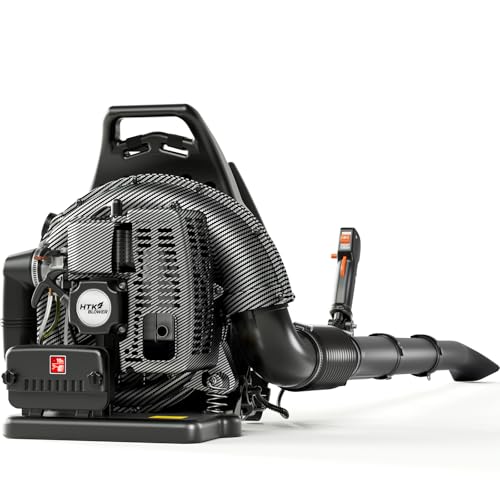
For large properties with wet, heavy debris, the high advertised output of a heavy-duty gas backpack model delivers the greatest clearing force, though it requires mixing fuel and carrying substantial weight. Homeowners with smaller paved areas will find lightweight electric models easier to handle, provided they accept limited cordless runtimes or cord length restrictions.

Pros
- Lightweight 4 lb build minimizes arm fatigue
- Delivers up to 390 CFM airflow and 210 MPH speed
- Continuous corded power eliminates recharging pauses
- Two-speed switch toggles between light and full force
- Nested two-piece tube design for full assembly
Cons
- Requires an extension cord and nearby wall outlet
- Tubes ship nested and must be pulled apart before use

Pros
- Lightweight 9.4-pound design offers easy handheld maneuvering
- Reduced-resistance recoil system eases engine pull starts
- Translucent fuel tank allows quick monitoring of gas levels
- Cushioned anti-vibration handle helps dampen arm strain
- Capable of up to 380 CFM and 180 MPH airflow
Cons
- Requires mixing 2-cycle gas and oil at a 50:1 ratio
- Modest 380 CFM output is best suited for lighter debris

Pros
- Delivers up to 550 CFM and 230 MPH for moving wet yard debris
- Lightweight 17-pound backpack design with cushioned straps
- Thumb throttle includes cruise control for steady blowing
- 33.8 fl oz fuel tank yields up to 45 minutes of run time
- Operating temperature range spans 14°F to 104°F
Cons
- Requires 2-cycle fuel mixing and engine maintenance
- 550 CFM is modest for a backpack-class gas blower

Pros
- Turbo mode delivers up to 650 CFM and 200 MPH
- Includes 20V 4.0Ah battery and 1-hour fast charger
- Battery features integrated overheat protection
- Ergonomic handle with contoured, rubberized grip
Cons
- Weighs 8.69 pounds, which may feel heavy to some users
- Includes only one battery, leading to downtime between charges

Pros
- Airflow reaches up to a manufacturer-stated 650 CFM
- Includes two 20V 5.2Ah batteries for reduced downtime
- Offers three adjustable speed settings for varying debris
- Includes a shoulder strap to minimize arm fatigue
- Comes complete with an extension nozzle and fast charger
Cons
- Higher speeds deplete the battery much faster than low mode

Pros
- Lightweight design at only 4.4 pounds
- 7-Amp motor rated up to 180 MPH and 180 CFM
- Built-in cord retention prevents unplugging
- Zero emissions with instant push-button start
- Simple, low-maintenance corded design
Cons
- Extension cord is not included
- Operating range is limited by cord reach

Pros
- Delivers up to 600 CFM and 110 MPH airflow
- Continuous corded power eliminates recharging and gas mixing
- Variable-speed control adjusts airflow to the task
- Lightweight design weighs just 6.4 pounds
Cons
- Operating range is tethered to an electrical outlet

Pros
- Turbo mode pushes up to 765 CFM and 200 MPH
- Cruise control dial for speeds from 260 to 580 CFM
- Includes a 5.0Ah 56V battery and fast charger
- High-efficiency brushless motor for smooth performance
- Comes with both tapered and spread nozzles
Cons
- Turbo output significantly reduces total operating runtime
- Total tool weight reaches 9.5 pounds

Pros
- Delivers up to 230 MPH airspeed and 920 CFM air volume
- Powered by a 63.3 cc, 3.7 HP 2-stroke gas engine
- Large 65 oz (1.9L) fuel tank reduces frequent refills
- Padded shoulder harness and back support enhance user comfort
- Weighs 19.5 pounds for manageable backpack handling
Cons
- Requires 2-stroke gas-and-oil fuel mixing
- Heavier and louder than comparable cordless electric alternatives

Pros
- High-output 62CC 2-stroke engine handles heavy yard waste
- Delivers up to a rated 880 CFM air volume and 320 MPH wind speed
- Padded backpack harness and adjustable straps distribute weight
- Built-in anti-vibration technology reduces operator fatigue
- Adjustable throttle control accommodates light and heavy tasks
Cons
- Relatively heavy unit weighing over 25 pounds
- Requires two-stroke gas and oil fuel mixing
- Gas engine demands regular maintenance and seasonal care
Understanding CFM vs MPH in Leaf Blower Power Ratings
Cubic feet per minute (CFM) measures the total volume of air emitted, while miles per hour (MPH) measures the speed of that air stream. Evaluating both numbers together gives the clearest picture of actual clearing power rather than relying on a single metric.
A machine like the ideal driveway cleaner often needs balanced ratings. For instance, the BLACK+DECKER Electric Leaf Blower lists 180 CFM and 180 MPH. While the 180 MPH speed is sufficient for blowing loose dust off smooth asphalt, its modest 180 CFM volume means clearing wide lawns takes significantly more passes. In contrast, the EGO POWER+ Cordless Electric Leaf Blower, 765 CFM claims up to 765 CFM and 200 MPH in turbo mode. The extra volume allows it to push massive heaps of leaves across turf, but operating at maximum output naturally drains energy reserves much faster.
Gas Engine Displacement: How CC Relates to Clearing Ability
Gas engine displacement is measured in cubic centimeters (cc), which directly correlates to the engine’s theoretical power generation and resultant air output. Larger displacement engines generally produce higher airflow metrics at the expense of tool weight and fuel usage.
Handheld options like the Getell 26cc Gas Leaf Blower utilize a 26cc 2-cycle engine to produce an advertised 380 CFM and 180 MPH, keeping the overall tool balanced for hand carry. When scaling up to professional-style backpack units, displacement increases dramatically. The Thalorus 52cc Gas Backpack Leaf Blower, 550 CFM delivers an advertised 550 CFM and 230 MPH from its 52cc engine, while the Schröder Backpack Leaf Blower – Backpack Blower features a 63.3 cc engine yielding 920 CFM and 230 MPH. Similarly, the GarveeTech 62CC Gas Backpack Leaf Blower claims 880 CFM and 320 MPH. While these larger engines move massive leaf piles effortlessly, backpack units like the Schröder weigh 19.5 pounds before adding fuel, presenting a trade-off in physical exertion.
Corded Electric Amperage: Continuous Power with Distance Limits
Corded electric blowers use motor amperage (Amps) to indicate electrical draw and steady output capacity, completely avoiding battery charging cycles or fuel mixing. The trade-off is a fixed operational radius defined by an extension cord.
For modest residential cleanups, a 7-Amp motor is common. The Grasstigon Electric Leaf Blower Corded, 7-Amp weighs just 4 pounds while claiming 390 CFM and 210 MPH across two speed settings. A larger motor, such as the 12-Amp motor found on the WORX 12 Amp Turbine Electric Leaf Blower for Daily, pulls more power to deliver up to 600 CFM at 110 MPH. The higher air volume of the 12-Amp turbine moves widespread garden debris more efficiently than 7-Amp alternatives, though at 6.4 pounds it is slightly heavier and still tethered to an electrical outlet.
Cordless Voltage and Air Output: Portability vs High-Speed Drain
Cordless battery-powered leaf blowers trade continuous operation for unrestricted portability, measuring battery potential in volts (V) and charge capacity in amp-hours (Ah). When evaluating these power ratings, higher CFM outputs typically come with significant battery drain during peak performance.
The Leaf Blower Cordless, 650CFM Electric Leaf Blowers uses two 20V 5.2Ah batteries to deliver up to 650 CFM, providing a dual-battery solution to mitigate downtime. Similarly, the Garvee Leaf Blower Cordless 20V 4.0A 2 Speed 650 advertises a 650 CFM air volume and 200 MPH top speed from a 20V 4.0Ah battery platform. For buyers deciding between platforms, see our guide on what leaf blower is the best for different power sources. Keep in mind that while manufacturers often cite maximum runtimes under low settings—such as EGO’s advertised up to 90 minutes on its 56V platform—utilizing turbo modes for maximum 765 CFM power rapidly depletes the pack.
Frequently Asked Questions About Leaf Blower Power Ratings
Does a higher MPH rating always mean a leaf blower is more powerful?
Not necessarily. MPH measures air speed, which helps dislodge stuck, wet debris. However, CFM measures air volume, which determines how much debris you can move at once. A model with high MPH but low CFM can scour surfaces clean but will move smaller piles slowly.
How do gas engine sizes (cc) translate to blowing performance?
Engine displacement (measured in cubic centimeters, or cc) indicates the engine's combustion capacity. Generally, higher cc ratings—such as 52cc or 63.3cc—deliver higher combined CFM and MPH output suitable for large areas, though they also increase tool weight and fuel consumption.
How to Choose the Right Blower Power for Your Yard
Matching leaf blower power ratings to your specific outdoor layout prevents overspending on unneeded power or buying an underpowered tool that struggles with wet yard debris.
If you have a large property requiring maximum air volume for wet, matted debris, the Schröder Backpack Leaf Blower – Backpack Blower is the top recommendation due to its advertised 920 CFM and 63.3 cc gas engine. Its main limitation is the 19.5-pound dry weight and regular gas-oil maintenance. For buyers with standard suburban lots who prefer push-button operation and zero emissions, the EGO POWER+ Cordless Electric Leaf Blower, 765 CFM serves as a powerful battery-driven alternative, provided you plan around battery charging between heavy yard clearing sessions.