For homeowners clearing small yards near an exterior outlet, a corded model delivers constant clearing power without battery drain, though reach remains strictly bounded by an extension cord. If your priority is unconstrained movement across driveways and expansive lawns, a cordless blower offers total freedom despite added battery weight and finite runtimes.

Pros
- Lightweight 4 lb build minimizes arm fatigue
- Delivers up to 390 CFM airflow and 210 MPH speed
- Continuous corded power eliminates recharging pauses
- Two-speed switch toggles between light and full force
- Nested two-piece tube design for full assembly
Cons
- Requires an extension cord and nearby wall outlet
- Tubes ship nested and must be pulled apart before use

Pros
- Delivers up to 615 CFM and 170 MPH in turbo mode
- Variable speed dial with lock-on button from 200–480 CFM
- High-efficiency brushless motor reduces operating vibration
- Includes 56V 2.5Ah battery and standard 50-minute charger
- Fully compatible with all EGO 56V ARC Lithium batteries
Cons
- Turbo mode rapidly reduces the available battery runtime
- Weighs 7.5 pounds, which may feel heavy with larger batteries

Pros
- Lightweight design at only 4.4 pounds
- 7-Amp motor rated up to 180 MPH and 180 CFM
- Built-in cord retention prevents unplugging
- Zero emissions with instant push-button start
- Simple, low-maintenance corded design
Cons
- Extension cord is not included
- Operating range is limited by cord reach

Pros
- Includes two 3.0Ah batteries for swapped use
- Stated output reaches up to 680 CFM and 230 MPH
- Lightweight handheld design at roughly 3.96 lbs
- Comes with two interchangeable blower tubes
- Built-in battery level indicator lights
Cons
- Combined runtime is roughly 40 minutes across both batteries
- Two speed settings offer limited flow adjustments

Pros
- Boost button provides up to 410 CFM and 110 MPH
- Brushless motor extends runtime and performance
- Includes a 5.0Ah V20 battery and charger
- Integrated hook fits VERSATRACK storage systems
- Weatherguard technology helps protect tool from dust/moisture
Cons
- Rated runtime is up to 24 minutes per charge
- Boost mode will deplete the battery more quickly

Pros
- Weighs only 2.28 lbs for easy one-handed operation
- Includes two 21V 4000mAh lithium batteries
- Variable speed trigger provides precise airflow control
- Comes with an extension tube and flat nozzle attachment
Cons
- Rated runtime tops out at roughly 30 minutes
- Not designed for large properties or heavy wet debris
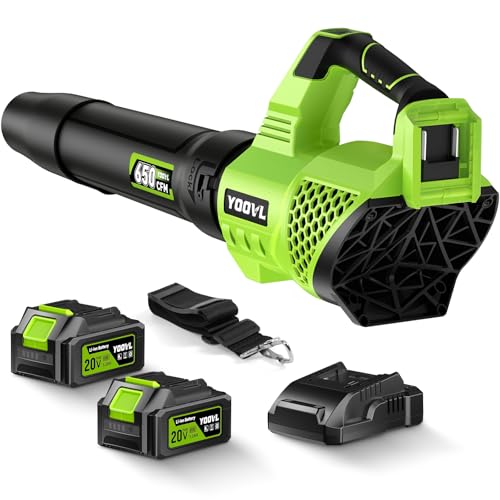
Pros
- Airflow rated up to 650 CFM using advanced turbo technology
- Comes with two high-capacity 20V 5.2Ah batteries and fast charger
- Three selectable speed modes for delicate to heavy-duty jobs
- Includes an adjustable shoulder strap to reduce arm fatigue
- Includes blower tube and extension nozzle attachments
Cons
- Maximum 150-minute runtime applies only to low-speed mode
- Heavier battery packs may add weight during prolonged handheld use

Pros
- Includes two 21V 4.0Ah batteries for extended runtime
- Delivers up to 420 CFM airflow and 150 MPH air speed
- Lightweight design weighs under 3 lbs bare tool for low fatigue
- Comes with both round and flat interchangeable nozzles
- Two adjustable speed settings for varying cleanup tasks
Cons
- Limited to two preset airflow speeds
- Best suited for dry leaves and light debris rather than heavy wet waste

Pros
- Lightweight build suitable for one-handed operation
- Operates at a relatively quiet 65 dB
- Rated up to 200 MPH and 600 CFM output
- Cordless battery platform allows flexible movement
- Versatile for dry debris, sawdust, and car drying
Cons
- Runtime decreases significantly at maximum output
- Single included battery limits extended sessions
- Not suited for heavy, wet leaf accumulations

Pros
- Brushless motor delivers rated airflow up to 650 CFM and 180 MPH
- Includes two 20V 4.0Ah batteries and a fast charger
- Six adjustable speed settings ranging from 80 to 180 MPH
- Comes with an ergonomic shoulder strap and two detachable nozzles
- Includes a storage bag to keep components organized
Cons
- Stated 30-minute runtime is restricted to low-speed operation
- High-speed settings will deplete battery charge more rapidly
Corded vs. Cordless Power: Deciding Between Unlimited Runtime and Yard Mobility
Corded blowers provide continuous electrical power without the need to recharge batteries, but cordless options grant the freedom to move anywhere across a property without cord management.
Units like the Grasstigon Electric Leaf Blower Corded, 7-Amp and the BLACK+DECKER Electric Leaf Blower draw power directly from standard outlets via 7-amp motors. This design eliminates downtime from depleted packs and avoids long-term battery degradation. The critical trade-off is geographic reach: you remain physically tethered to an outlet, and the BLACK+DECKER Electric Leaf Blower does not include an extension cord in the box, requiring a separate purchase. Furthermore, managing 50- to 100-foot outdoor cords around landscaping obstacles can prove tedious.
Conversely, cordless models such as the EGO POWER+ Cordless Electric Leaf Blower, 615 CFM and the CRAFTSMAN Leaf Blower Cordless with Battery provide untethered mobility. When addressing long perimeters or examining a dedicated leaf blower for driveway applications, cordless maneuverability lets you clear pathways quickly without dragging heavy cords across abrasive concrete.
Airflow (CFM) vs. Airspeed (MPH): Which Metric Dictates Real Clearing Ability?
Airflow measured in cubic feet per minute (CFM) governs the overall volume of leaves moved at once, while airspeed in miles per hour (MPH) indicates the force required to dislodge wet, compacted debris.
A tool optimized primarily for MPH concentrates air into a narrow, high-velocity stream. For instance, the BLACK+DECKER Electric Leaf Blower delivers an advertised 180 MPH alongside a modest 180 CFM. This velocity is sufficient for sweeping dry pavement and dislodging stuck pine needles, but its narrow column requires more passes across wide turf. In contrast, the Grasstigon Electric Leaf Blower Corded, 7-Amp pairs an advertised 210 MPH with 390 CFM, giving it greater air volume to move broader piles.
Higher-tier cordless blowers lean heavily on larger airflow volumes. The EGO POWER+ Cordless Electric Leaf Blower, 615 CFM advertises up to 615 CFM and 170 MPH in turbo mode, utilizing aeronautics-inspired turbine engineering to push substantial leaf mounds across open grass. Meanwhile, budget cordless options such as the Electric Leaf Blower Cordless with 3.0Ah Battery advertise peak specs reaching 680 CFM and 230 MPH across two selectable speeds. Keep in mind that manufacturer CFM and MPH ratings represent maximum laboratory outputs and can fluctuate depending on nozzle attachments and battery state of charge.
Battery Systems and Runtime Claims: Managing Expectations Across Cordless Models
Advertised battery runtimes reflect minimal power settings under zero load, meaning that high-output turbo modes will exhaust battery capacity in a fraction of the stated time.
The EGO POWER+ Cordless Electric Leaf Blower, 615 CFM lists up to 75 minutes of runtime on its included 2.5Ah 56V ARC Lithium battery. In practice, achieving this duration requires using lower settings on the variable speed dial; sustained turbo operation consumes stored energy much more quickly. To offset this, its included charger replenishes the pack in an advertised 50 minutes. The CRAFTSMAN Leaf Blower Cordless with Battery provides up to 24 minutes of runtime from its larger 5.0Ah V20 battery pack while powering a high-efficiency brushless motor.
Budget cordless brands frequently address battery limitations by bundling two battery packs. The Leaf Blower Cordless, 650CFM Electric Leaf Blowers includes two 20V 5.2Ah batteries advertising up to 150 minutes of combined operating time, while the Electric Leaf Blower Cordless with 3.0Ah Battery provides two 3.0Ah units claiming roughly 40 minutes of total work. Buyers exploring a small rechargeable leaf blower or alternative small blower cordless models should note that swapping dual packs keeps yard cleanup moving while one battery recharges.
Weight, Ergonomics, and Support: Avoiding Fatigue on Longer Cleanup Jobs
A leaf blower’s overall mass and balance directly affect arm and wrist comfort, especially during extended fall cleanups.
Ultra-lightweight models dramatically reduce strain for quick sweeping tasks. The wanvzo Cordless Leaf Blower advertises an exceptionally low weight of 2.28 lbs, making it suitable for one-handed operation along deck railings, flowerbeds, and elevated surfaces. The Electric Leaf Blower Cordless with Battery by VIBOGEN is similarly light at 2.74 lbs without its battery installed, allowing for agile maneuvering in tight spaces.
When cordless tools incorporate larger motors and heavy multi-cell battery packs, carrying support becomes essential. The Leaf Blower Cordless, 650CFM Electric Leaf Blowers and the Leaf Blower Cordless 650CFM with 2×4.0Ah Battery address this by including adjustable shoulder straps that redistribute weight across the torso and back. Noise levels also impact user comfort; while MZK lists its 20V Cordless Leaf Blower at an advertised 65 dB, higher-pitched turbine motors can still cause fatigue. Factoring in the physical sound of leaf blower tools and utilizing protective gear helps ensure a comfortable working environment.
Frequently Asked Questions About Choosing a Leaf.Blower
Can a corded leaf.blower handle large yards without hassle?
Corded blowers provide limitless electrical runtime but are practically constrained by extension cord lengths. Operating beyond 100 feet from an exterior outlet typically introduces voltage drop and cumbersome cable management, making a cordless model better suited for larger properties.
Why do cordless leaf.blower runtime estimates vary so widely across brands?
Manufacturer runtime estimates are usually recorded under minimal throttle or low-resistance settings. Engaging maximum speeds, variable boost triggers, or turbo buttons draws significantly higher amperage, which reduces actual operating time per charge.
What is the practical difference between CFM and MPH on a leaf.blower?
CFM (cubic feet per minute) measures the total volume of air emitted, which dictates how wide an area of leaves you can move simultaneously. MPH (miles per hour) measures air velocity, which determines how effectively the tool can lift heavy, wet, or compacted debris from surfaces.
Making the Right Leaf.Blower Choice for Your Yard
Selecting the optimal blower depends primarily on property scale, the type of debris you clear, and whether you prefer continuous corded power over the portability of lithium-ion systems.
For most homeowners seeking a balance of high airflow, dependable build quality, and cordless versatility, the EGO POWER+ Cordless Electric Leaf Blower, 615 CFM is our primary recommendation due to its aeronautic turbine fan design, variable trigger lock, and compatibility with the broad EGO 56V battery platform. Its primary limitation is a premium price tag and reduced runtime when running continuously in turbo mode with the bundled 2.5Ah pack. Buyers prioritizing maximum value for small yard cleanups should instead opt for the Grasstigon Electric Leaf Blower Corded, 7-Amp, which delivers unlimited runtime and solid 390 CFM output at a fraction of the cost, provided they do not mind managing an extension cord.